Creation by Amma
Accounts of Amma's making of the world, the earth and the first beings, given in different forms by Ogotemmêli and in Le Renard pâle.
Source: Marcel Griaule, Dieu d'eau, 1948 (to check)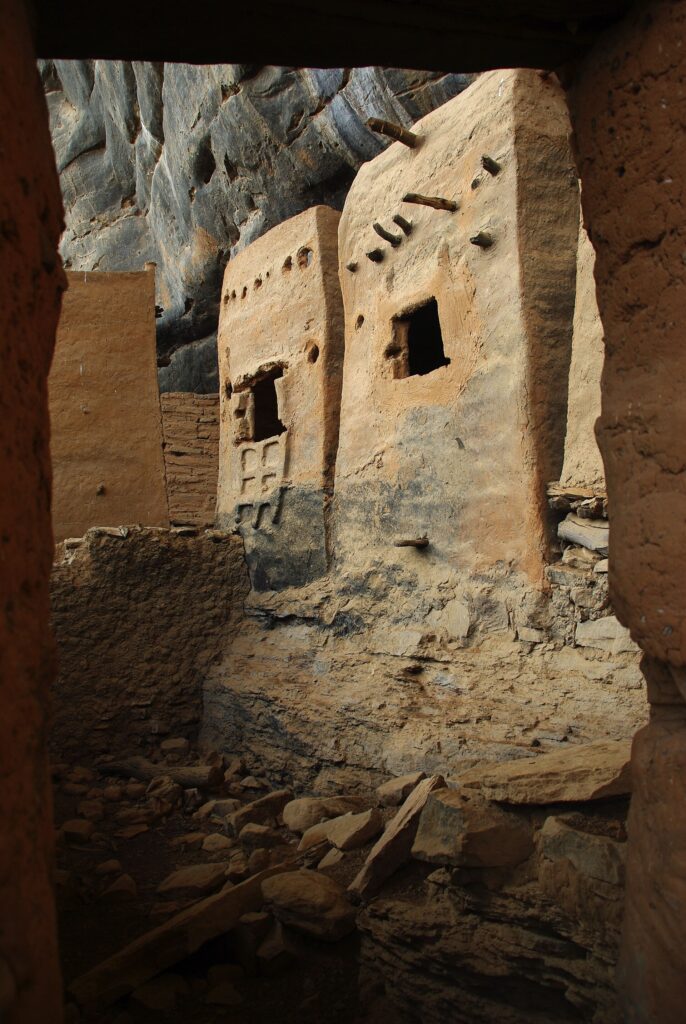
The Lore · West Africa · Lore Universe
Dogon
Sirius knowledge, Nommo creation beings, Hogon priests, 8-day cosmological calendar, extraordinary astronomical sophistication.
Why its stories are told
Stories are told to teach, to explain and to keep the rites meaningful. Everyday tales and riddles entertain and instruct children and young people, especially in the dry season evenings when farm work is light.
The people are the Dogon (DOH-gon) of central Mali, and that is the name they use for themselves in dealing with others.
The Land · Geography
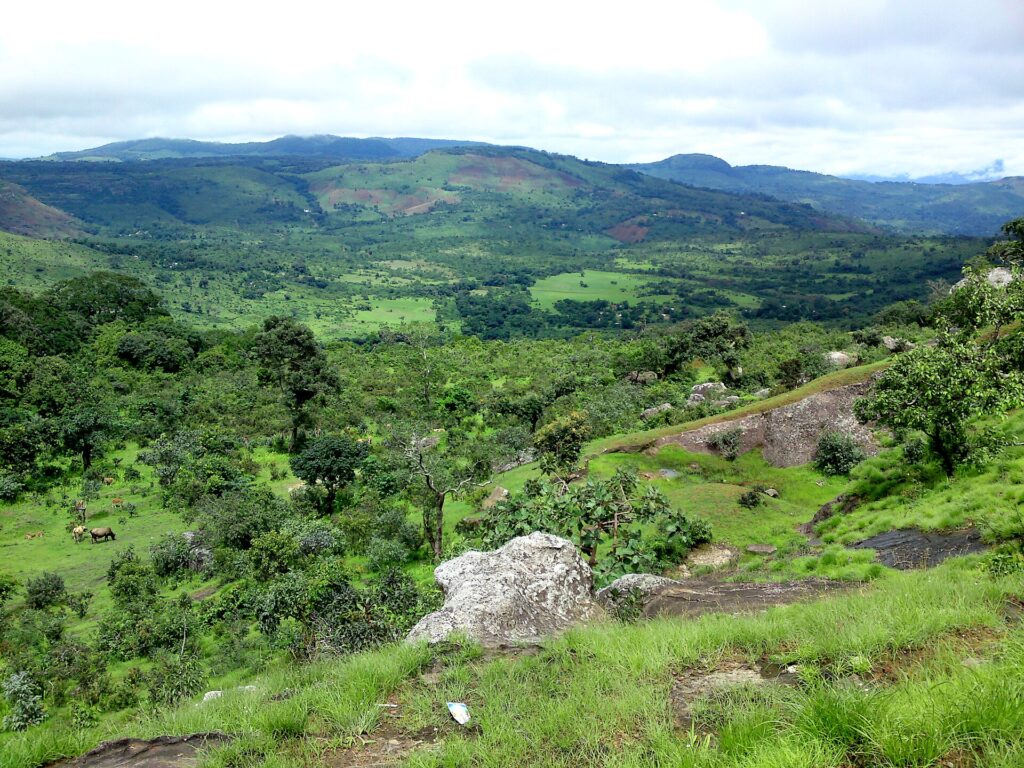
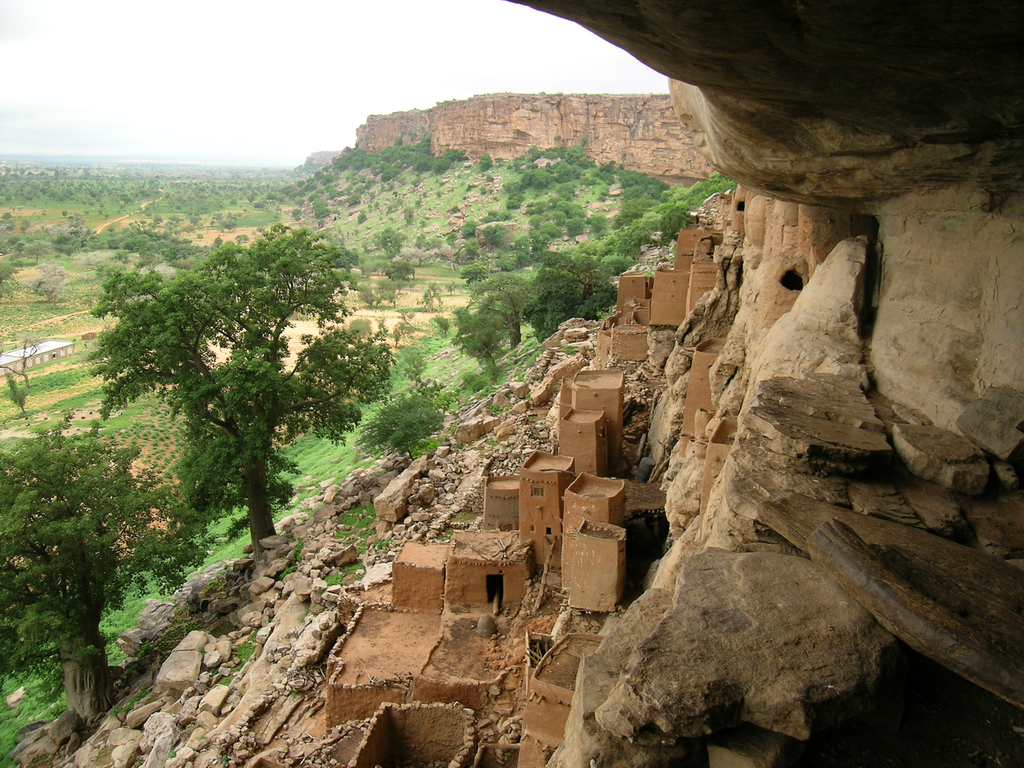
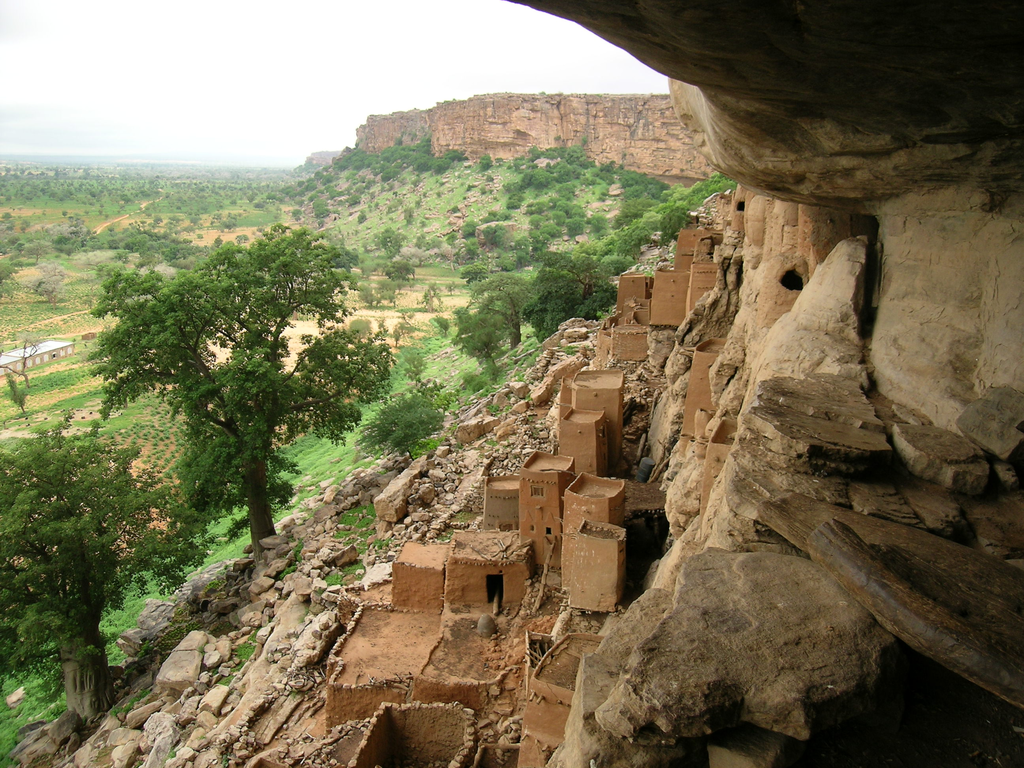
The Dogon land is one of the most striking landscapes in West Africa. The Bandiagara Escarpment rises up to several hundred metres above the Seno-Gondo plain. Above it lies a rocky sandstone plateau with scattered fields; below it a sandy plain. Villages cling to the cliff face and its scree, with granaries and houses of stone and mud built among the rocks. The caves above the villages hold the burials of the Tellem and, later, of the Dogon.
The climate is Sahelian: a short rainy season, roughly June to September, and a long dry season. Water is scarce, and farmers grow millet, sorghum and, on the plateau, onions, irrigated from small dams and pools.
The land shapes the stories. The cliff is a threshold between earth and sky, the living and the dead; the caves hold the ancestors; water is precious and holy, the domain of the Nommo; the bush is full of spirits; the rains are the gift of Amma.
The land is also a refuge. Tradition holds that the ancestors chose the cliff because it offered safety, and that history lives in the stones.
The People · Cultural Foundation · Society
The Dogon live in the Mopti region of central Mali, on three zones: the sandstone plateau around Bandiagara, the Bandiagara Escarpment, a cliff running some 150 kilometres from northeast to southwest, and the Seno-Gondo plain below it, which extends into northern Burkina Faso. Villages such as Sangha (Sanga), Ireli, Banani, Tireli and Bongo sit on or under the cliff.
The Dogon are not one uniform group. Communities differ in language, in ritual detail and in the form of their institutions from one end of the cliff to the other, which is one reason accounts disagree.
Dogon tradition holds that the ancestors came from Mandé, the Mande heartland to the southwest, entering the cliff region at Kani-Kombolé. Historians usually place this migration between the 14th and 16th centuries, though the dating is uncertain. The incomers found earlier inhabitants, whom Dogon call the Tellem; archaeologists such as Rogier Bedaux have studied Tellem burials in the cliff caves from roughly the 11th to the 16th centuries, and an earlier Toloy culture from the last centuries BCE.
The tradition took shape on the cliff, from Mande inheritance, Tellem encounter and long life on a hard land.
Four values recur.
Order and balance: the world, the village, the house and the body are meant to be in proportion, and rites restore it when death, quarrel or drought disturb it.
The word: speech is powerful and can heal or harm. Good speech nourishes; bad speech damages. Calame-Griaule showed how deeply this idea runs, and the men's shelter, the toguna, is a place for careful speaking.
Seniority and the ancestors: elders, lineage heads and the Hogon represent continuity with the founders. Their authority comes from age and from closeness to the dead.
Complementarity: in the accounts given to Griaule, twinship is the ideal state, and pairs, male and female, sky and earth, are needed to make a whole. Van Beek found the twin theme less systematic than Griaule did.
Collective needs come before individual ones. The lineage, the ward and the village are the main actors. This produces story logic that can seem unfamiliar to Western readers: a story may be about the origin of a rite or a prohibition rather than about a character's desire, and the satisfying point is that things are now as they should be.
Dogon society is patrilineal and patrilocal. Men hold public ritual offices: Hogon, Binu priest, lineage head and Awa member. Women farm, process grain, cook, fetch water, spin cotton, trade at markets and raise children. Men weave.
The gender logic is complementary in the accounts given to Griaule: male and female are both needed, and twinship of male and female is the ideal. Van Beek found the twin theme less central in daily thought.
Women hold power in several ways. In the story of the origin of masks recorded by Griaule, women found the masks first and men took them; the satimbe mask's figure honours that woman. Women born during a Sigi have a special status. Women control parts of the household economy and their own trade income.
Menstrual seclusion in the punulu and exclusion from the mask society mark restrictions. Women's songs and dances at funerals, harvests and other events form their own repertoire.
The balance has shifted with Islam, Christianity, schooling and migration, and women's movements in Mali have changed some practices, including excision.
Age is the main axis of authority. The eldest man of a lineage (ginna bana in Griaule's terminology) heads it and keeps the wagem altar in the family house. The Hogon is chosen from among the oldest men. Village decisions are made by elders in the toguna.
Age sets formed by circumcision group young men who share duties and solidarity throughout life.
The Sigi structures generations. Men who took part in one Sigi become the elders who guide the next, and a man may see it twice only if he lives long.
Elders hold knowledge others cannot access: the deeper accounts of creation, the meanings of masks and shrines, ritual words, genealogies, histories of land. Knowledge is revealed in stages, so that the oldest know most.
Youth hold energy and labour; they dance the masks, farm, and increasingly migrate to towns for work. Adults raise families and carry out rites.
In stories, elders are sources of wisdom and ritual power; youth are learners and doers. Ogotemmêli's authority with Griaule came partly from age and partly from his reputation for knowledge.
Dogon society is less stratified than many Mande societies. Most Dogon are farmers. There are endogamous artisan groups, especially smiths and leatherworkers, who traditionally marry within their own groups. Smiths have a special ritual position: in Ogotemmêli's account the smith ancestor brought fire and the granary to humanity.
The justification is ancestral and ritual: smiths' work with iron and fire carries power, which sets them apart.
The Hogon, Binu priests and lineage heads have ritual rank, but this rests on age and office rather than on a ruling class. There were no Dogon kings.
Storytellers are not a hereditary caste here, unlike the Mande jeliw. Elders, initiates and ordinary people tell stories according to their knowledge and position.
In stories, smiths appear as culture-bringers; differences between Dogon and neighbouring peoples, Fulbe herders, Bozo fishers, Mande states, appear in tales of origin and alliance. In the 19th and 20th centuries, relations with Fulbe overlords and with slavery shaped Dogon history, and these differences still matter.
The basic unit is the patrilineage, living in a compound around the ginna, the great family house, which holds the wagem altar. Lineages group into clans tied to Binu shrines and prohibitions. Villages consist of wards (often of one lineage or clan), each with its own toguna.
Villages are grouped into regions that share a Hogon, and the Hogon of Arou is recognised as the senior Hogon of a wide area.
Membership carries obligations: labour in the fields, contributions to funerals and the Dama, participation in the Sigi, offerings at shrines, keeping prohibitions, and hospitality. Mutual aid is expected, and alliances extend outward, notably the joking alliance with the Bozo, which forbids conflict and obliges help.
The village layout itself encodes community: the Hogon's house, the toguna, the ginna, granaries, shrines and the women's houses each have their place.
Expulsion is rare and grave. To be cut off from lineage is to lose access to the ancestors, the altar and one's place in the rites, and therefore one's place among the living and the dead.
Through Time · History
In the 3rd and 2nd centuries BCE, people of the Toloy culture used the caves of the Bandiagara Escarpment, according to archaeologists.
From about the 11th century to the 16th century, the Tellem lived along the cliff, burying their dead in caves, as Rogier Bedaux's excavations showed.
By the 15th century, by most historians' reckoning, Dogon ancestors from Mandé had settled on the cliff, entering at Kani-Kombolé in tradition; the dating is uncertain.
In the 19th century, the Fulbe state of Macina and then the Tukulor empire pressed on Dogon country, and Dogon communities defended the cliff.
In the 1890s, French forces conquered the region.
In 1931, Marcel Griaule's Dakar-Djibouti mission reached Sangha.
In 1946, Griaule held his conversations with Ogotemmêli, published in 1948.
In 1950, Griaule and Dieterlen published their article on a Sudanese Sirius system.
In 1967, the Sigi began at Yougo Dogorou and ended in 1973, filmed by Jean Rouch and Germaine Dieterlen.
In 1976, Robert Temple's The Sirius Mystery popularised claims built on Griaule.
In 1989, UNESCO inscribed the Cliff of Bandiagara (Land of the Dogons).
In 1991, Walter van Beek published Dogon Restudied.
In 2019, attacks at Ogossagou and Sobane Da marked the conflict in central Mali that has displaced many Dogon and Fulbe communities.
The founding migration from Mandé is the central Dogon story of movement. Clans came separately, each with its own route and founding ancestor, and spread along the cliff from the arrival point at Kani-Kombolé. In tradition, they brought earth from the grave of Lébé in Mandé to found Lébé altars in their new villages, so that the earth power moved with them.
The Dogon have lived among neighbours for centuries: Mande states to the southwest, Songhai to the northeast, Fulbe herders on the plain, Bozo fishers on the Niger, Mossi to the south. With the Bozo they share a joking alliance that forbids conflict and enjoins help, explained by tales of shared origin.
Dogon stories exist to explain and maintain order: how Amma made the world, why people die, why the masks dance, why each clan keeps its shrine and its prohibition, and how the ancestors came to the cliff. They give reasons for the rites that hold the community together. History shaped them.
The Sacred · Deities and Spirits
Creation of the world from the egg or seed (Griaule and Dieterlen, Le Renard pâle); shaping of the earth from clay (Ogotemmêli in Dieu d'eau)
The birth of the Nommo and the gift of speech (Dieu d'eau); the sacrifice and restoration of a Nommo (Le Renard pâle)
Ogo's revolt against Amma and his transformation into the pale fox (Le Renard pâle)
The death of Lébé and his return as a serpent (Dieu d'eau); the carrying of earth from Lébé's grave in Mandé (migration traditions)
Clan migration stories in which an animal helps the ancestor and becomes the Binu
The origin of death and of the masks (Griaule, Masques dogons)
The account of Yasigi in Le Renard pâle; the yasigine women of the Sigi
Tales of the first inhabitants of the escarpment and of meetings with bush beings
Sacredness among the Dogon is concentrated in shrines, masks, words and offices. What makes something sacred is its connection to an ancestor or a power, established through consecration and maintained through offerings.
Altars and shrines are central: the Lébé altars of the villages, built in tradition with earth brought from Mandé; the Binu shrines of clans, with their painted facades and their own priests; the wagem, lineage ancestor altars in the great family house (ginna); and the shrines of Amma.
Masks are sacred when they are danced. The Imina na, the great mask carved at each Sigi, is the most sacred and is kept by the Awa in rock shelters; it belongs to its keepers and is not described here.
Words are sacred: sigi so, the restricted language of the mask society, and ritual speech at shrines. Offices are sacred: the Hogon is a living sacred person.
Sacrifice, especially of chickens, goats and millet porridge, renews the link. Calame-Griaule showed how speech itself carries power in Dogon thought, so the correct words at an altar are part of what makes it sacred.
Amma is the creator and highest power. Amma is approached through priests at Amma altars and is associated with the sky and with rain.
Below Amma, Griaule's accounts give the Nommo, twin water beings created by Amma, who bring speech, order, weaving and fertility. One Nommo is sacrificed and restored in Le Renard pâle. Ogo (Yurugu) is Amma's rebellious creation, incomplete and turned into the pale fox. Van Beek's informants recognised Amma clearly, and recognised nommo as water spirits, but did not give the elaborate system.
Lébé is an ancestor-power of the earth, tied to the Hogon. The Binu are clan ancestor spirits, each with its shrine and animal. The first ancestors, eight in Ogotemmêli's account, are the founders of the lineages; Dyongu Seru is the one most associated with death and masks.
Bush spirits, including the andumbulu, and the dead fill out the lower ranks.
Humans relate to all of these through altars, priests, sacrifices and prohibitions. The hierarchy is not a rigid court but a set of relationships, each with its own keepers and protocols.
Ancestors are present and active. They are honoured at the wagem altar of the lineage house, at Binu shrines and in funerary rites. They protect the lineage, give fertility and rain, and punish neglect.
The dead pass through stages. After a death, the soul stays near the village; the funeral, and later the Dama, send it away to the land of the dead, where it becomes an ancestor. Until the Dama is performed, the dead can be dangerous. The masks of the Dama lead the souls out.
The founding ancestors hold a special place. The Binu ancestors of clans were, in the accounts given to Griaule, ancestors who did not die in the usual way and who are linked to animals that helped them; their prohibitions bind their descendants. Lébé, ancestor of the earth cult, gives the Hogon his power.
Communication runs through sacrifice, divination and dreams. Protocol requires that only the appropriate elder or priest make offerings at each altar, using the right words.
Ancestors want offerings, respect for prohibitions, continuation of the lineage and the correct performance of the rites.
The Dogon spirit world is not usually described in fixed numbered layers, though Griaule's informants gave elaborate structures. In general terms, it has several domains.
The sky is the domain of Amma. The waters, pools and rain are the domain of the Nommo. The earth is linked to Lébé. The bush beyond the fields belongs to bush spirits, among them the andumbulu, whom Dogon describe as small beings associated with the cliff and its caves, and who are sometimes linked in tradition with the earlier inhabitants. The land of the dead lies to the south in some accounts.
These domains overlap with the physical world. The bush is a real place, and spirits live in particular trees, rocks and springs. The cliff and its caves are thresholds.
Crossing happens in both directions. The dead cross outward through funerals and the Dama. Spirits enter the village through illness, through masks and through possession of priests. The living cross toward spirits through offerings, divination, initiation and the dance of the masks, in which, in Griaule's accounts, the dancer temporarily carries the force of the dead.
Dogon ritual marks the life course, the agricultural year and the passage of generations.
Transitions: naming, circumcision of boys (historically in groups, with paintings renewed at sites such as the rock shelter of Songo), excision of girls, marriage, the funeral and the Dama.
Balance: offerings at Lébé, Binu and wagem altars; divination with the pale fox; purification after broken prohibitions; and the agricultural rites, including the Bulu festival before sowing and harvest offerings.
Generations: the Sigi, about every sixty years, travels from village to village over several years, beginning at Yougo Dogorou. Men wear special dress, speak sigi so, and a new Imina na is carved. Women born during a Sigi, called yasigine in Griaule's accounts, have a special role.
In stories, rituals appear as events (the first Sigi, the first Dama), as frames (the story told during the rite) and as resolutions (the rite that ends disorder). The relationship is circular: the story explains the rite, and the rite performs the story. This makes Dogon narrative inseparable from the calendar of ritual life.
Amma is the creator and supreme power, associated with the sky and rain. Amma's altars are kept by priests in villages, and offerings of millet porridge and animals are made for rain and fertility. In Griaule's account Amma created the world from an egg or seed and shaped the earth from clay.
The Nommo are water beings. In Ogotemmêli's account they are twins, born of Amma's union with the earth, with human upper bodies and serpent lower bodies; they bring speech, weaving and order. In Le Renard pâle one Nommo is sacrificed and restored to purify the world. Van Beek's informants knew nommo as water spirits of pools without this elaborate role.
Ogo, called Yurugu in some accounts, is the rebellious creation who seeks his twin and is turned into the pale fox, the animal of divination.
Lébé is the ancestor who died and returned as a serpent, giving the earth its life force. The Hogon is his priest, and Lébé altars are found in villages.
The Binu are clan ancestor spirits with shrines and animal associations.
Ritual protocols belong to their priests.
Ancestral spirits: the recently dead, who remain near the village until the funeral and the Dama send them away; the lineage ancestors honoured at the wagem altar; and the Binu ancestors of clans.
Water spirits: nommo of pools and streams, recognised widely even where the elaborate cosmology is not known.
Bush spirits: the andumbulu, small beings associated with the cliff, caves and bush, sometimes identified in tradition with the earlier inhabitants; and other spirits of trees, rocks and wild places, who can teach or harm hunters and healers. Griaule recorded the yeban as another class of bush spirits.
The pale fox: not a spirit in the usual sense but the animal through which Ogo speaks in divination.
The masks: when danced, they carry the force of the dead and act as beings. They are not deities but are dangerous and sacred.
Rules of interaction: offerings at the proper place by the proper person, avoidance of spirit places at certain times, purification after contact with the force of the dead, and observance of prohibitions. Diviners and healers mediate.
The serpent is the most important creature in Dogon myth. Lébé returns as a serpent; the first ancestors, in Griaule's account of the origin of the Sigi, took serpent form in old age instead of dying; the Imina na represents the great serpent of the first ancestor. In popular accounts, the serpent of Lébé visits the Hogon at night to renew his force.
The pale fox (Ogo or Yurugu) is the transformed rebel and the messenger of divination, read through its tracks in the sand.
The Nommo, with human and serpent features in Ogotemmêli's description, are hybrid beings of water.
The andumbulu are small beings of the cliff, linked to the earlier inhabitants.
Animals of the Binu: each clan's Binu is linked to an animal, often one that helped the ancestor during migration, such as a crocodile that carried an ancestor across water in some tellings. Members must not kill or eat it.
The hare and hyena are the central animals of folktales: the clever hare and the greedy hyena.
Masks represent many animals, antelope, hare, crocodile and birds, each with its dance and its story.
Each Binu clan keeps prohibitions tied to its ancestor and to an animal associated with it; members must not kill or eat that animal. Breaking such a prohibition is believed to bring illness or misfortune.
The Hogon is surrounded by prohibitions concerning his body, his food and his movements; they protect the life force of the earth that he carries.
The masks and their knowledge are prohibited to women and uninitiated people, and the secrets of the Awa and sigi so belong to their keepers. Revealing them is a grave breach.
Women during menstruation stay in special houses (punulu) outside the village and avoid contact with altars and certain activities, as ethnographers including Griaule and Beverly Strassmann have recorded.
Social prohibitions include those against marriage with smiths and with certain groups, and against violence in the toguna.
Consequences may be immediate, such as illness, or delayed, such as drought or barrenness, and may fall on the whole lineage or village. The original broken prohibition, which in the stories brought death, cannot be undone: the rites manage its consequences but do not reverse it.
This part carries no pictures. Gods, spirits, the ancestors and ceremonies are named, with their roles, and drawn as marks only.
The Stories · Signature Stories
The origin of death and the masks is the most representative Dogon story, recorded in Griaule's Masques dogons and widely known in Dogon villages in varying forms. In the beginning, the ancestors did not die. When they grew very old, they transformed into serpents and went on living.
The Telling · Oral Tradition · Narrative Structure
The Figures · Survival and Diaspora
The creator: Amma, who makes, sets limits and responds to disorder by reordering.
The ordering twins: the Nommo, who bring speech, water and fertility.
The rebel who becomes a messenger: Ogo, the impatient twin whose transgression turns him into the fox through whom the future is read.
The ancestor who dies and returns: Lébé, the serpent of the earth.
The culture-bringer who steals: the smith ancestor, who in Ogotemmêli's account brings fire and the granary.
The elder who breaks the rule: the old man whose speech brought death.
The woman who finds first: the woman who discovered the masks, honoured in the satimbe mask.
The founding ancestor: the clan's Binu ancestor, who led his people from Mandé and made a pact with an animal.
The wise elder: in stories as in life, an Ogotemmêli figure who knows the meaning of things.
In folktales, the clever hare, the greedy hyena, the orphan, the hunter in the bush. The typical arc is from disorder to institution, and each archetype's significance lies in what it gave the community.
Survival and diaspora
Partially. The Dogon religion is still practised in many villages, but a large and growing share of Dogon are Muslim or Christian, and conflict in central Mali has disrupted village life since 2015. What continues: Hogons are installed and serve, including at Arou. Binu and Lébé altars receive offerings.
The Dogon were not among the peoples whose traditions are widely documented in the Atlantic diaspora; the cliff offered protection from slave-raiding, though some Dogon were enslaved, and no distinct Dogon religious community in the Americas is recorded in the published literature. The Dogon diaspora that matters today is internal and recent.
Dogon communities and Malian institutions have worked to sustain the tradition. Village associations organise the Dama and maintain toguna and shrines. Mask festivals, some begun for visitors, have also served local renewal.
The Catalog · its places, peoples, practices and sources


The World Bible
For the reader who wants all of it: every section of Star Watchers, in its eleven parts.
The people are the Dogon (DOH-gon) of central Mali, and that is the name they use for themselves in dealing with others. There is no single Dogon word for their religion as a whole; it is known through its institutions and powers: Amma (AH-mah), the creator; the Nommo or Nummo (NOH-moh), the water beings; the Hogon (HOH-gon), the priest-elder; Lébé (LEH-beh), the earth power; Binu (BEE-noo), the clan ancestor shrines; the Awa (AH-wah), the mask society; and the Sigi (SEE-gee), the great ceremony held about every sixty years.
Dogon speak not one language but a cluster of more than a dozen related languages, among them Toro so, Tommo so, Donno so and Jamsay. In several of these, so means speech or word, and Geneviève Calame-Griaule built her study of Dogon thought around it. The restricted language of the mask society is called sigi so.
Spellings vary between sources: Nommo and Nummo, Lébé and Lewe, Sigi and Sigui, Ogo and Yurugu for the being Marcel Griaule and Germaine Dieterlen called the Pale Fox.
The Dogon live in the Mopti region of central Mali, on three zones: the sandstone plateau around Bandiagara, the Bandiagara Escarpment, a cliff running some 150 kilometres from northeast to southwest, and the Seno-Gondo plain below it, which extends into northern Burkina Faso. Villages such as Sangha (Sanga), Ireli, Banani, Tireli and Bongo sit on or under the cliff.
The Dogon are not one uniform group. Communities differ in language, in ritual detail and in the form of their institutions from one end of the cliff to the other, which is one reason accounts disagree.
Dogon tradition holds that the ancestors came from Mandé, the Mande heartland to the southwest, entering the cliff region at Kani-Kombolé. Historians usually place this migration between the 14th and 16th centuries, though the dating is uncertain. The incomers found earlier inhabitants, whom Dogon call the Tellem; archaeologists such as Rogier Bedaux have studied Tellem burials in the cliff caves from roughly the 11th to the 16th centuries, and an earlier Toloy culture from the last centuries BCE.
The tradition took shape on the cliff, from Mande inheritance, Tellem encounter and long life on a hard land.
Dogon stories exist to explain and maintain order: how Amma made the world, why people die, why the masks dance, why each clan keeps its shrine and its prohibition, and how the ancestors came to the cliff. They give reasons for the rites that hold the community together.
History shaped them. The migration from Mandé and the settlement of the escarpment, a defensible land that offered refuge from slave-raiding and from the pressure of Islamising states, gave the stories of arrival and of the Tellem their weight. The long encounter with Muslim neighbours, with the Fulbe of Macina in the 19th century and then with French colonial rule, made the cliff a place where the old religion continued while much around it changed.
The stories serve funerals, the Sigi, the agricultural year, healing and the education of boys entering the mask society.
Sacred and secular are distinct. Everyday tales, riddles and proverbs are told openly, in the evenings. The deeper accounts of creation and of the masks belong to elders, priests and initiates of the Awa, and some knowledge, such as sigi so, belongs only to those who have been taught it.
The published record is unusually contested, and readers should know this from the start.
Marcel Griaule began fieldwork at Sangha in 1931 with the Dakar-Djibouti mission and returned for decades with Germaine Dieterlen and others. His Masques dogons (1938) is a detailed study of the mask society. His Dieu d'eau (1948; Conversations with Ogotemmêli, 1965) records thirty-three days of talks with Ogotemmêli, a blind elder of Lower Ogol. Griaule and Dieterlen's Le Renard pâle (1965; The Pale Fox, 1986) and their 1950 article on Sirius present an elaborate cosmology.
Walter E. A. van Beek led a team that restudied the Dogon of Sangha and found that much of the elaborate cosmology, including knowledge of an invisible companion of Sirius, could not be confirmed with Dogon informants. His article Dogon Restudied (Current Anthropology, 1991) set out the critique, and Griaule's defenders replied. Most scholars now treat the Griaule-Dieterlen cosmology as reflecting a small group of informants and the dialogue with the researchers.
Geneviève Calame-Griaule's work on Dogon speech, Eric Jolly's research, Jeffrey Heath's linguistic documentation and Jean Rouch's films of the Sigi are further sources. Everything here should be checked against them.
Four values recur.
Order and balance: the world, the village, the house and the body are meant to be in proportion, and rites restore it when death, quarrel or drought disturb it.
The word: speech is powerful and can heal or harm. Good speech nourishes; bad speech damages. Calame-Griaule showed how deeply this idea runs, and the men's shelter, the toguna, is a place for careful speaking.
Seniority and the ancestors: elders, lineage heads and the Hogon represent continuity with the founders. Their authority comes from age and from closeness to the dead.
Complementarity: in the accounts given to Griaule, twinship is the ideal state, and pairs, male and female, sky and earth, are needed to make a whole. Van Beek found the twin theme less systematic than Griaule did.
Collective needs come before individual ones. The lineage, the ward and the village are the main actors. This produces story logic that can seem unfamiliar to Western readers: a story may be about the origin of a rite or a prohibition rather than about a character's desire, and the satisfying point is that things are now as they should be.
Causation in Dogon thought is moral and relational. Illness, drought or misfortune may come from a broken prohibition, an offended ancestor, an unfulfilled duty to a shrine, a spirit of the bush, or a person's bad intentions. Diviners read the cause, most famously with the fox: lines are drawn in sand at evening, and the next morning the tracks of the pale fox across the grid are read.
The individual exists within the lineage, the ward and the village. Each person carries a life force (nyama, in Griaule's account) and duties to the ancestors.
Time has both cycles and a direction. The agricultural year turns; the market week repeats; the Sigi returns about every sixty years, and each return marks a generation. At the same time, the creation accounts narrate a sequence from the first acts of Amma to the present.
Reality is layered: the visible world of village and fields, the bush full of spirits, the waters of the Nommo, the sky of Amma and the realm of the dead. They are linked rather than separate, and rites move between them.
Stories are told to teach, to explain and to keep the rites meaningful. Everyday tales and riddles entertain and instruct children and young people, especially in the dry season evenings when farm work is light. Deeper accounts of creation, death and the masks are taught in stages to initiates of the Awa and to those who will hold ritual office.
The tellers range from everyone, for folktales and proverbs, to elders and specialists for sacred accounts. Ogotemmêli, Griaule's great informant, was a hunter and elder respected for his knowledge. Lineage heads, Binu priests and the Hogon hold ritual knowledge. The olubaru, men initiated in the Sigi, hold the language and lore of the masks.
Stories are told daily, at ceremonies such as the Dama and the Sigi, and in times of crisis, when diviners recount causes.
Knowledge is power. Elders control what is taught and to whom, and van Beek emphasised that Dogon often say there are many levels of knowledge and that no one person knows everything. Researchers themselves became part of this dynamic: what informants told Griaule was shaped by what he asked.
Dogon sacred narrative is above all explanatory. Each account tells how a part of the present order came to be: the first word, the first death, the first mask, the first granary, the first shrine. Stories are often short and linked to a specific rite, object or place, and are told when that rite is performed.
The larger cosmology given to Griaule by Ogotemmêli is structured as a chain of creative acts and disruptions: Amma creates, an error or transgression occurs, order is restored at a new level, and the result is a feature of the world. Each step is a correction of the one before. Le Renard pâle presents an even more elaborate chain; van Beek's informants gave simpler, more fragmentary accounts.
Folktales follow more familiar patterns: a problem, a test, a clever or foolish act, and a consequence, often ending in a moral or the explanation of an animal's habit.
Story movement is often from disorder to order, and from the invisible to the visible. Narratives are usually anchored in a physical thing, a mask, a shrine, a house plan or a field, which carries the story and is read as a sign of it.
The driving force in Dogon sacred narrative is imbalance more than conflict in the Western sense. A being acts out of order, breaking a rule or taking what should be shared, and the consequences spread until order is re-established.
The clearest example in Griaule's accounts is Ogo (Yurugu), who rebels against Amma's plan, leaves the womb before his time and seeks his female twin; his incompleteness disturbs creation, and Amma turns him into the pale fox. In Ogotemmêli's account the smith ancestor steals fire and descends with the granary, bringing both culture and disorder.
In the origin of death, the first ancestors did not die; one breaks a prohibition by speaking the language of humans while in serpent form, and death enters the world. The rest of the story is about how the masks and the Sigi were made to deal with it.
In folktales, tension comes from rivalry, cleverness, greed or the breaking of a prohibition. Discovery also drives stories: the women who find the masks first, the hunter who learns from the bush spirits.
The protagonists of Dogon sacred narrative are mostly beings and ancestors, not individual human heroes. Amma is the creator. The Nommo are water beings, in Griaule's account twins, who bring order, speech and fertility. Ogo is the rebel whose incompleteness generates disorder. Lébé is an ancestor who dies and returns as a serpent. The first ancestors, eight in Ogotemmêli's account, found the lineages.
In the stories of masks and death, the protagonist may be a group: the first old men, the women who find the masks, the young men who take them.
Communities also act as protagonists in migration stories. The Dogon come from Mandé as clans, each following its own route, and the founding of each village is told as a lineage's act.
In folktales, protagonists include hunters, orphans, clever youths and animals, especially the hare and the hyena.
This matters for structure: because the protagonist is often a primordial being whose actions set up a permanent feature of the world, the story's real subject is the feature, and the being is how it came.
Dogon sacred stories end with an institution in place. The first death leads to the first mask and to the Sigi; the theft of fire leads to the smithy; the descent of the granary leads to fields and the layout of the house. The satisfying ending is that the present world has received its form.
Resolution often involves sacrifice. In Griaule's accounts one Nommo is sacrificed and restored so that the world can be purified. The death of Lébé and his rebirth as a serpent give the earth its power and the Hogon his authority.
Restoration is also central. Disorder caused by Ogo, by a broken prohibition, or by death is answered by rites that rebalance. The Dama ends mourning by sending the dead to the ancestors; the Sigi renews the community and its relation to the first ancestor.
The ending is also continuation. Because the Sigi recurs, each completion opens toward the next. In folktales, the end is more often a lesson, a reversal or the explanation of something in the natural world.
Dogon narrative time has several layers. Primordial time is the time of Amma's creation and the first beings; it is complete but its effects are present in every rite. Ancestral time covers the first ancestors, the migration from Mandé and the founding of villages. Present time is lived in cycles.
The cycles are nested. The market week repeats, and most ethnographers record it as five days. The agricultural year turns from sowing, marked by the Bulu festival in many villages, to harvest. Funerals and the Dama follow deaths. The Sigi comes about every sixty years and lasts several years as it moves from village to village; the last began in 1967 and closed in 1973.
The brief for this universe mentions an eight-day calendar. The published record does not clearly support a general eight-day Dogon calendar; eight is an important number in Ogotemmêli's account, with the eight ancestors, but the market week is usually given as five days. This should be checked.
In stories, primordial events are told as if they were also present: the masks that dance now are the masks found then.
The community is the main actor in Dogon life and narrative. Lineages, wards and villages carry out the rites that the stories explain, and the stories tell how those groups came to exist.
Individuals relate to the community through roles: lineage head, Binu priest, Hogon, olubaru, diviner, smith, mask dancer. A person's significance in a story usually lies in what their action made possible for the community.
The Awa society is a collective protagonist in ritual: all initiated men dance at the Dama, and the Sigi brings together whole generations of men. The toguna, where men gather to speak, is the communal space for deciding disputes, and its low roof is said to prevent anyone from standing up in anger.
The community expects stories to confirm its order and to explain its obligations. A clan's Binu story explains its prohibitions; a village's founding story explains who controls the land. Stories also bind the Dogon to neighbours: the joking alliance with the Bozo fishing people of the Niger, for example, is explained by tales of shared ancestry and mutual help.
Dogon morality is relational and tied to order. Right action keeps the proper relations between people, ancestors and powers: honouring elders, keeping prohibitions, fulfilling duties to shrines, sharing, speaking well. Wrong action disturbs them: theft, adultery, quarrelling, breaking prohibitions, careless or bad speech.
The stories make moral logic visible through consequence. Ogo's impatience and rebellion produce disorder and his transformation into the fox. The ancestor who speaks human language in serpent form brings death. The smith's theft brings fire, which is good, but also hardship. In these stories a single act can be both a wrong and the origin of something needed, so morality is not simple.
Condemnation falls on disorder, on secrecy used against the community, and on speech that wounds. Honour falls on generosity, mastery of knowledge, correct performance of rites and good speech.
Morality is not absolute in the sense of fixed commands from a divine law-giver. It is the keeping of balance, and what is wrong is what upsets it. Rites, not punishment, are the usual remedy.
Transformation is often the purpose of Dogon sacred narrative: the world becomes ordered, beings take on their present forms, and humans gain the means to live.
In Griaule's accounts, Ogo is transformed into the pale fox, the animal through which diviners now read the future. Lébé dies and is transformed into a serpent who gives the earth its life. The first ancestors are transformed from immortals into mortals, and the dead become ancestors.
The Dama is a transformation rite: the souls of the recently dead are sent out of the village and become ancestors. The Sigi transforms young men into olubaru and renews the generations.
Initiation transforms boys into men through circumcision and entry into the Awa. In Griaule's interpretation, circumcision removes the female element from the boy and makes him fully male; this is Griaule's reading and should be treated with care.
The tradition mourns some transformations: the loss of immortality, the coming of death. It celebrates others: the coming of speech, weaving, farming and the masks.
Sacredness among the Dogon is concentrated in shrines, masks, words and offices. What makes something sacred is its connection to an ancestor or a power, established through consecration and maintained through offerings.
Altars and shrines are central: the Lébé altars of the villages, built in tradition with earth brought from Mandé; the Binu shrines of clans, with their painted facades and their own priests; the wagem, lineage ancestor altars in the great family house (ginna); and the shrines of Amma.
Masks are sacred when they are danced. The Imina na, the great mask carved at each Sigi, is the most sacred and is kept by the Awa in rock shelters; it belongs to its keepers and is not described here.
Words are sacred: sigi so, the restricted language of the mask society, and ritual speech at shrines. Offices are sacred: the Hogon is a living sacred person.
Sacrifice, especially of chickens, goats and millet porridge, renews the link. Calame-Griaule showed how speech itself carries power in Dogon thought, so the correct words at an altar are part of what makes it sacred.
Ancestors are present and active. They are honoured at the wagem altar of the lineage house, at Binu shrines and in funerary rites. They protect the lineage, give fertility and rain, and punish neglect.
The dead pass through stages. After a death, the soul stays near the village; the funeral, and later the Dama, send it away to the land of the dead, where it becomes an ancestor. Until the Dama is performed, the dead can be dangerous. The masks of the Dama lead the souls out.
The founding ancestors hold a special place. The Binu ancestors of clans were, in the accounts given to Griaule, ancestors who did not die in the usual way and who are linked to animals that helped them; their prohibitions bind their descendants. Lébé, ancestor of the earth cult, gives the Hogon his power.
Communication runs through sacrifice, divination and dreams. Protocol requires that only the appropriate elder or priest make offerings at each altar, using the right words.
Ancestors want offerings, respect for prohibitions, continuation of the lineage and the correct performance of the rites.
The Dogon spirit world is not usually described in fixed numbered layers, though Griaule's informants gave elaborate structures. In general terms, it has several domains.
The sky is the domain of Amma. The waters, pools and rain are the domain of the Nommo. The earth is linked to Lébé. The bush beyond the fields belongs to bush spirits, among them the andumbulu, whom Dogon describe as small beings associated with the cliff and its caves, and who are sometimes linked in tradition with the earlier inhabitants. The land of the dead lies to the south in some accounts.
These domains overlap with the physical world. The bush is a real place, and spirits live in particular trees, rocks and springs. The cliff and its caves are thresholds.
Crossing happens in both directions. The dead cross outward through funerals and the Dama. Spirits enter the village through illness, through masks and through possession of priests. The living cross toward spirits through offerings, divination, initiation and the dance of the masks, in which, in Griaule's accounts, the dancer temporarily carries the force of the dead.
Dogon ritual marks the life course, the agricultural year and the passage of generations.
Transitions: naming, circumcision of boys (historically in groups, with paintings renewed at sites such as the rock shelter of Songo), excision of girls, marriage, the funeral and the Dama.
Balance: offerings at Lébé, Binu and wagem altars; divination with the pale fox; purification after broken prohibitions; and the agricultural rites, including the Bulu festival before sowing and harvest offerings.
Generations: the Sigi, about every sixty years, travels from village to village over several years, beginning at Yougo Dogorou. Men wear special dress, speak sigi so, and a new Imina na is carved. Women born during a Sigi, called yasigine in Griaule's accounts, have a special role.
In stories, rituals appear as events (the first Sigi, the first Dama), as frames (the story told during the rite) and as resolutions (the rite that ends disorder). The relationship is circular: the story explains the rite, and the rite performs the story. This makes Dogon narrative inseparable from the calendar of ritual life.
Amma is the creator and highest power. Amma is approached through priests at Amma altars and is associated with the sky and with rain.
Below Amma, Griaule's accounts give the Nommo, twin water beings created by Amma, who bring speech, order, weaving and fertility. One Nommo is sacrificed and restored in Le Renard pâle. Ogo (Yurugu) is Amma's rebellious creation, incomplete and turned into the pale fox. Van Beek's informants recognised Amma clearly, and recognised nommo as water spirits, but did not give the elaborate system.
Lébé is an ancestor-power of the earth, tied to the Hogon. The Binu are clan ancestor spirits, each with its shrine and animal. The first ancestors, eight in Ogotemmêli's account, are the founders of the lineages; Dyongu Seru is the one most associated with death and masks.
Bush spirits, including the andumbulu, and the dead fill out the lower ranks.
Humans relate to all of these through altars, priests, sacrifices and prohibitions. The hierarchy is not a rigid court but a set of relationships, each with its own keepers and protocols.
Dogon speech is highly valued and closely studied by the Dogon themselves. Calame-Griaule recorded a whole vocabulary for kinds of speech: good and bad, straight and crooked, the speech of elders, of women, of children, of the masks.
Greetings are long and formal, with repeated questions and answers about family and work, and their correct performance is a sign of good character.
Folktales are told in the evening with formulas at the beginning and end, with dialogue voiced in different tones for characters, and with songs inserted into tales. Riddles are exchanged in rapid alternation.
Ritual speech at altars uses fixed formulas, invocations of ancestors by name, and requests in set order. Praise poetry and funerary speech honour the dead and their lineage.
The language of the masks, sigi so, is a restricted ritual language used in the Sigi and by the Awa; it belongs to its keepers.
Silence is also part of the tradition. Knowledge is held back and revealed in stages, and an elder may speak with deliberate indirection, through proverbs and allusion, so that only those ready to understand will do so.
The masks are the great performance form. The Awa society carves and dances many types, among them the kanaga, with a cross-shaped superstructure; the sirige, a tall storeyed mask; the satimbe, crowned by a female figure who in Griaule's accounts represents the woman who first found the masks; the walu (antelope); and masks representing hunters, animals and neighbouring peoples such as the Fulbe. Masks are worn with fibre costumes dyed red, black and yellow.
The Dama brings out the masks to end mourning; dancers perform on rooftops and in the public square, and the sirige dancer sweeps the tall mask to the ground.
Drums lead the dance, with different rhythms for different masks, and bells, rattles and bull-roarers are used in ritual contexts. Stilt dancers appear in some villages.
In the Sigi, men wear distinctive dress and carry ritual objects, and the dance moves from village to village.
Folktale telling is quieter: a group at evening, a teller using voice, hands and song.
The body is the carrier of story in the mask dance: movement, posture and costume tell who the mask is.
In folktales, listeners respond with exclamations and answers, sing the songs embedded in tales, and correct the teller if a detail is wrong. Riddles demand an answer, and the exchange is a game in which everyone participates.
At the Dama, the village gathers to watch. Women and children watch from a distance set by custom; women and uninitiated people are expected to keep apart from certain parts of the ceremony. Initiated men dance or support the dancers. The masks interact with the audience, chasing, teasing and threatening, and people react.
The Sigi involves whole generations: every man of age takes part, and the event is shared by the villages it passes through.
At the toguna, discussion is collective. Speakers take turns, and the group arrives at a judgment together.
At altars, participants respond to invocations and share the sacrificial meal.
Participation is structured by gender, age and initiation. Who may see, hear and speak is part of the performance itself, and the audience's knowledge of what it may not see gives the masks their power.
Dogon memory is stored in things as much as in words. Masks, shrines, house plans, field layouts, granaries and paintings all carry stories. Ogotemmêli explained to Griaule how the plan of the house, the shape of the granary and the patterns of weaving encode the creation; whether this was general Dogon knowledge or his own synthesis is debated, but the principle of reading meaning in objects is widely attested.
The Imina na, carved anew at each Sigi, is kept in rock shelters with those of earlier Sigis. Griaule used the number of these masks in a shelter to estimate how many Sigis had been held.
Paintings on Binu shrine facades and at the circumcision shelter of Songo are renewed periodically, keeping images alive.
Specialised keepers carry knowledge: the Hogon, Binu priests, lineage heads, olubaru and diviners. Knowledge is taught in stages over a lifetime, which ensures that elders hold the most.
Ritual cycles enforce memory: each Dama and each Sigi requires the knowledge to be used. The sixty-year Sigi means that men who took part as boys teach the next generation as elders.
The defining power system of the Dogon world is the relation between life force, the word and the altar. Every being has life force; the word can direct it; the altar is where it is fed and channelled.
What can be done: rain can be sought, fertility given, illness healed, the dead sent on, the future read, wrongdoers punished, and protection secured, all through offerings, correct words, and the cooperation of ancestors and powers.
What cannot be done: death cannot be undone, and the rule broken at the origin of death stands. Powers cannot be compelled without the proper relationship, and an altar served by the wrong person or with the wrong words is dangerous.
The unstated rules are about order and access. Power flows through the proper channels: lineage, office, initiation. Masks carry the force of the dead and are dangerous to those not prepared.
Divination with the pale fox reveals what powers want. Healers use plants and knowledge of the bush. Sorcery that harms is recognised and feared. Smiths, set apart by birth, work iron and fire, a craft with its own power and prohibitions.
Power comes from Amma, from the Nommo, from Lébé and the earth, from the ancestors and from the bush.
It is inherited: lineage heads, Binu priests and smiths hold their roles through descent. The Hogon is chosen from among the eldest men of certain lineages, and his power comes from Lébé.
It is earned: through initiation into the Awa, through participation in the Sigi as an olubaru, and through long study with elders. Diviners and healers learn their arts.
It comes from the dead: masks carry the force of the dead, and the Dama releases it.
It comes from the bush: hunters and healers gain knowledge from bush spirits and from animals, in stories and in practice.
Stolen power appears in myth: the smith ancestor steals fire in Ogotemmêli's account.
Access has costs. The Hogon lives under many restrictions, in Griaule's and later accounts often in seclusion, observing rules about his body and food. Initiates take on prohibitions. Mask dancers handle dangerous force and must be purified. Every power demands offerings and the keeping of rules.
Each Binu clan keeps prohibitions tied to its ancestor and to an animal associated with it; members must not kill or eat that animal. Breaking such a prohibition is believed to bring illness or misfortune.
The Hogon is surrounded by prohibitions concerning his body, his food and his movements; they protect the life force of the earth that he carries.
The masks and their knowledge are prohibited to women and uninitiated people, and the secrets of the Awa and sigi so belong to their keepers. Revealing them is a grave breach.
Women during menstruation stay in special houses (punulu) outside the village and avoid contact with altars and certain activities, as ethnographers including Griaule and Beverly Strassmann have recorded.
Social prohibitions include those against marriage with smiths and with certain groups, and against violence in the toguna.
Consequences may be immediate, such as illness, or delayed, such as drought or barrenness, and may fall on the whole lineage or village. The original broken prohibition, which in the stories brought death, cannot be undone: the rites manage its consequences but do not reverse it.
Initiation for Dogon boys historically began with circumcision, performed in groups at set intervals; at Songo, the rock shelter used for circumcision is painted and repainted. The boys stay apart for a period, are taught, and return as young men. Girls were excised; the practice has been widely challenged in Mali in recent decades.
Entry into the Awa, the mask society, follows. Young men learn to make and dance masks, and are taught stories and words in stages. Teachings and restricted content belong to members.
The Sigi is the great initiation of generations. Young men who take part become olubaru, holders of the language and lore of the Sigi. Because the Sigi occurs about every sixty years, it marks each generation once.
The Hogon is installed through rites specific to his office.
What dies is the child, the uninitiated person, the ignorant. What is born is a man with knowledge and duties, a member of a society, eventually an elder. Elders and priests administer the rites; the initiates are expected to survive and carry knowledge forward, and the rite itself is the bridge between generations.
Dogon society is patrilineal and patrilocal. Men hold public ritual offices: Hogon, Binu priest, lineage head and Awa member. Women farm, process grain, cook, fetch water, spin cotton, trade at markets and raise children. Men weave.
The gender logic is complementary in the accounts given to Griaule: male and female are both needed, and twinship of male and female is the ideal. Van Beek found the twin theme less central in daily thought.
Women hold power in several ways. In the story of the origin of masks recorded by Griaule, women found the masks first and men took them; the satimbe mask's figure honours that woman. Women born during a Sigi have a special status. Women control parts of the household economy and their own trade income.
Menstrual seclusion in the punulu and exclusion from the mask society mark restrictions. Women's songs and dances at funerals, harvests and other events form their own repertoire.
The balance has shifted with Islam, Christianity, schooling and migration, and women's movements in Mali have changed some practices, including excision.
Age is the main axis of authority. The eldest man of a lineage (ginna bana in Griaule's terminology) heads it and keeps the wagem altar in the family house. The Hogon is chosen from among the oldest men. Village decisions are made by elders in the toguna.
Age sets formed by circumcision group young men who share duties and solidarity throughout life.
The Sigi structures generations. Men who took part in one Sigi become the elders who guide the next, and a man may see it twice only if he lives long.
Elders hold knowledge others cannot access: the deeper accounts of creation, the meanings of masks and shrines, ritual words, genealogies, histories of land. Knowledge is revealed in stages, so that the oldest know most.
Youth hold energy and labour; they dance the masks, farm, and increasingly migrate to towns for work. Adults raise families and carry out rites.
In stories, elders are sources of wisdom and ritual power; youth are learners and doers. Ogotemmêli's authority with Griaule came partly from age and partly from his reputation for knowledge.
Dogon society is less stratified than many Mande societies. Most Dogon are farmers. There are endogamous artisan groups, especially smiths and leatherworkers, who traditionally marry within their own groups. Smiths have a special ritual position: in Ogotemmêli's account the smith ancestor brought fire and the granary to humanity.
The justification is ancestral and ritual: smiths' work with iron and fire carries power, which sets them apart.
The Hogon, Binu priests and lineage heads have ritual rank, but this rests on age and office rather than on a ruling class. There were no Dogon kings.
Storytellers are not a hereditary caste here, unlike the Mande jeliw. Elders, initiates and ordinary people tell stories according to their knowledge and position.
In stories, smiths appear as culture-bringers; differences between Dogon and neighbouring peoples, Fulbe herders, Bozo fishers, Mande states, appear in tales of origin and alliance. In the 19th and 20th centuries, relations with Fulbe overlords and with slavery shaped Dogon history, and these differences still matter.
The basic unit is the patrilineage, living in a compound around the ginna, the great family house, which holds the wagem altar. Lineages group into clans tied to Binu shrines and prohibitions. Villages consist of wards (often of one lineage or clan), each with its own toguna.
Villages are grouped into regions that share a Hogon, and the Hogon of Arou is recognised as the senior Hogon of a wide area.
Membership carries obligations: labour in the fields, contributions to funerals and the Dama, participation in the Sigi, offerings at shrines, keeping prohibitions, and hospitality. Mutual aid is expected, and alliances extend outward, notably the joking alliance with the Bozo, which forbids conflict and obliges help.
The village layout itself encodes community: the Hogon's house, the toguna, the ginna, granaries, shrines and the women's houses each have their place.
Expulsion is rare and grave. To be cut off from lineage is to lose access to the ancestors, the altar and one's place in the rites, and therefore one's place among the living and the dead.
The Dogon land is one of the most striking landscapes in West Africa. The Bandiagara Escarpment rises up to several hundred metres above the Seno-Gondo plain. Above it lies a rocky sandstone plateau with scattered fields; below it a sandy plain. Villages cling to the cliff face and its scree, with granaries and houses of stone and mud built among the rocks. The caves above the villages hold the burials of the Tellem and, later, of the Dogon.
The climate is Sahelian: a short rainy season, roughly June to September, and a long dry season. Water is scarce, and farmers grow millet, sorghum and, on the plateau, onions, irrigated from small dams and pools.
The land shapes the stories. The cliff is a threshold between earth and sky, the living and the dead; the caves hold the ancestors; water is precious and holy, the domain of the Nommo; the bush is full of spirits; the rains are the gift of Amma.
The land is also a refuge. Tradition holds that the ancestors chose the cliff because it offered safety, and that history lives in the stones.
Arou (Aru), near Ibi, is the seat of the Hogon of Arou, the senior Hogon, and a centre of the Lébé cult.
Yougo Dogorou, in the north of the cliff, is the village where the Sigi begins. In 1967 the Sigi opened there and moved through Dogon country until 1973.
Songo has a rock shelter where circumcision is performed and whose walls are covered with paintings, repainted at each cycle.
Kani-Kombolé, on the plain, is remembered as the place where the ancestors first arrived from Mandé.
Lower Ogol (Ogol-du-Bas), in Sangha, was the home of Ogotemmêli and the site of much of Griaule's work. Sangha holds Binu shrines and toguna that are well documented.
The cliff caves themselves, with Tellem and Dogon burials, are places of the dead.
Shrines of Lébé, Binu and Amma exist in villages throughout the region.
In narrative these sites are origins and thresholds: the place of arrival, the beginning of the Sigi, the passage to manhood. Rites performed there make the stories present. Their particular rites belong to their keepers.
In Ogotemmêli's account to Griaule, the cosmos is ordered as sky, earth and waters, with Amma above, the Nommo in the waters, and humans on the earth. The granary brought by the smith ancestor is a model of the world, with stairs on each side and compartments for different things. The house, the village and the fields reproduce the order of creation, and the body of a person lying down maps the house.
In Le Renard pâle, Griaule and Dieterlen present a far more elaborate cosmology, beginning with a seed and spiralling outward, with Amma's egg and the twin Nommo, and with Ogo's disruption. This is the account in which Sirius and an invisible companion appear. Van Beek's team did not find it among other informants; scholars today treat it with caution.
In more widely shared Dogon thought, the village is ordered space, the bush is open space, the cliff caves are the place of the dead, water is the realm of the Nommo, and the sky is Amma's.
Movement between realms happens through death, initiation, masks, divination and offerings, and the cliff is the most visible meeting point.
In the 3rd and 2nd centuries BCE, people of the Toloy culture used the caves of the Bandiagara Escarpment, according to archaeologists.
From about the 11th century to the 16th century, the Tellem lived along the cliff, burying their dead in caves, as Rogier Bedaux's excavations showed.
By the 15th century, by most historians' reckoning, Dogon ancestors from Mandé had settled on the cliff, entering at Kani-Kombolé in tradition; the dating is uncertain.
In the 19th century, the Fulbe state of Macina and then the Tukulor empire pressed on Dogon country, and Dogon communities defended the cliff.
In the 1890s, French forces conquered the region.
In 1931, Marcel Griaule's Dakar-Djibouti mission reached Sangha.
In 1946, Griaule held his conversations with Ogotemmêli, published in 1948.
In 1950, Griaule and Dieterlen published their article on a Sudanese Sirius system.
In 1967, the Sigi began at Yougo Dogorou and ended in 1973, filmed by Jean Rouch and Germaine Dieterlen.
In 1976, Robert Temple's The Sirius Mystery popularised claims built on Griaule.
In 1989, UNESCO inscribed the Cliff of Bandiagara (Land of the Dogons).
In 1991, Walter van Beek published Dogon Restudied.
In 2019, attacks at Ogossagou and Sobane Da marked the conflict in central Mali that has displaced many Dogon and Fulbe communities.
The founding migration from Mandé is the central Dogon story of movement. Clans came separately, each with its own route and founding ancestor, and spread along the cliff from the arrival point at Kani-Kombolé. In tradition, they brought earth from the grave of Lébé in Mandé to found Lébé altars in their new villages, so that the earth power moved with them.
What was carried: the Lébé cult, the masks in some accounts, lineage names, and Mande elements in language and practice; Dogon links to the Mande world appear in clan names and in shared alliances.
What was encountered: the Tellem, whom tradition says either withdrew or were absorbed, and the caves they left.
Over centuries, villages moved down from the cliff to the plain and up to the plateau as security and farming needs changed. In the 20th century, many villages descended to the plain once the threat of raids ended.
Modern migration takes young Dogon to Bamako, Mopti, Côte d'Ivoire and beyond. Since 2015, conflict in central Mali has forced many people from their villages, disrupting the rites that bind them to their land.
The Dogon have lived among neighbours for centuries: Mande states to the southwest, Songhai to the northeast, Fulbe herders on the plain, Bozo fishers on the Niger, Mossi to the south.
With the Bozo they share a joking alliance that forbids conflict and enjoins help, explained by tales of shared origin.
With the Fulbe, relations have been both cooperative and conflictual: trade of grain and livestock, but also domination by Fulbe states in the 19th century and violent conflict in the 21st. Fulbe figures appear among Dogon masks.
Islam came slowly. By the late 20th century many Dogon had become Muslim, and fewer have become Christian. Mosques now stand in many villages beside toguna and shrines. Some communities combine practices; others have given up the older rites.
French rule, schooling and anthropology brought new relationships. Griaule's work made Dogon thought famous, and in turn some Dogon learned Griaule's accounts. Tourism from the 1970s to the 2000s brought visitors to Sangha and the Dama.
The tradition has kept its integrity through its institutions: lineages, shrines, the Awa and the Sigi, which remain distinctively Dogon.
Partially. The Dogon religion is still practised in many villages, but a large and growing share of Dogon are Muslim or Christian, and conflict in central Mali has disrupted village life since 2015.
What continues: Hogons are installed and serve, including at Arou. Binu and Lébé altars receive offerings. The Dama is held in many villages, the Awa dances masks, and the toguna remain places of discussion. Divination with the pale fox is practised. The Sigi is expected again in the late 2020s by Dogon reckoning, though its timing and form remain to be seen.
What has changed: Islam has spread widely. Schooling, migration and markets have reshaped youth. Mask performances were adapted for tourists in Sangha and elsewhere, and debates arose over performance for visitors. Excision is contested.
What has been lost or is threatened: in villages where the old rites ended, knowledge held by elders has not always been passed on. Insecurity has emptied some villages and halted ceremonies and tourism.
Contemporary practitioners are Hogons, Binu priests, lineage heads, Awa members, diviners and the elders who teach them.
The Dogon were not among the peoples whose traditions are widely documented in the Atlantic diaspora; the cliff offered protection from slave-raiding, though some Dogon were enslaved, and no distinct Dogon religious community in the Americas is recorded in the published literature.
The Dogon diaspora that matters today is internal and recent. Young men and women migrate to Bamako, Mopti, Ségou, and to Côte d'Ivoire, Ghana and beyond for work, and some to Europe. Many return for funerals, harvests and the Dama, and associations of Dogon migrants in cities support their villages.
A second diaspora is of ideas. Griaule's books, translated into English, and Temple's The Sirius Mystery spread versions of Dogon cosmology across the world, especially among readers interested in astronomy, African heritage and alternative history. In some African American and Afrocentric writing the Dogon became a symbol of ancient African knowledge. These adaptations rest mainly on the contested Griaule-Dieterlen accounts, not on Dogon communities themselves.
Dogon masks and sculpture entered museums and art markets worldwide, raising questions about how they left and who should hold them.
Dogon communities and Malian institutions have worked to sustain the tradition. Village associations organise the Dama and maintain toguna and shrines. Mask festivals, some begun for visitors, have also served local renewal.
The Mission Culturelle de Bandiagara, set up by the Malian state after the 1989 UNESCO inscription, has worked on the conservation of architecture, sites and cultural practices.
Linguists, including Jeffrey Heath and Dogon collaborators, have documented many Dogon languages, producing grammars and dictionaries that support teaching in local languages.
Anthropologists and Dogon elders together revisited the Griaule legacy; van Beek's restudy and later work by Eric Jolly and others aimed to distinguish what Dogon communities say from what earlier scholarship claimed.
Debates about the return of masks and sculpture held in foreign museums have grown.
What has been recovered: much linguistic knowledge, documentation of architecture and rites, and a clearer picture of the history of scholarship. What remains uncertain: how much of the Griaule-Dieterlen cosmology was ever general Dogon knowledge, and whether rites disrupted by conflict will resume fully.
Amma is the creator and supreme power, associated with the sky and rain. Amma's altars are kept by priests in villages, and offerings of millet porridge and animals are made for rain and fertility. In Griaule's account Amma created the world from an egg or seed and shaped the earth from clay.
The Nommo are water beings. In Ogotemmêli's account they are twins, born of Amma's union with the earth, with human upper bodies and serpent lower bodies; they bring speech, weaving and order. In Le Renard pâle one Nommo is sacrificed and restored to purify the world. Van Beek's informants knew nommo as water spirits of pools without this elaborate role.
Ogo, called Yurugu in some accounts, is the rebellious creation who seeks his twin and is turned into the pale fox, the animal of divination.
Lébé is the ancestor who died and returned as a serpent, giving the earth its life force. The Hogon is his priest, and Lébé altars are found in villages.
The Binu are clan ancestor spirits with shrines and animal associations.
Ritual protocols belong to their priests.
Ancestral spirits: the recently dead, who remain near the village until the funeral and the Dama send them away; the lineage ancestors honoured at the wagem altar; and the Binu ancestors of clans.
Water spirits: nommo of pools and streams, recognised widely even where the elaborate cosmology is not known.
Bush spirits: the andumbulu, small beings associated with the cliff, caves and bush, sometimes identified in tradition with the earlier inhabitants; and other spirits of trees, rocks and wild places, who can teach or harm hunters and healers. Griaule recorded the yeban as another class of bush spirits.
The pale fox: not a spirit in the usual sense but the animal through which Ogo speaks in divination.
The masks: when danced, they carry the force of the dead and act as beings. They are not deities but are dangerous and sacred.
Rules of interaction: offerings at the proper place by the proper person, avoidance of spirit places at certain times, purification after contact with the force of the dead, and observance of prohibitions. Diviners and healers mediate.
The serpent is the most important creature in Dogon myth. Lébé returns as a serpent; the first ancestors, in Griaule's account of the origin of the Sigi, took serpent form in old age instead of dying; the Imina na represents the great serpent of the first ancestor. In popular accounts, the serpent of Lébé visits the Hogon at night to renew his force.
The pale fox (Ogo or Yurugu) is the transformed rebel and the messenger of divination, read through its tracks in the sand.
The Nommo, with human and serpent features in Ogotemmêli's description, are hybrid beings of water.
The andumbulu are small beings of the cliff, linked to the earlier inhabitants.
Animals of the Binu: each clan's Binu is linked to an animal, often one that helped the ancestor during migration, such as a crocodile that carried an ancestor across water in some tellings. Members must not kill or eat it.
The hare and hyena are the central animals of folktales: the clever hare and the greedy hyena.
Masks represent many animals, antelope, hare, crocodile and birds, each with its dance and its story.
The origin of death and the masks is the most representative Dogon story, recorded in Griaule's Masques dogons and widely known in Dogon villages in varying forms.
In the beginning, the ancestors did not die. When they grew very old, they transformed into serpents and went on living. One day the young men took a red fibre skirt that a woman had found, the first mask garment in some tellings, and the old men were displeased. One old man, in serpent form, met the young men and spoke to them in the language of the living rather than in the language of spirits. By breaking that rule, he lost his power to return to human form, and he died. He was the first to die.
His spirit, without a body, troubled the living and brought illness. To give it a dwelling, the people carved a great wooden serpent, the first Imina na, and held the first Sigi to honour him. From then on people died, and masks and rites were made to guide the dead.
The story reveals the Dogon logic of order: a broken rule brings death, and the community answers not by undoing it but by making a rite. The masks, the Sigi and the restricted language all come from this moment.
The creator: Amma, who makes, sets limits and responds to disorder by reordering.
The ordering twins: the Nommo, who bring speech, water and fertility.
The rebel who becomes a messenger: Ogo, the impatient twin whose transgression turns him into the fox through whom the future is read.
The ancestor who dies and returns: Lébé, the serpent of the earth.
The culture-bringer who steals: the smith ancestor, who in Ogotemmêli's account brings fire and the granary.
The elder who breaks the rule: the old man whose speech brought death.
The woman who finds first: the woman who discovered the masks, honoured in the satimbe mask.
The founding ancestor: the clan's Binu ancestor, who led his people from Mandé and made a pact with an animal.
The wise elder: in stories as in life, an Ogotemmêli figure who knows the meaning of things.
In folktales, the clever hare, the greedy hyena, the orphan, the hunter in the bush. The typical arc is from disorder to institution, and each archetype's significance lies in what it gave the community.
The Granary of the World. In Ogotemmêli's account, the smith ancestor steals a piece of the sun's fire from the Nommo and descends to earth on a rainbow inside a granary that holds seeds, animals and the models of the world. The granary lands hard, breaking the ancestors' limbs and giving humans joints so they can work. Structure: a theft and a fall that become the origins of farming, smithing and the human body. Whether this was a common Dogon story or Ogotemmêli's own synthesis is debated.
The Women Who Found the Masks. Griaule recorded that women first found the masks and the red fibres, and frightened the men with them; the men took them and forbade them to women. The satimbe mask honours the woman. Structure: an origin that explains present restriction while acknowledging women's priority.
The Coming from Mandé. Clans leave Mandé, carrying earth from Lébé's grave, and travel to the cliff. Animals help them along the way and become their Binu; at Kani-Kombolé they arrive and spread out. Structure: migration as the founding of every clan's identity, shrine and prohibition, and of the Dogon presence on the cliff.
Titles: The creator; Amma of the sky
Domain: Creation, sky, rain, fertility, the order of the world
In the stories: Creation of the world from the egg or seed (Griaule and Dieterlen, Le Renard pâle); shaping of the earth from clay (Ogotemmêli in Dieu d'eau)
Notes: Amma is recognised across Dogon communities as the creator and highest power. Amma altars are kept by priests and receive offerings for rain. The elaborate account of Amma's creation in Le Renard pâle is contested.
Titles: Nummo; the twin water beings
Domain: Water, speech, weaving, fertility, order
In the stories: The birth of the Nommo and the gift of speech (Dieu d'eau); the sacrifice and restoration of a Nommo (Le Renard pâle)
Notes: In Ogotemmêli's account the Nommo are twins with human and serpent features who bring speech and order. Van Beek's informants knew nommo as water spirits of pools. The claim that the Nommo came from Sirius belongs to later interpreters, not to Dogon tellers in the published record.
Titles: Yurugu; the Pale Fox
Domain: Disorder, incompleteness, divination
In the stories: Ogo's revolt against Amma and his transformation into the pale fox (Le Renard pâle)
Notes: Ogo seeks his female twin and disturbs creation. Amma turns him into the fox. Diviners read his tracks in sand to learn the future.
Titles: Lewe; Lébé Seru; the serpent of the earth
Domain: Earth, fertility, the life force of the land, the office of the Hogon
In the stories: The death of Lébé and his return as a serpent (Dieu d'eau); the carrying of earth from Lébé's grave in Mandé (migration traditions)
Notes: Lébé is the ancestor of the earth cult and the source of the Hogon's power. Lébé altars in villages are built, in tradition, with earth from Mandé. The serpent is said to visit the Hogon at night.
Titles: Binu ancestors; totemic clan spirits
Domain: Clan protection, prohibitions, rain and fertility for the clan
In the stories: Clan migration stories in which an animal helps the ancestor and becomes the Binu
Notes: Each clan keeps a Binu shrine with its own priest and prohibitions. The animal linked to the Binu must not be killed or eaten by members. Binu shrine facades are painted and renewed.
Titles: First ancestor associated with death; one of the eight ancestors
Domain: Death, the masks, the Sigi
In the stories: The origin of death and of the masks (Griaule, Masques dogons)
Notes: In Griaule's accounts Dyongu Seru is among the first ancestors and is associated with the first death. The Imina na and the Sigi are linked to him. Versions differ, and van Beek's informants gave simpler accounts of the first death.
Titles: The Sigi woman; female twin of Ogo in Le Renard pâle
Domain: The Sigi, women's place in the mask tradition
In the stories: The account of Yasigi in Le Renard pâle; the yasigine women of the Sigi
Notes: Griaule and Dieterlen describe Yasigi as Ogo's female twin and a figure of the Sigi. Women born in a Sigi year are called yasigine and hold a special role. The figure belongs mainly to Griaule's sources.
Titles: Small beings of the cliff
Domain: The bush, caves and cliff; earlier inhabitants in tradition
In the stories: Tales of the first inhabitants of the escarpment and of meetings with bush beings
Notes: Dogon describe the andumbulu as small beings associated with the cliff and its caves. Some tellings link them with the earlier inhabitants, the Tellem. They are spirits, not deities, and are treated with caution.
Also in West Africa