Fumo Liyongo
The heroic legend of the poet-warrior of Pate or Shanga, betrayed by his son and killed with a copper needle, dying at the well with his bow drawn.
Source: Alice Werner, The Swahili Saga of Liongo Fumo, 1926 (to check)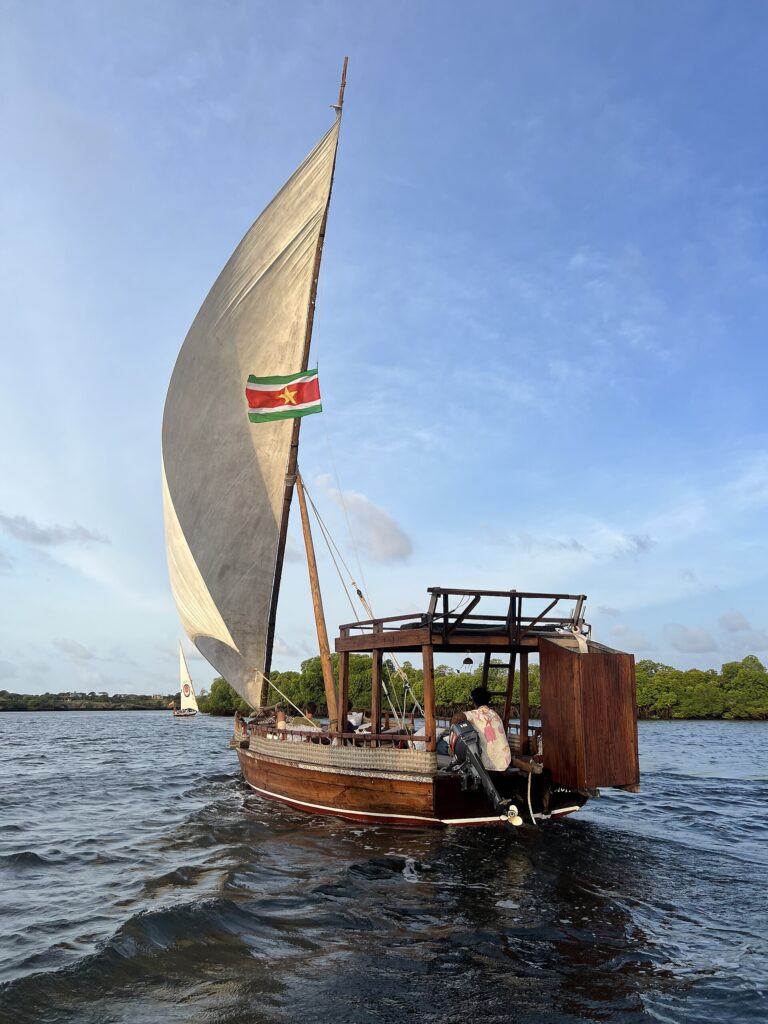
The Lore · East Africa · Lore Universe
Indian Ocean traders (Swahili)
Swahili as African-Arab synthesis (150M+ speakers), monsoon trade routes, Zanzibar sultanate, dhow navigation, coastal city-state architecture, Kiswahili oral literature.
Why its stories are told
Stories are told to entertain, instruct, honour and remember. Hadithi (tales), especially animal tales of Sungura the hare, are told to children in the evening, often by grandmothers and other older women.
The people call themselves Waswahili (singular Mswahili), their language Kiswahili, and their way of life and culture Uswahili; the coastal world itself is sometimes called Uswahilini.
The Land · Geography
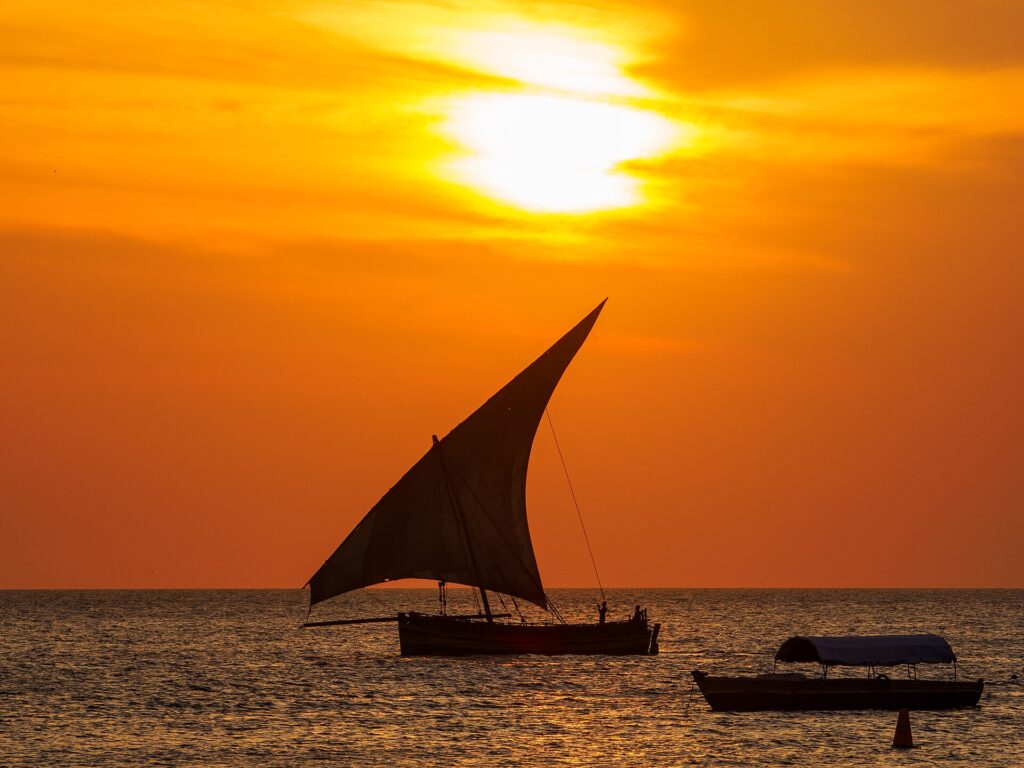
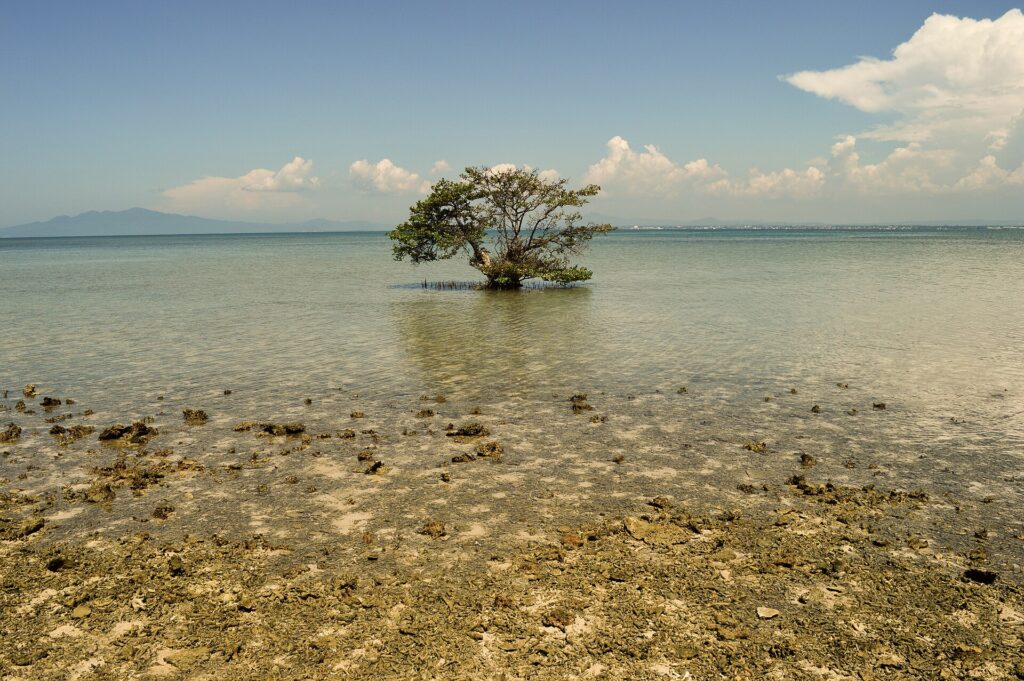
The Swahili world is a narrow strip of coast and islands along the western Indian Ocean: coral islands, mangrove creeks, sandy beaches, coral reefs and the hinterland of bush and farmland. The climate is hot and humid, ruled by the monsoons: the kaskazi from the northeast from about November to March and the kusi from the southwest from about April to October.
The monsoons made the coast a meeting point. Ships from Arabia, Persia and India could sail to East Africa on one monsoon and return on the next, so traders stayed for months. Swahili towns grew as ports exchanging ivory, gold, mangrove poles, slaves and other goods from the interior for cloth, beads and ceramics from the ocean.
The sea shapes the stories: sailors and voyages, storms, spirits of the sea, fish and sharks in tales like the monkey and the shark. The stone towns, with their coral-rag buildings, mosques and carved doors, are settings of chronicle and poem. The land beyond, bara, is the inland world, contrasted with the coast, pwani.
The land is memory: ruins of towns like Kilwa, Gede and Shanga are reminders of past greatness and of mortality.
The People · Cultural Foundation · Society
Kiswahili is a Bantu language of the Sabaki group, closely related to the languages of the Mijikenda, Pokomo and Comorian peoples. Linguists and archaeologists, notably Derek Nurse, Thomas Spear and Mark Horton, place its origins on the northern Kenya coast and the Lamu archipelago in the second half of the first millennium CE, among African farming and fishing communities who traded across the Indian Ocean.
The Swahili world grew along about 3,000 km of coast, from southern Somalia through Kenya and Tanzania to northern Mozambique, and to the offshore islands: Lamu, Pate, Manda, Pemba, Unguja (Zanzibar), Mafia, Kilwa and the Comoros.
Two origin traditions are told by the people. The Shungwaya tradition, shared with the Mijikenda, Pokomo and Bajuni, names a homeland on the northern coast from which peoples dispersed. The Shirazi tradition, told in the Kilwa Chronicle and in Zanzibar and Pemba, traces founding lineages to Persian princes from Shiraz. Historians read the Shirazi story as a statement of status and Islamic heritage rather than a literal migration; the coastal towns were founded by Africans, with Arab and Persian settlers joining over centuries.
1. Ustaarabu, civility or refinement: the ideal of the cultured town-dweller who knows how to behave, speak, dress and receive guests. The word comes from the Arabic for 'becoming Arab', but in Swahili it means being civilised in the coastal manner, and its opposite is ushenzi, uncivilised behaviour.
2. Heshima, respect and honour: the standing of a person and a family, earned by conduct, generosity and reserve, and easily lost through scandal.
3. Dini, faith: Islam as the frame of life; a good story ends in a lesson about God's will and the end of all things.
4. Utu, humanity: the value of treating others as people, often linked to the proverb that a person is a person through others.
5. Wit and verbal skill: a clever answer, a good proverb, a well-made verse.
These values place family and town standing above the individual and the hereafter above the present. A Western reader may find it unfamiliar that great poems, like Al-Inkishafi, celebrate the ruin of worldly power rather than its triumph, or that a heroine's best choice is obedience and patience.
Swahili gender roles are shaped by Islam and coastal custom, but women have always had important roles.
Separation of spheres: men dominate public religious and political life, mosques and trade, while women organise households, weddings, many ceremonies and much of the spirit-possession world. Women in the stone towns historically lived in greater seclusion, especially in upper-class families.
Women as poets and keepers of knowledge: Mwana Kupona binti Mshamu wrote one of the most famous Swahili poems in 1858. Women compose and perform songs at weddings and in taarab, where their verses carry indirect social commentary. Older women hold the knowledge of marriage, childbirth and many customs.
Women in power: some towns had women rulers. Traditions of Mombasa name Mwana Mkisi as a founding queen, and historical records note women rulers in Zanzibar and other places; details are uncertain in some cases.
Possession: many spirit cults are led by women, giving them authority and a space of their own.
Modern Swahili women writers, scholars and activists debate the advice of Mwana Kupona and the place of women in coastal society.
Age brings authority and respect in Swahili society. Children are taught to greet elders with Shikamoo ('I hold your feet'), answered with Marahaba, a greeting that expresses the hierarchy in every encounter.
Youth is a time of learning: Qur'anic school, apprenticeship and, for girls, instruction in household and marriage. Young people's behaviour reflects on their families.
Adults carry the household, trade and community duties. Marriage marks full adulthood.
Elders hold counsel, genealogy, religious knowledge and the memory of the town's history. Older women hold knowledge of customs, marriage and spirits; older men hold authority in mosques and community affairs.
What elders hold that others cannot access: knowledge of lineages and land, of old poems and stories, of how past disputes were settled, and, for women, the knowledge of the women's rites. They also have the right to give blessing and, more feared, to curse; a parent's curse is believed to have real effect.
In stories, elders are wise advisers, as in Mwana Kupona's poem, and their advice is to be heeded.
Swahili society was historically stratified. At the top were the waungwana, freeborn patrician families of the stone towns, who claimed old descent and practised ustaarabu. Masharifu, families descended from the Prophet, held religious prestige. Below were commoners, artisans, fishermen and farmers; and at the bottom, before abolition, the enslaved (watumwa), many brought from the interior.
The Zanzibar sultanate's 19th-century economy depended heavily on enslaved labour on clove plantations and on the trade in captives; the slave market closed in 1873, and slavery was abolished in Zanzibar in 1897. The 1964 Revolution overthrew the Arab-dominated ruling class.
The justification of status rested on descent, Islamic learning and civility. People of lower standing could gain status through learning, wealth and conduct, and the boundaries shifted over time.
Storytellers and poets came from many ranks. Classical poets were often learned men of good family; women of all ranks told hadithi and sang. In stories, class appears as the contrast between waungwana and others, as satire of the proud, and in tricksters who expose the powerful. Abdulrazak Gurnah's novels explore these hierarchies.
The Swahili community is built from the household (nyumba), the lineage (ukoo), the town quarter (mtaa) and the town (mji). Many towns were historically divided into two moieties or halves that competed in dance, poetry and sport; Lamu's Mkomani and Langoni quarters are an example.
The town was historically a city-state, ruled by a sultan, a council of elders or leading families, and towns formed alliances or fought one another: Pate, Lamu, Mombasa, Malindi and Kilwa all have histories of rivalry. Under Oman and the Zanzibar sultanate, many towns came under one authority.
Membership carries obligations: to attend weddings and funerals, contribute to community needs, support kin, respect elders, and uphold the town's honour.
Membership gives protection, identity and a share in the town's life.
Expulsion or loss of standing is severe: a person without lineage or town is a stranger. Exile appears in Swahili poetry, notably Abdilatif Abdalla's Sauti ya Dhiki (1973), written in prison in Kenya. In Abdulrazak Gurnah's novels, displacement from the coast and family is a central theme.
Through Time · History
In the 1st century CE, the Periplus of the Erythraean Sea described a trading port called Rhapta on the East African coast.
By the 8th century, communities at Shanga and other sites on the Lamu archipelago were building houses and, soon after, mosques, as Mark Horton's excavations show.
In 916, the Arab writer al-Mas'udi described the land of the Zanj and its trade.
By the 12th century, stone towns were growing along the coast, and Kilwa controlled much of the gold trade from the south.
Around 1331, the traveller Ibn Battuta visited Mombasa and Kilwa and praised Kilwa as one of the most beautiful towns.
In 1498, Vasco da Gama reached Malindi, and in 1505 the Portuguese sacked Kilwa and Mombasa.
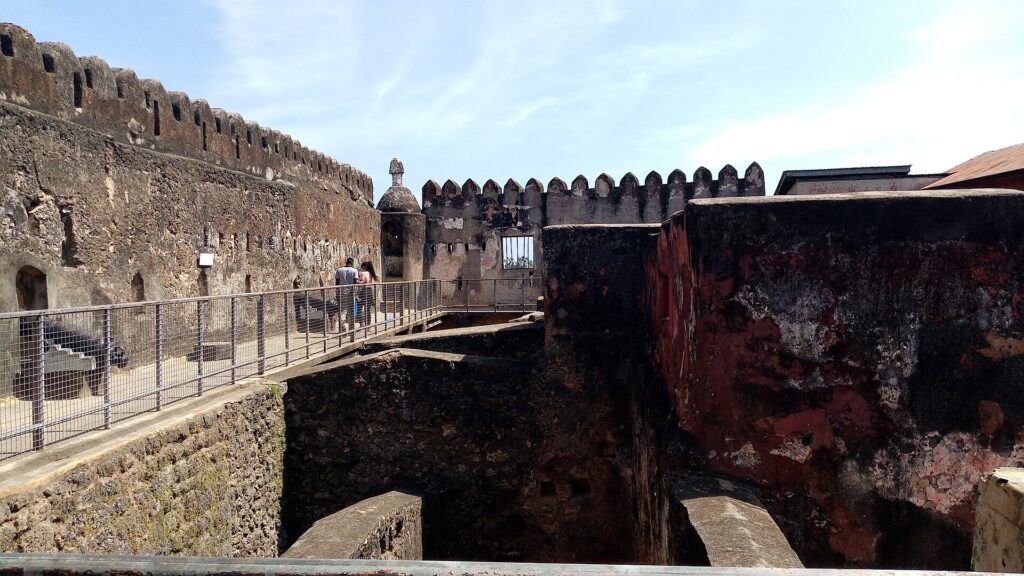
In 1593, the Portuguese began building Fort Jesus at Mombasa.
In 1698, Omani forces took Fort Jesus after a long siege.
In 1728, the Utendi wa Tambuka was copied at Pate, the earliest dated major Swahili manuscript.
In the 1st century CE, the Periplus of the Erythraean Sea described a trading port called Rhapta on the East African coast. By the 8th century, communities at Shanga and other sites on the Lamu archipelago were building houses and, soon after, mosques, as Mark Horton's excavations show. In 916, the Arab writer al-Mas'udi described the land of the Zanj and its trade. By the 12th century, stone towns were growing along the coast, and Kilwa controlled much of the gold trade from the south. Around 1331, the traveller Ibn Battuta visited Mombasa and Kilwa and praised Kilwa as one of the most beautiful towns. In 1498, Vasco da Gama reached Malindi, and in 1505 the Portuguese sacked Kilwa and Mombasa. In 1593, the Portuguese began building Fort Jesus at Mombasa. In 1698, Omani forces took Fort Jesus after a long siege. In 1728, the Utendi wa Tambuka was copied at Pate, the earliest dated major Swahili manuscript. In 1840, Sayyid Said made Zanzibar the capital of his Omani state. In 1873, the Zanzibar slave market was closed. In 1896, the Anglo-Zanzibar War lasted less than an hour. In 1964, the Zanzibar Revolution overthrew the sultanate, and Zanzibar joined Tanganyika to form Tanzania. In 2022, the first World Kiswahili Language Day was held on 7 July.
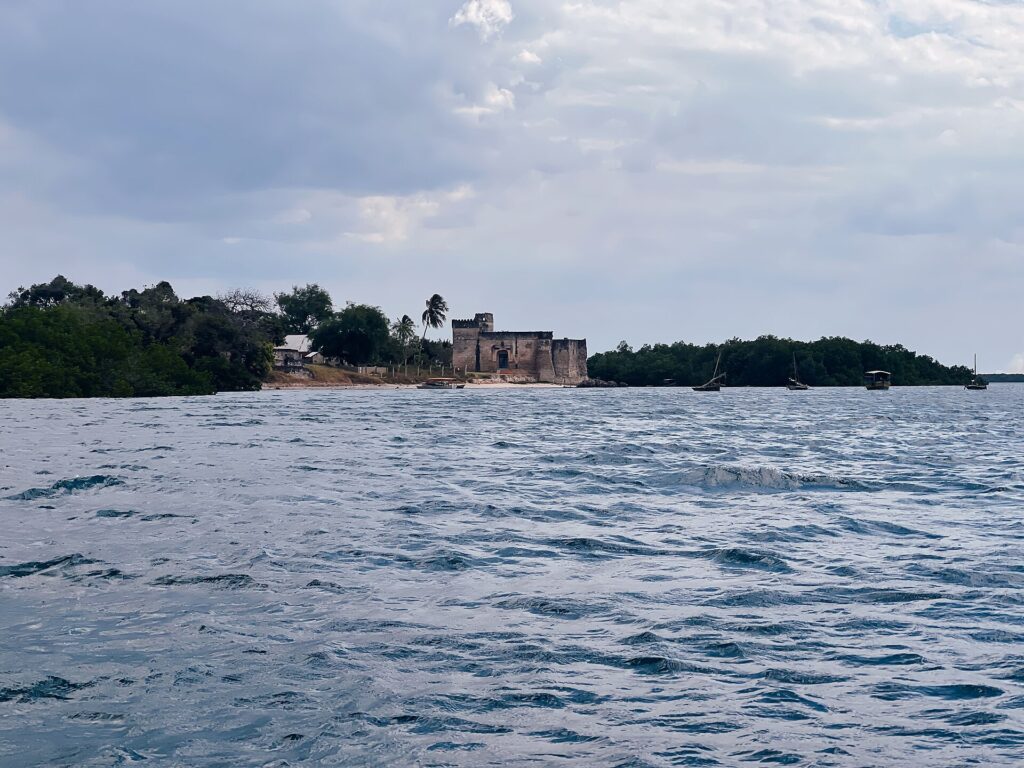
Movement made the Swahili world. Bantu-speaking peoples settled the coast in the first millennium CE, and the Sabaki languages, including Kiswahili, emerged there. The Shungwaya tradition records a dispersal of peoples from the north. From the north, the Swahili towns spread southward along the coast over centuries, reaching Kilwa, the Comoros and northern Mozambique.
The Swahili tradition is a product of exchange, but its base is African. The language is Bantu in grammar and core vocabulary, with many loanwords from Arabic (estimates vary, often around a third of vocabulary in classical texts), and smaller numbers from Persian, Hindi, Portuguese and English. Islam came early, probably by the 8th century, and became the faith of the coast.
Swahili stories exist in a world of towns that faced two ways: inland to Africa and outward to the ocean. They grew from the need to explain who belonged to which town and lineage, how Islam came, how founders acquired land, and how a trading people should live among strangers. History shaped the tradition directly.
The Sacred · Deities and Spirits
Invoked at the opening of every classical utenzi; the subject of religious poems such as the Hamziyya
Religious utenzi on the life of the Prophet; poems on the Prophet's night journey (Miiraji)
Poems on death and judgement; Al-Inkishafi's meditation on the grave
The Qur'anic story of Moses and the servant of God, retold in Swahili religious teaching
The refusal to bow to Adam, retold in Swahili religious poems
Hadithi and accounts of spirit encounters; Swahili customs recorded by Mtoro bin Mwinyi Bakari
Spirit-possession ceremonies (ngoma ya pepo) studied by Linda Giles and Kjersti Larsen
Offerings at sacred places in rural Zanzibar, Pemba and the coast
Reports of attacks in 1995 and 2007 in Pemba and Zanzibar
Sacredness flows first from God and the Qur'an. The Qur'anic word is sacred in itself: it is recited, copied, worn in amulets (hirizi) prepared by religious specialists, and in some healing practices written in ink and washed off to be drunk. The details of particular healing knowledge belong to its practitioners.
Mosques, especially old ones like the Great Mosque of Kilwa, are sacred spaces. The tombs of holy people and founders, including the pillar tombs found along the coast, are visited for blessing; some communities make pilgrimages to ruined towns, such as the people of Shela to the ruins of Takwa on Manda Island.
Learned and holy lineages, sharifu families descended from the Prophet and the walimu (teachers), carry baraka, blessing, which can be passed on through touch, prayer and presence.
Regalia carry sacred and political weight: the side-blown horns called siwa, such as the great ivory siwa of Pate and the brass siwa of Lamu, belonged to towns and were sounded on great occasions.
The mechanism of sacredness is closeness to God's word, to the Prophet's family and to the blessed dead. Respect, purity and correct procedure keep it.
Swahili religion is Islamic, and its hierarchy is the Islamic one. At the top is God, Mungu or Mwenyezi Mungu, also called Mola (Lord), one and without partner. Below God are the angels (malaika), including Jibrili (Gabriel), who brought the revelation; the prophets (manabii), from Adam to Muhammad, whose stories are told in poems; and the saints and holy people (mawalii), whose blessing continues after death.
Created beings who are not angels or humans are the majini, who can be good or harmful, and Iblisi (Shetani), the chief of the rebellious beings who refused to bow to Adam.
Alongside this Islamic hierarchy, in many communities, sit the possession spirits and place spirits, the pepo and mizimu, who are not gods and are not worshipped as gods, but who must be dealt with. Their relationship to Islam is debated by Swahili people themselves: some regard dealing with spirits as compatible with faith, others reject it.
There is no pantheon. God alone is worshipped; other beings are approached for help, protection or relief from affliction.
In Swahili Islam, ancestors are not worshipped, but they are present in several ways.
Genealogy is central. A family's standing depends on its descent, whether from founding lineages, Arab or Persian settlers, or the Prophet's family. Lineages are remembered, and chronicles record them.
The graves of founders and saints are visited, and prayers are said for the dead. Pillar tombs and graves of holy men are places where blessing may be sought.
The category of mizimu, spirits connected with the dead and with particular places, is known along the coast and among neighbouring peoples. In some Swahili communities, especially in rural Zanzibar, Pemba and the southern coast, offerings are made at places associated with mizimu, often old ruins, trees or caves, to ask for well-being, rain or a good harvest. Scholars note that this practice is regarded with suspicion by some religious teachers.
What the dead want is to be prayed for and remembered, and for their descendants to keep family honour and faith. Neglect of the dead and dishonour of lineage are wrongs.
The Swahili spirit world is shaped by Islam and by older East African understanding. It has several parts: God and the angels (malaika); the prophets; the dead in the grave awaiting judgement; and the spirits, which live alongside humans.
Spirits are of several kinds. Majini (jinn) are created beings of Islamic teaching, Muslim or not. Pepo and masheitani are terms often used for spirits that possess people. Spirits are understood to live in their own communities, with their own families, languages and religions; Linda Giles and Kjersti Larsen describe spirits identified as coastal Muslim spirits and inland or non-Muslim spirits, each with their own tastes and demands.
Crossings happen both ways. Spirits can enter people, causing illness, or attach themselves to a person and remain with them for life. People can approach spirits through healers (waganga), ceremonies with drumming and dance, and offerings. Possession is not always an affliction; some people learn to live with their spirits and become healers.
The conditions of crossing involve place (the sea, ruins, trees), time (night), and vulnerability (illness, grief, childbirth).
Rituals mark transitions and restore balance.
Life passages: birth and naming; boys' circumcision; girls' instruction before marriage, in which older women (somo) teach brides about marriage; weddings with days of music, dance and display; and death with Islamic burial, mourning and prayer. Mtoro bin Mwinyi Bakari's Desturi za Wasuaheli describes many of these customs as practised around 1900.
Religious calendar: Ramadan, the two Eids, and Maulidi, the celebration of the Prophet's birthday, which at Lamu draws pilgrims from across East Africa to the Riyadha Mosque.
The new year of Mwaka Kogwa at Makunduchi in Zanzibar, held in July, includes mock fights between men and the burning of a hut, rites to clear the old year's grievances.
Restoring balance: when spirits cause illness, healers hold ceremonies (ngoma ya pepo) with drumming, song and dance in which the spirit is identified, its wishes learned and the person helped. Inner details belong to the healers and their communities.
In stories, rituals frame tales (a poem recited at a wedding), mark key events (a hero's wedding) and resolve them (prayer at the poem's end).
The Waswahili are Muslim, and there is one God: Mungu, Mwenyezi Mungu ('Almighty God'), Mola ('Lord'), Allah. God has no image, no partner and no physical form. God is addressed in prayer, praised at the opening of every classical poem, and seen as the cause of all things. The protocol is Islamic: ritual purity, prayer five times a day, fasting, charity, pilgrimage, and the remembrance of God's names.
Below God are beings who are not worshipped but who are important in religious story and belief:
Malaika, the angels, including Jibrili (Gabriel), messenger of revelation, and the angels of death and the grave, who appear in poems about death and judgement.
The prophets (manabii), from Adam to Muhammad, whose lives are told in utenzi. The Prophet Muhammad is honoured at Maulidi.
Nabii Hidhiri (al-Khidr), a figure of hidden wisdom, connected in wider Islamic belief with water and travellers.
Iblisi or Shetani, the rebellious being who refused to bow to Adam and who tempts humans.
Other spirit beings, majini and pepo, are created beings, not gods.
Majini (jinn) are created beings of Islamic teaching, made of smokeless fire, who live in their own communities and may be Muslim or not, good or harmful. They can be summoned or bound by those with knowledge, a practice condemned by many as sorcery.
Pepo and masheitani are possession spirits. Scholars such as Linda Giles describe classes of spirits in coastal communities: coastal Muslim spirits who like Arabic-style dress and recitation, and inland spirits from the interior, each with their own tastes. They can cause illness and are calmed by ceremonies.
Mizimu are spirits linked to the dead and to places such as ruins, caves, trees and old wells. Offerings at their places ask for help.
Popobawa is a feared spirit reported in Pemba and Zanzibar, especially in waves of attacks in 1995 and 2007, described as a bat-winged being that attacks people at night. It is a modern phenomenon studied by scholars and journalists.
Rules of interaction: respect, avoidance of their places at the wrong time, seeking help from healers and religious specialists, and prayer and Qur'anic recitation for protection. The details of particular spirits' ceremonies belong to their communities.
Animals are the main characters of Swahili tales. Sungura, the hare, is the great trickster, outwitting lions, elephants and hyenas through cleverness. Kima, the monkey, appears in the famous tale of the monkey and the shark (Kima na Papa), in which the monkey, carried to sea by the shark, who plans to take his heart to cure a sultan, says he left his heart in the tree and so escapes. Fisi, the hyena, is greedy and foolish. Simba, the lion, is strong but often outwitted.
Sea creatures appear in sailors' stories: sharks, giant fish and sea spirits. Some sea spirits are said to live in their own towns beneath the waves.
The nyoka (snake) and other creatures may be spirits in disguise.
In religious poems, creatures from Islamic tradition appear: the Buraq, the winged mount of the Prophet's night journey; the creatures of the Qur'anic stories.
In the Liyongo story, Liyongo's son is sometimes described as being tempted by his father's enemies, and his fatal weapon is a copper needle.
These creatures relate to humans as teachers through example: the hare's cleverness, the hyena's greed, the monkey's quick thinking.
Islamic law defines the main prohibitions: worship of anything other than God, theft, adultery, murder, drinking alcohol, eating pork, and neglect of prayer and fasting.
Coastal customary rules concern modesty and respect: women's dress and movement in public, the proper behaviour of young people toward elders, and the conduct of guests and hosts. Breaking them brings shame (aibu) on oneself and one's family.
Rules toward spirits: avoid certain places at certain times, do not disturb spirits' dwellings, observe the food and colour rules of one's own spirits if one is possessed. Breaking these can bring illness or misfortune, often delayed.
Rules of pollution and purity: ritual cleanliness before prayer, after childbirth and after contact with the dead.
Sorcery is the gravest offence against both God and community.
What cannot be undone: the loss of heshima, a scandal that becomes public, a curse from a parent, and death. In Swahili tales and poems, these are often the turning points. The consequences of wrongdoing may be immediate in this world, delayed until the next, or fall on the family as a whole.
This part carries no pictures. Gods, spirits, the ancestors and ceremonies are named, with their roles, and drawn as marks only.
The Stories · Signature Stories
The story of Fumo Liyongo is the great heroic legend of the Swahili coast. Liyongo was a man of great size and strength, a poet and an archer, of the ruling family of Pate or Shanga in the Lamu archipelago. He had a rightful claim to rule, but by custom or rivalry the throne went to his kinsman, Daudi Mringwari.
And 2 more stories in the catalog below.
The Telling · Oral Tradition · Narrative Structure
The Figures · Survival and Diaspora
The tragic hero: Fumo Liyongo, strong, gifted and excluded, betrayed by kin. His arc is from strength to tragic death, and his fame outlives him.
The trickster: Sungura the hare and Abunuwasi, who outwit the strong and the proud. Abunuwasi, based on the Arabic poet Abu Nuwas, tricks sultans and rich men with wit, often in tales that mock pretension.
The wise mother or elder: Mwana Kupona, advising her daughter; Liyongo's mother, who saves him. They hold knowledge and loyalty.
The proud ruler: the sultan or king who abuses power, often humbled by a trickster or by death, as the rulers of Pate in Al-Inkishafi.
The founder: the Shirazi prince who buys land for Kilwa with cloth; the founding queen of Mombasa, Mwana Mkisi. Founders establish towns and lineages.
The pious believer: the Prophet's companions in religious utenzi, and the poet who turns from the world to God.
The sorcerer: a figure of fear, often exposed and punished.
These characters relate to the community as examples: the hero and the believer to admire, the trickster to enjoy, the proud and the sorcerer to avoid.
Survival and diaspora
Yes. The tradition is living. Swahili towns from Lamu to Kilwa, Zanzibar and the Comoros keep their language, faith, music, food, dress and festivals. Kiswahili is spoken by a very large number of people, estimates range from about 100 million to over 200 million, most as a second language, across Tanzania, Kenya, Uganda, the Democratic Republic of Congo and beyond.
The Swahili coast was a source of people carried away by force. Captives from East Africa, many passing through Zanzibar and Kilwa, were carried to Arabia, the Persian Gulf, India and the Indian Ocean islands, and some to the Americas.
Swahili poets and scholars have worked to keep classical forms and language alive. Ahmed Sheikh Nabhany (1927–2014) of Lamu collected and revived old Swahili words, composed poems in classical forms and helped develop Swahili vocabulary for modern use. Ahmad Nassir Juma Bhalo of Mombasa published classical-form poetry.
The Catalog · its places, peoples, practices and sources

The World Bible
For the reader who wants all of it: every section of Swahili Coast, in its eleven parts.
The people call themselves Waswahili (singular Mswahili), their language Kiswahili, and their way of life and culture Uswahili; the coastal world itself is sometimes called Uswahilini. Pronunciation: wah-swah-HEE-lee, kee-swah-HEE-lee, with every vowel sounded and the stress on the second-to-last syllable.
The word comes from Arabic sawāḥil, 'coasts', and was used by Arab writers before it became the people's own. Many coastal people prefer to name themselves by their town: Wamvita (people of Mvita, the old name of Mombasa), Waamu (Lamu), Wapate (Pate), Wagunya or Watikuu (the Bajuni of the northern islands), Wavumba (the southern Kenya coast), Waunguja (Zanzibar island, with the Wahadimu and Watumbatu), Wapemba (Pemba), and Wangazija (Grande Comore), whose Shingazija is closely related.
The main dialects include Kiamu (Lamu), Kipate, Kimvita (Mombasa), Kiunguja (Zanzibar town, the basis of Standard Swahili), Kipemba, Kitumbatu and Kimakunduchi. Classical poetry, utenzi or utendi and shairi, is mostly in Kiamu and Kipate, and in older texts it was written in Arabic script, known as Swahili ajami.
Kiswahili is a Bantu language of the Sabaki group, closely related to the languages of the Mijikenda, Pokomo and Comorian peoples. Linguists and archaeologists, notably Derek Nurse, Thomas Spear and Mark Horton, place its origins on the northern Kenya coast and the Lamu archipelago in the second half of the first millennium CE, among African farming and fishing communities who traded across the Indian Ocean.
The Swahili world grew along about 3,000 km of coast, from southern Somalia through Kenya and Tanzania to northern Mozambique, and to the offshore islands: Lamu, Pate, Manda, Pemba, Unguja (Zanzibar), Mafia, Kilwa and the Comoros.
Two origin traditions are told by the people. The Shungwaya tradition, shared with the Mijikenda, Pokomo and Bajuni, names a homeland on the northern coast from which peoples dispersed. The Shirazi tradition, told in the Kilwa Chronicle and in Zanzibar and Pemba, traces founding lineages to Persian princes from Shiraz. Historians read the Shirazi story as a statement of status and Islamic heritage rather than a literal migration; the coastal towns were founded by Africans, with Arab and Persian settlers joining over centuries.
Swahili stories exist in a world of towns that faced two ways: inland to Africa and outward to the ocean. They grew from the need to explain who belonged to which town and lineage, how Islam came, how founders acquired land, and how a trading people should live among strangers.
History shaped the tradition directly. The rise of stone towns from the 11th century; the arrival of the Portuguese in 1498 and their violence; Omani rule from the 1690s; the Zanzibar sultanate's wealth from cloves and the slave trade in the 19th century; British and German colonial rule; and the 1964 Zanzibar Revolution all appear in poetry and memory.
Stories serve to teach adab (proper conduct), to praise and lament, to instruct girls in marriage and boys in learning, to mock the arrogant, and to remember the ruin of once-great towns.
Sacred and secular are distinct but close. Religious poetry, maulidi recitations and the Qur'an are sacred; animal tales (hadithi), riddles and love songs are secular. Spirit-possession rites sit between, practised within an Islamic frame. Much classical poetry uses secular stories to teach religious lessons.
The Swahili have their own written record, which is rare among the traditions of the region. Manuscripts in Arabic script survive from the 18th century, with the Utendi wa Tambuka, copied at Pate and dated 1728, the earliest dated major work. Town chronicles, the Kilwa Chronicle (16th century) and the Pate Chronicle, record local history.
Early published collections include Edward Steere's Swahili Tales as told by Natives of Zanzibar (1870), and Mtoro bin Mwinyi Bakari's Desturi za Wasuaheli (1903), written by a Swahili scholar about his own people's customs, later translated by J. W. T. Allen as The Customs of the Swahili People (1981). Alice Werner, Jan Knappert, J. W. T. Allen and Ann Biersteker edited and translated classical poems.
Historians and archaeologists include Neville Chittick (Kilwa), Mark Horton (Shanga), Derek Nurse and Thomas Spear, John Middleton, Randall Pouwels and Abdul Sheriff. Studies of spirit possession include Linda Giles and Kjersti Larsen.
Swahili scholars and poets are central: Ahmed Sheikh Nabhany of Lamu, Abdilatif Abdalla, Farouk Topan, Kitula King'ei, M. M. Mulokozi and the Institute of Kiswahili Research at the University of Dar es Salaam (TUKI, now TATAKI). No elders were consulted directly for this entry.
1. Ustaarabu, civility or refinement: the ideal of the cultured town-dweller who knows how to behave, speak, dress and receive guests. The word comes from the Arabic for 'becoming Arab', but in Swahili it means being civilised in the coastal manner, and its opposite is ushenzi, uncivilised behaviour.
2. Heshima, respect and honour: the standing of a person and a family, earned by conduct, generosity and reserve, and easily lost through scandal.
3. Dini, faith: Islam as the frame of life; a good story ends in a lesson about God's will and the end of all things.
4. Utu, humanity: the value of treating others as people, often linked to the proverb that a person is a person through others.
5. Wit and verbal skill: a clever answer, a good proverb, a well-made verse.
These values place family and town standing above the individual and the hereafter above the present. A Western reader may find it unfamiliar that great poems, like Al-Inkishafi, celebrate the ruin of worldly power rather than its triumph, or that a heroine's best choice is obedience and patience.
For the Waswahili, causation rests with God, Mungu or Mwenyezi Mungu, 'the Almighty'. All things happen by God's will (majaliwa). Alongside this sits a well-established understanding that spirits (pepo, majini, masheitani) can cause illness and misfortune, that the evil eye (kijicho) and envy can harm, and that sorcery (uchawi) is real and wrong.
The individual exists within family, lineage and town. A person's standing is their family's, and scandal stains all.
Time is understood on several levels. There is Islamic linear time from creation to judgement, which gives poems like Al-Inkishafi their meditation on mortality. There is the cyclical time of the monsoons, kaskazi from the northeast and kusi from the southwest, which governed sailing, trade and the arrival of strangers. There is the ritual year, with the Islamic calendar and the Persian-derived new year, Mwaka Kogwa, still celebrated at Makunduchi in Zanzibar.
Reality is layered: the visible town, the world of spirits who live alongside humans in their own communities, and the world to come. Spirits and humans share the same coast but are not usually seen.
Stories are told to entertain, instruct, honour and remember. Hadithi (tales), especially animal tales of Sungura the hare, are told to children in the evening, often by grandmothers and other older women. They open with a call and response and teach cleverness and caution.
Poetry is the high art. Utenzi (long narrative poems in four-line stanzas) were composed by learned poets, often men of religious learning but also women like Mwana Kupona, and recited aloud at gatherings, weddings and religious occasions. Shairi and other short forms were used for debate, love, praise and satire; poets of Mombasa and Lamu exchanged verses in public contests.
Religious recitation, maulidi in praise of the Prophet, is performed at set times of year, especially the Prophet's birthday.
The power of telling rests with the learned and the skilled. A poet could praise a ruler or attack him; Muyaka bin Haji of Mombasa (c. 1776–1840) is remembered for poems on politics and the struggles of his town. A teller of hadithi has authority over children, and a poet's verse could shape public opinion.
Swahili narrative has several structural forms.
The utenzi is a long narrative poem in stanzas of four short lines, with the last line's rhyme carried through the whole poem. It usually opens with an invocation of God and the Prophet, states the poet's purpose, tells its story in order, and closes with a prayer and sometimes the poet's name and date. This frame of praise around a narrative is the most characteristic form.
The hadithi or folk tale follows a pattern of trial and outcome: a character, often an animal, faces danger or temptation, uses wit or fails to, and the story ends with a lesson. Tales are often built from repeated episodes and songs.
The heroic story, such as that of Fumo Liyongo, follows a life from strength through rivalry and betrayal to death, with prophecy and fate in the background.
The chronicle follows the succession of rulers and the founding of towns.
Movement in Swahili story is often toward recognition of God's will: from worldly pride to humility, from power to its loss, from ignorance to understanding. Many works are hybrids, mixing tale, chronicle and sermon.
Narrative tension comes from several sources.
Rivalry within the ruling family: the Liyongo story turns on conflict between the hero and his kinsman the ruler of Pate over power and succession. Many town chronicles record such contests.
The struggle between faith and unbelief: the Utendi wa Tambuka tells of war between the early Muslims and the Byzantine forces of Herakleios (Heraklius), seen as a story of faith triumphant.
Cleverness against strength: in hadithi, the hare, the monkey or Abunuwasi faces a stronger opponent, a lion, a shark, a sultan, and wins by wit.
Mortality against worldly pride: Al-Inkishafi sets the splendour of Pate's past against its ruin and the grave, and the tension is between the soul's attachment to the world and the truth of death.
Right conduct against temptation: Mwana Kupona's poem sets the duties of a wife against the dangers of a careless life.
The driving force is less often a clash between good and evil than a test, of wit, faith or conduct, under God's will.
Swahili tradition uses several types of protagonist.
The individual hero, above all Fumo Liyongo, poet, warrior and archer, whose strength is matched by his exclusion from power. He is individual but tied to lineage and town.
The pious community: in religious utenzi, the protagonists are the Prophet and his companions, and the story is of the Muslim community, of which the listeners are part.
The trickster: Sungura the hare and Abunuwasi, a figure taken from the Arabic poet Abu Nuwas and made into a Swahili trickster who outwits the powerful.
The advising elder: in didactic poems, the protagonist is the speaker, a mother like Mwana Kupona advising her daughter, or a father advising a son.
The town itself: in Al-Inkishafi and the chronicles, the true subject is a town, Pate or Kilwa, its rise and its fall.
Women appear as advisers, poets, wives and mothers, and in Liyongo's story his mother is a key helper. Spirits are rarely protagonists but are present as forces.
Swahili stories end in several ways.
Submission to God's will is the most important. Even heroic poems end with prayer, and Al-Inkishafi ends with the soul called to repentance before the grave. A satisfying ending is one that reminds listeners that all worldly things end and only God remains.
Tragic death: Liyongo dies, betrayed by his own son, and the story ends with his body standing at the well. The ending is satisfying not because it is happy but because it is fitting: the hero dies as a hero, and his fame remains.
The trickster's victory: hadithi often end with the clever animal or Abunuwasi winning, and a closing lesson or proverb.
The founding: chronicles end with the establishment of a dynasty or town.
Restoration of order: some tales end with a marriage, a return home, or the punishment of a wrongdoer.
The utenzi frame itself is a resolution: the poet names himself or herself, asks for prayers, and closes the story within the community of believers.
Swahili narrative works with three clocks.
The linear Islamic clock runs from creation through the Prophet's time to the present and on to judgement. Religious utenzi place their stories within it, and Al-Inkishafi looks back on the past and forward to the grave.
The genealogical and dynastic clock of the chronicles counts the reigns of rulers and the founding of towns. It is linear but often compressed; scholars note that chronicles may merge or reorder generations.
The seasonal clock of the monsoons governs sailing: ships came from Arabia, Persia and India with the kaskazi and left with the kusi. Many stories begin with arrivals from the sea and end with departures.
The tale clock of hadithi is the undated past of 'once upon a time', with animals speaking.
Time is often layered in poetry: Al-Inkishafi sets the poet's present among the ruins against the past splendour of Pate and the future of death, so that all three are present at once. This layering of past glory, present ruin and coming judgement is one of the distinctive shapes of Swahili verse.
The community is central in Swahili narrative. The town, mji, is the unit of identity: its lineages, its quarters (mitaa), its rulers and its mosques. Chronicles are the stories of towns, and many poems are addressed to the people of a town.
Individuals act within the community's sight. A person's honour (heshima) depends on public opinion, and stories often show the consequences of shame. Liyongo's tragedy is partly public: he is a great man excluded from rule, and the town watches.
The community is also the audience and judge of poetry. Poets addressed each other publicly, and poetic contests between quarters or towns (such as Mombasa's Muyaka and his rivals) drew crowds.
The community expects stories to teach good conduct, to honour God, to respect lineages and to be well made. Poetry is judged on language, rhyme and meaning. Satire is accepted but can lead to feud.
In the Islamic religious poems, the community is the umma, the community of believers, of which the town is a part. Listening is itself a religious act.
Morality in Swahili tradition is defined by Islam and by the town's code of conduct, ustaarabu and heshima.
Islamic morality is absolute in principle: God's law defines what is right and wrong. In practice, Swahili moral teaching is also relational: the duties owed to parents, husbands, wives, neighbours, guests and rulers differ.
What earns honour: piety, learning, generosity, hospitality, modesty in dress and speech, eloquence, courage, loyalty to kin and obedience to parents. Mwana Kupona advises her daughter to be patient, clean, well-mannered and obedient to her husband; modern readers, including Swahili women writers, debate this advice.
What earns condemnation: pride, greed, betrayal, sorcery, lack of shame, and forgetting God and death. Al-Inkishafi condemns the rulers of Pate who lived in luxury and forgot the grave.
Stories teach through consequence: the proud fall, the betrayer is punished, the clever survive, the pious are rewarded in the next life. Proverbs (methali) state the lesson directly, and many are printed on kanga cloths worn by women.
Transformation in Swahili narrative is mostly moral and spiritual rather than physical.
The central transformation is from worldly attachment to awareness of God and death. Al-Inkishafi is a poem of the soul's awakening, and its listeners are meant to be transformed by it. This is the transformation the tradition celebrates most.
Growth into proper adulthood is another: a girl becomes a wise wife, a boy a learned man. Mwana Kupona's poem guides this passage.
The fall of the great is mourned and also accepted. Pate, Kilwa and other towns rose and fell, and poems record their transformation from splendour to ruin. Liyongo's fall from strength to death is a transformation of fate.
Trickster tales show small reversals: the weak become victorious, the proud are made foolish.
Physical transformations, spirits taking human or animal form, humans possessed by spirits, appear in belief and some tales, and are dealt with through ritual and prayer rather than celebrated. Conversion to Islam is a key transformation in some origin stories.
Sacredness flows first from God and the Qur'an. The Qur'anic word is sacred in itself: it is recited, copied, worn in amulets (hirizi) prepared by religious specialists, and in some healing practices written in ink and washed off to be drunk. The details of particular healing knowledge belong to its practitioners.
Mosques, especially old ones like the Great Mosque of Kilwa, are sacred spaces. The tombs of holy people and founders, including the pillar tombs found along the coast, are visited for blessing; some communities make pilgrimages to ruined towns, such as the people of Shela to the ruins of Takwa on Manda Island.
Learned and holy lineages, sharifu families descended from the Prophet and the walimu (teachers), carry baraka, blessing, which can be passed on through touch, prayer and presence.
Regalia carry sacred and political weight: the side-blown horns called siwa, such as the great ivory siwa of Pate and the brass siwa of Lamu, belonged to towns and were sounded on great occasions.
The mechanism of sacredness is closeness to God's word, to the Prophet's family and to the blessed dead. Respect, purity and correct procedure keep it.
In Swahili Islam, ancestors are not worshipped, but they are present in several ways.
Genealogy is central. A family's standing depends on its descent, whether from founding lineages, Arab or Persian settlers, or the Prophet's family. Lineages are remembered, and chronicles record them.
The graves of founders and saints are visited, and prayers are said for the dead. Pillar tombs and graves of holy men are places where blessing may be sought.
The category of mizimu, spirits connected with the dead and with particular places, is known along the coast and among neighbouring peoples. In some Swahili communities, especially in rural Zanzibar, Pemba and the southern coast, offerings are made at places associated with mizimu, often old ruins, trees or caves, to ask for well-being, rain or a good harvest. Scholars note that this practice is regarded with suspicion by some religious teachers.
What the dead want is to be prayed for and remembered, and for their descendants to keep family honour and faith. Neglect of the dead and dishonour of lineage are wrongs.
The Swahili spirit world is shaped by Islam and by older East African understanding. It has several parts: God and the angels (malaika); the prophets; the dead in the grave awaiting judgement; and the spirits, which live alongside humans.
Spirits are of several kinds. Majini (jinn) are created beings of Islamic teaching, Muslim or not. Pepo and masheitani are terms often used for spirits that possess people. Spirits are understood to live in their own communities, with their own families, languages and religions; Linda Giles and Kjersti Larsen describe spirits identified as coastal Muslim spirits and inland or non-Muslim spirits, each with their own tastes and demands.
Crossings happen both ways. Spirits can enter people, causing illness, or attach themselves to a person and remain with them for life. People can approach spirits through healers (waganga), ceremonies with drumming and dance, and offerings. Possession is not always an affliction; some people learn to live with their spirits and become healers.
The conditions of crossing involve place (the sea, ruins, trees), time (night), and vulnerability (illness, grief, childbirth).
Rituals mark transitions and restore balance.
Life passages: birth and naming; boys' circumcision; girls' instruction before marriage, in which older women (somo) teach brides about marriage; weddings with days of music, dance and display; and death with Islamic burial, mourning and prayer. Mtoro bin Mwinyi Bakari's Desturi za Wasuaheli describes many of these customs as practised around 1900.
Religious calendar: Ramadan, the two Eids, and Maulidi, the celebration of the Prophet's birthday, which at Lamu draws pilgrims from across East Africa to the Riyadha Mosque.
The new year of Mwaka Kogwa at Makunduchi in Zanzibar, held in July, includes mock fights between men and the burning of a hut, rites to clear the old year's grievances.
Restoring balance: when spirits cause illness, healers hold ceremonies (ngoma ya pepo) with drumming, song and dance in which the spirit is identified, its wishes learned and the person helped. Inner details belong to the healers and their communities.
In stories, rituals frame tales (a poem recited at a wedding), mark key events (a hero's wedding) and resolve them (prayer at the poem's end).
Swahili religion is Islamic, and its hierarchy is the Islamic one. At the top is God, Mungu or Mwenyezi Mungu, also called Mola (Lord), one and without partner. Below God are the angels (malaika), including Jibrili (Gabriel), who brought the revelation; the prophets (manabii), from Adam to Muhammad, whose stories are told in poems; and the saints and holy people (mawalii), whose blessing continues after death.
Created beings who are not angels or humans are the majini, who can be good or harmful, and Iblisi (Shetani), the chief of the rebellious beings who refused to bow to Adam.
Alongside this Islamic hierarchy, in many communities, sit the possession spirits and place spirits, the pepo and mizimu, who are not gods and are not worshipped as gods, but who must be dealt with. Their relationship to Islam is debated by Swahili people themselves: some regard dealing with spirits as compatible with faith, others reject it.
There is no pantheon. God alone is worshipped; other beings are approached for help, protection or relief from affliction.
Swahili poetry is sung or chanted, not spoken. Each utenzi or shairi is performed to a melody (mahadhi or sauti) that suits the metre, and a good reciter's voice carries the meaning. Utenzi stanzas are short, with eight syllables per line, and the rhythm carries the listener forward through long narratives. The fixed final rhyme of each stanza binds the whole poem together.
Classical poems open with set formulas: an invocation of God (Bismillahi), praise of the Prophet, and the poet's statement that he or she will now tell a story. They close with a prayer and often the poet's name.
Hadithi have their own formulas. The teller says 'Paukwa!' and the listeners answer 'Pakawa!', and the tale begins; this opening exchange is one of the best-known in East African storytelling. Tales use repetition, dialogue, changes of voice for animals and sung refrains.
Riddles (vitendawili) begin with the teller's 'Kitendawili!' and the listeners' 'Tega!' ('set it!'). Proverbs are used in speech to make a point without saying it directly. Silence and indirection are part of eloquence: a good speaker hints rather than states.
Swahili performance includes many forms of music and dance.
Taarab, sung poetry with an orchestra of instruments such as the qanun, 'ud, violins, accordion and drums, developed in Zanzibar in the late 19th and early 20th centuries and spread along the coast. Siti binti Saad (c. 1880–1950) of Zanzibar was its first great star and among the first East African singers to make commercial recordings. Taarab songs use shairi-like verses, and women's taarab often carries indirect messages to rivals.
Women's dances include lelemama and chakacha, performed at weddings. Men's dances include the stick dances and sword dances of Lamu and other towns. Maulidi recitations are accompanied by frame drums (tari) and, at Lamu, by group movement.
Spirit ceremonies use drums, rattles, special clothing and incense; the person possessed may dress in the spirit's colours and dance in its manner.
Objects used include the siwa horns on state occasions, kanga cloths, and manuscripts of poems held by the reciter.
The body in poetry recitation is still; in dance it is expressive. Clothing, the kanzu for men, the buibui and kanga for women, marks the coastal style of performance.
Listeners take part in many ways. Hadithi begin with the exchange of 'Paukwa!' and 'Pakawa!', which signals that the audience is ready and joins the teller in setting the tale apart. Children may sing refrains, answer questions, and correct the teller.
Riddles require answers: the audience guesses and, if they fail, must 'give a town' to the riddler before hearing the solution, a playful forfeit.
In poetry recitation, the audience judges. Learned listeners appreciate rhyme, language and meaning, comment, and sometimes reply with their own verses. Poetic contests (malumbano) are public exchanges in which poets answer each other, and the audience decides the winner by acclaim.
In maulidi, the congregation joins in refrains and moves together; at Lamu, men perform the maulidi with group movement and drums.
In taarab, women in the audience stand, dance and place money on the singer when a song speaks for them, signalling which side they take in a rivalry.
In spirit ceremonies, participants drum, sing and respond to the spirit, and the community helps to identify it.
The Swahili tradition is unusual in combining oral memory with writing.
Writing in Arabic script: from at least the 18th century, poems were written down in manuscripts, copied by scribes, and passed down in families. Many are held in collections in Lamu, Mombasa, Zanzibar and in libraries abroad, such as SOAS in London. Manuscripts were recited aloud, so writing supported performance rather than replacing it.
Metre and rhyme: the fixed rhyme and syllable count of utenzi and shairi make long poems easier to remember. Many people knew long poems by heart.
Formulas: openings, closings and refrains are fixed in both poetry and tales.
Proverbs and kanga: methali are short and memorable, and kanga cloths printed with sayings carry them into daily life.
Specialists: poets, scholars, reciters and teachers (walimu) carried knowledge, and families of poets passed on skills.
The land and buildings: ruins, mosques and tombs recall stories, and the coast's stone towns stand as reminders of their histories. Schools, Qur'anic and secular, teach language and poetry.
The Swahili understanding of unseen power is shaped by Islam and by coastal custom.
Baraka, blessing, comes from God through the Qur'an, the Prophet's family and holy people. It heals, protects and brings good fortune.
The knowledge of the learned includes Islamic sciences of healing and protection, such as the preparation of amulets with Qur'anic verses and astrological calculation (falaki). These are considered licit by many when done within Islam.
Spirits can be dealt with by healers (waganga) through ceremonies, offerings and negotiation. A spirit's demands, for food, clothing, music, can be met to calm it.
Sorcery (uchawi) is the harmful use of unseen power, condemned as evil. Accusations of sorcery are serious, and the sorcerer (mchawi) is a figure of fear in tales and life.
The evil eye and envy can harm without intent.
What cannot be done: overturn God's will or bring back the dead. The stated rules are Islamic; the unstated rules concern respect for spirits, keeping one's affairs private to avoid envy, and seeking help from the right person.
Divine power through baraka is the highest form, coming from God and flowing through the Qur'an, the Prophet's descendants (masharifu) and saints. It is accessed through piety, learning and closeness to the blessed, and those who hold it are expected to teach, heal and make peace.
Learned power comes from study. The walimu and other scholars hold knowledge of the Qur'an, law and the sciences of protection and healing. It is earned through years of study.
Inherited power: lineage gives status. Ruling families, sharifu families and families of healers pass on standing and skills.
Power through spirits: some people are possessed and learn to live with their spirits, becoming healers. This path is not chosen; it begins with affliction.
Wealth from trade was the material power behind the coastal towns: merchants, ship-owners and later clove-plantation owners held great influence.
Stolen or illicit power is sorcery, condemned. In tales, power gained by trickery, like the hare's, is admired when used against the powerful but punished when used for greed.
The cost of power is responsibility, the risk of envy and the need to account to God.
Islamic law defines the main prohibitions: worship of anything other than God, theft, adultery, murder, drinking alcohol, eating pork, and neglect of prayer and fasting.
Coastal customary rules concern modesty and respect: women's dress and movement in public, the proper behaviour of young people toward elders, and the conduct of guests and hosts. Breaking them brings shame (aibu) on oneself and one's family.
Rules toward spirits: avoid certain places at certain times, do not disturb spirits' dwellings, observe the food and colour rules of one's own spirits if one is possessed. Breaking these can bring illness or misfortune, often delayed.
Rules of pollution and purity: ritual cleanliness before prayer, after childbirth and after contact with the dead.
Sorcery is the gravest offence against both God and community.
What cannot be undone: the loss of heshima, a scandal that becomes public, a curse from a parent, and death. In Swahili tales and poems, these are often the turning points. The consequences of wrongdoing may be immediate in this world, delayed until the next, or fall on the family as a whole.
Swahili initiations are mostly passages into adult roles and into learning.
For boys, circumcision marks the passage from childhood. It was historically accompanied by celebrations and by a period of instruction; Mtoro bin Mwinyi Bakari describes customs around 1900.
For girls, the passage to womanhood is marked by instruction from older women, especially before marriage. The somo, a female instructor, teaches the bride about marriage, conduct and the body. The content of this instruction belongs to the women who give it.
Qur'anic school (chuo) is a passage into religious learning. A child who completes reading the Qur'an is celebrated, and further study can lead to becoming a mwalimu or scholar.
Spirit initiation: a person possessed by a spirit may go through a series of ceremonies in which the spirit is identified, given what it asks, and settled; the person may later become a healer. This knowledge belongs to its keepers.
What dies in these passages is a child's state; what is born is a person with new duties. Administrators are elders, teachers, healers and older women.
Swahili gender roles are shaped by Islam and coastal custom, but women have always had important roles.
Separation of spheres: men dominate public religious and political life, mosques and trade, while women organise households, weddings, many ceremonies and much of the spirit-possession world. Women in the stone towns historically lived in greater seclusion, especially in upper-class families.
Women as poets and keepers of knowledge: Mwana Kupona binti Mshamu wrote one of the most famous Swahili poems in 1858. Women compose and perform songs at weddings and in taarab, where their verses carry indirect social commentary. Older women hold the knowledge of marriage, childbirth and many customs.
Women in power: some towns had women rulers. Traditions of Mombasa name Mwana Mkisi as a founding queen, and historical records note women rulers in Zanzibar and other places; details are uncertain in some cases.
Possession: many spirit cults are led by women, giving them authority and a space of their own.
Modern Swahili women writers, scholars and activists debate the advice of Mwana Kupona and the place of women in coastal society.
Age brings authority and respect in Swahili society. Children are taught to greet elders with Shikamoo ('I hold your feet'), answered with Marahaba, a greeting that expresses the hierarchy in every encounter.
Youth is a time of learning: Qur'anic school, apprenticeship and, for girls, instruction in household and marriage. Young people's behaviour reflects on their families.
Adults carry the household, trade and community duties. Marriage marks full adulthood.
Elders hold counsel, genealogy, religious knowledge and the memory of the town's history. Older women hold knowledge of customs, marriage and spirits; older men hold authority in mosques and community affairs.
What elders hold that others cannot access: knowledge of lineages and land, of old poems and stories, of how past disputes were settled, and, for women, the knowledge of the women's rites. They also have the right to give blessing and, more feared, to curse; a parent's curse is believed to have real effect.
In stories, elders are wise advisers, as in Mwana Kupona's poem, and their advice is to be heeded.
Swahili society was historically stratified. At the top were the waungwana, freeborn patrician families of the stone towns, who claimed old descent and practised ustaarabu. Masharifu, families descended from the Prophet, held religious prestige. Below were commoners, artisans, fishermen and farmers; and at the bottom, before abolition, the enslaved (watumwa), many brought from the interior.
The Zanzibar sultanate's 19th-century economy depended heavily on enslaved labour on clove plantations and on the trade in captives; the slave market closed in 1873, and slavery was abolished in Zanzibar in 1897. The 1964 Revolution overthrew the Arab-dominated ruling class.
The justification of status rested on descent, Islamic learning and civility. People of lower standing could gain status through learning, wealth and conduct, and the boundaries shifted over time.
Storytellers and poets came from many ranks. Classical poets were often learned men of good family; women of all ranks told hadithi and sang. In stories, class appears as the contrast between waungwana and others, as satire of the proud, and in tricksters who expose the powerful. Abdulrazak Gurnah's novels explore these hierarchies.
The Swahili community is built from the household (nyumba), the lineage (ukoo), the town quarter (mtaa) and the town (mji). Many towns were historically divided into two moieties or halves that competed in dance, poetry and sport; Lamu's Mkomani and Langoni quarters are an example.
The town was historically a city-state, ruled by a sultan, a council of elders or leading families, and towns formed alliances or fought one another: Pate, Lamu, Mombasa, Malindi and Kilwa all have histories of rivalry. Under Oman and the Zanzibar sultanate, many towns came under one authority.
Membership carries obligations: to attend weddings and funerals, contribute to community needs, support kin, respect elders, and uphold the town's honour.
Membership gives protection, identity and a share in the town's life.
Expulsion or loss of standing is severe: a person without lineage or town is a stranger. Exile appears in Swahili poetry, notably Abdilatif Abdalla's Sauti ya Dhiki (1973), written in prison in Kenya. In Abdulrazak Gurnah's novels, displacement from the coast and family is a central theme.
The Swahili world is a narrow strip of coast and islands along the western Indian Ocean: coral islands, mangrove creeks, sandy beaches, coral reefs and the hinterland of bush and farmland. The climate is hot and humid, ruled by the monsoons: the kaskazi from the northeast from about November to March and the kusi from the southwest from about April to October.
The monsoons made the coast a meeting point. Ships from Arabia, Persia and India could sail to East Africa on one monsoon and return on the next, so traders stayed for months. Swahili towns grew as ports exchanging ivory, gold, mangrove poles, slaves and other goods from the interior for cloth, beads and ceramics from the ocean.
The sea shapes the stories: sailors and voyages, storms, spirits of the sea, fish and sharks in tales like the monkey and the shark. The stone towns, with their coral-rag buildings, mosques and carved doors, are settings of chronicle and poem. The land beyond, bara, is the inland world, contrasted with the coast, pwani.
The land is memory: ruins of towns like Kilwa, Gede and Shanga are reminders of past greatness and of mortality.
Kilwa Kisiwani, on an island off southern Tanzania, holds the Great Mosque, among the oldest standing mosques on the coast, with parts from the 11th century and a domed extension from the 14th, and the palace of Husuni Kubwa. Kilwa and Songo Mnara were listed by UNESCO in 1981.
Lamu Old Town, listed by UNESCO in 2001, holds the Riyadha Mosque, centre of the annual Maulidi.
Pate Island holds the ruins of Pate town, subject of Al-Inkishafi, and Shanga, where Mark Horton's excavations found mosques from the 8th century onward.
Takwa, on Manda Island, a town abandoned in the 17th century, has a pillar tomb visited by people from Shela.
The grave attributed to Fumo Liyongo near Kipini, at the mouth of the Tana River, is visited by people who honour him.
Stone Town in Zanzibar, listed by UNESCO in 2000, holds mosques, shrines and the site of the former slave market, now the Anglican cathedral.
Gede, near Malindi, a ruined town from the 12th to 17th centuries, is regarded by some local people as a place of spirits.
In narrative, these sites are places of founding, of ruin and of reminder.
The Swahili cosmology is Islamic: seven heavens above, the earth, and beneath it the grave, where the dead await judgement, followed by paradise and hell. This map is taught in religious poems and in sermons.
On earth, the map has several layers. The town is the centre of ordered, civilised life (ustaarabu). Around it lie the fields and the bush (bara), the inland world, seen as less civilised. Beyond lies the sea, the route to other lands, and a place of spirits.
Directions matter for prayer, toward Mecca (qibla), north of the Swahili coast. Mecca is the spiritual centre; the pilgrimage (hajj) links the coast to it.
The spirit world overlaps the human world: spirits live in their own towns, sometimes imagined beneath the sea or in the bush, with their own society.
Movement between realms: the dead pass through the grave to the next world; spirits cross into human bodies through possession; the living reach the unseen through prayer, dreams and ceremonies. Thresholds include the sea, ruins, trees, caves and night.
In the 1st century CE, the Periplus of the Erythraean Sea described a trading port called Rhapta on the East African coast. By the 8th century, communities at Shanga and other sites on the Lamu archipelago were building houses and, soon after, mosques, as Mark Horton's excavations show. In 916, the Arab writer al-Mas'udi described the land of the Zanj and its trade. By the 12th century, stone towns were growing along the coast, and Kilwa controlled much of the gold trade from the south. Around 1331, the traveller Ibn Battuta visited Mombasa and Kilwa and praised Kilwa as one of the most beautiful towns. In 1498, Vasco da Gama reached Malindi, and in 1505 the Portuguese sacked Kilwa and Mombasa. In 1593, the Portuguese began building Fort Jesus at Mombasa. In 1698, Omani forces took Fort Jesus after a long siege. In 1728, the Utendi wa Tambuka was copied at Pate, the earliest dated major Swahili manuscript. In 1840, Sayyid Said made Zanzibar the capital of his Omani state. In 1873, the Zanzibar slave market was closed. In 1896, the Anglo-Zanzibar War lasted less than an hour. In 1964, the Zanzibar Revolution overthrew the sultanate, and Zanzibar joined Tanganyika to form Tanzania. In 2022, the first World Kiswahili Language Day was held on 7 July.
Movement made the Swahili world. Bantu-speaking peoples settled the coast in the first millennium CE, and the Sabaki languages, including Kiswahili, emerged there. The Shungwaya tradition records a dispersal of peoples from the north.
From the north, the Swahili towns spread southward along the coast over centuries, reaching Kilwa, the Comoros and northern Mozambique. Merchants and settlers from Arabia, especially Oman and Hadramawt, from Persia and from India came with the monsoons and settled, marrying into local families; Hadrami sharifu families, such as those of Lamu, brought religious learning.
Migration carried Islam, Arabic words, poetry forms, clothing and building styles to the coast and carried Swahili people to Arabia and beyond. It lost local languages in some places and led to tensions over origin and belonging.
In the 19th century, Swahili traders led caravans deep into the interior, to Lake Tanganyika and the Congo, spreading Kiswahili as a trade language. In the 20th century, Kiswahili became the national language of Tanzania and Kenya, spoken by many millions, most of them not ethnic Swahili. After 1964, many Zanzibaris left for Oman, the Gulf and Britain.
The Swahili tradition is a product of exchange, but its base is African. The language is Bantu in grammar and core vocabulary, with many loanwords from Arabic (estimates vary, often around a third of vocabulary in classical texts), and smaller numbers from Persian, Hindi, Portuguese and English.
Islam came early, probably by the 8th century, and became the faith of the coast. Swahili poets adapted Arabic forms: the Hamziyya, a translation from Arabic dated to 1652, and religious utenzi on the Prophet's life. They also created forms of their own, like the utenzi, which has no exact Arabic model.
Trade brought goods and ideas from Persia, India and China: Chinese porcelain set into the walls of mosques and tombs; Indian textiles; the Zheng He fleets of the 1410s, which took a giraffe from Malindi to China.
The Portuguese brought violence and some words; Omani rule brought Ibadi Islamic influence at court and new Arab settlers; British and German rule brought Roman script and English.
Resisted: Portuguese domination, and loss of the coastal way of life. The tradition kept its integrity by making the borrowed its own: Islam, Arabic poetry, Indian music in taarab, all became Swahili.
Yes. The tradition is living. Swahili towns from Lamu to Kilwa, Zanzibar and the Comoros keep their language, faith, music, food, dress and festivals. Kiswahili is spoken by a very large number of people, estimates range from about 100 million to over 200 million, most as a second language, across Tanzania, Kenya, Uganda, the Democratic Republic of Congo and beyond.
What is kept: poetry in classical forms, still composed and recited; taarab music; the Lamu Maulidi; Mwaka Kogwa at Makunduchi; dhow building on Lamu and Zanzibar; kanga sayings; hadithi told to children; spirit ceremonies in some communities.
What has changed: the Arabic script for Swahili has largely given way to Roman script; urbanisation, tourism and national culture have changed the towns; the 1964 Revolution changed Zanzibar's social order; and some religious reform movements oppose spirit practices.
Contemporary practitioners include poets like the late Ahmed Sheikh Nabhany and Ahmad Nassir Juma Bhalo, taarab singers like the late Bi Kidude of Zanzibar, scholars at universities in Dar es Salaam, Nairobi and Zanzibar, dhow builders at Lamu, and novelists such as Abdulrazak Gurnah, awarded the Nobel Prize in Literature in 2021, and Said Ahmed Mohamed.
The Swahili coast was a source of people carried away by force. Captives from East Africa, many passing through Zanzibar and Kilwa, were carried to Arabia, the Persian Gulf, India and the Indian Ocean islands, and some to the Americas. Their descendants in the Gulf and India kept forms of music and ritual: scholars link dances such as the leiwah of Oman and the United Arab Emirates and some Gulf healing ceremonies with East African origins, and the Siddi communities of India descend partly from East Africans.
Swahili people themselves have moved widely. After 1964, many Zanzibaris settled in Oman, the Gulf and Britain, where they keep the language, taarab and food. Comorians in Marseille and Paris keep their own Comorian traditions. Kenyan and Tanzanian coastal people live in the Gulf, Europe and North America.
Kiswahili also spread as a language of liberation and pan-Africanism. African Americans in the 1960s adopted Swahili words and names, and Kwanzaa, created in 1966 by Maulana Karenga, uses Swahili terms for its principles. This is an adaptation of the language rather than of the coastal tradition itself.
Swahili poets and scholars have worked to keep classical forms and language alive. Ahmed Sheikh Nabhany (1927–2014) of Lamu collected and revived old Swahili words, composed poems in classical forms and helped develop Swahili vocabulary for modern use. Ahmad Nassir Juma Bhalo of Mombasa published classical-form poetry. Abdilatif Abdalla's Sauti ya Dhiki (1973) used classical forms for prison poetry.
Institutions support this work: TATAKI (Institute of Kiswahili Studies) at the University of Dar es Salaam, the Baraza la Kiswahili la Taifa (BAKITA) in Tanzania, the Lamu Museum, and the Zanzibar Indian Ocean Research Institute. Manuscript projects have digitised Swahili ajami texts.
Festivals and culture: the Lamu Cultural Festival, the Zanzibar International Film Festival and Sauti za Busara music festival bring the tradition to new audiences. Dhow Countries Music Academy in Zanzibar teaches taarab and other coastal music.
At the international level, the African Union adopted Kiswahili as a working language in 2022, and UNESCO declared 7 July World Kiswahili Language Day.
What remains lost: many manuscripts and poems from towns that declined, and the full knowledge of the old Kiamu and Kipate poetic language.
The Waswahili are Muslim, and there is one God: Mungu, Mwenyezi Mungu ('Almighty God'), Mola ('Lord'), Allah. God has no image, no partner and no physical form. God is addressed in prayer, praised at the opening of every classical poem, and seen as the cause of all things. The protocol is Islamic: ritual purity, prayer five times a day, fasting, charity, pilgrimage, and the remembrance of God's names.
Below God are beings who are not worshipped but who are important in religious story and belief:
Malaika, the angels, including Jibrili (Gabriel), messenger of revelation, and the angels of death and the grave, who appear in poems about death and judgement.
The prophets (manabii), from Adam to Muhammad, whose lives are told in utenzi. The Prophet Muhammad is honoured at Maulidi.
Nabii Hidhiri (al-Khidr), a figure of hidden wisdom, connected in wider Islamic belief with water and travellers.
Iblisi or Shetani, the rebellious being who refused to bow to Adam and who tempts humans.
Other spirit beings, majini and pepo, are created beings, not gods.
Majini (jinn) are created beings of Islamic teaching, made of smokeless fire, who live in their own communities and may be Muslim or not, good or harmful. They can be summoned or bound by those with knowledge, a practice condemned by many as sorcery.
Pepo and masheitani are possession spirits. Scholars such as Linda Giles describe classes of spirits in coastal communities: coastal Muslim spirits who like Arabic-style dress and recitation, and inland spirits from the interior, each with their own tastes. They can cause illness and are calmed by ceremonies.
Mizimu are spirits linked to the dead and to places such as ruins, caves, trees and old wells. Offerings at their places ask for help.
Popobawa is a feared spirit reported in Pemba and Zanzibar, especially in waves of attacks in 1995 and 2007, described as a bat-winged being that attacks people at night. It is a modern phenomenon studied by scholars and journalists.
Rules of interaction: respect, avoidance of their places at the wrong time, seeking help from healers and religious specialists, and prayer and Qur'anic recitation for protection. The details of particular spirits' ceremonies belong to their communities.
Animals are the main characters of Swahili tales. Sungura, the hare, is the great trickster, outwitting lions, elephants and hyenas through cleverness. Kima, the monkey, appears in the famous tale of the monkey and the shark (Kima na Papa), in which the monkey, carried to sea by the shark, who plans to take his heart to cure a sultan, says he left his heart in the tree and so escapes. Fisi, the hyena, is greedy and foolish. Simba, the lion, is strong but often outwitted.
Sea creatures appear in sailors' stories: sharks, giant fish and sea spirits. Some sea spirits are said to live in their own towns beneath the waves.
The nyoka (snake) and other creatures may be spirits in disguise.
In religious poems, creatures from Islamic tradition appear: the Buraq, the winged mount of the Prophet's night journey; the creatures of the Qur'anic stories.
In the Liyongo story, Liyongo's son is sometimes described as being tempted by his father's enemies, and his fatal weapon is a copper needle.
These creatures relate to humans as teachers through example: the hare's cleverness, the hyena's greed, the monkey's quick thinking.
The story of Fumo Liyongo is the great heroic legend of the Swahili coast. Liyongo was a man of great size and strength, a poet and an archer, of the ruling family of Pate or Shanga in the Lamu archipelago. He had a rightful claim to rule, but by custom or rivalry the throne went to his kinsman, Daudi Mringwari. Liyongo's power and fame made the ruler fear him.
The ruler tried to kill him several times. Liyongo was captured and chained, but his mother sent him bread with a file baked inside, and while the guards were distracted by music and song he filed his chains and escaped. He went to live among the Pokomo, Oromo (Galla) and others of the mainland, and his strength was legendary.
Liyongo could not be killed by ordinary weapons; only a copper needle driven into his navel could kill him. His son, persuaded by Liyongo's enemies with promises, learned the secret and stabbed him while he slept. Liyongo woke, took his bow and went to the well outside the town, where he knelt with his bow drawn and died. People were afraid to come near the well for days until his mother came and found him dead.
The story is told in the Utendi wa Fumo Liyongo, composed in the 19th century, and in older songs attributed to Liyongo himself. Scholars disagree about whether Liyongo lived and when, with proposed dates from the 9th to the 17th century. The story reveals the tradition's themes: the hero excluded from power, the betrayal by kin, the tragic ending and the lasting fame.
The tragic hero: Fumo Liyongo, strong, gifted and excluded, betrayed by kin. His arc is from strength to tragic death, and his fame outlives him.
The trickster: Sungura the hare and Abunuwasi, who outwit the strong and the proud. Abunuwasi, based on the Arabic poet Abu Nuwas, tricks sultans and rich men with wit, often in tales that mock pretension.
The wise mother or elder: Mwana Kupona, advising her daughter; Liyongo's mother, who saves him. They hold knowledge and loyalty.
The proud ruler: the sultan or king who abuses power, often humbled by a trickster or by death, as the rulers of Pate in Al-Inkishafi.
The founder: the Shirazi prince who buys land for Kilwa with cloth; the founding queen of Mombasa, Mwana Mkisi. Founders establish towns and lineages.
The pious believer: the Prophet's companions in religious utenzi, and the poet who turns from the world to God.
The sorcerer: a figure of fear, often exposed and punished.
These characters relate to the community as examples: the hero and the believer to admire, the trickster to enjoy, the proud and the sorcerer to avoid.
The Founding of Kilwa (Kilwa Chronicle). Ali bin al-Hasan, a son of a ruler of Shiraz by an Abyssinian mother, sails with his brothers to the East African coast. At Kilwa, he buys the island from the local ruler for enough cloth to encircle it. The ruler later regrets the bargain and tries to return, but Ali has cut the causeway to the mainland. Structure: arrival from the sea, exchange, claim, founding. It explains a ruling lineage's legitimacy and Kilwa's place in the Islamic world, and historians read it as a statement of status rather than a literal record.
Al-Inkishafi ('The Soul's Awakening'). Sayyid Abdallah bin Ali bin Nasir, writing in the early 19th century, addresses his own heart and describes the ruins of Pate, once full of rich houses, lamps and music, now home to owls and bats, and the rulers who lived there now in the grave. Structure: meditation moving from past splendour to present ruin to coming judgement. It shows the tradition's view that worldly glory passes and only faith remains.
Kima na Papa (The Monkey and the Shark). The shark befriends the monkey, carries him to sea and reveals his plan to take his heart; the monkey says he left it in the tree, is carried back, and escapes. Structure: friendship, betrayal, wit, escape. It teaches that quick thinking saves life and that friendship with the powerful has risks.
Titles: Mwenyezi Mungu ('Almighty God'); Mola ('Lord'); Allah
Domain: The one God of Islam, creator and cause of all things
In the stories: Invoked at the opening of every classical utenzi; the subject of religious poems such as the Hamziyya
Notes: God is one and without image in Swahili Islam. Every classical poem begins with God's name and ends with prayer. God's will (majaliwa) explains all outcomes.
Titles: Gabriel; the angel of revelation
Domain: Messenger of God, bringer of revelation
In the stories: Religious utenzi on the life of the Prophet; poems on the Prophet's night journey (Miiraji)
Notes: Jibrili is the best-known of the malaika in Swahili religious poetry. He appears as messenger and guide. Angels are not worshipped.
Titles: Munkari and Nakiri; the angels of the grave
Domain: Questioning of the dead in the grave
In the stories: Poems on death and judgement; Al-Inkishafi's meditation on the grave
Notes: In Islamic teaching two angels question the dead in the grave. Swahili poems on death refer to this questioning. They give the grave its weight in Swahili verse.
Titles: al-Khidr; the Green One
Domain: Hidden wisdom; associated with water and travellers
In the stories: The Qur'anic story of Moses and the servant of God, retold in Swahili religious teaching
Notes: Hidhiri is honoured across the Muslim world as a figure of hidden knowledge. His connection to sea and travel gives him meaning on a seafaring coast. He is a prophet or saint, not a deity.
Titles: Shetani; the rebel
Domain: Temptation; disobedience to God
In the stories: The refusal to bow to Adam, retold in Swahili religious poems
Notes: Iblisi is the chief of the beings who rebelled against God. In Swahili belief he tempts humans toward pride and sin. His name is also used loosely for evil spirits.
Titles: Jinn; singular jini
Domain: Created spirit beings who live alongside humans
In the stories: Hadithi and accounts of spirit encounters; Swahili customs recorded by Mtoro bin Mwinyi Bakari
Notes: Majini are created from smokeless fire and can be Muslim or not, helpful or harmful. Some are said to serve those who bind them, a practice many condemn. They live in their own communities.
Titles: Masheitani; possession spirits
Domain: Possession, illness and healing
In the stories: Spirit-possession ceremonies (ngoma ya pepo) studied by Linda Giles and Kjersti Larsen
Notes: Pepo are spirits that possess people, each with its own tastes, dress and music. They can cause illness, and ceremonies settle them. Their relationship to Islam is debated by Swahili people.
Titles: Place and ancestral spirits
Domain: Ruins, trees, caves, wells; local well-being
In the stories: Offerings at sacred places in rural Zanzibar, Pemba and the coast
Notes: Mizimu are spirits connected with the dead and particular places. Offerings are made to them for help. Some religious teachers oppose these practices.
Titles: 'Bat-wing'
Domain: Night attacks; a feared spirit of Pemba and Zanzibar
In the stories: Reports of attacks in 1995 and 2007 in Pemba and Zanzibar
Notes: Popobawa is a modern spirit figure reported in waves of night attacks. Scholars connect the reports to social and political anxieties. It is feared rather than honoured.
Also in East Africa