Kintu and Nambi
Ganda origin story of the first man, his sky-born wife and the coming of death. Kintu passes Ggulu's tests and Nambi's return lets Walumbe follow.
Source: Apolo Kaggwa, The Customs of the Baganda, 1934 (to check)
The Lore · East Africa · Lore Universe
Great Lakes kingdoms (Buganda, Rwanda, Burundi)
Interlacustrine kingdoms, Kabaka divine kingship, Imandwa spirit possession, sophisticated court cultures, Great Lakes oral poetry.
Why its stories are told
Stories are told to place people. They say where a dynasty, a clan or a custom came from and who has the right to what. Everyone tells some stories.
There is no single name for this body of lore, because it belongs to several kingdoms that speak related Bantu languages. Each names its own.
The Land · Geography
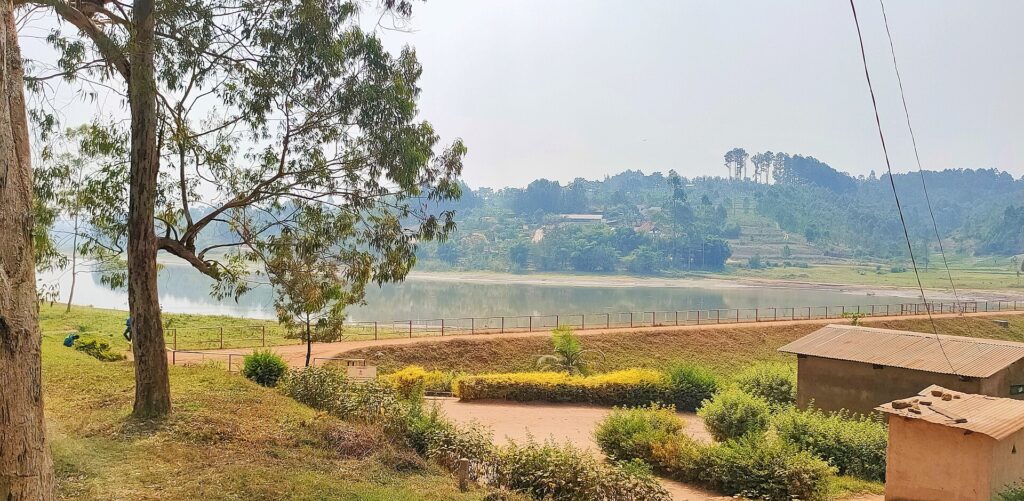
This is a region of lakes, hills and highlands astride the equator. Buganda lies on the northern and western shores of Lake Nalubaale (Lake Victoria): low, rolling hills, papyrus swamps, a double rainy season, and banana gardens that feed people year-round. The lake and its islands, especially the Ssese group, are central to Ganda spiritual life.
Rwanda is a land of steep hills, earning it the name of a thousand hills, cut by valleys and bounded in the north-west by the Virunga volcanoes, including Karisimbi, Muhabura and, across the border, Nyiragongo. Lake Kivu lies to the west.
Burundi lies between Lake Tanganyika and the Ruvubu and Akanyaru rivers, with high central plateaus and the Congo-Nile ridge.
The land shapes the stories. Hills are units of rule and of memory; Rwandan stories place events on named hills. Volcanoes are the home of the dead in kubandwa belief. The lake gives fish and danger, and is ruled by Mukasa. Banana gardens and cattle pastures structure daily life and appear in every tale.
Land is not only a resource: it is held through clans and kings, and is where the ancestors lie.
The People · Cultural Foundation · Society
The lore belongs to the Baganda of the northern and western shores of Lake Nalubaale (Lake Victoria) in today's Uganda; to the Banyarwanda of the hill country between Lake Kivu and the Akagera river in Rwanda; and to the Barundi of the highlands east of Lake Tanganyika in Burundi. Close neighbours who share much of it are the Banyoro of Bunyoro-Kitara, the Batooro, the Banyankore and the Bahaya.
Rwanda and Burundi share three social categories, Hutu, Tutsi and Twa; the Batwa are also a distinct people with their own forest and pottery traditions. What these categories meant before colonial rule, and how fixed they were, is debated by historians.
Bantu-speaking farmers were living in the region with iron by around 500 BCE. The kingdoms grew over the last seven to eight centuries. Ganda tradition counts its kings back to Kintu, and Vansina places the core of the Rwandan Nyiginya kingdom in the seventeenth century. Stories of movement, of founders arriving from elsewhere, of cattle-keepers and farmers meeting, and of the earlier Cwezi rulers of Kitara run through all of them.
1. Order and rightful place. Every person belongs to a clan, a lineage and a station in relation to the king. Stories reward those who keep their place and punish those who reach beyond it.
2. Continuity of the line. Kintu's children must not be finished; a dynasty must not break. Fertility, twins and heirs carry enormous weight.
3. Loyalty and service. The faithful servant, the warrior who praises himself in the king's name, the clan that guards a shrine for generations are all models.
4. Restraint and measured speech. Rwandan and Burundian tradition prizes eloquence that is controlled. Ganda courtesy demands kneeling, greeting and patience.
5. Generosity of the powerful. A good king or patron gives cattle and land; the greedy one, like Sebgugugu, loses all.
The priority runs from the collective to the individual: clan and kingdom first, ancestors before the living. Western stories often celebrate the person who breaks rules to become themselves. Here, the person who breaks the rule usually brings death or loss on everyone, and a story can end in sorrow without anyone thinking it unfinished.
These kingdoms were patrilineal: clan and lineage pass through fathers, and kingship passed to sons of kings. But women held high office.
In Buganda the Namasole (queen mother) and the Lubuga (royal sister, often called queen sister) had their own courts, estates and officials. Because the Kabaka belongs to his mother's clan, the choice of a king's wife decided which clan would supply a future king, and so women connected the throne to the clans.
In Rwanda, the umugabekazi (queen mother) was a co-ruler. Kanjogera, mother of Musinga, is remembered as one of the most powerful figures of her time. Burundi's queen mother also held high ritual standing.
In religion, women held strong roles. Berger documents women as leading mediums in kubandwa and in the Cwezi cult. Nyabingi, a female spirit, was served by mediums, many of them women; Muhumusa, a woman leader of the Nyabingi cult, resisted colonial rule in the 1910s.
In stories, women often hold the decisive act: Nambi returns, the Nyoro captive reveals Kibuuka's secret. Tradition records such women as both powerful and dangerous, and that framing is the tradition's own, open to the debate it receives.
Age brings authority. In all three kingdoms, elders head lineages, settle disputes, speak at marriages and funerals, and hold the clan's history. Younger people defer to them in speech and posture.
In Buganda the clan heads (bataka) and lineage heads keep clan lands, offices and stories. At a funeral, it is the elders who choose and install the heir.
In Burundi, the bashingantahe were men of proven integrity, usually mature, who arbitrated disputes on the hills. Becoming one involved recognition and investiture; the institution still exists.
In Rwanda, young men trained as intore in military and cultural schools at court, learning dance, speech, poetry and warfare under older men. Youth was a time of display; elderhood was a time of counsel.
Elders hold what youth cannot: the detailed history of the line, knowledge of what is owed to which ancestor, the meaning of ritual, and the right to name the heir. Children learn tales early, but the deeper layers are given with age and trust.
Age does not override rank: a young king outranks old chiefs, though he relies on them.
Buganda had a king, princes and princesses (balangira and bambejja), appointed chiefs (bakungu), clan heads (bataka), commoners (bakopi), and captives. Over the nineteenth century, appointed chiefs gained power at the expense of the clan heads, a shift Ganda tradition and historians both record.
In Rwanda and Burundi the categories Hutu, Tutsi and Twa existed before colonial rule, linked to occupation, cattle and nearness to power. Vansina and others show they hardened in the Nyiginya kingdom's later centuries. Belgian rule fixed them in identity cards from the 1930s and explained them through the false Hamitic theory. That racialisation fed the violence of the late twentieth century, including the 1994 genocide against the Tutsi in Rwanda. Burundi also had the Ganwa, princely lineages standing apart from all three.
Storytellers sit in many places. Court poets and genealogists in Rwanda had high, protected standing; royal musicians in Buganda came from particular clans. Evening tales belong to every household.
Class appears in stories as a natural order, but possession cults suspend it, and tales such as those of the hare mock the powerful.
Buganda is organised by clans and by the kingdom. Each clan (ekika) has a head, a founder, a principal totem, estates, and subdivisions down to lineages and households. Ganda tradition lists around fifty clans today. Everyone belongs to the father's clan, except the royal children, who take their mother's. The kingdom has a Kabaka, a Katikkiro (chief minister) and a Lukiiko (council), and counties (amasaza) under chiefs.
Rwanda was organised into lineages and clans that cut across Hutu, Tutsi and Twa, which is one reason historians question fixed ethnic readings. The mwami ruled through chiefs of land, cattle and armies. Cattle clientship (ubuhake) bound people to patrons.
Burundi had the mwami, the Ganwa princes who governed provinces, and the bashingantahe on the hills.
Membership means obligations: contributing to clan funerals, marrying outside the clan, honouring totems, supporting the heir, serving the king. It also gives protection and a place in the land.
Expulsion from clan or kingdom was severe. Without a clan a person had no land, no one to bury them, and no place among the ancestors.
Through Time · History
By around 500 BCE, Bantu-speaking farmers were working iron around Lake Victoria, a period archaeologists mark by Urewe pottery.
In the seventeenth century, according to Vansina, the Nyiginya kingdom took shape in Rwanda, with Ruganzu Ndori as its key founding king, and the Burundian kingdom formed under Ntare Rushatsi; both datings remain open to revision.
In the eighteenth and nineteenth centuries, Buganda grew at Bunyoro's expense, and Rwanda expanded under Kigeli IV Rwabugiri, who died in 1895.
In 1862, John Hanning Speke reached the court of Kabaka Muteesa I.
In 1877 and 1879, Protestant and Catholic missionaries arrived in Buganda; Muslims were already at court.
Between 1885 and 1887, young Christian converts were executed under Kabaka Mwanga II; they are now the Uganda Martyrs.
In 1900, the Buganda Agreement fixed British rule and chiefly landholding.
In 1931, the Belgians deposed Rwanda's King Musinga.
In 1959, revolution began in Rwanda, and in 1961 its monarchy was abolished.
By around 500 BCE, Bantu-speaking farmers were working iron around Lake Victoria, a period archaeologists mark by Urewe pottery.
By the fourteenth and fifteenth centuries, large earthwork sites such as Bigo bya Mugenyi stood in what is now western Uganda; tradition links them to the Cwezi rulers of Kitara, though archaeologists debate that link.
In the seventeenth century, according to Vansina, the Nyiginya kingdom took shape in Rwanda, with Ruganzu Ndori as its key founding king, and the Burundian kingdom formed under Ntare Rushatsi; both datings remain open to revision.
In the eighteenth and nineteenth centuries, Buganda grew at Bunyoro's expense, and Rwanda expanded under Kigeli IV Rwabugiri, who died in 1895.
In 1862, John Hanning Speke reached the court of Kabaka Muteesa I.
In 1877 and 1879, Protestant and Catholic missionaries arrived in Buganda; Muslims were already at court.
Between 1885 and 1887, young Christian converts were executed under Kabaka Mwanga II; they are now the Uganda Martyrs.
In 1900, the Buganda Agreement fixed British rule and chiefly landholding.
In 1931, the Belgians deposed Rwanda's King Musinga.
In 1959, revolution began in Rwanda, and in 1961 its monarchy was abolished.
In 1962, Uganda, Rwanda and Burundi became independent.
In 1966, Burundi's monarchy ended, and Uganda's army attacked the Kabaka's palace at Mengo.
In 1967, Uganda abolished its kingdoms.
In 1993, Buganda's kingship was restored and Ronald Muwenda Mutebi II was crowned.
In 1994, the genocide against the Tutsi took place in Rwanda.
In 2014, UNESCO listed the ritual dance of the royal drum of Burundi.
These events live inside the stories. Bunyoro is the enemy in the Kibuuka story, the martyrs are part of Ganda memory, and the loss of the monarchies changed who keeps the court traditions.

Founders in these traditions almost always come from elsewhere. Kintu arrives alone with his cow. Rwanda's first kings fell from the sky, according to the ibimanuka traditions, or came from the north-east, according to others. Ganda clans tell of founders who came from Ssese, Bunyoro, the east or the lake.
The Great Lakes kingdoms borrowed from one another constantly. The Cwezi spirit cult spread from Kitara to Buganda, Ankole, Toro, Karagwe and Buhaya, and its kin, kubandwa, spread through Rwanda and Burundi. Drums, court titles, clan names and regalia moved across borders. Buganda and Bunyoro were enemies but shared many forms.
These stories exist because kingship needed them. Each court kept an account of where the dynasty came from, which clans served it, and how the land, the lake and the hills came under its care. A king's legitimacy rested on being placed correctly in that account. The stories also do work outside the court. Ganda clan histories explain why a clan holds an office, keeps a totem, or tends a shrine.
The Sacred · Deities and Spirits
Kintu and Nambi; Walumbe and Kayikuuzi
Kintu and Nambi
Kintu and Nambi; Walumbe and Kayikuuzi; Mpobe the hunter
Kibuuka and Nakibinge's war; shrine traditions of Bubembe
Kibuuka and the Nyoro captive
Ganda shrine traditions (to check)
Sebgugugu; Imana and Death; the saying that Imana sleeps in Rwanda
The death of Ryangombe and the buffalo
Burundian kubandwa traditions (to check)
Traditions of Nyabingi's mediums; Muhumusa's resistance
The disappearance of the Cwezi
Drums are the clearest sacred objects in this region. In Buganda the royal drums Mujaguzo announce the reign. In Rwanda the dynastic drum Kalinga stood for the kingship itself. In Burundi the drum Karyenda was the sacred emblem of the mwami, and the royal drum ritual is now on UNESCO's list of intangible heritage. These drums belong to their keepers, and their particulars are theirs to tell.
Places are sacred: the royal tombs at Kasubi, the coronation hill at Naggalabi Buddo, Mukasa's island Bubembe in the Ssese group, the pits at Ttanda where Walumbe went into the earth, and Mount Karisimbi.
The body of the king is sacred: Ganda kings' jawbones and umbilical cords are kept in shrines.
Words are sacred when spoken by the right person: dynastic poetry, royal genealogy, and the songs of possession. Rwanda's ubwiru, the ritual code of the court, belonged to the abiru alone.
Sacredness comes from a link to a founding act, to a king, or to a spirit, and is kept by correct guardianship. A drum or shrine is sacred because a clan has tended it, and its power lapses when the tending stops.
Ganda belief does not set out one fixed pantheon, but its outline is clear. Above all is a creator, often called Katonda, and Ggulu, the sky, father of Nambi and Walumbe. The balubaale form a powerful middle tier, each with a domain and shrine: Mukasa of the lake, Kibuuka of war, Kiwanuka of thunder and lightning, Walumbe of death, Nende of war, Dungu of hunting, Musoke of the rainbow, Kawumpuli of plague. Ganda tradition sets some of them in one family. Mukasa and Kibuuka, for example, are spoken of as brothers. Below them are local nature spirits and the emizimu, the dead.
Rwanda and Burundi have a sharper structure. Imana is the single high god, distant but good, and is not given shrines of the same kind. The active spirits are the imandwa, Ryangombe and his companions in Rwanda, Kiranga in Burundi, and the abazimu. In the north of Rwanda and in Kigezi, Nyabingi is a powerful female spirit with her own mediums.
Humans relate to the high gods by thanks and prayer, and to the active spirits by offerings, mediums and initiation. The king stands between the people and the powers.
Ancestors are present and active. In Buganda the spirits of the dead (emizimu, singular omuzimu) stay close to their families and lands. They expect to be remembered, given small offerings, and consulted. Neglected ancestors can cause illness or misfortune until their due is given.
Kings are ancestors on a larger scale. Each dead Kabaka has a shrine, traditionally housing his jawbone and the cord called his twin, tended by appointed women and men. Through mediums, dead kings could speak to the living king.
In Rwanda and Burundi, the spirits of the dead are abazimu. They are approached with offerings at small shrines near the house, and divination identifies which one is troubling a family.
The protocol is respect, regular offerings, use of the proper names, and consulting a diviner when trouble comes. The ancestors want continuity: children, the clan's name carried on, the land held, their place remembered at funerals and successions.
In stories, ancestors are often the reason things happen. A king's dream, a clan's sudden ill fortune, or a rival's defeat may be put down to the dead making their wishes known.
Ganda tradition describes a sky realm ruled by Ggulu, from which Nambi came; the earth of the living; and an underworld into which Walumbe went at Ttanda. The great spirits, the balubaale, are tied to features of this world: lake, islands, thunder, plague, war. The dead remain near their families as emizimu.
In Rwanda and Burundi, Imana is above and beyond, the source of life and good fortune. Below Imana, the imandwa of Ryangombe's company and the abazimu, the spirits of the dead, are the active presences. Kubandwa tradition holds that initiates go after death to Mount Karisimbi with Ryangombe, while some accounts say those who were not initiated go elsewhere, to a less happy fate; versions differ.
Crossing is mainly by possession. Spirits come into mediums, and through them speak, heal and demand. Divination reads which spirit is acting. Dreams carry messages.
The living cross into the spirit world only at death, and the passage is ordered by rites: proper burial, mourning, and in Buganda the installation of an heir. Walumbe crosses the other way, from the realm of the dead into the world of the living, which is why people die.
Rituals mark the major transitions. In Buganda, the introduction ceremony (kwanjula) precedes marriage and formally links two clans. Twin births bring their own rites, and parents of twins take the titles Ssalongo and Nnalongo. Last funeral rites install an heir (omusika) and end mourning.
Royal rituals mark the kingdom's transitions. A new Kabaka goes to Naggalabi Buddo to be installed, an act called eating Buganda. Rwandan and Burundian kingship had their own accession and harvest rites; Burundi's umuganuro, the royal sorghum festival, renewed the kingdom each year.
Rituals restore balance after affliction. A diviner names the cause of a misfortune, and offerings, a medium's session or initiation into kubandwa follow. In Ganda practice, shrines of the balubaale received petitions for children, rain, health and success in war.
In stories, ritual is often the frame. The Ryangombe story explains kubandwa; the Kintu story explains why people die and why the dead are mourned. Royal stories often end with a ritual founded, a drum made, or a shrine established, so the story resolves into a practice the listeners still know.
Ggulu is the sky in Ganda tradition, father of Nambi and Walumbe, the giver who tests Kintu. He is spoken of as distant after the founding. Katonda is the name of the creator.
Walumbe is death, Nambi's brother. He follows her to earth, takes Kintu's children, and hides in the ground at Ttanda.
Mukasa is the great lubaale of Lake Nalubaale, giver of children, food and safe passage. His main shrine was at Bubembe in the Ssese Islands. Tradition describes him as gentle and generous, not warlike.
Kibuuka is the war spirit, said to be Mukasa's brother, sent to help Kabaka Nakibinge against Bunyoro. His shrine was at Mbaale in Mawokota.
Kiwanuka is the lubaale of thunder and lightning.
Imana, in Rwanda and Burundi, is the high god: the source of life, children and good fortune. Imana is addressed in prayer and names, such as names of children, but not given the shrines spirits receive.
Ryangombe, in Rwanda, and Kiranga, in Burundi, head the imandwa. Ryangombe is a hunter-hero who died, gored by a buffalo, and is honoured through kubandwa.
Nyabingi is a female spirit of northern Rwanda and Kigezi, honoured through her mediums.
Ritual approach to all of these goes through mediums, offerings and shrine keepers.
The balubaale (singular lubaale) are the great spirits of Buganda, each with a domain, shrine, medium and keepers. Some were once human, according to tradition, and became spirits; others are tied to natural forces.
The emizimu (singular omuzimu) in Buganda and abazimu in Rwanda and Burundi are the spirits of the dead. They live close to their families, need remembering and can trouble the neglectful.
The misambwa are Ganda nature spirits linked to particular places: rocks, rivers, forests and hills. They are honoured locally, often through small shrines.
The imandwa are Ryangombe's company in Rwanda, a group of named spirits each with its own character, and also the human initiates who take them on.
The Cwezi are the spirits of the rulers of Kitara, honoured through mediums in Bunyoro, Toro, Ankole and Buhaya. Ndahura and Wamara are among their best-known names.
Royal spirits: dead Kabakas, honoured at their own shrines, are a category of their own.
The rules: approach through the right person, at the right place, with the right offering. Spirits are not commanded but asked. A spirit that has been named and honoured usually calms.
The hare (Wakayima in Buganda, Bakame in Rwanda) is the most familiar animal in the stories. It is clever, often unscrupulous, and outwits larger animals such as the lion, the elephant and the leopard. In Burundi, the human trickster Samandari plays a similar role.
The buffalo is central in kubandwa tradition: a buffalo kills Ryangombe, and from that death the imandwa company comes into being.
Cattle are not monsters but they are close to sacred. Rwandan inyambo, long-horned royal cattle, were bred for beauty and praised in poetry; in Buganda, Kintu's single cow is the first gift.
The python is linked to certain spirits in Buganda. Ganda tradition tells of python shrines by the lake associated with fertility and twins; the details belong to their keepers.
The bee in the Kintu story helps Kintu pick out his own cow from Ggulu's herds, an animal helper who decides the plot.
The leopard is a totem of a Ganda clan and an emblem of royalty in the region.
Animals in these stories relate to humans as helpers, foes and kin. Clan totems make some of them family.
Every Ganda clan has its totem (omuziro), an animal, plant or object, which its members must not eat or harm. Marrying within one's own clan is forbidden. These rules are lived today.
The king was surrounded by prohibitions. In Buganda, subjects knelt before the Kabaka, and accounts describe rules about who could see him eat or drink. In Rwanda and Burundi, the royal drums and the king's ritual person carried strict rules.
Instructions given by spirits or high powers must be kept. The Kintu story is the clearest lesson: Ggulu told the couple not to return, and the forgotten millet brought death into the world. Kayikuuzi's hunt for Walumbe failed when the children broke the silence they had been told to keep. These are things that cannot be undone.
Secrets must not be spoken. What happens in kubandwa initiation is not told to outsiders. Kibuuka died because a secret about him was revealed.
Consequences are often collective and delayed. A broken prohibition can bring illness on a family or misfortune on a clan years later, and a diviner is called to trace it.
This part carries no pictures. Gods, spirits, the ancestors and ceremonies are named, with their roles, and drawn as marks only.
The Stories · Signature Stories
Kintu was the first man on earth. He lived alone with his cow, drinking her milk. Nambi, daughter of Ggulu, came down from the sky with her brothers, saw Kintu, and loved him. Her brothers suspected him, and Ggulu set tests. Kintu had to eat an enormous meal, which he hid; split a rock, which he did; and fetch water that was only dew.
And 3 more stories in the catalog below.
The Telling · Oral Tradition · Narrative Structure
The Figures · Survival and Diaspora
The founder who arrives: Kintu, Gihanga, the ibimanuka who fell from the sky. He comes from outside, is tested, and sets up an order. His arc ends in settlement, and his line is the kingdom.
The sky-born or royal woman: Nambi, queen mothers, princesses. She links the founder to the powers or the clans. Her choices decide the outcome, often with a cost.
The warrior who dies and becomes a spirit: Kibuuka, Ryangombe. He is mighty, falls through a breach or a hostile animal, and becomes honoured forever. His arc goes from life through death into permanence.
The king: courageous, generous, sometimes fearsome. He embodies the land. His arc is conquest, rule and death, followed by a shrine.
The faithful servant: messenger, warrior, poet, chief. He serves the king and is rewarded.
The greedy one: Sebgugugu and others, who receive good things and lose them by asking too much.
The trickster: the hare, Samandari. He survives by wit and exposes the vanity of the strong.
The medium: a person, often a woman, through whom a spirit speaks, whose arc runs from affliction to authority.
Survival and diaspora
Partially. In Buganda the tradition is strongly alive in its social forms. The Kabaka reigns again as a cultural leader, with a Katikkiro and Lukiiko at Mengo. Clans meet, keep their totems and choose their heads. The introduction ceremony, twin rites and last funeral rites are widely practised by Christians and Muslims alike. Kasubi has been rebuilt.
The Atlantic slave trade drew far less from this region than from West and Central Africa, and there is no large Great Lakes tradition in the Americas of the kind left by Yorùbá or Kongo peoples. Some people from the region were taken in the nineteenth-century trade towards the Indian Ocean coast, but what they carried is hard to trace. The main diasporas are modern.
The restoration of Buganda's kingship in 1993 is the largest revival. The Kabaka's government has since rebuilt the Bulange parliament building, reorganised clan structures, promoted Luganda, and led the rebuilding of Kasubi after the 2010 fire with traditional builders of the clans responsible for the work.
The Catalog · its places, peoples, practices and sources



The World Bible
For the reader who wants all of it: every section of Lake Kings, in its eleven parts.
There is no single name for this body of lore, because it belongs to several kingdoms that speak related Bantu languages. Each names its own.
In Buganda, speakers of Luganda (loo-GAHN-dah) speak of obuwangwa n'ennono, ‘culture and tradition’, and the religion of the great spirits is the way of the balubaale (bah-loo-BAH-leh; singular lubaale). The king is the Kabaka (kah-BAH-kah), the kingdom Buganda (boo-GAHN-dah), the people Baganda, one person a Muganda.
In Rwanda, Kinyarwanda speakers call culture umuco; the possession cult of the spirit-hero Ryangombe (ryahn-GOHM-beh) is kubandwa (koo-BAHN-dwah), and its spirits and initiates are imandwa (ee-MAHN-dwah). The king was the mwami (MWAH-mee). The high god is Imana (ee-MAH-nah).
In Burundi, Kirundi speakers use the same words kubandwa and Imana, but the spirit-hero is called Kiranga (kee-RAHN-gah). The king was also mwami.
In neighbouring Bunyoro-Kitara, Toro and Ankole, a related cult is that of the Cwezi (CHWEH-zee) spirits, whose mediums are embandwa. Scholars group all of these as the interlacustrine or Great Lakes kingdoms.
The lore belongs to the Baganda of the northern and western shores of Lake Nalubaale (Lake Victoria) in today's Uganda; to the Banyarwanda of the hill country between Lake Kivu and the Akagera river in Rwanda; and to the Barundi of the highlands east of Lake Tanganyika in Burundi. Close neighbours who share much of it are the Banyoro of Bunyoro-Kitara, the Batooro, the Banyankore and the Bahaya.
Rwanda and Burundi share three social categories, Hutu, Tutsi and Twa; the Batwa are also a distinct people with their own forest and pottery traditions. What these categories meant before colonial rule, and how fixed they were, is debated by historians.
Bantu-speaking farmers were living in the region with iron by around 500 BCE. The kingdoms grew over the last seven to eight centuries. Ganda tradition counts its kings back to Kintu, and Vansina places the core of the Rwandan Nyiginya kingdom in the seventeenth century. Stories of movement, of founders arriving from elsewhere, of cattle-keepers and farmers meeting, and of the earlier Cwezi rulers of Kitara run through all of them.
These stories exist because kingship needed them. Each court kept an account of where the dynasty came from, which clans served it, and how the land, the lake and the hills came under its care. A king's legitimacy rested on being placed correctly in that account.
The stories also do work outside the court. Ganda clan histories explain why a clan holds an office, keeps a totem, or tends a shrine. Tales of Kintu and Walumbe explain why people die. Rwandan and Burundian imigani (stories, proverbs) teach children how to speak and how not to be greedy.
Rival kingdoms shaped the tradition. Buganda's wars with Bunyoro sit inside the story of the war god Kibuuka. Rwanda's expansion under kings such as Ruganzu Ndori fills the landscape with place stories.
Sacred and secular are separated by who may speak and where. Evening tales by the fire are open to everyone. Dynastic poetry, royal genealogy and the ritual code of the Rwandan court belonged to appointed keepers. The words spoken in kubandwa initiation and at the shrines of the balubaale belong to initiates and mediums.
The written record of this tradition starts with its own people. Sir Apolo Kaggwa, Katikkiro (chief minister) of Buganda, published Basekabaka be Buganda (1901), a history of the kings, and Empisa za Baganda (1905), on Ganda customs; the latter appeared in English as The Customs of the Baganda (1934). Michael B. Nsimbi wrote on Ganda names and traditions in Luganda.
For Rwanda, the priest-scholar Alexis Kagame recorded and studied dynastic poetry and genealogies, publishing La poésie dynastique au Rwanda (1951). Pierre Smith collected popular tales in Le récit populaire au Rwanda (1975).
Key scholarship: John Roscoe, The Baganda (1911); Luc de Heusch on kubandwa and kingship; Iris Berger, Religion and Resistance (1981); Benjamin Ray, Myth, Ritual and Kingship in Buganda (1991); Christopher Wrigley, Kingship and State (1996); Jean-Pierre Chrétien, L'Afrique des Grands Lacs (2000); Jan Vansina, Antecedents to Modern Rwanda (2004); Neil Kodesh, Beyond the Royal Gaze (2010).
Today the Kabaka's government at Mengo, the clan heads of Buganda, the Institute of National Museums of Rwanda and the drummers of Gishora in Burundi are among the living keepers. This holding has not been reviewed by those keepers; entries marked ‘to check’ await that.
1. Order and rightful place. Every person belongs to a clan, a lineage and a station in relation to the king. Stories reward those who keep their place and punish those who reach beyond it.
2. Continuity of the line. Kintu's children must not be finished; a dynasty must not break. Fertility, twins and heirs carry enormous weight.
3. Loyalty and service. The faithful servant, the warrior who praises himself in the king's name, the clan that guards a shrine for generations are all models.
4. Restraint and measured speech. Rwandan and Burundian tradition prizes eloquence that is controlled. Ganda courtesy demands kneeling, greeting and patience.
5. Generosity of the powerful. A good king or patron gives cattle and land; the greedy one, like Sebgugugu, loses all.
The priority runs from the collective to the individual: clan and kingdom first, ancestors before the living. Western stories often celebrate the person who breaks rules to become themselves. Here, the person who breaks the rule usually brings death or loss on everyone, and a story can end in sorrow without anyone thinking it unfinished.
Events have persons behind them. Illness, drought, a failed harvest or a lost war are read as the work of a spirit, an offended ancestor, a broken prohibition, or a person using harmful power. Diviners are asked not only what happened but who, and why.
The individual exists inside the clan and the kingdom. In Buganda a person's clan name, totem and drum motto say who they are before their own name does. In Rwanda and Burundi lineage and the patron-client tie, especially through cattle, define a life.
Time is layered. Dynastic time is a line of reigns, counted carefully. Ritual time returns: each new Kabaka repeats the acts of the founders at accession, and harvest rites come round each year. Ancestral time sits beside the present; the dead are near.
Reality has more than one level. The visible world of hills and lake sits under a sky realm (Ggulu, in Ganda thought) and above an underworld where Walumbe hid. For kubandwa initiates in Rwanda, the dead go to the volcano Karisimbi with Ryangombe. These realms touch through mediums, dreams and shrines.
Stories are told to place people. They say where a dynasty, a clan or a custom came from and who has the right to what.
Everyone tells some stories. Grandmothers and parents tell evening tales (Luganda engero, Kinyarwanda and Kirundi imigani) to children, featuring the hare Wakayima in Buganda or Bakame in Rwanda.
Specialists tell others. Rwanda had abasizi, poets of the dynastic ibisigo, whose families memorised the poems, and abacurabwenge, reciters of royal genealogy. Abiru were ritual specialists who kept the esoteric royal code. In Buganda, clan elders kept clan histories, and royal musicians kept the drummed and sung praise of kings. Mediums of the balubaale and of the imandwa spoke for spirits.
Timing matters. Tales belong to evening. Dynastic poetry was performed at court. Clan histories are spoken at funerals, successions and the introduction ceremony before marriage. Possession songs belong to initiation and healing.
The teller with the right to speak holds power. Controlling the official version of royal history was part of ruling, and Vansina shows that court traditions were revised as rulers changed.
The fundamental pattern is the founding and its consequence. A first person or first king arrives, is tested, takes a wife or a land, and in doing so sets up an order that still holds, often with a cost attached. The Kintu story is the model: arrival, trials, marriage, one forgotten thing, and death enters the world forever.
On top of the founding, the tradition stacks a line. Dynastic history moves reign by reign, each king adding a conquest, a hill, a law or a misfortune. Rwandan dynastic poetry praises kings in sequence, and genealogy is recited as a chain.
Alongside both sits a third pattern from the possession cults: the death of a hero and the creation of a fellowship around him. Ryangombe dies, his companions follow, and the living join him through initiation.
So the tradition is a hybrid: founding narratives that explain, dynastic chronicle that orders, and spirit narratives that open a door between the living and the dead. Story moves outward from an origin and down a line, and it returns to the origin in ritual.
Tension usually comes from a breach in order rather than a clash of wills. Someone forgets an instruction, speaks a secret, crosses a boundary, or wants more than is given. Nambi goes back for millet; Kayikuuzi's hunt fails when children cry out; Kibuuka's secret is told by a captive woman; Sebgugugu asks for more.
There is also open conflict, especially in dynastic stories. Buganda fights Bunyoro; Rwandan kings conquer and lose hills; brothers dispute succession. But even war stories turn on a breach: Kibuuka was invincible until he broke the rule about Nyoro women.
A third source of tension is affliction. A spirit troubles a family with illness or barrenness until it is recognised and given its due. The story's question is not who wins, but what has been neglected and how to set it right.
Tension between the powerful and the weak is real but rarely resolved by rebellion. The possession cults let the weak speak with a spirit's authority for a time, and the Nyabingi cult in the north became a source of open resistance to kings and to colonial rule.
Most stories have a named individual at the centre, but that person stands for something larger. Kintu is the first man and the first Kabaka; his children are all Baganda. Gihanga is the founder of Rwanda's kingship and its drums. Ryangombe is a hero who becomes the head of a spirit company.
Kings are the main protagonists of court tradition, and what happens to them happens to the land. A king's wound, exile or victory is the kingdom's.
Clans are protagonists in clan histories. A Ganda clan's story follows its founder, the office the clan won, and the totem it keeps.
Spirits act as protagonists in shrine and possession traditions. Kibuuka fights; Mukasa heals and gives children; Nyabingi demands and punishes.
Everyday tales use small, clever creatures, the hare above all, and ordinary people, often greedy or foolish ones, who learn or fail to learn.
The woman is often the hinge of the plot: Nambi, the Nyoro captive in the Kibuuka story, the queen mother. She is seldom the narrated hero, but her choices decide the outcome.
The most characteristic ending is a settlement that explains the present. Walumbe escapes into the earth and death remains; Kintu says his people will never be finished, and both statements stay true. The story ends by establishing why things are as they are.
Dynastic stories end with order restored under a king, often at a cost: a king dies in battle, a rival line is pushed out, a new capital is founded. Rwandan traditions about Ruganzu Ndori end with the kingdom restored after a time of disorder.
Spirit stories end in a pact. Ryangombe dies, but Imana grants him and his followers a home on Karisimbi, and the living receive a rite through which to honour him.
Tales for children end with a lesson made plain, and often with the greedy or foolish person losing what they had.
A satisfying ending, in this cosmology, is one where everything is in its right place, even if that place includes grief. Unbroken triumph is rare. Continuation matters more: the line goes on, the shrine is tended, the drum is beaten again.
Time in these stories runs on two tracks.
The first is the line of reigns. Ganda tradition counts some thirty-six kings from Kintu to the present Kabaka, and Rwandan genealogy recites the Nyiginya kings in order. Events are dated by who was king. This is linear time, but its earliest stretch is condensed: the founders' era is a small number of very full reigns, and historians treat it differently from later, better-attested reigns.
The second is the returning time of ritual. At accession, a new Kabaka goes to Naggalabi Buddo and performs acts that recall the founders; the new reign begins the order again. Harvest rites in Rwanda and Burundi return each year. Initiation into kubandwa repeats the founding of Ryangombe's company for each new initiate.
The founding time is also present. Kintu's act at Ttanda and Ryangombe's death are not only past; they set the conditions of every life now. Stories therefore move between a far past that still binds, a counted dynastic past, and a present that is answerable to both.
The community is never just background. In Buganda the clans (ebika, singular ekika) are the frame of every story. Each clan has a founder, a totem it does not eat, a drum motto, estates and duties at court. A story about a clan founder is a story about everyone who carries that clan's name today.
The kingdom itself is a character. Ganda tradition speaks of the Kabaka ‘eating Buganda’ at accession: king and land become one body.
In Rwanda and Burundi the lineage and the bonds of patronage, often through cattle, shape every life story. Neighbourhood and hill communities matter, and Burundi's bashingantahe, respected arbitrators, embody communal judgment.
Individuals relate to the community through obligation. They must marry outside their clan, honour their ancestors, serve their patron and their king. A character who acts alone, for himself, usually brings harm.
The community expects a story to confirm where people belong and to remind them of what is owed. Clan histories are told at gatherings so that the living know their place in a long line.
Morality is relational. Right action is what keeps proper relations with the king, the clan, the ancestors and the spirits. Wrong action is what breaks them.
Condemnation falls on disobedience to an instruction from a higher power (Nambi's return, the children's cry), on betrayal of a secret, on greed, and on violating clan rules such as eating one's totem or marrying within one's clan. In Rwandan tales, Sebgugugu is ruined because he is never satisfied with what Imana gives.
Honour goes to loyalty, courage in the king's service, eloquence, generosity, and patience. Rwandan warriors praise themselves in ibyivugo, recounting their deeds; the praise is honourable because the deeds served the king.
The framework is not fully absolute. A king may do things a commoner may not; royal violence is spoken of as part of kingship. Spirits can be capricious. What is wrong for one station may be required of another.
Stories teach by consequence. The listener sees an act and its result, often a result far larger than the act, and draws the lesson. Proverbs then compress the lesson into a line that can be spoken in daily life.
The biggest transformations are of the world, not of the self. Kintu's marriage turns an empty land into a peopled one, and Nambi's return turns a deathless world into a mortal one. Gihanga's founding turns scattered people into a kingdom.
The second kind is a change of state: from living person to spirit. Kibuuka dies and becomes the war spirit honoured at Mbaale. Ryangombe dies and becomes the head of the imandwa. Ganda kings at death become spirits whose jawbones are kept in shrines. The tradition does not mourn this change so much as organise it.
Initiation is the third. A kubandwa initiate is changed into a member of Ryangombe's company, and a prince becomes a king through the accession rites.
Personal moral growth, the inner change Western stories celebrate, is less central. Characters in tales tend to be what they are: the hare stays clever, the greedy man stays greedy.
The tradition mourns transformations that come from breaking rules: the coming of death above all, and the loss of what a greedy or disobedient person had.
Drums are the clearest sacred objects in this region. In Buganda the royal drums Mujaguzo announce the reign. In Rwanda the dynastic drum Kalinga stood for the kingship itself. In Burundi the drum Karyenda was the sacred emblem of the mwami, and the royal drum ritual is now on UNESCO's list of intangible heritage. These drums belong to their keepers, and their particulars are theirs to tell.
Places are sacred: the royal tombs at Kasubi, the coronation hill at Naggalabi Buddo, Mukasa's island Bubembe in the Ssese group, the pits at Ttanda where Walumbe went into the earth, and Mount Karisimbi.
The body of the king is sacred: Ganda kings' jawbones and umbilical cords are kept in shrines.
Words are sacred when spoken by the right person: dynastic poetry, royal genealogy, and the songs of possession. Rwanda's ubwiru, the ritual code of the court, belonged to the abiru alone.
Sacredness comes from a link to a founding act, to a king, or to a spirit, and is kept by correct guardianship. A drum or shrine is sacred because a clan has tended it, and its power lapses when the tending stops.
Ancestors are present and active. In Buganda the spirits of the dead (emizimu, singular omuzimu) stay close to their families and lands. They expect to be remembered, given small offerings, and consulted. Neglected ancestors can cause illness or misfortune until their due is given.
Kings are ancestors on a larger scale. Each dead Kabaka has a shrine, traditionally housing his jawbone and the cord called his twin, tended by appointed women and men. Through mediums, dead kings could speak to the living king.
In Rwanda and Burundi, the spirits of the dead are abazimu. They are approached with offerings at small shrines near the house, and divination identifies which one is troubling a family.
The protocol is respect, regular offerings, use of the proper names, and consulting a diviner when trouble comes. The ancestors want continuity: children, the clan's name carried on, the land held, their place remembered at funerals and successions.
In stories, ancestors are often the reason things happen. A king's dream, a clan's sudden ill fortune, or a rival's defeat may be put down to the dead making their wishes known.
Ganda tradition describes a sky realm ruled by Ggulu, from which Nambi came; the earth of the living; and an underworld into which Walumbe went at Ttanda. The great spirits, the balubaale, are tied to features of this world: lake, islands, thunder, plague, war. The dead remain near their families as emizimu.
In Rwanda and Burundi, Imana is above and beyond, the source of life and good fortune. Below Imana, the imandwa of Ryangombe's company and the abazimu, the spirits of the dead, are the active presences. Kubandwa tradition holds that initiates go after death to Mount Karisimbi with Ryangombe, while some accounts say those who were not initiated go elsewhere, to a less happy fate; versions differ.
Crossing is mainly by possession. Spirits come into mediums, and through them speak, heal and demand. Divination reads which spirit is acting. Dreams carry messages.
The living cross into the spirit world only at death, and the passage is ordered by rites: proper burial, mourning, and in Buganda the installation of an heir. Walumbe crosses the other way, from the realm of the dead into the world of the living, which is why people die.
Rituals mark the major transitions. In Buganda, the introduction ceremony (kwanjula) precedes marriage and formally links two clans. Twin births bring their own rites, and parents of twins take the titles Ssalongo and Nnalongo. Last funeral rites install an heir (omusika) and end mourning.
Royal rituals mark the kingdom's transitions. A new Kabaka goes to Naggalabi Buddo to be installed, an act called eating Buganda. Rwandan and Burundian kingship had their own accession and harvest rites; Burundi's umuganuro, the royal sorghum festival, renewed the kingdom each year.
Rituals restore balance after affliction. A diviner names the cause of a misfortune, and offerings, a medium's session or initiation into kubandwa follow. In Ganda practice, shrines of the balubaale received petitions for children, rain, health and success in war.
In stories, ritual is often the frame. The Ryangombe story explains kubandwa; the Kintu story explains why people die and why the dead are mourned. Royal stories often end with a ritual founded, a drum made, or a shrine established, so the story resolves into a practice the listeners still know.
Ganda belief does not set out one fixed pantheon, but its outline is clear. Above all is a creator, often called Katonda, and Ggulu, the sky, father of Nambi and Walumbe. The balubaale form a powerful middle tier, each with a domain and shrine: Mukasa of the lake, Kibuuka of war, Kiwanuka of thunder and lightning, Walumbe of death, Nende of war, Dungu of hunting, Musoke of the rainbow, Kawumpuli of plague. Ganda tradition sets some of them in one family. Mukasa and Kibuuka, for example, are spoken of as brothers. Below them are local nature spirits and the emizimu, the dead.
Rwanda and Burundi have a sharper structure. Imana is the single high god, distant but good, and is not given shrines of the same kind. The active spirits are the imandwa, Ryangombe and his companions in Rwanda, Kiranga in Burundi, and the abazimu. In the north of Rwanda and in Kigezi, Nyabingi is a powerful female spirit with her own mediums.
Humans relate to the high gods by thanks and prayer, and to the active spirits by offerings, mediums and initiation. The king stands between the people and the powers.
Evening tales open with set formulas. Ganda tales often begin with a phrase like Awo olwatuuka, ‘Then it happened’, and Rwandan tales with a formula such as Kera habayeho, ‘Long ago there was’. The teller uses a relaxed voice, changing it for each character, and inserts songs that the listeners sing.
Court poetry is different. Rwandan ibisigo, dynastic poems, are dense, allusive and highly patterned. Kagame showed how they use stock images, word-play and long chains of royal names. Ibyivugo, warrior self-praises, are delivered fast and loud, at a run, in the first person.
Amazina y'inka, cattle poems in Rwanda, praise cows in elaborate metaphor, often in competitions between reciters.
In Buganda, praise is often carried by drums and xylophones as much as by voice. Drum rhythms encode phrases, so each clan's drum motto (omubala) can be heard and understood without words.
Silence and restraint matter. Rwandan and Burundian ideals of speech value control and indirectness, and a speaker who says too much is not admired. Proverbs carry meaning in few words.
Music is at the heart of performance. The Ganda court kept hereditary ensembles: the amadinda and akadinda xylophones, the entenga tuned drum set, the ennanga bow harp, and the endingidi fiddle. Songs about past kings and events were performed on these.
Dance is a main form. Baakisimba, a Ganda dance led by women's hip movement over drums, is spoken of as tied to the palace. Rwanda's intore dance, performed by young men with spears, shields and headdresses, shows the warrior ideal. Rwandan women perform a dance whose arm movements recall the long horns of cattle.
In Burundi, drumming with the royal drums is itself a performance art: drummers carry large drums on their heads, dance, and leap in a choreographed order, with the drum Inkiranya setting the rhythm. This is the practice UNESCO recognised in 2014.
The inanga, a trough zither, accompanies sung narratives in Rwanda and Burundi; in Burundi a soft, whispered style of inanga singing is famous.
In possession rites, mediums take on the dress, voice and objects of the spirit, and the gathered initiates sing the spirit's songs.
Listeners take part throughout. In evening tales, children sing back the repeated songs inside the story, answer the teller's questions, and keep the pace with responses. A tale without its songs would feel unfinished.
At court, audiences responded to dynastic poetry and to warrior praise with calls, cheers and gestures of approval. A good ibyivugo performance drew shouts from the listening men.
Cattle poetry competitions in Rwanda involve the audience as judges. The best poem wins by the listeners' response.
In Buganda, gatherings for clan and royal events involve everyone in song and dance, and the drummed clan motto calls members to respond.
In kubandwa and in the shrines of the balubaale, participants are not an audience at all but a congregation. Initiates sing the spirit's praise songs, answer the medium, and accept or question what the spirit says. A spirit's message is shaped in exchange with the people present.
Riddles and proverb contests, common among Baganda, Banyarwanda and Barundi, are explicit co-creation: one speaker begins and the other must complete, and speed and wit are judged on the spot.
These kingdoms kept long, exact memories through specialists. In Rwanda, abacurabwenge recited the royal genealogy, abasizi and their families held the dynastic poems word for word, and abiru held the ritual code. Each body of knowledge had appointed keepers, often hereditary.
Formula helps. Dynastic poems repeat stock phrases and praise names; genealogies follow a fixed chain from father to son. Kagame showed how such patterns let poems survive for generations.
Places are memory. Rwandan traditions tie events to particular hills, rocks and springs. Stones said to bear Ruganzu Ndori's footprints, for example, keep his story on the ground. Ganda royal tombs and the shrine of each dead king keep the line of kings visible.
Clans are memory. Each Ganda clan keeps its founder's story, its totem, its offices and its drum motto, and passes them down at gatherings and funerals.
Music is memory: drum rhythms and xylophone songs recall kings and events.
What stops memory loss is the duty attached to it. When keepers lose their office, as Rwanda's abiru did after the monarchy ended, some of what they held is lost or survives only in writing.
Power in this tradition flows through relationships with spirits and through knowledge of medicines. It is not a free-standing system of spells.
Mediums can receive a spirit and speak with its authority. A balubaale medium in Buganda or an imandwa initiate in Rwanda can, when possessed, heal, give advice, demand offerings, or warn of danger.
Diviners (Luganda omulaguzi; Kinyarwanda umupfumu) can find the cause of a misfortune by reading objects, animals or other signs, and say what must be done.
Healers work with plant medicines and protective objects. Some knowledge is open; some is held within lineages.
Harmful power exists. People are believed able to cause illness or death in others through hidden means, and much healing aims to name and counter such harm.
Rules are firm. Power must be used through proper channels and within one's station. A medium cannot command a spirit; the spirit chooses. No one can undo death. Kibuuka was mighty, but broke a condition and was killed. The unstated rule is that all power is borrowed, and it ends when the relationship that grants it is broken.
Power comes first from the high god and the sky: Imana in Rwanda and Burundi gives life, children and fortune, and Ganda tradition makes Ggulu the source of the first gifts, including Nambi herself.
It comes from the great spirits. The balubaale grant children, success in war and protection on the lake to those who honour them. Ryangombe and the imandwa protect their initiates.
It comes from ancestors, who bless or trouble their descendants.
It comes from kingship. The Kabaka and the bami held a power that was political and sacred together, gained at accession and tied to the drums, the land and the founders.
It is inherited. Mediumship, shrine-keeping, court offices and some healing knowledge run in families and clans.
It is earned through initiation, which is open more widely. Kubandwa was available to many people, including women and those of low status.
The cost is obligation: offerings, rules of conduct, service at the shrine. A medium's life is shaped by the spirit. A king's power came with constraints on how he lived and who he met.
Every Ganda clan has its totem (omuziro), an animal, plant or object, which its members must not eat or harm. Marrying within one's own clan is forbidden. These rules are lived today.
The king was surrounded by prohibitions. In Buganda, subjects knelt before the Kabaka, and accounts describe rules about who could see him eat or drink. In Rwanda and Burundi, the royal drums and the king's ritual person carried strict rules.
Instructions given by spirits or high powers must be kept. The Kintu story is the clearest lesson: Ggulu told the couple not to return, and the forgotten millet brought death into the world. Kayikuuzi's hunt for Walumbe failed when the children broke the silence they had been told to keep. These are things that cannot be undone.
Secrets must not be spoken. What happens in kubandwa initiation is not told to outsiders. Kibuuka died because a secret about him was revealed.
Consequences are often collective and delayed. A broken prohibition can bring illness on a family or misfortune on a clan years later, and a diviner is called to trace it.
Kubandwa, in Rwanda and Burundi, is the central initiation. A person, often one troubled by misfortune or illness, is brought into the company of Ryangombe or Kiranga by existing initiates. Scholars report more than one stage of initiation, a period of instruction, and the taking of a spirit identity. The rites themselves belong to initiates and are not described here.
What changes is status. The initiate becomes one of the imandwa, gains protection, and, according to tradition, will join Ryangombe on Karisimbi after death. Ordinary social rank is set aside during the rites: Berger and others note that women, poor people and Hutu took central roles, and in some accounts initiates took the place of the king himself within the rite.
In Buganda, mediums and priests of the balubaale were chosen by the spirit and trained at the shrine.
Accession is a royal initiation. A Ganda prince becomes Kabaka through rites at Naggalabi Buddo and elsewhere. In Rwanda and Burundi, the abiru and other ritual officers directed the king's accession; the content of those rites was restricted.
People survive initiation; what ends is their former standing.
These kingdoms were patrilineal: clan and lineage pass through fathers, and kingship passed to sons of kings. But women held high office.
In Buganda the Namasole (queen mother) and the Lubuga (royal sister, often called queen sister) had their own courts, estates and officials. Because the Kabaka belongs to his mother's clan, the choice of a king's wife decided which clan would supply a future king, and so women connected the throne to the clans.
In Rwanda, the umugabekazi (queen mother) was a co-ruler. Kanjogera, mother of Musinga, is remembered as one of the most powerful figures of her time. Burundi's queen mother also held high ritual standing.
In religion, women held strong roles. Berger documents women as leading mediums in kubandwa and in the Cwezi cult. Nyabingi, a female spirit, was served by mediums, many of them women; Muhumusa, a woman leader of the Nyabingi cult, resisted colonial rule in the 1910s.
In stories, women often hold the decisive act: Nambi returns, the Nyoro captive reveals Kibuuka's secret. Tradition records such women as both powerful and dangerous, and that framing is the tradition's own, open to the debate it receives.
Age brings authority. In all three kingdoms, elders head lineages, settle disputes, speak at marriages and funerals, and hold the clan's history. Younger people defer to them in speech and posture.
In Buganda the clan heads (bataka) and lineage heads keep clan lands, offices and stories. At a funeral, it is the elders who choose and install the heir.
In Burundi, the bashingantahe were men of proven integrity, usually mature, who arbitrated disputes on the hills. Becoming one involved recognition and investiture; the institution still exists.
In Rwanda, young men trained as intore in military and cultural schools at court, learning dance, speech, poetry and warfare under older men. Youth was a time of display; elderhood was a time of counsel.
Elders hold what youth cannot: the detailed history of the line, knowledge of what is owed to which ancestor, the meaning of ritual, and the right to name the heir. Children learn tales early, but the deeper layers are given with age and trust.
Age does not override rank: a young king outranks old chiefs, though he relies on them.
Buganda had a king, princes and princesses (balangira and bambejja), appointed chiefs (bakungu), clan heads (bataka), commoners (bakopi), and captives. Over the nineteenth century, appointed chiefs gained power at the expense of the clan heads, a shift Ganda tradition and historians both record.
In Rwanda and Burundi the categories Hutu, Tutsi and Twa existed before colonial rule, linked to occupation, cattle and nearness to power. Vansina and others show they hardened in the Nyiginya kingdom's later centuries. Belgian rule fixed them in identity cards from the 1930s and explained them through the false Hamitic theory. That racialisation fed the violence of the late twentieth century, including the 1994 genocide against the Tutsi in Rwanda. Burundi also had the Ganwa, princely lineages standing apart from all three.
Storytellers sit in many places. Court poets and genealogists in Rwanda had high, protected standing; royal musicians in Buganda came from particular clans. Evening tales belong to every household.
Class appears in stories as a natural order, but possession cults suspend it, and tales such as those of the hare mock the powerful.
Buganda is organised by clans and by the kingdom. Each clan (ekika) has a head, a founder, a principal totem, estates, and subdivisions down to lineages and households. Ganda tradition lists around fifty clans today. Everyone belongs to the father's clan, except the royal children, who take their mother's. The kingdom has a Kabaka, a Katikkiro (chief minister) and a Lukiiko (council), and counties (amasaza) under chiefs.
Rwanda was organised into lineages and clans that cut across Hutu, Tutsi and Twa, which is one reason historians question fixed ethnic readings. The mwami ruled through chiefs of land, cattle and armies. Cattle clientship (ubuhake) bound people to patrons.
Burundi had the mwami, the Ganwa princes who governed provinces, and the bashingantahe on the hills.
Membership means obligations: contributing to clan funerals, marrying outside the clan, honouring totems, supporting the heir, serving the king. It also gives protection and a place in the land.
Expulsion from clan or kingdom was severe. Without a clan a person had no land, no one to bury them, and no place among the ancestors.
This is a region of lakes, hills and highlands astride the equator. Buganda lies on the northern and western shores of Lake Nalubaale (Lake Victoria): low, rolling hills, papyrus swamps, a double rainy season, and banana gardens that feed people year-round. The lake and its islands, especially the Ssese group, are central to Ganda spiritual life.
Rwanda is a land of steep hills, earning it the name of a thousand hills, cut by valleys and bounded in the north-west by the Virunga volcanoes, including Karisimbi, Muhabura and, across the border, Nyiragongo. Lake Kivu lies to the west.
Burundi lies between Lake Tanganyika and the Ruvubu and Akanyaru rivers, with high central plateaus and the Congo-Nile ridge.
The land shapes the stories. Hills are units of rule and of memory; Rwandan stories place events on named hills. Volcanoes are the home of the dead in kubandwa belief. The lake gives fish and danger, and is ruled by Mukasa. Banana gardens and cattle pastures structure daily life and appear in every tale.
Land is not only a resource: it is held through clans and kings, and is where the ancestors lie.
Kasubi Tombs, on a hill in Kampala, is the burial place of four Kabakas, from Muteesa I (died 1884) onward, under a great thatched house, Muzibu Azaala Mpanga. It was inscribed as a World Heritage Site in 2001, burned in 2010, and has been rebuilt by Ganda craftsmen.
Naggalabi Buddo, near Kampala, is the coronation site. Ganda tradition links it to Kintu and to the founding of the kingship; here a new Kabaka is installed.
Bubembe, in the Ssese Islands, holds the principal shrine of Mukasa, spirit of the lake. People came by canoe for children, healing and safe crossings.
Ttanda, in Ssingo, has a field of pits where, Ganda tradition says, Walumbe went into the earth while Kayikuuzi dug for him.
Mbaale, in Mawokota, was the shrine of the war spirit Kibuuka.
Mount Karisimbi, in the Virunga, is where kubandwa initiates go after death.
Nyanza, in southern Rwanda, was the royal capital; the reconstructed palace and the inyambo royal cattle are there.
Gishora, near Gitega in Burundi, is a drum sanctuary where royal drumming is kept up.
In stories these places are destinations, thresholds to the dead, and seats of power.
Ganda tradition gives a three-part picture. Above is Ggulu, the sky realm, where Nambi's family lived with their cattle and grain. In the middle is the earth, Buganda itself, with its lake and islands. Below is the realm into which Walumbe went, reached at Ttanda. Movement between sky and earth happened at the beginning, when Nambi descended and returned; after that, the way closed.
The lake is a realm of its own, ruled by Mukasa, and the islands are its sacred centre.
In Rwanda, the high god Imana is above; there is a saying that Imana spends the day elsewhere but comes home to sleep in Rwanda. The founders, called ibimanuka, ‘those who fell from the sky’, came down from above. The volcanoes in the north-west, above all Karisimbi, are the realm of Ryangombe and the initiated dead.
The dead are also close at hand, in and around the homestead.
One moves between realms by birth and death, by possession, which brings spirits into the world, and by dreams. Kings stand at a crossing point, as their accession rites join them to the founders.
By around 500 BCE, Bantu-speaking farmers were working iron around Lake Victoria, a period archaeologists mark by Urewe pottery.
By the fourteenth and fifteenth centuries, large earthwork sites such as Bigo bya Mugenyi stood in what is now western Uganda; tradition links them to the Cwezi rulers of Kitara, though archaeologists debate that link.
In the seventeenth century, according to Vansina, the Nyiginya kingdom took shape in Rwanda, with Ruganzu Ndori as its key founding king, and the Burundian kingdom formed under Ntare Rushatsi; both datings remain open to revision.
In the eighteenth and nineteenth centuries, Buganda grew at Bunyoro's expense, and Rwanda expanded under Kigeli IV Rwabugiri, who died in 1895.
In 1862, John Hanning Speke reached the court of Kabaka Muteesa I.
In 1877 and 1879, Protestant and Catholic missionaries arrived in Buganda; Muslims were already at court.
Between 1885 and 1887, young Christian converts were executed under Kabaka Mwanga II; they are now the Uganda Martyrs.
In 1900, the Buganda Agreement fixed British rule and chiefly landholding.
In 1931, the Belgians deposed Rwanda's King Musinga.
In 1959, revolution began in Rwanda, and in 1961 its monarchy was abolished.
In 1962, Uganda, Rwanda and Burundi became independent.
In 1966, Burundi's monarchy ended, and Uganda's army attacked the Kabaka's palace at Mengo.
In 1967, Uganda abolished its kingdoms.
In 1993, Buganda's kingship was restored and Ronald Muwenda Mutebi II was crowned.
In 1994, the genocide against the Tutsi took place in Rwanda.
In 2014, UNESCO listed the ritual dance of the royal drum of Burundi.
These events live inside the stories. Bunyoro is the enemy in the Kibuuka story, the martyrs are part of Ganda memory, and the loss of the monarchies changed who keeps the court traditions.
Founders in these traditions almost always come from elsewhere. Kintu arrives alone with his cow. Rwanda's first kings fell from the sky, according to the ibimanuka traditions, or came from the north-east, according to others. Ganda clans tell of founders who came from Ssese, Bunyoro, the east or the lake. The Babito dynasty of Bunyoro is said to have come from the north, and Ganda tradition gives Kimera, an early Kabaka, a link to Bunyoro.
Historians read these stories as memories of real movement: farmers, herders and fishers moving across the region over many centuries, mixing languages and practices. Cattle-keeping and farming peoples met and intermarried; the language of the kingdoms is Bantu throughout.
What was carried: cattle, drums, iron-working, clan names, the Cwezi spirits, whose cult spread across many kingdoms.
What was lost: earlier rulers' names, the languages of some earlier peoples, and much of the history of the Batwa.
In the twentieth century, displacement changed the tradition. Rwandan refugees after 1959 lived for decades in Uganda, Burundi, Congo and Tanzania, and many returned after 1994. Burundi's conflicts produced similar flights. Each displacement carried songs, dances and stories and changed them.
The Great Lakes kingdoms borrowed from one another constantly. The Cwezi spirit cult spread from Kitara to Buganda, Ankole, Toro, Karagwe and Buhaya, and its kin, kubandwa, spread through Rwanda and Burundi. Drums, court titles, clan names and regalia moved across borders. Buganda and Bunyoro were enemies but shared many forms.
In the nineteenth century, Swahili and Arab traders from the coast reached Buganda, bringing cloth, guns and Islam. Kabaka Muteesa I adopted some Islamic practices for a time.
Christian missionaries arrived from 1877. Ganda converts became the new chiefly class, and after the religious wars of 1888 to 1892, Protestant, Catholic and Muslim factions divided power. Christianity is now the majority faith in all three countries.
The traditions resisted and adapted. Ganda clans kept their totems, introduction ceremonies and funeral rites inside Christian life. The balubaale shrines continued, often less openly. Kubandwa faced strong opposition from Catholic missions in Rwanda and Burundi and declined, but did not vanish.
The tradition held its integrity mainly through institutions that kept working: the clans, the kingship in Buganda, and the arts of drumming, dance and speech that people valued for their own sake.
Partially. In Buganda the tradition is strongly alive in its social forms. The Kabaka reigns again as a cultural leader, with a Katikkiro and Lukiiko at Mengo. Clans meet, keep their totems and choose their heads. The introduction ceremony, twin rites and last funeral rites are widely practised by Christians and Muslims alike. Kasubi has been rebuilt. Mukasa's shrine and other balubaale shrines still receive people, though often quietly.
In Rwanda, the monarchy ended in 1961 and its last king, Kigeli V, died in exile in 2016. The ritual code of the abiru is no longer practised as an office. Kubandwa is far less common than it was. But intore dance, drumming, cattle poetry and the arts of speech are performed and taught, and the palace at Nyanza is a museum with its royal cattle.
In Burundi, royal drumming is practised, performed and internationally known, and the bashingantahe remain a recognised institution.
Contemporary practitioners include clan heads and court officers in Buganda, shrine keepers and mediums, the drummers of Gishora, cultural troupes, and writers who draw on the lore.
The Atlantic slave trade drew far less from this region than from West and Central Africa, and there is no large Great Lakes tradition in the Americas of the kind left by Yorùbá or Kongo peoples. Some people from the region were taken in the nineteenth-century trade towards the Indian Ocean coast, but what they carried is hard to trace.
The main diasporas are modern. Rwandan refugees after 1959 kept songs, dances and poetry alive in camps and cities in Uganda, Burundi, Congo, Kenya and beyond, and carried them back after 1994. Many of Rwanda's cultural troupes have roots in exile.
Ganda migrants in Britain, the United States and elsewhere hold introduction ceremonies, clan gatherings and Kabaka's birthday celebrations abroad. The Kabaka's government has links with these communities.
Burundian drummers have toured the world since the 1960s, and their rhythms have been sampled and imitated widely, sometimes without credit.
Urbanisation has changed the forms. In Kampala, introduction ceremonies have become large, costly events. Clan identity remains, but many urban Baganda know only part of their clan history. Diaspora writers, such as Jennifer Nansubuga Makumbi, have made the lore a subject of new fiction.
The restoration of Buganda's kingship in 1993 is the largest revival. The Kabaka's government has since rebuilt the Bulange parliament building, reorganised clan structures, promoted Luganda, and led the rebuilding of Kasubi after the 2010 fire with traditional builders of the clans responsible for the work.
Clan associations in Buganda publish histories, hold annual gatherings, and record genealogies. Ganda writers and broadcasters work on Luganda language and tradition.
In Rwanda, the state has revived the harvest celebration umuganura as a national day and promotes the intore tradition and cultural education, framed within a national unity policy. The Institute of National Museums of Rwanda presents royal history at Nyanza, including the inyambo cattle.
In Burundi, royal drumming was recognised by UNESCO in 2014, and drumming groups train young people. Efforts to restore umuganuro have also been made.
Writers are part of the recovery: Makumbi's novel Kintu (2014) reworks the Kintu tradition as a modern family saga, and Scholastique Mukasonga writes of Rwandan life and memory.
What remains lost includes much of the abiru's ritual knowledge, many shrine histories, and a great deal of Batwa tradition.
Ggulu is the sky in Ganda tradition, father of Nambi and Walumbe, the giver who tests Kintu. He is spoken of as distant after the founding. Katonda is the name of the creator.
Walumbe is death, Nambi's brother. He follows her to earth, takes Kintu's children, and hides in the ground at Ttanda.
Mukasa is the great lubaale of Lake Nalubaale, giver of children, food and safe passage. His main shrine was at Bubembe in the Ssese Islands. Tradition describes him as gentle and generous, not warlike.
Kibuuka is the war spirit, said to be Mukasa's brother, sent to help Kabaka Nakibinge against Bunyoro. His shrine was at Mbaale in Mawokota.
Kiwanuka is the lubaale of thunder and lightning.
Imana, in Rwanda and Burundi, is the high god: the source of life, children and good fortune. Imana is addressed in prayer and names, such as names of children, but not given the shrines spirits receive.
Ryangombe, in Rwanda, and Kiranga, in Burundi, head the imandwa. Ryangombe is a hunter-hero who died, gored by a buffalo, and is honoured through kubandwa.
Nyabingi is a female spirit of northern Rwanda and Kigezi, honoured through her mediums.
Ritual approach to all of these goes through mediums, offerings and shrine keepers.
The balubaale (singular lubaale) are the great spirits of Buganda, each with a domain, shrine, medium and keepers. Some were once human, according to tradition, and became spirits; others are tied to natural forces.
The emizimu (singular omuzimu) in Buganda and abazimu in Rwanda and Burundi are the spirits of the dead. They live close to their families, need remembering and can trouble the neglectful.
The misambwa are Ganda nature spirits linked to particular places: rocks, rivers, forests and hills. They are honoured locally, often through small shrines.
The imandwa are Ryangombe's company in Rwanda, a group of named spirits each with its own character, and also the human initiates who take them on.
The Cwezi are the spirits of the rulers of Kitara, honoured through mediums in Bunyoro, Toro, Ankole and Buhaya. Ndahura and Wamara are among their best-known names.
Royal spirits: dead Kabakas, honoured at their own shrines, are a category of their own.
The rules: approach through the right person, at the right place, with the right offering. Spirits are not commanded but asked. A spirit that has been named and honoured usually calms.
The hare (Wakayima in Buganda, Bakame in Rwanda) is the most familiar animal in the stories. It is clever, often unscrupulous, and outwits larger animals such as the lion, the elephant and the leopard. In Burundi, the human trickster Samandari plays a similar role.
The buffalo is central in kubandwa tradition: a buffalo kills Ryangombe, and from that death the imandwa company comes into being.
Cattle are not monsters but they are close to sacred. Rwandan inyambo, long-horned royal cattle, were bred for beauty and praised in poetry; in Buganda, Kintu's single cow is the first gift.
The python is linked to certain spirits in Buganda. Ganda tradition tells of python shrines by the lake associated with fertility and twins; the details belong to their keepers.
The bee in the Kintu story helps Kintu pick out his own cow from Ggulu's herds, an animal helper who decides the plot.
The leopard is a totem of a Ganda clan and an emblem of royalty in the region.
Animals in these stories relate to humans as helpers, foes and kin. Clan totems make some of them family.
Kintu was the first man on earth. He lived alone with his cow, drinking her milk. Nambi, daughter of Ggulu, came down from the sky with her brothers, saw Kintu, and loved him.
Her brothers suspected him, and Ggulu set tests. Kintu had to eat an enormous meal, which he hid; split a rock, which he did; and fetch water that was only dew. Finally he had to pick his own cow out of Ggulu's herds. A bee told him: watch the cow whose horn I land on. He chose correctly, and Ggulu agreed to the marriage.
Ggulu told the couple to leave at once and not come back, for Walumbe, Nambi's brother, would want to go with them. On the way, Nambi remembered she had forgotten millet for her chicken. She went back, and Walumbe followed her.
On earth Walumbe asked for a child, and when refused, began to kill Kintu's children. Ggulu sent Kayikuuzi to bring him back. Walumbe fled into the earth; Kayikuuzi dug after him and ordered silence. But children saw Walumbe and cried out, and he escaped into the ground at Ttanda.
Walumbe stayed. Kintu said he could kill, but would never finish Kintu's people.
The story sets Buganda's order: a founder king, a sky-born mother, a broken instruction, and continuity that outlasts death.
The founder who arrives: Kintu, Gihanga, the ibimanuka who fell from the sky. He comes from outside, is tested, and sets up an order. His arc ends in settlement, and his line is the kingdom.
The sky-born or royal woman: Nambi, queen mothers, princesses. She links the founder to the powers or the clans. Her choices decide the outcome, often with a cost.
The warrior who dies and becomes a spirit: Kibuuka, Ryangombe. He is mighty, falls through a breach or a hostile animal, and becomes honoured forever. His arc goes from life through death into permanence.
The king: courageous, generous, sometimes fearsome. He embodies the land. His arc is conquest, rule and death, followed by a shrine.
The faithful servant: messenger, warrior, poet, chief. He serves the king and is rewarded.
The greedy one: Sebgugugu and others, who receive good things and lose them by asking too much.
The trickster: the hare, Samandari. He survives by wit and exposes the vanity of the strong.
The medium: a person, often a woman, through whom a spirit speaks, whose arc runs from affliction to authority.
Kibuuka and the Nyoro captive (Buganda). Kabaka Nakibinge, losing a war with Bunyoro, asked Mukasa for help, and Mukasa sent his brother Kibuuka. Kibuuka fought from the clouds, shooting arrows down, and Buganda began to win. He had been told to have nothing to do with Nyoro women, but he took a captive woman. She learned how he fought, escaped, and told her people, who shot into the clouds and killed him. His body fell at Mbaale, where his shrine stood.
Structure: a gift of power with a condition, a breach, a death and a shrine. The story joins real wars with spirit history and warns against betrayal.
Ryangombe's death (Rwanda). Ryangombe, hunter and leader of a company, went hunting and was gored by a buffalo; versions differ on why. His companions threw themselves after him in death. Imana gave them a home on Karisimbi, and Ryangombe asked that the living honour him through kubandwa.
Structure: a hero's death founds a fellowship and a rite that offers protection in life and a place after death.
Sebgugugu (Rwanda). A poor man receives gifts from Imana, each time losing them by demanding more, until he is left with nothing.
Structure: repetition, escalation and collapse, teaching contentment.
Titles: The Sky
Domain: Sky realm; father of Nambi and Walumbe
In the stories: Kintu and Nambi; Walumbe and Kayikuuzi
Notes: In Ganda tradition, Ggulu sets the tests Kintu must pass before he can marry Nambi. He warns the couple not to return to the sky. After the founding he is spoken of as distant.
Titles: Daughter of Ggulu
Domain: First woman of Buganda; mother of the Baganda
In the stories: Kintu and Nambi
Notes: Nambi comes down from the sky, chooses Kintu, and goes back for forgotten millet, which lets Walumbe follow. Ganda tradition remembers her as the mother of all Baganda. Her return is the hinge of the origin of death.
Titles: Death; brother of Nambi
Domain: Death, disease
In the stories: Kintu and Nambi; Walumbe and Kayikuuzi; Mpobe the hunter
Notes: Walumbe follows Nambi to earth and begins to take Kintu's children. He escapes Kayikuuzi by hiding in the earth at Ttanda. He is counted among the balubaale.
Titles: Lubaale of the lake
Domain: Lake Nalubaale, fertility, food, healing, safe passage
In the stories: Kibuuka and Nakibinge's war; shrine traditions of Bubembe
Notes: Mukasa is the most widely honoured of the balubaale. His main shrine stood at Bubembe in the Ssese Islands, where people came for children and safe crossings. Tradition remembers him as peaceful and generous.
Titles: War spirit; brother of Mukasa
Domain: War, protection of the kingdom
In the stories: Kibuuka and the Nyoro captive
Notes: Sent by Mukasa to help Kabaka Nakibinge against Bunyoro, Kibuuka fought from the clouds. He was killed after a captive revealed his secret, and his shrine was at Mbaale in Mawokota. Shrine objects associated with him were taken to Britain in the early twentieth century (to check).
Titles: Lubaale of thunder
Domain: Thunder, lightning
In the stories: Ganda shrine traditions (to check)
Notes: Kiwanuka is the Ganda spirit of thunder and lightning. He had shrines and mediums like the other balubaale. Few narrative traditions about him are widely published.
Titles: High god of Rwanda and Burundi
Domain: Life, fertility, good fortune, destiny
In the stories: Sebgugugu; Imana and Death; the saying that Imana sleeps in Rwanda
Notes: Imana is the source of life and good fortune in Rwandan and Burundian thought. Imana appears in personal names and proverbs and is addressed in prayer. Imana is not honoured through shrines in the way spirits are.
Titles: Lyangombe; head of the imandwa
Domain: Kubandwa spirit company; protection of initiates; the afterlife on Karisimbi
In the stories: The death of Ryangombe and the buffalo
Notes: Ryangombe is a hunter-hero whose death founds the kubandwa company. His initiates honour him and expect to join him on Mount Karisimbi. Versions of his story differ widely across Rwanda.
Titles: Burundian head of the imandwa
Domain: Kubandwa in Burundi
In the stories: Burundian kubandwa traditions (to check)
Notes: Kiranga is the Burundian counterpart of Ryangombe. He is honoured through kubandwa, in which an initiate may stand in his place. Scholars treat the two as closely related figures.
Titles: Nyabinghi
Domain: Fertility, prosperity, justice; northern Rwanda and Kigezi
In the stories: Traditions of Nyabingi's mediums; Muhumusa's resistance
Notes: Nyabingi is a female spirit honoured through mediums (abagirwa) in the north. Her cult became a centre of resistance to the Rwandan court and to colonial rule in the early twentieth century. The name later passed, by a separate route, into Jamaican Rastafari usage.
Titles: Cwezi king
Domain: Cwezi spirits; Kitara and Buhaya
In the stories: The disappearance of the Cwezi
Notes: Wamara is remembered as a Cwezi ruler of Kitara who, with his people, left the world of the living. He is honoured through Cwezi mediums. His story links the Great Lakes kingdoms to an earlier era of rule.
Also in East Africa