Abuk and the rope to the sky
The Dinka account of how Abuk's hoe struck Divinity and a small blue bird cut the rope, separating sky and earth.
Source: Godfrey Lienhardt, Divinity and Experience: The Religion of the Dinka, 1961 (to check)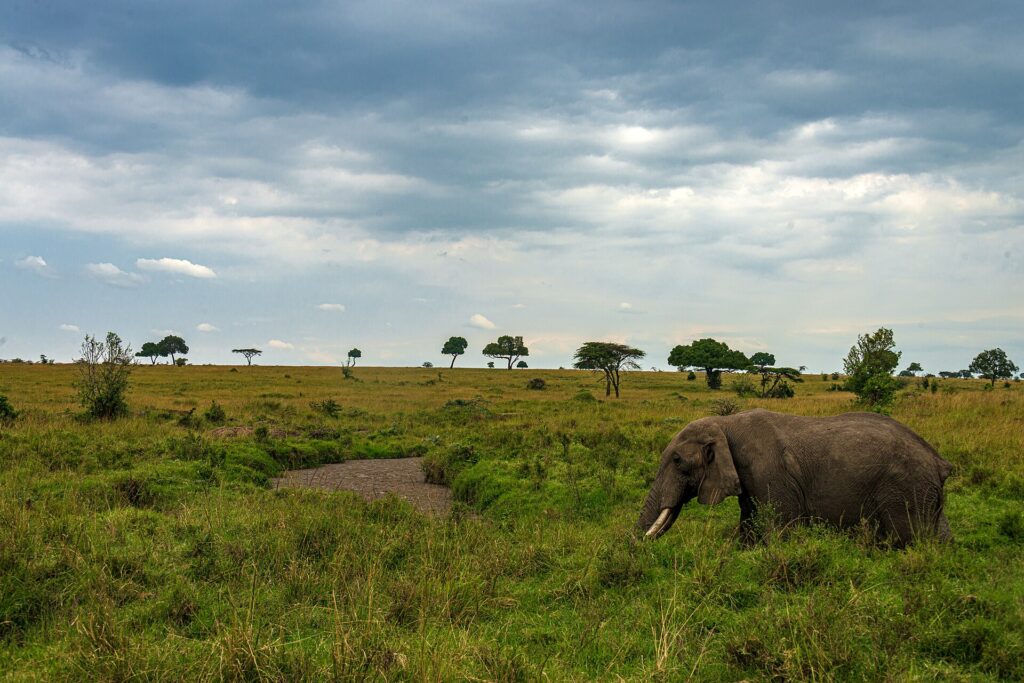
The Lore · East Africa · Lore Universe
Nilotic pastoralists (Maasai, Dinka, Nuer)
Cattle as currency and cosmology, Nuer segmentary lineage, Dinka song-oxen, Maasai age-grade warriors (moran), pastoralist resistance to colonialism.
Why its stories are told
Stories are told to explain the shape of the world, to teach children, to praise, and to remember. Myths explain why God withdrew, why death came and where cattle came from.
There is no single name for this body of lore, because it belongs to three peoples who name themselves.
The Land · Geography
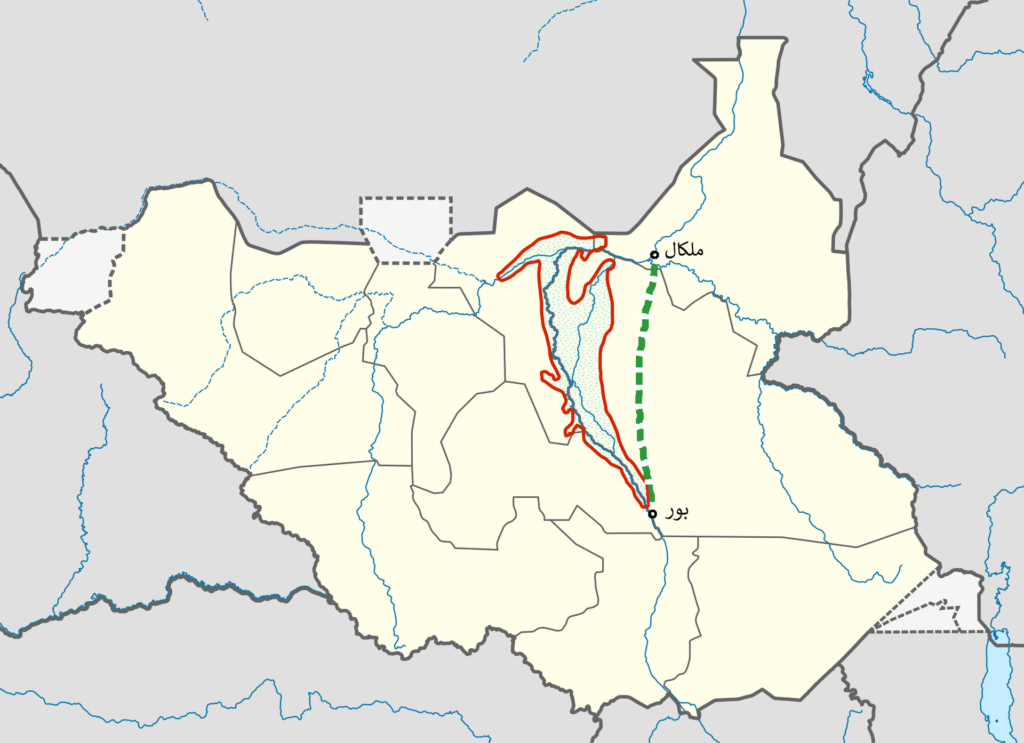
The Dinka and Nuer live in the flat clay plains of the Nile basin in South Sudan. The Sudd, one of the largest wetlands in the world, lies at their centre. In the rains, the plains flood and people move to villages on higher ground, growing millet and sorghum; in the dry season, they take cattle to the river and swamp edges, living in cattle camps. The rhythm of flood and drought shapes life and story. Mosquitoes, flies, flood and drought are hard companions, and cattle disease is a constant fear.
The Maasai live in the Rift Valley and its highlands in Kenya and Tanzania: grassland, acacia savannah, volcanoes and crater highlands, including the Serengeti plains, the Ngorongoro highlands, the Loita hills and the Laikipia plateau they once held. Rains are seasonal and uneven; herds move to find grass and water.
The land shapes the stories. Rivers, pools and grass are the stuff of song. Mountains such as Ol Doinyo Lengai are sacred. The cattle camp and the village are the two poles of Dinka and Nuer life.
The land means life and identity. It is used by right of community and custom, not owned in plots, which made colonial seizures of land especially devastating.
The People · Cultural Foundation · Society
All three peoples speak Nilotic languages. Dinka and Nuer belong to the Western Nilotic branch and are close relatives; Maa belongs to the Eastern Nilotic branch.
The Dinka live on the plains east and west of the White Nile in South Sudan, from Bor and the Upper Nile in the east to the Bahr el Ghazal in the west. They are divided into many independent sections, including the Rek, Agar, Bor, Padang, Malual, Twic and Ngok.
The Nuer live in the swamps and floodplains of the Sudd and eastward toward the Ethiopian border, in sections such as the Lou, Jikany, Gaawar, Lak, Thiang, Bul and Leek. Some Nuer live in Ethiopia's Gambela region.
The Maasai live in southern Kenya and northern Tanzania, across the Rift Valley, in sections such as the Purko, Kisongo, Loita, Matapato and Ilkeekonyokie.
Linguists place the origins of Nilotic languages in the southern Sudan region several thousand years ago; dates are debated. Maa speakers moved south along the Rift Valley over the second millennium CE, reaching central Tanzania by the eighteenth century. The Nuer expanded eastward across the Nile in the nineteenth century, into Dinka and Anywaa lands. These movements live in the stories of origin and separation.
1. Cattle as the measure of life. Cattle mediate marriage, compensation, sacrifice and friendship. A gift or loss of cattle is a gift or loss of social being.
2. Dignity and pride. Dinka speak of dheeng, a word for dignity, beauty and nobility of bearing; Nuer pride and independence struck every outside observer; Maasai value enkanyit, respect, alongside the warrior's courage. A person must not be humiliated, and stories turn on dignity defended.
3. The group of kin and age-mates. For Dinka and Nuer the lineage and clan; for Maasai the age-set, whose members share food, lodging and loyalty for life.
4. Respect for God and for those who stand between people and God: spear-masters, leopard-skin chiefs, prophets and the oloiboni.
5. Continuity of the name. A man without sons is lost to memory; Nuer and Dinka marriage customs, such as marriage to the name of a dead man, exist so that his line continues.
The priority runs from the group, living and dead, to the person. Western readers may be surprised that a dead man can be a husband and father, that a woman can marry a wife, or that a story ends happily when cattle change hands rather than when a hero wins.
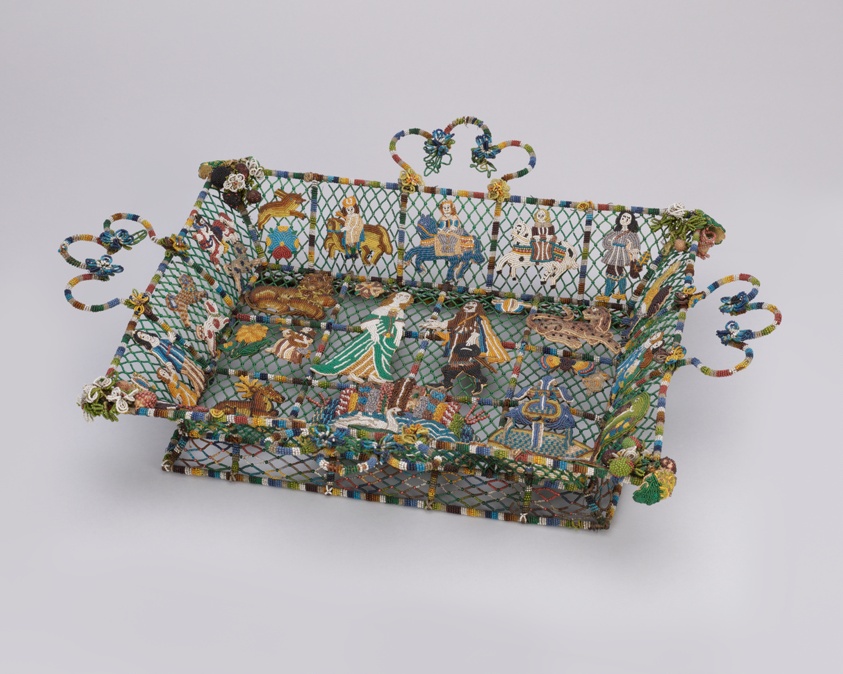
In all three societies, cattle are mainly controlled by men, but women have vital rights and roles.
Among the Maasai, women build the houses (inkajijik) of the homestead, milk the cows, and hold rights to particular cows allotted to them; these cows pass to their sons. Women make the beadwork that marks every stage of life. Women's groups are powerful: their songs praise or shame warriors, and they can collectively punish men who break moral rules.
Among Dinka and Nuer, women milk, manage dairy products, cultivate grain, and raise children. A woman's marriage passes cattle to her family, and her brothers' marriages often depend on the cattle her own marriage brought. Women compose songs and are central to mortuary rites.
Gender is not only about sex. Evans-Pritchard recorded that a Nuer woman who is barren may be treated as a man for kinship purposes: she can take cattle and marry a wife, and the children of that wife call her father. The divinity Abuk among the Dinka is female and associated with women and gardens.
In stories, women often act decisively: Abuk's hoe struck God; women's songs decide a warrior's name. Today, Maasai, Dinka and Nuer women lead in education, politics and writing.
Age is the backbone of Maasai society. Every man belongs to an age-set formed at his circumcision. The age-set moves through grades: boys, junior warriors, senior warriors, junior elders, senior elders, and retired elders. Each grade has its duties: warriors defend the herds and raid; elders hold authority, make decisions and bless. Respect between grades is strict. A man's age-mates are his closest companions; Spencer called the Maasai system a 'gerontocracy' in which elders control marriage and cattle, which is why warriors' freedom is both licensed and limited.
Among the Nuer, age-sets were opened by initiation every few years, and men of different sets owed each other respect; but Nuer age-sets did not form a governing body. Among the Dinka, age-sets also link young men for life and once formed fighting units.
Elders hold what others cannot: knowledge of genealogy, law, cattle histories, past agreements; the power to bless and curse; and control over marriage and cattle. The young hold strength, courage and song.
In stories, elders advise, judge and bless; the young act, err and learn. The tension between the warrior's pride and the elder's control is one of the great themes of Maasai song.
These societies are strongly egalitarian in spirit. Evans-Pritchard described Nuer as having no chiefs with power to command; every man considered himself the equal of any other. Dinka and Maasai likewise had no kings.
But there are distinctions. Among the Dinka, spear-master clans hold ritual precedence over warrior clans; the two have complementary roles. Among the Nuer, the 'aristocratic' clan of a territory (dil) had certain precedence, though not power to rule; Dinka captured or adopted into Nuer lineages were often fully incorporated. Leopard-skin chiefs had ritual, not political, standing. Prophets gained great influence.
Among the Maasai, the iloibonok held special ritual standing. Some Maa-speaking groups, such as Il-Torrobo (Dorobo) hunters, were treated as of lower standing by pastoral Maasai, who held that people without cattle lived a lesser life; this view is widely contested today.
Wealth in cattle differs between families, and a rich man has more influence, but this is not caste.
Storytellers come from all ranks; songs belong to every young man and woman. In stories, status appears in the contrast between cattle-owners and those without cattle, and in the dignity of every person.
The Nuer are the classic case of segmentary lineage, as described by Evans-Pritchard. Society is divided into sections, sub-sections and villages, each linked to a lineage of a clan. In a dispute, groups unite or divide depending on how closely they are related: two villages that quarrel with each other will unite against another sub-section, and all Nuer unite against outsiders. Order is kept by this balance, not by rulers.
The Dinka are similarly organised in independent sections, each with its spear-master clans and warrior clans, and with lineages that share cattle obligations.
The Maasai are organised by section (olosho), by clan, and above all by age-set, which crosses clans and binds men from many homesteads. A homestead (enkang) holds several families and their herds, enclosed by a thorn fence.
Membership carries obligations: to contribute and receive cattle at marriages and in compensation, to defend kin and age-mates, to share food and shelter, and to respect elders.
Expulsion is grave. A person cut off from lineage or age-set has no one to pay bloodwealth for him, no cattle for marriage, and no protection. He may seek a place in another group, as many did, but at the cost of starting again.
Through Time · History
By the second millennium CE, Maa-speaking herders were moving south along the Rift Valley, and by the 18th century Maasai sections held the grasslands from Laikipia to central Tanzania.
From about 1820, Nuer sections expanded eastward across the Nile into Dinka and Anywaa lands, a movement that continued into the 1860s.
In 1839 the first Turco-Egyptian expedition sailed up the White Nile, opening the way for the ivory and slave traders who raided Dinka and Nuer communities from the 1840s to the 1880s.
In the 1880s the Mahdist state took control of Sudan.
From 1883 to 1892 the Maasai suffered Emutai, the disaster: cattle pleuropneumonia, rinderpest in 1891, smallpox and famine killed great numbers of people and cattle.
The laibon Mbatiany died around 1890, and his sons Olonana and Senteu divided the leadership.
In 1904 and 1911 agreements with the British moved Maasai from Laikipia and the central Rift into a southern reserve.
In 1906 the Nuer prophet Ngundeng Bong died.
In 1928 and 1929 the British carried out the 'Nuer Settlement', damaging Ngundeng's mound and killing his son Gwek in 1929.
Over several millennia BCE, ancestral Nilotic languages developed in the southern Sudan region; linguists and archaeologists debate the dates. By the second millennium CE, Maa-speaking herders were moving south along the Rift Valley, and by the 18th century Maasai sections held the grasslands from Laikipia to central Tanzania. From about 1820, Nuer sections expanded eastward across the Nile into Dinka and Anywaa lands, a movement that continued into the 1860s.
In 1839 the first Turco-Egyptian expedition sailed up the White Nile, opening the way for the ivory and slave traders who raided Dinka and Nuer communities from the 1840s to the 1880s. In the 1880s the Mahdist state took control of Sudan. From 1883 to 1892 the Maasai suffered Emutai, the disaster: cattle pleuropneumonia, rinderpest in 1891, smallpox and famine killed great numbers of people and cattle. The laibon Mbatiany died around 1890, and his sons Olonana and Senteu divided the leadership.
In 1904 and 1911 agreements with the British moved Maasai from Laikipia and the central Rift into a southern reserve. In 1906 the Nuer prophet Ngundeng Bong died. In 1928 and 1929 the British carried out the 'Nuer Settlement', damaging Ngundeng's mound and killing his son Gwek in 1929. Sudan became independent in 1956, Tanganyika in 1961 and Kenya in 1963. Wars in southern Sudan from 1955 to 1972 and 1983 to 2005 devastated Dinka and Nuer life. In 2009 Ngundeng's rod was returned to South Sudan, and in 2011 South Sudan became independent.
This history lives in prophets' songs, age-set names and laments.
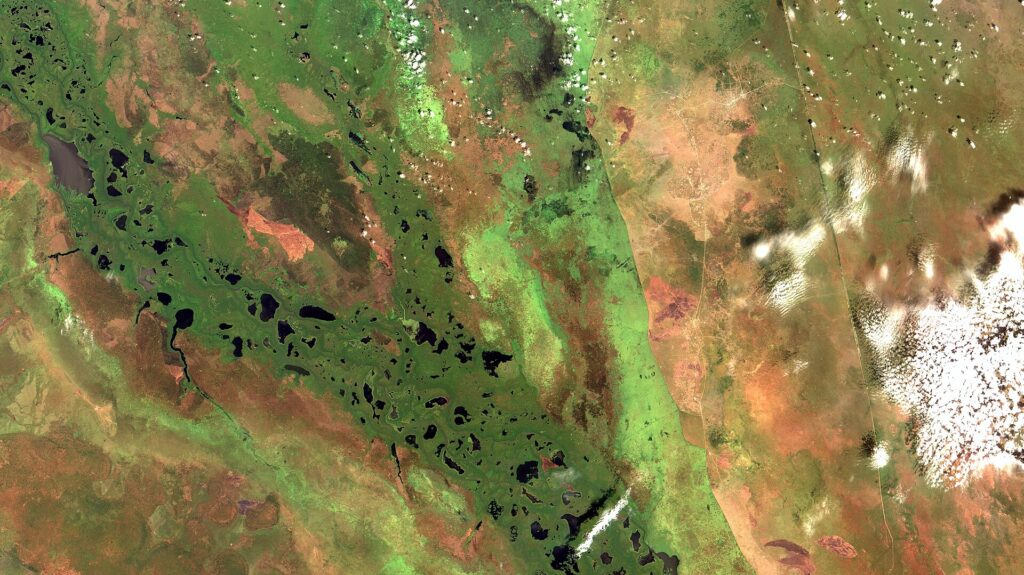
Movement is the life of pastoralists. Each year Dinka and Nuer move between villages and cattle camps; Maasai move herds between wet and dry-season grazing. Over centuries, larger movements shaped these peoples. Maa speakers moved south along the Rift Valley, absorbing and displacing earlier peoples, and splitting into pastoral Maasai sections and other Maa-speaking groups.
Dinka and Nuer have exchanged with each other most closely: through war, raiding, intermarriage and the absorption of whole groups. They share divinities such as Deng and many customs. Nuer prophets drew on Dinka shrines such as Luak Deng. The Maasai exchanged with farming neighbours such as the Kikuyu and the Chagga, trading cattle products for grain, intermarrying, and sharing some ritual.
Cattle are the reason. For Dinka, Nuer and Maasai, cattle are food, wealth, bridewealth, compensation, sacrifice and the language in which people speak of beauty, honour and God. Evans-Pritchard wrote of the Nuer 'bovine idiom': social relations are expressed through cattle, and much of the tradition is about how cattle pass between people and between people and God.
The Sacred · Deities and Spirits
The separation of sky and earth after Abuk's hoe struck Divinity and a small blue bird cut the rope.
The rope from the sky cut by the hyena and a bird; God's gift of the cow and calf to Nuer and Dinka.
The lowering of cattle from the sky to the Maasai; the separation of sky and earth.
The possession of the Nuer prophet Ngundeng; the shrine of Luak Deng.
The beginning of the world, as partner of Abuk.
Her hoe striking Divinity, which led to the separation of sky and earth.
Invoked in accounts of affliction and in sacrifices to ward off harm.
Stories of clan origins that link a lineage with its emblem animal or plant.
Accounts in Evans-Pritchard's Nuer Religion of lightning deaths and their aftermath.
His birth from the river's power, the river crossing and the wrestling with Agothyathon, and the gift of fishing spears.
God is the source of sacredness: Nhialic, Kwoth, Enkai. Much that is sacred is sacred because it stands near God or carries God's power.
Cattle are the most important sacred things in practice. An ox dedicated to a spirit or to a lineage's divinity is set apart. Sacrifice of an ox is the central act of worship among Dinka and Nuer, and the ox stands for the people who offer it; Evans-Pritchard argued that in Nuer sacrifice the ox is a substitute for the person.
The spear is sacred in the hands of those with ritual power. The fishing spears of the Dinka spear-masters (beny bith) are sacred objects that carry the founder's power. Nuer prophets had sacred objects, above all the rod (dang) of Ngundeng.
Words are sacred when spoken by the right person. Invocations by spear-masters, the curses of elders, the blessings of Maasai elders, who spit to bless, and the hymns of prophets are believed to act.
Certain trees, such as the Maasai oreteti (wild fig), certain mountains, such as Ol Doinyo Lengai, and certain shrines are places of sacredness.
The mechanism is relation: something becomes sacred by being dedicated, by being touched by divine power, or by belonging to a line that holds that power.
Each of these peoples speaks of one supreme God, with other spiritual beings understood in relation to God.
The Nuer: Kwoth, Spirit, often called Kwoth nhial, Spirit of the sky, is supreme. The spirits of the above, such as Deng, are next; then the spirits of the below. Evans-Pritchard stressed that Nuer understood these as Kwoth in different refractions, not as rival gods.
The Dinka: Nhialic, Divinity, is supreme and also the whole of divine power. The free-divinities (Deng, Garang, Abuk, Macardit and others) act in the world; Lienhardt described them as images of human experience, such as rain, fertility and misfortune. Below them are the clan-divinities (yath) of lineages.
The Maasai: Enkai is supreme. Enkai's two aspects, the black and the red, are not two gods but two faces. Enkai is approached by prayer, by the blessing of elders, and through the oloiboni.
Humans relate to the divine through mediators: spear-masters, leopard-skin chiefs, prophets, the oloiboni and elders. Ordinary people pray directly too, and a Dinka or Nuer man may invoke God over his own ox. The divine is approached with respect, and too much nearness, such as possession, is a risk as well as a gift.
Ancestors are present mainly through names, lineage and the continuing line. For Dinka and Nuer, the dead are remembered in genealogy and their names must be continued. A man who dies without sons may still have them: his kin marry a wife to his name, and her children are his. This 'ghost marriage', described by Evans-Pritchard among the Nuer, shows how strongly the line of the dead is kept.
The dead can trouble the living. Among the Nuer a ghost (jook) may cause misfortune if neglected or wronged, and sacrifice may be needed. Among the Dinka the dead are respected, and the ancestors of a lineage are associated with its clan divinity.
Among the Maasai, the dead have a less elaborate cult. Elders were traditionally buried, while others were often left in the bush; important elders and laibons were honoured. Respect for the ancestors appears in blessings and in the keeping of clan and age-set traditions.
The protocol is respect, sacrifice where required, the keeping of names, and right conduct among the living. What the ancestors want from the living, as the tradition puts it, is continuity: that their names live, that their cattle increase, and that their descendants keep faith with one another.
For the Nuer, Evans-Pritchard described a clear structure. Above is Kwoth, Spirit, who is in the sky and also everywhere. There are 'spirits of the above' (kuth nhial), powerful spirits of the air such as Deng, who may possess prophets. There are 'spirits of the below' (kuth piny), including totemic spirits connected with lineages and animals, and lesser spirits of nature and medicines. All are understood as refractions of Kwoth.
For the Dinka, Lienhardt described Divinity (Nhialic) as both one and many. There are free-divinities, such as Deng, Garang, Abuk and Macardit, which act widely and may seize people; and clan-divinities (yath), associated with each lineage and often with an animal or plant.
For the Maasai, Enkai is in the sky, with two aspects: Enkai Narok, the black, kind and rain-giving, and Enkai Nanyokie, the red, angry, linked with lightning. The oloiboni has special access to Enkai's knowledge.
Crossings happen in several directions. Spirits come down to possess prophets and others; people send prayers and sacrifices up; lightning strikes and the person struck may become a spirit, the Nuer colwic. Dreams and divination open the way between.
Rituals mark transitions and restore balance.
Transition rites. Among the Maasai the age-set ceremonies are the great transitions: enkipaata before circumcision, emuratare (circumcision), eunoto (passage of warriors to junior elderhood), and later ceremonies such as olng'esher, which closes the age-set's career. Among Dinka and Nuer, initiation by forehead scarification, marriage and mortuary rites are the great transitions.
Balance rites. Sacrifice is central among Dinka and Nuer: when illness, misfortune or a wrong has broken order, an ox is offered with invocation, and its meat is shared. The leopard-skin chief's rites cleanse homicide. Among the Maasai, elders bless, the oloiboni prescribes rites after divination, and prayers are offered to Enkai in drought.
In stories, rituals act as frames and resolutions. A myth explains the origin of a rite; the Aiwel Longar story explains why spear-masters invoke over sacrifice. A tale reaches its end when the sacrifice is made, the cattle exchanged, or the warriors' hair shaved. History is remembered by the ceremony that marked it: an age-set's eunoto, a prophet's great sacrifice.
The secret parts of rites belong to their keepers and are not described here.
Nhialic (Dinka). Divinity, the sky, the creator. Nhialic is one and many: the free-divinities are understood as aspects of Nhialic. In the myth of beginnings, Nhialic was close to people until Abuk struck Divinity with her hoe; then Divinity withdrew and sent a small blue bird to cut the rope. Nhialic is approached by prayer and the sacrifice of oxen, through spear-masters. No image is made.
Kwoth (Nuer). Spirit, Spirit of the sky, creator, present everywhere 'like wind'. Kwoth is approached by prayer and sacrifice, and spirits of the above and below are Kwoth's refractions. No image is made; Kwoth is spoken of as father and as one who judges.
Enkai or Engai (Maasai). The sky, rain, God. Enkai Narok, the black, is kind and brings rain; Enkai Nanyokie, the red, is angry and brings lightning and drought. In myth Enkai gave all cattle to the Maasai, lowering them from the sky. Enkai is approached by prayer, the blessing of elders, and through the oloiboni. Ol Doinyo Lengai is Enkai's mountain.
Deng (Dinka and Nuer). A great free-divinity of rain, lightning and fertility, who possessed the Nuer prophet Ngundeng and has shrines such as Luak Deng.
Free-divinities (Dinka). Powers such as Deng, Garang, Abuk and Macardit, which may seize people and cause illness or inspiration. Each is associated with particular experiences: Abuk with women and gardens, Macardit with misfortune. They are placated or honoured with sacrifice.
Clan-divinities (Dinka yath). Each lineage has a divinity, often linked with an animal or plant, that protects its members. Members respect the emblem and may not harm it.
Spirits of the above (Nuer kuth nhial). Spirits of the air, such as Deng, that seize prophets and speak through them.
Spirits of the below (Nuer kuth piny). Totemic spirits, nature spirits and spirits of medicines, closer to earth and less powerful.
Colwic (Nuer). A person killed by lightning, believed to be taken by Kwoth and become a spirit, honoured by his kin.
Ghosts (Nuer jook). The dead who may trouble the living if neglected or wronged.
The oloiboni's knowledge (Maasai). Not a spirit, but access to Enkai's knowledge through divination.
Rules of interaction: respect, sacrifice when required, avoidance of the emblem of one's clan-divinity, and recourse to ritual specialists when a spirit troubles a person.
The ox is the great creature of this tradition, not as a monster but as a being of meaning. A man's display ox is his companion and alter ego; he takes its name, sings its praises, and dances with arms shaped like its horns. In sacrifice, the ox stands for the person. In Maasai myth cattle came down from the sky from Enkai.
The small blue bird (Dinka). In Lienhardt's record of the Dinka myth, Divinity sent a small blue bird to cut the rope that joined sky and earth.
The hyena. In Nuer myth recorded by Evans-Pritchard, the hyena and a bird cut the rope from the sky, bringing death. In folktales, the hyena is greedy and foolish.
The river and its power (Dinka). Aiwel Longar's mother was made pregnant by the power of the river; the river is a source of spear-masters' power, and the fishing spear links them to it.
The lion. Strong and dangerous; Maasai warriors traditionally proved courage by hunting lions, a practice now restricted.
The hare. A clever trickster in folktales of many Nilotic and neighbouring peoples.
Animal emblems of clans, such as the crocodile or certain snakes, are not monsters but kin, and must not be harmed by their clan.
Among the Nuer, Evans-Pritchard recorded grave prohibitions: incest (rual), which brings sickness and must be cleansed by sacrifice; and homicide, which brings pollution (nueer) on the killer until cleansed by the leopard-skin chief, and which must not be ignored: the killer must not eat or drink until cleansed. People of lineages in feud must not eat together.
Among the Dinka, Lienhardt described how hidden wrongs, including incest and adultery, are thought to cause sickness, and must be confessed and cleansed.
Among the Maasai, many prohibitions mark age and gender. Warriors traditionally must not eat meat that women have seen, and eat in the bush in groups. Milk and meat are not taken on the same day. Most wild game, fish and birds were traditionally avoided. A man must show deep respect to his mother-in-law, and certain age-mates' wives and daughters are forbidden.
Consequences may be immediate (sickness), delayed (misfortune years later), or collective (a lineage affected by one member's wrong).
What cannot be undone: death. Bloodwealth can settle a feud but cannot restore the dead; the name must be continued by marriage to the dead man's name. Some breaches leave a stain that lasts generations.
This part carries no pictures. Gods, spirits, the ancestors and ceremonies are named, with their roles, and drawn as marks only.
The Stories · Signature Stories
The Nuer tell, as Evans-Pritchard recorded, why Nuer and Dinka are rivals. God had two sons, Nuer and Dinka. God promised to give Nuer his old cow and Dinka its young calf. But Dinka came to God's byre at night and, imitating Nuer's voice, asked for the calf. God gave it to him.
And 1 more stories in the catalog below.
The Telling · Oral Tradition · Narrative Structure
The Figures · Survival and Diaspora
The first woman. Abuk among the Dinka, whose work with the hoe struck God and caused the separation. She is not condemned simply; she is the one who works, and her act is the beginning of human life as it is.
The founder with power. Aiwel Longar among the Dinka, born of the river, who tests his people and then gives them spear-masters. His arc: power shown, challenged, and turned to gift.
The prophet. Ngundeng among the Nuer, seized by a spirit, who builds, sings, foretells and leads. His arc: seizure, authority, and long remembrance.
The ritual guide. The Maasai oloiboni, the Nuer leopard-skin chief, the Dinka spear-master. They stand between people and God, and settle conflict.
The brothers. Nuer and Dinka, Olonana and Senteu: two sons whose division explains the present, often through trickery.
The young warrior and his ox. The moran or the young Dinka and Nuer man, proud, brave, singing, whose arc is the passage to elderhood.
The elder. Holder of memory, law, blessing and curse.
The trickster and the fool. Hare and hyena in folktales.
The absorbed stranger. Kir, found in a gourd, who becomes the ancestor of a great Nuer line.
Survival and diaspora
Yes. The tradition is living, though under heavy pressure. Dinka and Nuer still keep cattle at the centre of social life. Bridewealth in cattle continues, often in large numbers. Young men compose and sing ox-songs and take ox-names. Cattle camps continue, now often armed because of insecurity.
The Dinka, Nuer and Maasai were not carried in large numbers through the Atlantic slave trade, though Dinka and Nuer people were taken in the nineteenth-century Nile slave trade to northern Sudan and Egypt. The modern diaspora is the result of war. From the 1980s, war drove Dinka and Nuer into refugee camps in Ethiopia and Kenya, including Kakuma.
Because the tradition is living, much work is recording and defence rather than revival. Francis Mading Deng has spent a lifetime recording and publishing Dinka songs, folktales and oral history, and writing about Dinka values in national and international life. Dinka and Nuer scholars, teachers and churches have produced written materials in Thuɔŋjäŋ and Thok Naath.
The Catalog · its places, peoples, practices and sources
The World Bible
For the reader who wants all of it: every section of Cattle Lords, in its eleven parts.
There is no single name for this body of lore, because it belongs to three peoples who name themselves.
The Dinka call themselves Jieng (roughly 'jyeng') or Muonyjang ('mwon-yjang', 'the people'); their language is Thuɔŋjäŋ. 'Dinka' is an outsiders' name that has also come into Dinka use.
The Nuer call themselves Naath ('naath', 'the people'); their language is Thok Naath, 'the mouth of the people'. 'Nuer' is the name others used.
The Maasai call themselves Ilmaasai, the speakers of Maa; the language is ɔl Maa. The name is said 'MAH-sai', not 'mah-SAI'. They are kin in language and custom to the Samburu, who call themselves Lokop.
The central concept words travel through all three. God is Nhialic ('nyah-lik') to the Dinka, Kwoth ('kwoth') to the Nuer and Enkai or Engai ('en-KAI') to the Maasai. Cattle are weng (cow) and muor (ox) in Dinka, yang (cow) and thak (ox) in Nuer, and inkishu in Maa. The young warrior is ilmurran in Maa, which English has taken as 'moran'.
All three peoples speak Nilotic languages. Dinka and Nuer belong to the Western Nilotic branch and are close relatives; Maa belongs to the Eastern Nilotic branch.
The Dinka live on the plains east and west of the White Nile in South Sudan, from Bor and the Upper Nile in the east to the Bahr el Ghazal in the west. They are divided into many independent sections, including the Rek, Agar, Bor, Padang, Malual, Twic and Ngok.
The Nuer live in the swamps and floodplains of the Sudd and eastward toward the Ethiopian border, in sections such as the Lou, Jikany, Gaawar, Lak, Thiang, Bul and Leek. Some Nuer live in Ethiopia's Gambela region.
The Maasai live in southern Kenya and northern Tanzania, across the Rift Valley, in sections such as the Purko, Kisongo, Loita, Matapato and Ilkeekonyokie.
Linguists place the origins of Nilotic languages in the southern Sudan region several thousand years ago; dates are debated. Maa speakers moved south along the Rift Valley over the second millennium CE, reaching central Tanzania by the eighteenth century. The Nuer expanded eastward across the Nile in the nineteenth century, into Dinka and Anywaa lands. These movements live in the stories of origin and separation.
Cattle are the reason. For Dinka, Nuer and Maasai, cattle are food, wealth, bridewealth, compensation, sacrifice and the language in which people speak of beauty, honour and God. Evans-Pritchard wrote of the Nuer 'bovine idiom': social relations are expressed through cattle, and much of the tradition is about how cattle pass between people and between people and God.
The stories exist to explain why God is far, why the Maasai hold all cattle to be theirs, why Nuer and Dinka raid each other, how spear-masters came to lead the Dinka, and how age-sets succeed each other among the Maasai. They are also the record of history: the expansion of the Nuer, the disasters of the 1890s, the arrival of slavers, the Mahdist wars and colonial rule.
Sacred and secular are not cleanly separate. Sacrifice of an ox is both a meal and a prayer. A Dinka man's song in praise of his ox is personal art and an act of honour. A Maasai age-set ceremony is a public festival and a sacred passage under the blessing of Enkai and the guidance of the oloiboni. Prayers, invocations and the songs of prophets belong more fully to the sacred; folktales, ox-songs and dance songs to daily life.
This holding is drawn from published scholarship and published collections, not from new fieldwork.
For the Nuer, the classic works are E. E. Evans-Pritchard's The Nuer (1940), Kinship and Marriage among the Nuer (1951) and Nuer Religion (1956), with Douglas H. Johnson's Nuer Prophets (1994) and Sharon Hutchinson's Nuer Dilemmas (1996), which follows Nuer life through war and change. For the Dinka, Godfrey Lienhardt's Divinity and Experience (1961) and the many books of the Ngok Dinka scholar Francis Mading Deng, including The Dinka and Their Songs (1973) and Dinka Folktales (1974). For the Maasai, A. C. Hollis's The Masai: Their Language and Folklore (1905), Naomi Kipury's Oral Literature of the Maasai (1983), Paul Spencer's studies of Maasai age organisation, and Thomas Spear and Richard Waller's edited volume Being Maasai (1993).
The colonial-era works were made under colonial conditions, and Evans-Pritchard's Nuer fieldwork took place directly after a British military campaign. Later scholars, Dinka, Nuer and Maasai among them, have corrected and deepened them.
No review by Dinka, Nuer or Maasai elders or native-speaker readers has yet been recorded for this holding. That review is open, and their corrections take precedence.
1. Cattle as the measure of life. Cattle mediate marriage, compensation, sacrifice and friendship. A gift or loss of cattle is a gift or loss of social being.
2. Dignity and pride. Dinka speak of dheeng, a word for dignity, beauty and nobility of bearing; Nuer pride and independence struck every outside observer; Maasai value enkanyit, respect, alongside the warrior's courage. A person must not be humiliated, and stories turn on dignity defended.
3. The group of kin and age-mates. For Dinka and Nuer the lineage and clan; for Maasai the age-set, whose members share food, lodging and loyalty for life.
4. Respect for God and for those who stand between people and God: spear-masters, leopard-skin chiefs, prophets and the oloiboni.
5. Continuity of the name. A man without sons is lost to memory; Nuer and Dinka marriage customs, such as marriage to the name of a dead man, exist so that his line continues.
The priority runs from the group, living and dead, to the person. Western readers may be surprised that a dead man can be a husband and father, that a woman can marry a wife, or that a story ends happily when cattle change hands rather than when a hero wins.
Causation is ultimately in God. Nuer say of misfortune that it is Kwoth's doing; Dinka speak of Nhialic and of the many divinities that act in the world as aspects of Divinity; Maasai attribute rain and drought, life and death to Enkai. But causes also lie in human acts: a sin such as incest or homicide brings pollution and sickness, a curse brings harm, and a broken obligation brings trouble.
The person is a node in a web. A Nuer is defined by lineage, by age-set and by the cattle that passed at his parents' marriage. A Maasai is defined by age-set and clan. A Dinka is defined by lineage and the divinity of his clan.
Time is structural rather than numbered. Evans-Pritchard showed that Nuer reckon time by the activities of the year, the movement to cattle camps in the dry season and back to villages in the rains, and by the sequence of age-sets. Maasai time is the succession of age-sets, each with its name. Genealogy holds a deeper time.
Reality is one world in which God, the spirits and the dead are present. God is above, in the sky, and also everywhere; the spirits act on earth; the dead persist in name and memory.
Stories are told to explain the shape of the world, to teach children, to praise, and to remember. Myths explain why God withdrew, why death came and where cattle came from. Folktales, told in the evening, teach right behaviour and cleverness. Songs praise oxen, age-mates, lovers and leaders, and mock rivals. Prophets' songs among the Nuer carry warnings and promises.
Everyone tells folktales; grandmothers and mothers are central tellers to children. Song is open to all: among the Dinka and Nuer, every young man composes songs for his ox, and women compose songs too. Among the Maasai, young men and women sing in groups at dances, led by a song leader (olaranyani). Specialists tell or sing sacred matters: spear-masters invoke at sacrifices, Nuer prophets compose their own hymns, and the Maasai oloiboni speaks in divination.
Times are set by the year and by events. Dances at cattle camps in the dry season, age-set ceremonies, weddings, sacrifices for illness and prayers in drought all call for song and story.
Power is real. A prophet's song can call people to war or peace. A song of insult can start a fight. A spear-master's invocation is believed to bring about what it says.
The foundational pattern is separation. In the Dinka, Nuer and Maasai accounts of beginnings, God and people were once close, joined by a rope from the sky; an act by a person or animal broke that closeness, and the world as it is followed. The story moves from unity to distance, and the rest of life, including sacrifice and prayer, is an attempt to speak across that distance.
A second pattern is division and inheritance. Two brothers or two sons receive different gifts, one by trickery; the outcome explains why peoples or lineages stand as they do. The Nuer and Dinka calf story and the Maasai account of Mbatiany's blessing both take this form.
A third is the trial of the founder. A hero, such as the Dinka Aiwel Longar, shows his power, sets a test, is overcome by a man of courage, and then gives the gifts that found an institution.
The ox-song moves differently: it is a praise poem built from images, linking the singer, his ox, his age-mates and his lineage in a chain of comparisons.
Across these, movement is less a climb to a climax than a passage from one ordering of the world to another, which ends with things as they now are.
Conflict in the open sense is frequent: raids, feuds, wars between sections and peoples. Nuer and Dinka lore is full of cattle raiding and the duels of young men. Maasai lore remembers wars between sections, such as the nineteenth-century Iloikop wars, and with neighbours.
But the deepest tension is a breach of relationship: between God and people, between brothers, between lineages. The first breach, the cutting of the rope from the sky, sets the frame. A man steals his brother's inheritance; a son tricks his father; a man kills another and pollution falls on both lines. The story seeks to repair, or explain, the breach.
Scarcity sharpens every breach. Drought and cattle disease, above all the disasters of the 1890s that the Maasai call Emutai, are remembered as times when all bonds were tested.
There is also the tension between the individual's pride and the group's needs. A young man's longing for glory, for a fine ox, for a lover, presses against the authority of elders.
Because the driving force is broken relation, endings come through compensation, sacrifice, blessing, marriage or the passage of age-sets, more than through a final victory.
Several protagonists recur.
The first people, and God. In the stories of beginnings, the actors are God and the first man and woman, such as the Dinka Garang and Abuk. The woman's act often decides the story.
The founder or culture hero, such as Aiwel Longar, who founds the line of Dinka spear-masters, or Kir, remembered as the ancestor of the Jikany Nuer, found as a child in a gourd.
The prophet or ritual leader: Ngundeng Bong among the Nuer, Mbatiany and his sons among the Maasai. These are historical people remembered in story.
The young man and his ox. In Dinka and Nuer song, the singer and his display ox are the protagonists together; the man takes his name from the ox and speaks through it.
The age-set. For the Maasai the ilmurran, as a group, are protagonists: their raids, their ceremonies, their passage to elderhood.
The lineage or people. In accounts of migration and war, the actor is the Nuer, the Dinka, or a section, moving and fighting together.
Animals act in folktales: the hyena, the hare, the lion, the bird that cut the rope.
The most satisfying end is restoration of right relations, sealed in cattle. A feud closes when the bloodwealth cattle are paid; a quarrel closes when an ox is sacrificed and the parties share its meat; a marriage is complete when the bridewealth cattle have passed and children are born. In Nuer practice the leopard-skin chief helps bring about these settlements.
Stories of beginnings resolve in the world as it is. After the rope is cut, God is far away, death is in the world, and people must reach God through prayer and sacrifice. This is not happy, but it is understood.
Stories of division resolve in a lasting arrangement. Because the Dinka took the calf, the Nuer raid the Dinka; because Olonana received his father's blessing, his line held the leadership.
The Maasai age-set story resolves in succession: the ilmurran become elders, and a new set of young men takes their place. The ending is a turn of the cycle, not a final state.
A bad ending is a broken line: a man who dies without heirs and whose name is not continued. Many customs exist to prevent this, and stories show their working.
Time in this tradition runs as a cycle within a cycle within a line.
The year: among Dinka and Nuer, the movement from villages in the rains to cattle camps by the rivers in the dry season, and back. Evans-Pritchard called this 'ecological time'. Songs and stories are set in camp or village, wet or dry.
The age-set: among the Maasai, every fifteen years or so a new age-set is formed, passes through warriorhood and becomes elders; Nuer had age-sets too, opened at intervals by initiation. Time is reckoned by which set was in its warriorhood when something happened. Evans-Pritchard called this 'structural time'.
The line: genealogy runs back through named ancestors to the founders, and beyond them to the time of beginnings, when God was near. This time does not repeat.
In stories these overlap. A Maasai tale set 'when the Iltalala were moran' places itself in a cycle; a Dinka account of Aiwel Longar places itself at the founding of the line. History, such as the coming of the British, is remembered by age-set and by the deeds of prophets, and so folds into the cycles.
The community is the frame and often the actor. In Nuer and Dinka lore, lineages and sections act as wholes: they move, raid and settle together. In Maasai lore, the age-set is a body whose members are bound to each other for life.
Individuals relate to the community through precise roles. A Nuer is a member of a lineage, a son of a particular marriage, a member of an age-set, and perhaps a leopard-skin chief or a prophet. A Maasai is first a member of an age-set, then of a clan and section. A Dinka is a member of a lineage with its own clan divinity.
What the community expects of stories and songs is that they honour the right people, keep the right names, and teach the right behaviour. An ox-song is sung before age-mates and girls, and its success depends on their response. A Maasai dance song is sung by a group, and the song leader must carry the group.
Personal pride matters greatly, but it is always pride before others. A Dinka or Nuer young man's dignity, a Maasai warrior's courage, are valued because they are seen and spoken of. The community is the audience that makes a person's name.
Morality is relational and also religious. Right action keeps faith with kin, age-mates, in-laws and God. Some acts, however, are wrong in themselves because they offend God and bring pollution.
Among the Nuer, Evans-Pritchard recorded grave wrongs such as incest (rual) and the pollution (nueer) that follows homicide, which must be cleansed by the leopard-skin chief. Among the Dinka, Lienhardt described how wrongs, including those done in secret, are thought to bring sickness until confessed and cleansed by sacrifice. Among the Maasai, respect between age-sets and generations, and between a man and his mother-in-law, is strictly kept; disrespect is shameful and dangerous.
What earns condemnation: theft from one's own people, cowardice, meanness with cattle, disrespect of elders, and murder within the community. What earns honour: courage, generosity, dignity, eloquence, loyalty to age-mates, and wisdom in settling disputes.
Stories teach moral logic by showing consequences, often long-lasting. The trick that took the calf set Nuer and Dinka against each other for all time. A careless act cut the rope to the sky. Stories also show mercy: compensation, sacrifice and blessing can restore what wrong has broken.
Transformation of status is central, especially among the Maasai. A boy becomes a warrior at circumcision, a warrior becomes a junior elder at eunoto and later ceremonies, an elder becomes a senior elder whose blessing is sought. Each passage is celebrated and also mourned: the moran's freedom and glory end at eunoto, when mothers shave the warriors' long braided hair, and many songs grieve this.
Among the Dinka and Nuer, the young man's initiation by scarification of the forehead, now much less common, transformed a boy into a man who could own an ox and marry. Marriage transforms both families. Death transforms a person into an ancestor whose name must be continued.
Transformation of the world is told in stories of beginnings: from nearness to God to distance, from a world without death to one with death. This is mourned.
In historical memory, the great transformations are disasters: the cattle plagues and famine of the 1890s, the loss of Maasai lands under the 1904 and 1911 agreements, and the wars that devastated Dinka and Nuer life from 1955 to 2005 and again after 2013. The tradition celebrates continuity through these, the survival of the cattle and the name.
God is the source of sacredness: Nhialic, Kwoth, Enkai. Much that is sacred is sacred because it stands near God or carries God's power.
Cattle are the most important sacred things in practice. An ox dedicated to a spirit or to a lineage's divinity is set apart. Sacrifice of an ox is the central act of worship among Dinka and Nuer, and the ox stands for the people who offer it; Evans-Pritchard argued that in Nuer sacrifice the ox is a substitute for the person.
The spear is sacred in the hands of those with ritual power. The fishing spears of the Dinka spear-masters (beny bith) are sacred objects that carry the founder's power. Nuer prophets had sacred objects, above all the rod (dang) of Ngundeng.
Words are sacred when spoken by the right person. Invocations by spear-masters, the curses of elders, the blessings of Maasai elders, who spit to bless, and the hymns of prophets are believed to act.
Certain trees, such as the Maasai oreteti (wild fig), certain mountains, such as Ol Doinyo Lengai, and certain shrines are places of sacredness.
The mechanism is relation: something becomes sacred by being dedicated, by being touched by divine power, or by belonging to a line that holds that power.
Ancestors are present mainly through names, lineage and the continuing line. For Dinka and Nuer, the dead are remembered in genealogy and their names must be continued. A man who dies without sons may still have them: his kin marry a wife to his name, and her children are his. This 'ghost marriage', described by Evans-Pritchard among the Nuer, shows how strongly the line of the dead is kept.
The dead can trouble the living. Among the Nuer a ghost (jook) may cause misfortune if neglected or wronged, and sacrifice may be needed. Among the Dinka the dead are respected, and the ancestors of a lineage are associated with its clan divinity.
Among the Maasai, the dead have a less elaborate cult. Elders were traditionally buried, while others were often left in the bush; important elders and laibons were honoured. Respect for the ancestors appears in blessings and in the keeping of clan and age-set traditions.
The protocol is respect, sacrifice where required, the keeping of names, and right conduct among the living. What the ancestors want from the living, as the tradition puts it, is continuity: that their names live, that their cattle increase, and that their descendants keep faith with one another.
For the Nuer, Evans-Pritchard described a clear structure. Above is Kwoth, Spirit, who is in the sky and also everywhere. There are 'spirits of the above' (kuth nhial), powerful spirits of the air such as Deng, who may possess prophets. There are 'spirits of the below' (kuth piny), including totemic spirits connected with lineages and animals, and lesser spirits of nature and medicines. All are understood as refractions of Kwoth.
For the Dinka, Lienhardt described Divinity (Nhialic) as both one and many. There are free-divinities, such as Deng, Garang, Abuk and Macardit, which act widely and may seize people; and clan-divinities (yath), associated with each lineage and often with an animal or plant.
For the Maasai, Enkai is in the sky, with two aspects: Enkai Narok, the black, kind and rain-giving, and Enkai Nanyokie, the red, angry, linked with lightning. The oloiboni has special access to Enkai's knowledge.
Crossings happen in several directions. Spirits come down to possess prophets and others; people send prayers and sacrifices up; lightning strikes and the person struck may become a spirit, the Nuer colwic. Dreams and divination open the way between.
Rituals mark transitions and restore balance.
Transition rites. Among the Maasai the age-set ceremonies are the great transitions: enkipaata before circumcision, emuratare (circumcision), eunoto (passage of warriors to junior elderhood), and later ceremonies such as olng'esher, which closes the age-set's career. Among Dinka and Nuer, initiation by forehead scarification, marriage and mortuary rites are the great transitions.
Balance rites. Sacrifice is central among Dinka and Nuer: when illness, misfortune or a wrong has broken order, an ox is offered with invocation, and its meat is shared. The leopard-skin chief's rites cleanse homicide. Among the Maasai, elders bless, the oloiboni prescribes rites after divination, and prayers are offered to Enkai in drought.
In stories, rituals act as frames and resolutions. A myth explains the origin of a rite; the Aiwel Longar story explains why spear-masters invoke over sacrifice. A tale reaches its end when the sacrifice is made, the cattle exchanged, or the warriors' hair shaved. History is remembered by the ceremony that marked it: an age-set's eunoto, a prophet's great sacrifice.
The secret parts of rites belong to their keepers and are not described here.
Each of these peoples speaks of one supreme God, with other spiritual beings understood in relation to God.
The Nuer: Kwoth, Spirit, often called Kwoth nhial, Spirit of the sky, is supreme. The spirits of the above, such as Deng, are next; then the spirits of the below. Evans-Pritchard stressed that Nuer understood these as Kwoth in different refractions, not as rival gods.
The Dinka: Nhialic, Divinity, is supreme and also the whole of divine power. The free-divinities (Deng, Garang, Abuk, Macardit and others) act in the world; Lienhardt described them as images of human experience, such as rain, fertility and misfortune. Below them are the clan-divinities (yath) of lineages.
The Maasai: Enkai is supreme. Enkai's two aspects, the black and the red, are not two gods but two faces. Enkai is approached by prayer, by the blessing of elders, and through the oloiboni.
Humans relate to the divine through mediators: spear-masters, leopard-skin chiefs, prophets, the oloiboni and elders. Ordinary people pray directly too, and a Dinka or Nuer man may invoke God over his own ox. The divine is approached with respect, and too much nearness, such as possession, is a risk as well as a gift.
Song is the main vehicle. Dinka and Nuer ox-songs are built from images: the colour pattern of the ox, the curve of its horns, the singer's age-mates, girls, rivals, his lineage, God. Francis Mading Deng showed that Dinka songs use close, rich comparison and allusion, and that each man composes his own songs and sometimes asks a skilled composer for help.
Maasai songs are polyphonic and sung in groups. The song leader (olaranyani) sings a line, and the group answers with deep, rhythmic chest sounds and harmonies. Women's songs are high and clear, often in call-and-response.
Folktales are told in plain speech, with formulas to open and close, repeated phrases, changes of voice, and songs inside the tale that listeners join.
Invocation at a sacrifice is a specialised speech form. A Dinka spear-master or Nuer elder speaks at length, repeating, addressing God and the spirits, stating the problem and the hope, while brandishing a spear. The invocation is believed to help bring about what it states.
Praise names are another technique: a man is called by his ox-name, a Maasai warrior by his age-set name, and these names open songs and greetings.
The body is the main instrument. Dinka and Nuer men dance with arms raised and curved above the head in the shape of their ox's horns, a gesture that makes the singer and the ox one. Dances at cattle camps bring young men and women together, with jumping and stamping.
Maasai men dance the adumu, the jumping dance, at eunoto and other gatherings: warriors take turns leaping straight up from a circle while the group sings. Women dance with shoulder movements that make their wide beaded collars rise and fall.
Adornment is part of performance. Maasai warriors wear red cloth (shuka), ochre on skin and hair, long braids, and beadwork made by women; beadwork colours and patterns carry meaning about age and status. Dinka and Nuer men traditionally decorated with ash, ochre and beads, and their oxen are adorned with tassels and bells. Display oxen often have their horns trained into special shapes.
Drums are used among the Dinka and Nuer at some dances. Maasai music is mostly vocal, without drums.
Sacrifice is a performance too: the tethering of the ox, the invocation with spear in hand, the killing, and the sharing of meat by rule among kin.
The audience is always part of the performance.
In Maasai song, there is no separate audience: the group sings, and the song leader's lines are answered by everyone. Women answer men in songs of courtship and praise. A song leader who cannot draw the group's response will be replaced.
In Dinka and Nuer song, a young man sings his ox-song before age-mates and girls, who judge it. Others may join refrains, and a fine song is learnt and sung by others. A rival may answer with a song of his own.
At sacrifices, those present respond to the invocation, sometimes repeating its words, and the whole group shares the meat according to kinship. Evans-Pritchard and Lienhardt both noted that a sacrifice is a common act.
In folktales, children answer the teller, sing the songs inside the tale, and call out at the right places.
At Maasai ceremonies, elders bless the young by spitting and by speech, and the young respond. Women's groups sing songs of praise or reproach to warriors, which are taken very seriously: a warrior shamed in women's songs has lost face.
In every case, the audience decides what is kept and passed on.
Cattle are the first memory device. Each cow and ox has a name, a colour pattern and a history: whose bridewealth it came from, whose cow it was born of. Ask a Nuer or Dinka about a cow and you learn the marriages of the lineage. Colour terms are numerous and precise, so the herd encodes knowledge.
Names are the second device. Ox-names, age-set names, and the names of ancestors hold history. Maasai age-sets are named, and events are dated by them.
Genealogy is the third. Lineages are recited back through named ancestors, and stories attach to them.
Song is the fourth. Songs are learnt and repeated, and they carry names, places and events. Nuer prophets' songs, such as those of Ngundeng, were memorised and passed on; Douglas Johnson showed that they were carefully kept and reinterpreted in later crises.
Specialists keep particular knowledge: spear-masters keep invocations, leopard-skin chiefs keep the rites of settlement, the Maasai iloibonok keep divination, and elders keep law and history.
Writing and recording have added new means: Dinka and Nuer written in Latin script, recordings of songs, and books by Dinka, Nuer and Maasai writers. The young men's songs remain the living archive.
The chief supernatural power is the power of God, working through people and things set apart.
Invocation and sacrifice. A Dinka spear-master or Nuer elder who invokes over an ox speaks to God and the spirits; if his words are true and his relation to God is right, they may come to pass. Lienhardt described Dinka invocation as speech that helps make real what it states.
Blessing and curse. Elders' blessings bring fertility and prosperity; their curses bring harm. Among the Maasai the blessing of elders is essential to every passage; the curse of a father or an age-set is feared.
Prophecy and possession. A spirit may seize a person and speak through them. Nuer prophets such as Ngundeng were believed to be possessed by the spirit Deng, and could foretell, heal and call people to action.
Divination. The Maasai oloiboni divines by casting stones from a container (enkidong), reading the answers, and prescribing remedies and the timing of ceremonies.
Medicines and harmful power. Some people are believed to use harmful medicines or the evil eye; these are condemned.
The rules: power comes from God and must be used rightly. Invocation by a person whose own conduct is wrong fails. No power can overturn God's will.
Power comes from God, but reaches people by different paths.
Inherited power. Dinka spear-masters inherit their power from the founder Aiwel Longar through their clans. Nuer leopard-skin chiefs belong to particular lineages. Maasai iloibonok come from a particular clan, the Inkidong'i of the Ilaiser, and their gift passes in families.
Power by seizure. A spirit may seize anyone, and a person possessed may become a prophet. Ngundeng was not of a priestly line; his power came from the spirit Deng. This is power that comes unbidden.
Power by age. Elders gain the power to bless and curse as they age. Among the Maasai, an age-set's ritual authority grows as it moves through its stages.
Power by cattle. Wealth in cattle gives social power: the ability to marry, to compensate, to make friends, to sacrifice.
Power by courage. Warriors win honour and names through raids and the defence of herds.
The cost is real. Possession is dangerous and can bring illness. Spear-masters and prophets carry heavy responsibility; a prophet whose words fail loses following. Power used for harm brings condemnation and, the tradition holds, God's punishment.
Among the Nuer, Evans-Pritchard recorded grave prohibitions: incest (rual), which brings sickness and must be cleansed by sacrifice; and homicide, which brings pollution (nueer) on the killer until cleansed by the leopard-skin chief, and which must not be ignored: the killer must not eat or drink until cleansed. People of lineages in feud must not eat together.
Among the Dinka, Lienhardt described how hidden wrongs, including incest and adultery, are thought to cause sickness, and must be confessed and cleansed.
Among the Maasai, many prohibitions mark age and gender. Warriors traditionally must not eat meat that women have seen, and eat in the bush in groups. Milk and meat are not taken on the same day. Most wild game, fish and birds were traditionally avoided. A man must show deep respect to his mother-in-law, and certain age-mates' wives and daughters are forbidden.
Consequences may be immediate (sickness), delayed (misfortune years later), or collective (a lineage affected by one member's wrong).
What cannot be undone: death. Bloodwealth can settle a feud but cannot restore the dead; the name must be continued by marriage to the dead man's name. Some breaches leave a stain that lasts generations.
Among the Maasai, initiation is the great passage. Boys of an age group are prepared at enkipaata, then circumcised at emuratare; they must show no flinching, as a sign of courage. They become warriors (ilmurran) of a new age-set and live for years in a warriors' camp (manyatta), defending the herds, learning from older warriors, growing their hair long. At eunoto, led by the oloiboni and elders, they pass to junior elderhood: their mothers shave their hair, and they may marry. Later ceremonies, such as the milk-drinking and meat-eating rites, complete the passage. Girls were traditionally circumcised before marriage; this is now illegal in Kenya and Tanzania and opposed by many Maasai, and other rites of passage for girls are being developed.
Among Dinka and Nuer, initiation was by scarification of the forehead: six parallel lines among many Nuer (gaar), and other patterns among Dinka sections. It made a boy a man, able to own his own ox and take an ox-name. The practice has declined greatly.
What dies is childhood and its freedoms; what is born is the adult member of an age-set, with its loyalties.
Elders and ritual specialists administer; the secret parts of the rites belong to their keepers.
In all three societies, cattle are mainly controlled by men, but women have vital rights and roles.
Among the Maasai, women build the houses (inkajijik) of the homestead, milk the cows, and hold rights to particular cows allotted to them; these cows pass to their sons. Women make the beadwork that marks every stage of life. Women's groups are powerful: their songs praise or shame warriors, and they can collectively punish men who break moral rules.
Among Dinka and Nuer, women milk, manage dairy products, cultivate grain, and raise children. A woman's marriage passes cattle to her family, and her brothers' marriages often depend on the cattle her own marriage brought. Women compose songs and are central to mortuary rites.
Gender is not only about sex. Evans-Pritchard recorded that a Nuer woman who is barren may be treated as a man for kinship purposes: she can take cattle and marry a wife, and the children of that wife call her father. The divinity Abuk among the Dinka is female and associated with women and gardens.
In stories, women often act decisively: Abuk's hoe struck God; women's songs decide a warrior's name. Today, Maasai, Dinka and Nuer women lead in education, politics and writing.
Age is the backbone of Maasai society. Every man belongs to an age-set formed at his circumcision. The age-set moves through grades: boys, junior warriors, senior warriors, junior elders, senior elders, and retired elders. Each grade has its duties: warriors defend the herds and raid; elders hold authority, make decisions and bless. Respect between grades is strict. A man's age-mates are his closest companions; Spencer called the Maasai system a 'gerontocracy' in which elders control marriage and cattle, which is why warriors' freedom is both licensed and limited.
Among the Nuer, age-sets were opened by initiation every few years, and men of different sets owed each other respect; but Nuer age-sets did not form a governing body. Among the Dinka, age-sets also link young men for life and once formed fighting units.
Elders hold what others cannot: knowledge of genealogy, law, cattle histories, past agreements; the power to bless and curse; and control over marriage and cattle. The young hold strength, courage and song.
In stories, elders advise, judge and bless; the young act, err and learn. The tension between the warrior's pride and the elder's control is one of the great themes of Maasai song.
These societies are strongly egalitarian in spirit. Evans-Pritchard described Nuer as having no chiefs with power to command; every man considered himself the equal of any other. Dinka and Maasai likewise had no kings.
But there are distinctions. Among the Dinka, spear-master clans hold ritual precedence over warrior clans; the two have complementary roles. Among the Nuer, the 'aristocratic' clan of a territory (dil) had certain precedence, though not power to rule; Dinka captured or adopted into Nuer lineages were often fully incorporated. Leopard-skin chiefs had ritual, not political, standing. Prophets gained great influence.
Among the Maasai, the iloibonok held special ritual standing. Some Maa-speaking groups, such as Il-Torrobo (Dorobo) hunters, were treated as of lower standing by pastoral Maasai, who held that people without cattle lived a lesser life; this view is widely contested today.
Wealth in cattle differs between families, and a rich man has more influence, but this is not caste.
Storytellers come from all ranks; songs belong to every young man and woman. In stories, status appears in the contrast between cattle-owners and those without cattle, and in the dignity of every person.
The Nuer are the classic case of segmentary lineage, as described by Evans-Pritchard. Society is divided into sections, sub-sections and villages, each linked to a lineage of a clan. In a dispute, groups unite or divide depending on how closely they are related: two villages that quarrel with each other will unite against another sub-section, and all Nuer unite against outsiders. Order is kept by this balance, not by rulers.
The Dinka are similarly organised in independent sections, each with its spear-master clans and warrior clans, and with lineages that share cattle obligations.
The Maasai are organised by section (olosho), by clan, and above all by age-set, which crosses clans and binds men from many homesteads. A homestead (enkang) holds several families and their herds, enclosed by a thorn fence.
Membership carries obligations: to contribute and receive cattle at marriages and in compensation, to defend kin and age-mates, to share food and shelter, and to respect elders.
Expulsion is grave. A person cut off from lineage or age-set has no one to pay bloodwealth for him, no cattle for marriage, and no protection. He may seek a place in another group, as many did, but at the cost of starting again.
The Dinka and Nuer live in the flat clay plains of the Nile basin in South Sudan. The Sudd, one of the largest wetlands in the world, lies at their centre. In the rains, the plains flood and people move to villages on higher ground, growing millet and sorghum; in the dry season, they take cattle to the river and swamp edges, living in cattle camps. The rhythm of flood and drought shapes life and story. Mosquitoes, flies, flood and drought are hard companions, and cattle disease is a constant fear.
The Maasai live in the Rift Valley and its highlands in Kenya and Tanzania: grassland, acacia savannah, volcanoes and crater highlands, including the Serengeti plains, the Ngorongoro highlands, the Loita hills and the Laikipia plateau they once held. Rains are seasonal and uneven; herds move to find grass and water.
The land shapes the stories. Rivers, pools and grass are the stuff of song. Mountains such as Ol Doinyo Lengai are sacred. The cattle camp and the village are the two poles of Dinka and Nuer life.
The land means life and identity. It is used by right of community and custom, not owned in plots, which made colonial seizures of land especially devastating.
Ol Doinyo Lengai, 'the Mountain of God', in northern Tanzania, is an active volcano sacred to the Maasai as a dwelling or seat of Enkai. Prayers are offered toward it, especially in drought, and it appears in songs and stories.
Ngundeng's mound, in Lou Nuer country, is a great earth mound built in the late nineteenth century under the prophet Ngundeng Bong as a place of the spirit Deng. It was a site of sacrifice and gathering. British forces damaged it in 1928 during their campaign against Nuer prophets. It remains a sacred and historical site.
Luak Deng, a shrine of the divinity Deng on the borderlands of Dinka and Nuer, was an important pilgrimage centre for both peoples, whose prophets competed for its keeping, as Douglas Johnson has described.
Shrines of clan divinities and spear-masters, often in a cattle byre (luak) or at a sacred tree, exist across Dinka country.
Sacred trees such as the Maasai oreteti (wild fig) are places of ceremony and prayer.
In stories, these sites are destinations for prayer and sacrifice, places where the spirit speaks, and memorials of prophets and their deeds.
The universe has two main levels, the sky and the earth, with God above.
In Dinka and Nuer accounts, sky and earth were once close, joined by a rope, and people could climb to God. After the rope was cut, sky and earth separated; God withdrew above, and death came. The sky is God's place; rain, lightning and the sun come from there. Spirits of the above dwell in the air. Spirits of the below dwell on and in the earth, in rivers, trees and animals. The dead go to a place that is not clearly described; the stress falls on their names among the living.
In Maasai accounts, Enkai is in the sky, and sky and earth were once joined. Cattle came down from the sky to the Maasai by a rope or a thong, which was later cut. The east, where the sun rises, is favoured; doors of houses and ceremonies may face particular directions.
Directions and height matter: up is toward God, and prayers are raised upward, with arms lifted; sacrifice sends the life of the ox toward God.
Movement between realms is by prayer, sacrifice, possession, dreams, lightning and death. No living person now climbs to God; the rope is gone.
Over several millennia BCE, ancestral Nilotic languages developed in the southern Sudan region; linguists and archaeologists debate the dates. By the second millennium CE, Maa-speaking herders were moving south along the Rift Valley, and by the 18th century Maasai sections held the grasslands from Laikipia to central Tanzania. From about 1820, Nuer sections expanded eastward across the Nile into Dinka and Anywaa lands, a movement that continued into the 1860s.
In 1839 the first Turco-Egyptian expedition sailed up the White Nile, opening the way for the ivory and slave traders who raided Dinka and Nuer communities from the 1840s to the 1880s. In the 1880s the Mahdist state took control of Sudan. From 1883 to 1892 the Maasai suffered Emutai, the disaster: cattle pleuropneumonia, rinderpest in 1891, smallpox and famine killed great numbers of people and cattle. The laibon Mbatiany died around 1890, and his sons Olonana and Senteu divided the leadership.
In 1904 and 1911 agreements with the British moved Maasai from Laikipia and the central Rift into a southern reserve. In 1906 the Nuer prophet Ngundeng Bong died. In 1928 and 1929 the British carried out the 'Nuer Settlement', damaging Ngundeng's mound and killing his son Gwek in 1929. Sudan became independent in 1956, Tanganyika in 1961 and Kenya in 1963. Wars in southern Sudan from 1955 to 1972 and 1983 to 2005 devastated Dinka and Nuer life. In 2009 Ngundeng's rod was returned to South Sudan, and in 2011 South Sudan became independent.
This history lives in prophets' songs, age-set names and laments.
Movement is the life of pastoralists. Each year Dinka and Nuer move between villages and cattle camps; Maasai move herds between wet and dry-season grazing.
Over centuries, larger movements shaped these peoples. Maa speakers moved south along the Rift Valley, absorbing and displacing earlier peoples, and splitting into pastoral Maasai sections and other Maa-speaking groups. These movements are remembered in stories of origin, often from the north, and in the names of sections.
The Nuer expansion of the nineteenth century, studied by Raymond Kelly and others, took Nuer sections east of the Nile into lands of the Dinka and Anywaa. Many Dinka were absorbed into Nuer lineages, so that Nuer and Dinka share much ancestry. Stories of Kir, the Jikany ancestor of Dinka origin, reflect this.
What was carried: cattle, language, songs, the age-set and lineage systems. What was lost: some old places of origin, and the identity of absorbed peoples.
In the twentieth and twenty-first centuries, war drove millions of Dinka and Nuer from their homes into camps in Ethiopia and Kenya, into towns, and abroad. Maasai lost land to colonial and later state and private use, and many moved to towns.
Dinka and Nuer have exchanged with each other most closely: through war, raiding, intermarriage and the absorption of whole groups. They share divinities such as Deng and many customs. Nuer prophets drew on Dinka shrines such as Luak Deng.
The Maasai exchanged with farming neighbours such as the Kikuyu and the Chagga, trading cattle products for grain, intermarrying, and sharing some ritual. Maa-speaking hunters and other groups shared knowledge with pastoral Maasai. Kikuyu and Maasai borrowed age-set terms and practices from one another, scholars suggest.
Islam and Christianity came with outsiders. Northern Sudanese traders, the Mahdist state and later Khartoum governments brought Islam and Arabic; Christian missions came from the late nineteenth century. Today many Dinka and Nuer are Christian, and Christian faith has blended with older ways of speaking of God; Nhialic and Kwoth are the words used for the Christian God. Many Maasai are also Christian, and Enkai is the name for God in Maasai churches.
The tradition kept its integrity through cattle and song. Even where new religion and new economies came, cattle kept their place in marriage and honour, and songs kept being composed in the old forms with new content.
Yes. The tradition is living, though under heavy pressure.
Dinka and Nuer still keep cattle at the centre of social life. Bridewealth in cattle continues, often in large numbers. Young men compose and sing ox-songs and take ox-names. Cattle camps continue, now often armed because of insecurity. Many Dinka and Nuer are Christian, but older ways of honouring God and the spirits continue alongside. Nuer prophets have continued to arise in modern times.
Maasai age-sets are still formed, and eunoto and other ceremonies are still held, drawing large gatherings. The ilmurran still exist, though many young men now go to school and combine warriorhood with education. Maasai beadwork and dress remain strong. Herding continues, though land is shrinking.
What has changed: wars have killed many people and cattle, scattered communities and turned cattle raiding into armed conflict. Scarification has largely ended. Female circumcision is opposed by law and by many in the communities. Land loss has pressed Maasai into smaller areas and into tourism and towns.
What has been lost: some songs, some knowledge of older ceremonies, and in places the independence of the herding life. Contemporary practitioners are herders, elders, singers, prophets and ordinary families.
The Dinka, Nuer and Maasai were not carried in large numbers through the Atlantic slave trade, though Dinka and Nuer people were taken in the nineteenth-century Nile slave trade to northern Sudan and Egypt. The modern diaspora is the result of war.
From the 1980s, war drove Dinka and Nuer into refugee camps in Ethiopia and Kenya, including Kakuma. Thousands of young boys, many of them Dinka, walked to these camps and later, from 2000 and 2001, were resettled in the United States as the 'Lost Boys of Sudan'. Large South Sudanese communities now live in the United States (including Nuer communities in Nebraska and Minnesota), Canada, Australia and Britain.
In the diaspora, bridewealth is still negotiated, sometimes in cash equivalent to cattle. Ox-names are still taken; songs are composed and shared online, sometimes of oxen the singer has never seen. Christian churches serve as community centres. Lineage and section ties are kept by phone and visits.
Maasai diaspora is smaller, but many Maasai live in Nairobi, Arusha and other cities, and some abroad, keeping age-set ties and returning for ceremonies.
What they create is a tradition carried in memory and song when the cattle are far away.
Because the tradition is living, much work is recording and defence rather than revival.
Francis Mading Deng has spent a lifetime recording and publishing Dinka songs, folktales and oral history, and writing about Dinka values in national and international life. Dinka and Nuer scholars, teachers and churches have produced written materials in Thuɔŋjäŋ and Thok Naath.
The return of Ngundeng's rod (dang) to South Sudan in 2009, after decades outside the country, was celebrated by Nuer as a recovery of sacred heritage; Douglas Johnson has written on the history of the rod.
Maasai organisations, many led by Maasai women and men, work to defend land rights, notably in Loliondo and Ngorongoro, and to keep Maasai culture strong through schools and community programmes. Maasai writers and scholars, such as Tepilit Ole Saitoti and Naomi Kipury, have recorded Maasai life and oral literature from inside. Alternative rites of passage for girls have been developed in some Maasai communities, keeping the ceremony while ending circumcision.
What remains uncertain: many songs from earlier generations, many prophets' songs, and much knowledge of older ceremonies were not recorded, and war has destroyed some communities' memory-keepers.
Nhialic (Dinka). Divinity, the sky, the creator. Nhialic is one and many: the free-divinities are understood as aspects of Nhialic. In the myth of beginnings, Nhialic was close to people until Abuk struck Divinity with her hoe; then Divinity withdrew and sent a small blue bird to cut the rope. Nhialic is approached by prayer and the sacrifice of oxen, through spear-masters. No image is made.
Kwoth (Nuer). Spirit, Spirit of the sky, creator, present everywhere 'like wind'. Kwoth is approached by prayer and sacrifice, and spirits of the above and below are Kwoth's refractions. No image is made; Kwoth is spoken of as father and as one who judges.
Enkai or Engai (Maasai). The sky, rain, God. Enkai Narok, the black, is kind and brings rain; Enkai Nanyokie, the red, is angry and brings lightning and drought. In myth Enkai gave all cattle to the Maasai, lowering them from the sky. Enkai is approached by prayer, the blessing of elders, and through the oloiboni. Ol Doinyo Lengai is Enkai's mountain.
Deng (Dinka and Nuer). A great free-divinity of rain, lightning and fertility, who possessed the Nuer prophet Ngundeng and has shrines such as Luak Deng.
Free-divinities (Dinka). Powers such as Deng, Garang, Abuk and Macardit, which may seize people and cause illness or inspiration. Each is associated with particular experiences: Abuk with women and gardens, Macardit with misfortune. They are placated or honoured with sacrifice.
Clan-divinities (Dinka yath). Each lineage has a divinity, often linked with an animal or plant, that protects its members. Members respect the emblem and may not harm it.
Spirits of the above (Nuer kuth nhial). Spirits of the air, such as Deng, that seize prophets and speak through them.
Spirits of the below (Nuer kuth piny). Totemic spirits, nature spirits and spirits of medicines, closer to earth and less powerful.
Colwic (Nuer). A person killed by lightning, believed to be taken by Kwoth and become a spirit, honoured by his kin.
Ghosts (Nuer jook). The dead who may trouble the living if neglected or wronged.
The oloiboni's knowledge (Maasai). Not a spirit, but access to Enkai's knowledge through divination.
Rules of interaction: respect, sacrifice when required, avoidance of the emblem of one's clan-divinity, and recourse to ritual specialists when a spirit troubles a person.
The ox is the great creature of this tradition, not as a monster but as a being of meaning. A man's display ox is his companion and alter ego; he takes its name, sings its praises, and dances with arms shaped like its horns. In sacrifice, the ox stands for the person. In Maasai myth cattle came down from the sky from Enkai.
The small blue bird (Dinka). In Lienhardt's record of the Dinka myth, Divinity sent a small blue bird to cut the rope that joined sky and earth.
The hyena. In Nuer myth recorded by Evans-Pritchard, the hyena and a bird cut the rope from the sky, bringing death. In folktales, the hyena is greedy and foolish.
The river and its power (Dinka). Aiwel Longar's mother was made pregnant by the power of the river; the river is a source of spear-masters' power, and the fishing spear links them to it.
The lion. Strong and dangerous; Maasai warriors traditionally proved courage by hunting lions, a practice now restricted.
The hare. A clever trickster in folktales of many Nilotic and neighbouring peoples.
Animal emblems of clans, such as the crocodile or certain snakes, are not monsters but kin, and must not be harmed by their clan.
The Nuer tell, as Evans-Pritchard recorded, why Nuer and Dinka are rivals.
God had two sons, Nuer and Dinka. God promised to give Nuer his old cow and Dinka its young calf. But Dinka came to God's byre at night and, imitating Nuer's voice, asked for the calf. God gave it to him. In the morning, when Nuer came and asked for the calf, God realised he had been tricked. Angry, God told Nuer to go and raid Dinka's cattle for ever, to avenge the theft.
And so, the Nuer say, they have taken cattle from the Dinka ever since, by right.
This story reveals a great deal. First, it puts cattle at the centre: the whole relationship of two peoples turns on one cow and one calf. Second, it explains a present arrangement, Nuer raiding of Dinka, by a past event; the story ends with things as they are. Third, it shows trickery and justice: the Dinka trick is not undone, but is answered by a right to raid. Fourth, it shows Nuer and Dinka as brothers, sons of one father, which matches their shared language, customs and ancestry.
Dinka tellers, naturally, have their own view of the matter, and the story is a Nuer account. It shows how story carries the logic of a relationship between peoples through generations.
The first woman. Abuk among the Dinka, whose work with the hoe struck God and caused the separation. She is not condemned simply; she is the one who works, and her act is the beginning of human life as it is.
The founder with power. Aiwel Longar among the Dinka, born of the river, who tests his people and then gives them spear-masters. His arc: power shown, challenged, and turned to gift.
The prophet. Ngundeng among the Nuer, seized by a spirit, who builds, sings, foretells and leads. His arc: seizure, authority, and long remembrance.
The ritual guide. The Maasai oloiboni, the Nuer leopard-skin chief, the Dinka spear-master. They stand between people and God, and settle conflict.
The brothers. Nuer and Dinka, Olonana and Senteu: two sons whose division explains the present, often through trickery.
The young warrior and his ox. The moran or the young Dinka and Nuer man, proud, brave, singing, whose arc is the passage to elderhood.
The elder. Holder of memory, law, blessing and curse.
The trickster and the fool. Hare and hyena in folktales.
The absorbed stranger. Kir, found in a gourd, who becomes the ancestor of a great Nuer line.
Aiwel Longar (Dinka). As Lienhardt recorded, Aiwel was born to a woman made pregnant by the power of the river. As a child he showed strange power. In a time of drought he offered to lead the people to new pastures, but they refused and went their own way. Later, as they crossed a river, Aiwel stood on the bank and speared them in the water as they came. A man called Agothyathon held an ox's backbone before him as a decoy, then seized Aiwel and wrestled him until he was exhausted. Aiwel yielded and gave the people fishing spears and the power of invocation, founding the spear-masters. Structure: power shown, conflict, test, gift. Values: power must be turned to the people's good; courage earns it.
Naiteru-kop and Le-eyo (Maasai). As Hollis recorded, Naiteru-kop told Le-eyo that when a child died he should throw the body away saying, 'Man, die and come back; moon, die and remain away.' When a child who was not his own died, Le-eyo spoke the words wrongly, and death stayed with people. Structure: a command, failure, a lasting result. Values: the power of exact words and care for others' children.
Olonana and Senteu (Maasai). Mbatiany meant his blessing for Senteu, but Olonana received it first, and the two divided the leadership. Structure: two brothers, one blessing, division.
Titles: Divinity, Nhialic Aciek (Divinity the Creator)
Domain: Sky, creation, all divine power (Dinka)
In the stories: The separation of sky and earth after Abuk's hoe struck Divinity and a small blue bird cut the rope.
Notes: Lienhardt described Nhialic as one and many, with free-divinities as aspects. Nhialic is approached by prayer and sacrifice through spear-masters. Dinka Christians use the name for the Christian God.
Titles: Kwoth nhial (Spirit of the sky), Spirit
Domain: Sky, creation, Spirit present everywhere (Nuer)
In the stories: The rope from the sky cut by the hyena and a bird; God's gift of the cow and calf to Nuer and Dinka.
Notes: Evans-Pritchard's Nuer Religion describes Kwoth as one Spirit refracted in many spirits. Kwoth is father, judge and giver of life. Nuer Christians use the name for the Christian God.
Titles: Engai, Enkai Narok (black), Enkai Nanyokie (red)
Domain: Sky, rain, cattle, God (Maasai)
In the stories: The lowering of cattle from the sky to the Maasai; the separation of sky and earth.
Notes: Enkai has two aspects, kind and rain-giving, and angry and lightning-bearing. Ol Doinyo Lengai is called Enkai's mountain. Maasai Christians use the name for God.
Titles: Dengdit (Great Deng)
Domain: Rain, lightning, fertility (Dinka and Nuer)
In the stories: The possession of the Nuer prophet Ngundeng; the shrine of Luak Deng.
Notes: Among the Dinka a free-divinity, among the Nuer a spirit of the above. His shrine at Luak Deng drew pilgrims from both peoples. His power is linked with rain.
Titles: The first man
Domain: Free-divinity linked with the first man and with heat and sickness in some accounts (Dinka)
In the stories: The beginning of the world, as partner of Abuk.
Notes: In Lienhardt's account Garang is both the first man and a free-divinity who may seize people. Accounts of his domain vary by Dinka section. He is honoured with sacrifice when he troubles a person.
Titles: The first woman
Domain: Women, gardens, grain, fertility (Dinka)
In the stories: Her hoe striking Divinity, which led to the separation of sky and earth.
Notes: Abuk is the first woman and a female free-divinity. Her emblem is a small snake in Lienhardt's account. Women especially honour her.
Titles: The Great Black One
Domain: Misfortune, sterility, untimely death (Dinka)
In the stories: Invoked in accounts of affliction and in sacrifices to ward off harm.
Notes: Lienhardt described Macardit as the divinity of the final and inexplicable misfortunes of life. He is placated rather than welcomed. His name is spoken with care.
Titles: Clan-divinities (plural yieth)
Domain: Protection of lineages (Dinka)
In the stories: Stories of clan origins that link a lineage with its emblem animal or plant.
Notes: Each Dinka lineage has its own divinity, often linked with an emblem such as a creature or plant. Members respect the emblem. Spear-master clans' divinities include powers linked with the river and the fishing spear.
Titles: Spirit of one killed by lightning
Domain: A person taken by Kwoth through lightning (Nuer)
In the stories: Accounts in Evans-Pritchard's Nuer Religion of lightning deaths and their aftermath.
Notes: A person struck by lightning is believed taken by Kwoth and becomes a spirit of the lineage. Special rites follow such a death. The colwic is honoured by kin.
Titles: Founder of the spear-masters
Domain: Culture hero of spear-masters' power (Dinka)
In the stories: His birth from the river's power, the river crossing and the wrestling with Agothyathon, and the gift of fishing spears.
Notes: Not a god but a founding being of power. His story founds the spear-master clans. He is remembered at invocations.
Also in East Africa