Nehanda and the rising of 1896
The story of the mhondoro Nehanda and her medium Charwe Nyakasikana, who guided resistance to colonial occupation and was executed in 1898.
Source: Terence Ranger, Revolt in Southern Rhodesia 1896-7 (1967) (to check)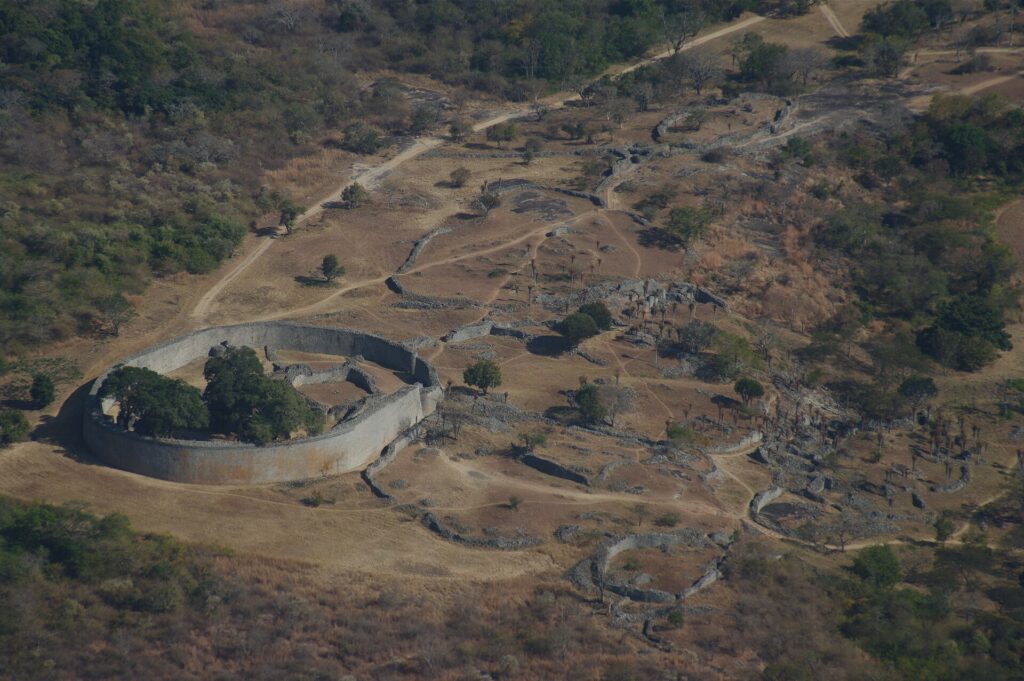
The Lore · Southern Africa · Lore Universe
Zimbabwe plateau (Shona, Rozvi)
Great Zimbabwe (11th-15th century), Mwari/Murenga supreme deity, Nehanda spirit medium, Shona mbira music as spirit communication, gold trade routes.
Why its stories are told
Stories are told to teach, to entertain, to remember and to settle claims. Ngano, told mostly by grandmothers (vanambuya) to children in the evening, teach how to behave, how to see through deceit and why greed and cruelty fail.
The people of this tradition speak of themselves by their dialect and clan names first, and as vaShona (SHOH-nah) collectively; the language is chiShona (chee-SHOH-nah).
The Land · Geography
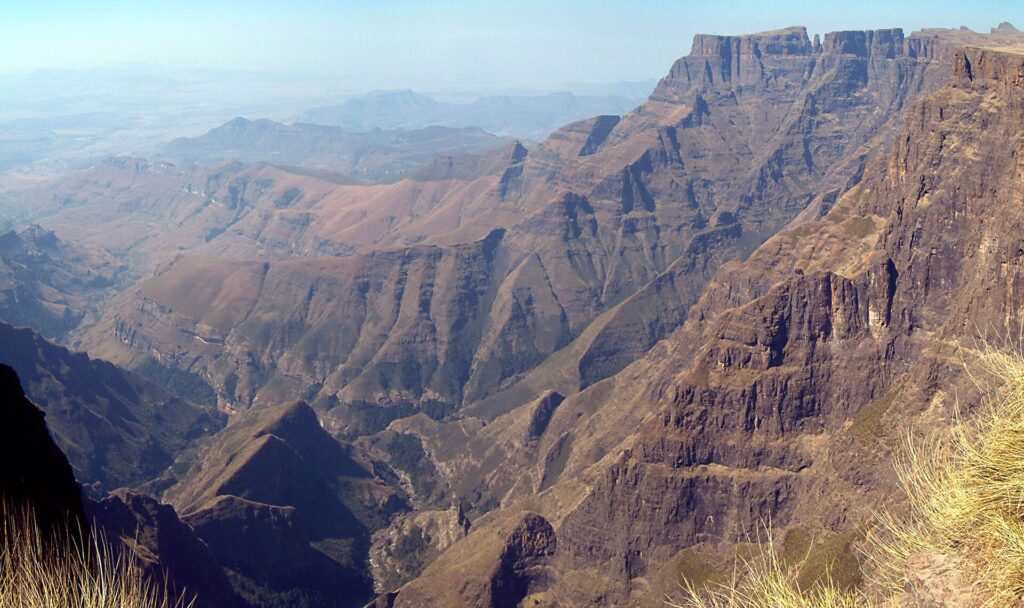
The Zimbabwe plateau is a high, rolling land of granite, between the Zambezi river in the north and the Limpopo in the south, with the eastern highlands rising along the border with Mozambique. Granite domes and kopjes (rocky hills) and great balanced boulders are everywhere, especially in the Matobo Hills. The highveld is grassland and woodland of msasa trees; the lower valleys of the Zambezi and the Limpopo are hotter and drier.
The climate has a single rainy season, roughly November to March, followed by a long dry season. Rain is everything. A late or failed season means hunger, which is why rain-making and the spirits who control rain hold such a central place in the tradition.
The granite itself shaped history. It splits naturally into slabs, which builders used to make the dry-stone walls of Great Zimbabwe and many smaller sites without mortar. Gold lies in the plateau's rocks and was mined and traded to the coast for centuries.
The land is not property but trust. It belongs to the ancestors, especially the mhondoro, and the living use it with their permission. Hills, pools and forests are filled with the presence of the dead.
The People · Cultural Foundation · Society
This tradition belongs to the Shona-speaking peoples of the Zimbabwe plateau: the Karanga of the south-central highveld around Masvingo, the Zezuru of the centre around Harare, the Korekore of the northern escarpment and the Zambezi valley (Dande), the Manyika and Ndau of the eastern highlands and the Mozambique border, and the Kalanga of the south-west around the Matobo Hills and north-eastern Botswana. The Rozvi were the dynasty that ruled from the south-west from the late 17th century.
Speakers of early Bantu languages farmed the plateau from the first millennium CE. Archaeologists trace a line of state-building from Mapungubwe in the Limpopo valley (13th century) to Great Zimbabwe (roughly the 11th to 15th centuries, with the great walls built mostly in the 13th and 14th), then to two successor states: the Mutapa state in the north and the Torwa state centred at Khami in the south-west, which the Rozvi under Changamire Dombo took over in the 1680s. Movement within the plateau, northward toward the Zambezi and westward toward the Matobo Hills, is the migration that shaped the tradition: the founding stories of chiefdoms are stories of ancestors who arrived, settled and became the lion spirits of that land.
1. Hunhu (also unhu): personhood shown through respect, generosity and right conduct toward others. A person is judged by how they treat kin, strangers and elders.
2. Respect for the ancestors and the land. The vadzimu and mhondoro are owners of the land; the living are its tenants and must keep its rules, such as the chisi rest day.
3. Kinship and totem loyalty. The mutupo (totem) and its praise names bind a person to a clan across distance, and marriage rules follow from it.
4. Restoration of balance. Wrongs, especially killing and the cheating of the dead, must be put right, or the wronged spirit returns.
5. Hospitality and sharing, especially of food and beer at ceremonies.
The order of priority runs from ancestors and clan to household and then to the individual. Western stories often reward the person who breaks from the group; Shona stories usually reward the one who honours obligations, and punish cleverness used selfishly, even when the clever one is the hero, as the hare sometimes learns. A reader may find the story logic unfamiliar when a wrong done generations ago drives present events, or when a medium, not the living hero, settles the plot.
Shona society is patrilineal and patrilocal: descent and inheritance usually run through men, and a woman traditionally moves to her husband's home on marriage. Yet women hold important positions of their own, and the tradition's own logic gives them power that patrilineal descent alone does not show.
The vatete, a father's sister, has great authority in her brother's family: she advises on marriage, settles disputes and speaks at ceremonies. A woman remains a member of her father's lineage, and after death she may become a powerful ancestor to her own children's family.
Spirits do not follow social gender lines. Nehanda, one of the most important mhondoro, is a female spirit, and mediums of both female and male spirits may be women or men. Women are prominent as mediums and healers.
At the Matobo shrines, women are recorded as shrine attendants and singers. Grandmothers are the principal tellers of ngano, which gives them a central role in moral teaching.
The stories reflect this complexity. Women appear as cruel stepmothers and as rescuers, as jealous co-wives and as wise sisters, and the greatest heroine of all, Nehanda, is both a historical woman and a spirit.
Age confers status in Shona life, and seniority governs speech, inheritance and access to the ancestors.
Children learn by listening and by joining in song. Young men and women take on work and, through marriage, become adults with households of their own. Adults raise children, farm, and take part in ceremonies. Elders, especially the senior man and senior women of a lineage, speak for the family and address the ancestors on its behalf.
What elders hold that others cannot is knowledge of genealogy, land, clan history and ritual practice, and the right to approach ancestors. They know who is buried where, which land belongs to whom, and how a ceremony must be done. A younger person who addresses an ancestor directly, skipping the senior, breaks protocol.
Seniority also orders the dead. A senior ancestor outranks a junior one, and the spirits of chiefs outrank the spirits of commoners.
The ultimate elder is the ancestor. Becoming an ancestor is the completion of age. For this reason, death in old age with many descendants is a good death, while death in youth, especially without children, is feared because the person may not take up the ancestral role fully.
The Shona plateau has no caste system, but it has known clear distinctions of rank.
At Great Zimbabwe, archaeology shows that the elite lived within the stone walls, on the Hill and in the enclosures, while most people lived in daga (mud) houses outside. Imported glass beads, Chinese ceramics and gold were found in elite areas. Later states, the Mutapa and the Rozvi, had royal lineages, councillors, officials and tributary chiefdoms.
At chiefdom level, rank rests on descent from the founding ancestor. Royal lineages are distinguished from commoner ones, and lineages that arrived later or were conquered may hold lesser positions. Some lineages hold ritual offices instead of chiefship, such as the custodianship of a shrine.
Storytellers are not a separate class. Grandmothers tell ngano; elders and mediums tell history. Mediums, though often of modest birth, gain authority through their spirit, and in some periods their word has outweighed that of chiefs.
In stories, class appears as the contrast between the powerful and the small. The hare against the lion and the elephant, the orphan against a wealthy family, the commoner who becomes a spirit's host: these show that rank does not decide who is right.
The basic unit is the household (imba) within a patrilineal lineage. Lineages belong to clans defined by totem (mutupo), each with praise names (zvidawo). People of the same totem across great distances recognise one another as kin.
Villages (misha) are grouped into wards and chiefdoms (nyika), each under a chief (ishe or mambo) from a royal lineage, with its own mhondoro and territory. In the past, chiefdoms were grouped into larger states: the Great Zimbabwe state, the Mutapa state, the Torwa and Rozvi states, which received tribute and sometimes appointed chiefs.
Membership carries obligations: to help kin in need, contribute to bridewealth and ceremonies, attend funerals, respect elders and keep the land's rules. In return, membership gives land, protection, a place among the ancestors and a share in ceremony.
Expulsion or separation is serious. A person cut off from the lineage, or one who dies far from home without proper rites, loses their place among the living and the dead. Spirits of such people may become mashavi, wandering spirits seeking a host. Accused witches have in the past been driven from their communities, a fate equal to social death.
Through Time · History
By the 10th century CE, farming communities with cattle were living on the plateau and in the Limpopo valley, and trade goods from the Indian Ocean were reaching the interior.
In the 13th century, Mapungubwe, in the Limpopo valley, flourished as a centre of trade and rank, then declined around 1290.
By the 14th century, Great Zimbabwe was the largest centre on the plateau, with the Great Enclosure built in this period and gold trade flowing toward the Swahili town of Kilwa via Sofala.
1450, Great Zimbabwe was in decline, and power moved to the Mutapa state in the north, founded in tradition by Nyatsimba Mutota, and to the Torwa state at Khami in the south-west.
In 1561, the Portuguese Jesuit Gonçalo da Silveira was killed at the Mutapa court, and in the following decades Portuguese traders and soldiers pressed into the north.
In the 1680s and 1690s, Changamire Dombo and his Rozvi army defeated the Portuguese and took over the south-western state.
In the late 1830s, the Ndebele under Mzilikazi settled in the south-west, and the Rozvi state ended.
In 1890, the British South Africa Company's column occupied Mashonaland.
In 1896 to 1897, the Shona and Ndebele rose against colonial rule, guided by mediums including Nehanda and Kaguvi, who were executed in 1898.
By the 10th century CE, farming communities with cattle were living on the plateau and in the Limpopo valley, and trade goods from the Indian Ocean were reaching the interior.
In the 13th century, Mapungubwe, in the Limpopo valley, flourished as a centre of trade and rank, then declined around 1290.
By the 14th century, Great Zimbabwe was the largest centre on the plateau, with the Great Enclosure built in this period and gold trade flowing toward the Swahili town of Kilwa via Sofala.
By c. 1450, Great Zimbabwe was in decline, and power moved to the Mutapa state in the north, founded in tradition by Nyatsimba Mutota, and to the Torwa state at Khami in the south-west.
In 1561, the Portuguese Jesuit Gonçalo da Silveira was killed at the Mutapa court, and in the following decades Portuguese traders and soldiers pressed into the north.
In the 1680s and 1690s, Changamire Dombo and his Rozvi army defeated the Portuguese and took over the south-western state.
In the late 1830s, the Ndebele under Mzilikazi settled in the south-west, and the Rozvi state ended.
In 1890, the British South Africa Company's column occupied Mashonaland.
In 1896 to 1897, the Shona and Ndebele rose against colonial rule, guided by mediums including Nehanda and Kaguvi, who were executed in 1898.
In 1980, after the liberation war, Zimbabwe became independent, taking its name from the stone city.
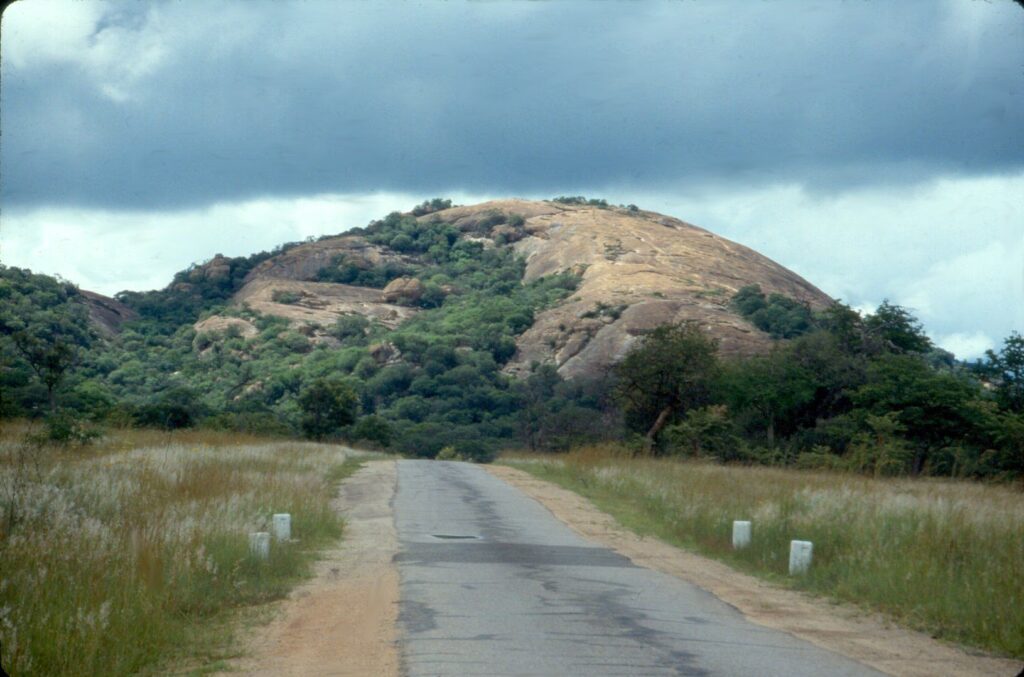
The stories of the plateau are full of arrival. Clan and chiefdom histories commonly begin with an ancestor who came from elsewhere, met people already living there, and made agreements or fought for the land. The previous inhabitants are often remembered as the owners of the soil, who keep ritual duties even after a newcomer becomes chief.
The plateau was never isolated. Gold, ivory and other goods went east to the Swahili coast; glass beads, cloth and Chinese and Persian ceramics came inland. Archaeologists have found coins from Kilwa and Chinese ceramics at Great Zimbabwe. Arab and Swahili traders and, from the 16th century, Portuguese traders settled at fairs and on the Zambezi.
Shona stories exist because the land and its people are held together by relationships with the dead. A chiefdom's history is a sequence of ancestors, each of whom still speaks through a medium; to tell the story of who came first and who married whom is to say who owns the land, who may bring the rain and who may install a chief. Stories therefore do legal and political work as well as moral work.
The Sacred · Deities and Spirits
Appears in accounts of the Matonjeni oracle shrines of the Matobo Hills and in rain-seeking delegations from across the plateau.
Named in the traditions of the 1896-1897 rising, the First Chimurenga, and in the naming of the liberation war of the 1970s.
The rising of 1896-1897 and the hanging of her medium Charwe Nyakasikana in 1898; the remembered saying that her bones would rise again.
The story of the medium Pasipamire, who foretold the coming of strangers and was killed by men sent by the Ndebele king in the 1880s.
The organisation of the 1896-1897 rising in Mashonaland and the execution of his medium alongside Nehanda's in 1898.
The northward migration from the south to the Zambezi in search of salt and the founding of the Mutapa state around the mid-15th century.
The contest with Nyanhehwe Matope, son of Mutota, in which Dzivaguru withdraws, taking rain and light with him.
The creation story of the moon-man, his wives Massassi and Morongo, the drought and his death, recorded by Leo Frobenius.
Sacredness in this tradition comes from relationship with Mwari and the ancestors, and from the land where they dwell.
Places: hills, caves, springs, pools (madziva) and groves where ancestors are buried or where Mwari speaks are sacred. The shrines of the Matobo Hills, the burial sites of chiefs and the forests of the mhondoro may not be farmed, cut or entered carelessly.
Beings: Mwari above all; the mhondoro; the family vadzimu; certain animals, especially the lion, which is associated with the royal spirits, and the bateleur eagle, called shiri ya Mwari, 'bird of God'.
Objects: the mbira dzavadzimu ('mbira of the ancestors'), snuff (bute) offered to spirits, ritual beer brewed for ceremonies, and the cloth, beads and staffs that mark a medium. The soapstone birds of Great Zimbabwe are national symbols today, and their original meaning is still discussed.
Practices and words: the chisi rest day, the totem (mutupo) and its praise names, and the words spoken when addressing ancestors.
The mechanism of sacredness is the presence or association of spirits. A thing, place or day becomes sacred because ancestors claim it, and it remains sacred as long as the living keep its rules.
The structure is a high God, territorial spirits, family spirits and wandering spirits.
Mwari is the high God and creator, known by praise names such as Musikavanhu ('creator of people'), Nyadenga ('of the sky') and Dzivaguru ('great pool'). Mwari is not usually depicted, is linked to rain, fertility and the order of the land, and is approached chiefly through the oracle shrines of the Matobo Hills in the south-west, where a voice is said to speak from the rock. Elsewhere on the plateau, Mwari is approached more often through the ancestors.
The mhondoro, 'lions', are the spirits of founding ancestors and royal figures, such as Nehanda, Chaminuka, Kaguvi and Mutota, each with a territory and a medium. They control rain and judge chiefs.
The vadzimu are family ancestors who look after their own descendants. The mashavi are spirits of strangers and animals who choose living hosts.
The relationship is one of mediation. People address their own vadzimu, who carry concerns upward; chiefdoms address their mhondoro; the Mwari shrines are visited by messengers from distant communities in times of serious drought or crisis. Murenga is discussed in its own place, as the scholarship on that name is less settled.
Ancestors are present and active. The vadzimu of a family watch over its members, protect them from harm, and warn or punish when they are neglected. Illness, failed harvests or quarrels may be read as signs that an ancestor wants attention.
Ancestors communicate through dreams, through illness and misfortune that a diviner interprets, and directly through possession of a medium, when they speak in the first person to their descendants.
The protocol is respectful and ordered. One addresses ancestors through the senior member of the family, often at the doorway or the place where offerings are made, with snuff, beer or a pot of water, and with praise names. Ancestors are approached in order of seniority; a junior ancestor is not addressed past a senior one. At a bira, the family brews beer, invites relatives and plays mbira through the night so the ancestor will come.
What the ancestors want is remembrance, respect, the keeping of clan and land rules, and the continuation of the lineage through children. A person who dies without proper burial or the kurova guva ceremony cannot fully take up the ancestral role, which is why those rites are kept with care.
Shona thought does not usually describe the spirit world as a stack of distinct heavens. It speaks rather of kinds of spirits, ordered by reach and seniority, living in the same land as the people.
At the top is Mwari, who is above and beyond, associated with the sky and the rain and, in the south-west, with the voice from the Matobo shrines. Below Mwari are the mhondoro, royal and territorial ancestors who care for a chiefdom's land and rain. Then come the vadzimu of each family. Beside these are mashavi, spirits of people or animals who died far from home or were never properly settled, and who attach themselves to the living, giving gifts such as healing, hunting or music. Hostile beings include ngozi, the avenging spirits of the wronged, and spirits used by witches.
Crossing happens chiefly in one direction: spirits enter the living through possession, dreams and signs. The living cross toward the spirits through offerings, prayer, music and the mediation of a medium or diviner. The dead pass into the ancestral state at death and are brought home through the kurova guva ceremony. Crossing requires right timing, right persons and right gifts.
Ritual in Shona life marks transitions and restores balance.
Transitions: at birth, a child is introduced to the family's ancestors. Marriage is made through roora, bridewealth, and a long series of negotiations that bind two families. At death, burial is followed a year or more later by kurova guva, 'striking the grave', in which the spirit of the dead is brought home to the household as an ancestor. A chief's installation is approved by the mhondoro speaking through its medium.
Restoration: mukwerera, the rain ceremony held before planting, asks the land's spirits for rain. A bira is held to honour or consult an ancestor, especially when misfortune shows that one is displeased. Compensation ceremonies settle an ngozi. Healing rites, conducted by a n'anga, find and remove the cause of illness.
In stories, ritual appears in all three ways. It is an event: the bira at which a spirit speaks. It is a frame: a history told at a rain ceremony. And it is the resolution: the story ends when the right ceremony is finally performed and balance returns.
Mwari, the high God and creator, is known by praise names including Musikavanhu ('creator of people'), Nyadenga ('of the sky'), Wokumusoro ('the one above') and Dzivaguru ('great pool'). Mwari is not depicted in images, is associated with the sky, rain, fertility and the order of the world, and is described by some sources as having male, female and child aspects. In the south-west, Mwari speaks from the rocks of the Matobo shrines, where messengers bring gifts and requests in times of drought; the ritual protocol belongs to the shrine custodians.
Murenga is a name tied to the 1896 to 1897 rising, which Shona speakers call the Chimurenga, a word widely understood to come from Murenga. Some sources describe Murenga as an ancestral war spirit, others as a title of Mwari; scholars disagree.
Nehanda is a female mhondoro, in Korekore tradition the daughter or sister of the early Mutapa rulers, whose medium Charwe Nyakasikana led resistance in 1896 and was executed in 1898.
Chaminuka, a mhondoro associated with Chitungwiza, is remembered for a medium who foretold the coming of strangers and was killed in the 1880s.
Kaguvi, a mhondoro whose medium Gumboreshumba helped lead the 1896 rising, was executed alongside Nehanda.
Mutota and Dzivaguru are discussed in the deity list below.
Vadzimu (singular mudzimu): family ancestors who protect their descendants. They are addressed by the senior family member, honoured with beer and snuff, and asked for help. When neglected, they send warning signs such as illness.
Mhondoro: 'lions', the spirits of royal ancestors and founders of chiefdoms, guardians of the land and the rain. Each has a territory and a medium. They may appear in lion form, and real lions are sometimes understood as their presence.
Mashavi (singular shavi): spirits of people or animals who died away from home or without proper rites, who choose living hosts. They bring skills: healing, hunting, music, dancing, and in recent times even foreign ways. A shavi of a stranger can make a person good at a trade. Hosts honour their shavi with special dances and cloth.
Ngozi: the avenging spirit of a person who was murdered or badly wronged. It returns to afflict the family of the wrongdoer until compensation is paid. It is the most feared spirit.
Spirits used by varoyi (witches): familiars and harmful powers. These belong to the realm of uroyi and are opposed by healers.
The rules of interaction are seniority, offering, respect and restitution. No spirit is approached without the right person and the right gift.
The lion (shumba) is the most important sacred animal: the form of the mhondoro and a royal symbol. Lions seen near a village may be understood as the spirits watching over it. Shumba is also a major totem.
The bateleur eagle, called shiri ya Mwari, 'bird of God', is regarded as Mwari's messenger. Many scholars link the soapstone birds of Great Zimbabwe to an eagle such as this, though their exact meaning is debated.
The python (shato) is associated with rain and with pools in several traditions of the region, and is treated with respect; in some places it may not be killed.
The njuzu are water spirits recorded in Shona belief, often described as half human or as beings who live in pools and rivers. They may take a person under the water, who, if they return, may come back as a healer. Accounts of their appearance vary by region.
Tsuro, the hare, is the great trickster of ngano, small and clever, who outwits lion, elephant and baboon, but is sometimes caught out by his own greed.
The tortoise (kamba) and baboon (gudo) recur in ngano as rivals and foils to the hare.
Among the main prohibitions recorded:
Land: no work in the fields on chisi, the day of rest owed to the land's spirits in each chiefdom. No cutting of trees, hunting or careless entry into sacred groves, graves and shrines. Some springs and pools may not be disturbed.
Totem: a person may not eat their mutupo animal, and in general may not marry someone of the same totem, which is treated as incest.
Death and the dead: a person must be buried correctly and mourned; the kurova guva ceremony must be done. Murder, especially murder hidden from the community, brings the ngozi.
Mediums: many mediums follow restrictions linked to their spirit, such as avoiding certain foods or objects associated with outsiders. Lan records that some Zambezi valley mediums avoided objects associated with Europeans.
Consequences vary. Drought, failed harvests and illness fall on a whole chiefdom when land rules are broken; ngozi falls on the murderer's family, often for generations, until compensation is made; personal misfortune follows the breaking of family taboos.
What cannot be undone without great cost is the shedding of blood. A ngozi must be settled with compensation and ceremony, and the tradition records that this can take generations.
This part carries no pictures. Gods, spirits, the ancestors and ceremonies are named, with their roles, and drawn as marks only.
The Stories · Signature Stories
The story of Nehanda is the most important Shona narrative today, because it joins ancestral myth, historical resistance and the birth of the nation. In Korekore tradition, Nehanda is a royal spirit from the time of the Mutapa state, linked to the early kings of the north; some versions call her the daughter of Mutota, others his sister.
The Telling · Oral Tradition · Narrative Structure
The Figures · Survival and Diaspora
The Medium (svikiro): a person, often of modest standing, who becomes the voice of an ancestor. Through them the dead speak to the living; their arc is from illness and calling to authority and sometimes martyrdom.
The Founding Ancestor: the arriving chief who takes the land, marries, sets the rules and becomes a mhondoro. Their story is the charter of the chiefdom.
The Trickster, Tsuro the hare: small, clever and often selfish, who outwits the large and powerful. His arc is not reform; he remains himself, and sometimes pays for his tricks.
The Orphan or Wronged Child: a child abused by a stepmother or family, often helped by ancestors or animals, whose suffering is revealed and rewarded. The arc moves from neglect to justice.
The Jealous Relative: a co-wife, sister or brother whose envy drives the plot and is exposed.
The Healer (n'anga): who finds hidden causes and restores balance. Often the turning point of a story.
The Muroyi (witch): who harms in secret and whose exposure is the story's resolution.
The Avenging Dead (ngozi): who returns until justice is done.
These figures stand in relation to the community; each either protects it, tests it, or threatens it.
Survival and diaspora
Yes. The tradition is living. Across Zimbabwe, families hold bira and kurova guva ceremonies, consult n'anga and mediums, and keep the chisi day and totem rules. The Mwari shrines in the Matobo Hills are still visited, and mhondoro mediums are still active in the Zambezi valley and elsewhere. What has changed is the setting.
The Shona tradition did not pass through the Atlantic slave trade in any large or well-documented way, unlike traditions of West and West-Central Africa, so there is no recorded Shona-derived religion in the Americas comparable to those of Yorùbá or Kongo origin. Its diaspora is more recent.
Since independence in 1980, the stories and spirits of the plateau have been publicly reclaimed. Great Zimbabwe gave the nation its name and the Zimbabwe Bird its flag emblem, and the history of the stone builders was restored to the African people who built it, against the colonial-era claims that others had built it.
The Catalog · its places, peoples, practices and sources
The World Bible
For the reader who wants all of it: every section of Stone Builders, in its eleven parts.
The people of this tradition speak of themselves by their dialect and clan names first, and as vaShona (SHOH-nah) collectively; the language is chiShona (chee-SHOH-nah). The name Shona came into general use only in the 19th century and was not originally a self-name, so many speakers still prefer the cluster names: vaKaranga, vaZezuru, vaKorekore, vaManyika, vaNdau, and the closely related Kalanga (TjiKalanga) of south-western Zimbabwe and Botswana. The Rozvi (vaRozvi, ROH-zvee) are the ruling house of the later plateau state.
The tradition's own words for its stories and its sacred life carry its name better than any English label. Ngano (NGAH-noh) are told tales with song; nhoroondo are accounts of the past; madetembedzo and nhetembo are poetry and praise. The stone towns are dzimba dza mabwe, 'houses of stone', from which the country takes its name, Zimbabwe; some scholars prefer dzimba woye, 'venerated houses', as the source. The high God is Mwari (MWAH-ree), Mwali in Kalanga. Ancestral spirits are vadzimu (vah-DZEE-moo, singular mudzimu), and the great lion spirits of the land are mhondoro (mm-hoh-NDOH-roh).
This tradition belongs to the Shona-speaking peoples of the Zimbabwe plateau: the Karanga of the south-central highveld around Masvingo, the Zezuru of the centre around Harare, the Korekore of the northern escarpment and the Zambezi valley (Dande), the Manyika and Ndau of the eastern highlands and the Mozambique border, and the Kalanga of the south-west around the Matobo Hills and north-eastern Botswana. The Rozvi were the dynasty that ruled from the south-west from the late 17th century.
Speakers of early Bantu languages farmed the plateau from the first millennium CE. Archaeologists trace a line of state-building from Mapungubwe in the Limpopo valley (13th century) to Great Zimbabwe (roughly the 11th to 15th centuries, with the great walls built mostly in the 13th and 14th), then to two successor states: the Mutapa state in the north and the Torwa state centred at Khami in the south-west, which the Rozvi under Changamire Dombo took over in the 1680s. Movement within the plateau, northward toward the Zambezi and westward toward the Matobo Hills, is the migration that shaped the tradition: the founding stories of chiefdoms are stories of ancestors who arrived, settled and became the lion spirits of that land.
Shona stories exist because the land and its people are held together by relationships with the dead. A chiefdom's history is a sequence of ancestors, each of whom still speaks through a medium; to tell the story of who came first and who married whom is to say who owns the land, who may bring the rain and who may install a chief. Stories therefore do legal and political work as well as moral work.
The great events behind the tradition are the rise and decline of the stone-building states, the gold and ivory trade with the Swahili coast and later the Portuguese, the 19th-century raids and the arrival of the Ndebele, colonial conquest in 1890, the uprisings of 1896 to 1897 and the liberation war of the 1960s and 1970s. Each of these left its mark in the stories of mhondoro and mediums.
Secular and sacred contexts are distinct. Ngano, the sung tales of the hare and other animals, are told for teaching and enjoyment, by tradition at night around the fire. Accounts of royal ancestors, clan origins and the sayings of mediums belong to sacred and ceremonial settings, such as the bira, where they are spoken with care and by the right people.
This holding is drawn from published scholarship and recorded oral literature; it has not yet been reviewed with community elders or mediums, and that review is still to be done.
The main historical sources are David Beach, The Shona and Zimbabwe 900-1850 (1980); Innocent Pikirayi, The Zimbabwe Culture (2001); Peter Garlake, Great Zimbabwe (1973); and Terence Ranger, Revolt in Southern Rhodesia 1896-7 (1967) and Voices from the Rocks (1999). For religion: Michael Gelfand, Shona Religion (1962); M. L. Daneel, The God of the Matopo Hills (1970); David Lan, Guns and Rain (1985), on mediums in the Zambezi valley; and Herbert Aschwanden on Karanga symbolism. For music, Paul Berliner, The Soul of Mbira (1978). For oral literature, the work of Aaron Hodza and George Fortune on Shona praise poetry, and Fortune's ngano collections.
Shona-speaking scholars and writers whose work should guide any review include Solomon Mutswairo, Herbert Chitepo, Gordon Chavunduka (on healing and the Zimbabwe National Traditional Healers Association) and Innocent Pikirayi. Institutions engaged with the tradition include National Museums and Monuments of Zimbabwe, which manages Great Zimbabwe, and the University of Zimbabwe.
1. Hunhu (also unhu): personhood shown through respect, generosity and right conduct toward others. A person is judged by how they treat kin, strangers and elders.
2. Respect for the ancestors and the land. The vadzimu and mhondoro are owners of the land; the living are its tenants and must keep its rules, such as the chisi rest day.
3. Kinship and totem loyalty. The mutupo (totem) and its praise names bind a person to a clan across distance, and marriage rules follow from it.
4. Restoration of balance. Wrongs, especially killing and the cheating of the dead, must be put right, or the wronged spirit returns.
5. Hospitality and sharing, especially of food and beer at ceremonies.
The order of priority runs from ancestors and clan to household and then to the individual. Western stories often reward the person who breaks from the group; Shona stories usually reward the one who honours obligations, and punish cleverness used selfishly, even when the clever one is the hero, as the hare sometimes learns. A reader may find the story logic unfamiliar when a wrong done generations ago drives present events, or when a medium, not the living hero, settles the plot.
Causation in this tradition is relational. Illness, drought, misfortune or success are asked about not only as events but as messages: which spirit is unhappy, what has been neglected, who has done wrong? A diviner (n'anga) is consulted to find the cause among people and spirits, not only in the body or the weather.
The individual exists inside a web of living kin, the dead of the family, the lion spirits of the chiefdom and, above them, Mwari. Each person also may carry a shavi, a spirit that gives a particular gift, so individuality itself is partly understood as something given by a spirit.
Time is layered. The founding ancestors are not simply in the past; they speak now through their mediums, and the medium of a 16th-century royal spirit can address a 20th-century gathering in the first person. Generations succeed one another in a line, while ceremonies return each season and each year, so time is both successive and recurring.
Reality is one world with a seen and an unseen side, closely joined. The dead live in the land, in the forests, pools and hills, rather than in a distant heaven, and they can enter the living through possession.
Stories are told to teach, to entertain, to remember and to settle claims. Ngano, told mostly by grandmothers (vanambuya) to children in the evening, teach how to behave, how to see through deceit and why greed and cruelty fail. Clan praise poetry (madetembedzo) and family accounts are spoken by elders and at ceremonies to bind people to their lineage. Histories of chiefdoms are held by senior men, by mediums and by court specialists, and in the past by royal praise-singers.
The most authoritative voice belongs to the svikiro, the medium, when possessed. What an ancestor says through a medium is not one person's opinion but the spirit's word, which gives mediums great authority, sometimes above chiefs; David Lan's work shows how mediums gave legitimacy to guerrillas during the liberation war.
Timing matters. Ngano belong to the night, after work. Ancestral histories belong to the bira, to funerals and to the kurova guva ceremony after a death, to rain ceremonies before planting and to moments of crisis, such as drought or war, when the living ask the ancestors what has gone wrong.
Two shapes run through Shona storytelling. The first is the ngano: a short tale built around a repeated song. The narrator tells the action in prose and the audience sings the refrain at set points; the story moves forward in episodes, each one marked by the song, until a trick is revealed or a wrong is punished. Repetition with small changes, often in threes, is the engine.
The second is the genealogical history of a chiefdom or spirit: an ancestor arrives, does a deed (kills a rival, marries, finds water, defies a king), dies, and becomes a mhondoro whose medium continues to speak. These stories are open-ended. They end not with a closing but with a living spirit that will speak again.
The tradition is best described as a hybrid. The tales are cyclical and episodic, held together by song; the histories are lineal and cumulative, each generation added to the last; and both are surrounded by ceremony, which re-opens the old stories whenever a medium is possessed. Story movement is less a climb to a single climax than a widening chain of relationship between the living, the dead and the land.
The driving force in Shona narrative is most often imbalance in a relationship: a debt unpaid, a death unavenged, a rule of the land broken, a spirit neglected. Western-style conflict between opponents does appear, in the hare's contests with larger animals, in the struggle between Nyanhehwe and Dzivaguru over the land and the rain, and in the wars of the 1890s, but the opponents are usually drawn into a larger question of what is owed and to whom.
The ngozi, the avenging spirit of a person who was murdered or wronged, is the clearest form of this tension. Its story begins with a wrong that the living have hidden; misfortune follows the wrongdoer's family until the wrong is admitted and compensation is paid. The tension is discovery as well as conflict: someone must find out, through divination, what lies behind the trouble.
In ngano, tension often arises from greed, jealousy or foolishness inside a household, such as a stepmother's cruelty or a sister's envy, and from the trickster testing the limits of the strong. In all of these the story asks the audience to recognise the broken bond before it can be mended.
The protagonist varies with the kind of story. In ngano the central figure is often an animal, especially Tsuro the hare, or a child, an orphan or a girl wronged by her family. These are small figures who survive by wit or by keeping faith, and the audience sides with them.
In histories the protagonist is an ancestor who became a spirit: Nyatsimba Mutota leading his people north, Nehanda guiding resistance, Chaminuka the seer who foretold the coming of strangers. Their stories continue after death, so the true protagonist is a spirit whose life is longer than any human one, and whose medium carries the story forward.
A third kind of protagonist is collective: the chiefdom or clan that suffers drought and must restore its relationship with the land. In stories of the 1896 rising and of the liberation war, the people as a whole, led by mediums, are at the centre.
This matters for the shape of the story. When the protagonist is a living spirit, the story does not end with death; when it is a community, its success is measured in rain, harvest and peace rather than in personal triumph.
The most satisfying ending in this tradition is restoration: rain falls, the sick recover, the wronged spirit accepts compensation and leaves the family in peace, or the lost child is welcomed home. The world returns to right relation rather than to a new state of victory.
In ngano, the ending often punishes the greedy and rewards the patient or the kind. The trickster hare sometimes wins and sometimes is caught; when he wins against the strong, the ending pleases because the small have outwitted the powerful, and when he is caught, it pleases because selfishness has been checked. Many tales close with an explanation of how something came to be, such as why an animal looks as it does.
In ancestral history, resolution is continuation. An ancestor's death is not the end of the tale; the ancestor becomes a mhondoro, is given a medium and keeps speaking. The phrase widely remembered from Nehanda, that her bones would rise again, is part of this pattern; whether she said it is debated by historians, but it shaped how the liberation war understood itself. A satisfying ending in this cosmology leaves a door open to the next speaking.
Shona narrative time is layered. Three streams run together: the time of the founding ancestors, the time of the living, and the seasonal round of planting, rain and harvest.
Genealogical histories move in a line: this ancestor came first, then his son, then the chiefdom divided. Yet the founding ancestors are present now, through mediums, and speak in the first person about deeds of centuries ago. When the medium of Nehanda addressed fighters in the 1970s, the time of the 1890s and the time of the war were treated as one continuing event.
The agricultural year adds a circle. Each year the rain ceremony (mukwerera) returns before planting, and the stories and prayers told then are the same each year. The year after a death, the kurova guva ceremony brings the deceased home as an ancestor, so every family's history also turns in a regular cycle.
Ngano have their own time: an undated once-upon-a-time opened by the narrator's formula. They stand outside history altogether and can be retold at any point. Readers should expect stories in which past and present speak to each other directly.
The community is rarely just a background. In many stories it is the party that suffers and the party that is healed. Drought falls on the whole chiefdom when its rules are broken, and the remedy is collective: elders gather, consult the medium, brew beer, perform the ceremony.
Individual characters are understood through their place in the community: as someone's child, wife, sister's son, or as a member of a totem clan. A character who acts alone, especially a witch (muroyi), who is by definition someone who works secretly against others, is a figure of danger. A person who wins by keeping faith with kin is a figure of honour.
The community also expects the story to do something. Listeners to ngano must sing the refrain, and without them the tale cannot go on. At a bira, the gathering must play, sing, dance and clap so that the spirit will come; the story of the ancestor is drawn out by the participation of everyone present.
What the community expects, above all, is that the story will remind it of its obligations and of who it is, and that it will leave people in better relation with one another and with the dead.
Morality in this tradition is relational rather than abstract. Right action is that which keeps good relations with kin, neighbours, ancestors and the land; wrong action is that which breaks them. The same act can be judged differently depending on who is wronged and whether amends are made.
What earns the deepest condemnation is murder, especially hidden murder, which creates an ngozi; witchcraft (uroyi), the secret use of power to harm; incest; cheating on debts, especially bridewealth (roora); and disrespect toward the land and ancestors, such as working the fields on the chisi day or cutting trees in a sacred grove.
Honour comes from hunhu: generosity, respect for elders, care for orphans and strangers, courage in defence of the community and faithfulness to the ancestors. A chief who provides, a medium who speaks truly and a child who obeys good counsel are honoured figures.
Stories teach this logic through consequence. The greedy brother loses what he grabbed, the cruel stepmother is exposed, the murderer's family is followed by misfortune until the wrong is admitted. The listener learns that harm returns, often across generations, and that the cure is acknowledgement and restitution rather than punishment alone.
The central transformation is from living person to ancestor. Through death, burial and the kurova guva ceremony a year or more later, a person becomes a mudzimu who cares for descendants. The greatest become mhondoro, lion spirits of the land. This transformation is celebrated; it is the purpose of a good life.
A second transformation is possession. An ordinary person who suffers a calling illness may be revealed as a host chosen by a spirit and, after recognition and training, becomes a svikiro, a medium. The person does not stop being themselves, but a new voice now speaks through them.
In ngano, transformations are often literal: a person becomes an animal, a girl is turned into a bird or a tree, the hare changes shape or disguises himself. Many end with a lasting change in the world, explaining the markings of animals or the origin of a custom.
What the tradition mourns is the failed transformation: the person who dies badly, far from home, unburied or wronged, and who cannot become a caring ancestor but returns as ngozi, or wanders as a spirit without a place. Such stories warn the living to bury, mourn and remember correctly.
Sacredness in this tradition comes from relationship with Mwari and the ancestors, and from the land where they dwell.
Places: hills, caves, springs, pools (madziva) and groves where ancestors are buried or where Mwari speaks are sacred. The shrines of the Matobo Hills, the burial sites of chiefs and the forests of the mhondoro may not be farmed, cut or entered carelessly.
Beings: Mwari above all; the mhondoro; the family vadzimu; certain animals, especially the lion, which is associated with the royal spirits, and the bateleur eagle, called shiri ya Mwari, 'bird of God'.
Objects: the mbira dzavadzimu ('mbira of the ancestors'), snuff (bute) offered to spirits, ritual beer brewed for ceremonies, and the cloth, beads and staffs that mark a medium. The soapstone birds of Great Zimbabwe are national symbols today, and their original meaning is still discussed.
Practices and words: the chisi rest day, the totem (mutupo) and its praise names, and the words spoken when addressing ancestors.
The mechanism of sacredness is the presence or association of spirits. A thing, place or day becomes sacred because ancestors claim it, and it remains sacred as long as the living keep its rules.
Ancestors are present and active. The vadzimu of a family watch over its members, protect them from harm, and warn or punish when they are neglected. Illness, failed harvests or quarrels may be read as signs that an ancestor wants attention.
Ancestors communicate through dreams, through illness and misfortune that a diviner interprets, and directly through possession of a medium, when they speak in the first person to their descendants.
The protocol is respectful and ordered. One addresses ancestors through the senior member of the family, often at the doorway or the place where offerings are made, with snuff, beer or a pot of water, and with praise names. Ancestors are approached in order of seniority; a junior ancestor is not addressed past a senior one. At a bira, the family brews beer, invites relatives and plays mbira through the night so the ancestor will come.
What the ancestors want is remembrance, respect, the keeping of clan and land rules, and the continuation of the lineage through children. A person who dies without proper burial or the kurova guva ceremony cannot fully take up the ancestral role, which is why those rites are kept with care.
Shona thought does not usually describe the spirit world as a stack of distinct heavens. It speaks rather of kinds of spirits, ordered by reach and seniority, living in the same land as the people.
At the top is Mwari, who is above and beyond, associated with the sky and the rain and, in the south-west, with the voice from the Matobo shrines. Below Mwari are the mhondoro, royal and territorial ancestors who care for a chiefdom's land and rain. Then come the vadzimu of each family. Beside these are mashavi, spirits of people or animals who died far from home or were never properly settled, and who attach themselves to the living, giving gifts such as healing, hunting or music. Hostile beings include ngozi, the avenging spirits of the wronged, and spirits used by witches.
Crossing happens chiefly in one direction: spirits enter the living through possession, dreams and signs. The living cross toward the spirits through offerings, prayer, music and the mediation of a medium or diviner. The dead pass into the ancestral state at death and are brought home through the kurova guva ceremony. Crossing requires right timing, right persons and right gifts.
Ritual in Shona life marks transitions and restores balance.
Transitions: at birth, a child is introduced to the family's ancestors. Marriage is made through roora, bridewealth, and a long series of negotiations that bind two families. At death, burial is followed a year or more later by kurova guva, 'striking the grave', in which the spirit of the dead is brought home to the household as an ancestor. A chief's installation is approved by the mhondoro speaking through its medium.
Restoration: mukwerera, the rain ceremony held before planting, asks the land's spirits for rain. A bira is held to honour or consult an ancestor, especially when misfortune shows that one is displeased. Compensation ceremonies settle an ngozi. Healing rites, conducted by a n'anga, find and remove the cause of illness.
In stories, ritual appears in all three ways. It is an event: the bira at which a spirit speaks. It is a frame: a history told at a rain ceremony. And it is the resolution: the story ends when the right ceremony is finally performed and balance returns.
The structure is a high God, territorial spirits, family spirits and wandering spirits.
Mwari is the high God and creator, known by praise names such as Musikavanhu ('creator of people'), Nyadenga ('of the sky') and Dzivaguru ('great pool'). Mwari is not usually depicted, is linked to rain, fertility and the order of the land, and is approached chiefly through the oracle shrines of the Matobo Hills in the south-west, where a voice is said to speak from the rock. Elsewhere on the plateau, Mwari is approached more often through the ancestors.
The mhondoro, 'lions', are the spirits of founding ancestors and royal figures, such as Nehanda, Chaminuka, Kaguvi and Mutota, each with a territory and a medium. They control rain and judge chiefs.
The vadzimu are family ancestors who look after their own descendants. The mashavi are spirits of strangers and animals who choose living hosts.
The relationship is one of mediation. People address their own vadzimu, who carry concerns upward; chiefdoms address their mhondoro; the Mwari shrines are visited by messengers from distant communities in times of serious drought or crisis. Murenga is discussed in its own place, as the scholarship on that name is less settled.
Ngano are told with lively voices and changes of pitch for each character, slow and quick passages, and frequent repetition. The narrator commonly opens with a formula; collections record the narrator saying Paivapo ('there was once') and the listeners answering with a set response, often recorded as Dzepfunde. The closing formula marks the end of the tale and returns listeners to the present.
The defining technique is the song. Each tale has one or more songs, often sung by the characters themselves, that the narrator leads and the audience answers in call and response. The song repeats, sometimes with small changes, each time the action reaches a turning point.
Praise poetry (madetembedzo, nhetembo) uses parallelism, repetition of praise names, epithets and rapid delivery. Clan praise names (zvidawo) are recited in a fixed form, linking a person to the totem and its history.
In ceremonial speech the voice of a possessed medium is often marked by change: older diction, a different pitch, sometimes a sound associated with the spirit, such as the growl linked to the lion spirits. Silences, deliberate pauses and indirect speech, including proverbs (tsumo), carry meaning, especially when elders speak.
The mbira dzavadzimu is the instrument most closely tied to the spirit world: a set of metal keys, commonly about twenty-two or more, mounted on a hardwood board, played with the thumbs and forefinger, and usually placed inside a large calabash resonator (deze). Bottle tops or shells fixed to the resonator add a buzzing sound valued by players. Two or more mbira interlock their parts, and the music is cyclical: patterns repeat with variation for hours.
The hosho, a pair of gourd rattles, keeps the beat. Drums (ngoma) accompany many ceremonies and dances. Singers and dancers join, with hand-clapping and ululation.
At a bira, the setting is a dark room or a homestead at night, beer in large pots, snuff, and family and neighbours gathered. Pieces such as Nhemamusasa and Nyamamusango are widely known in the mbira repertoire and are regarded as favoured by ancestors.
The body is active throughout. Dancers stamp and move in circles; mediums who become possessed change posture, put on cloth associated with the spirit, take up a staff or other marks, and begin to speak as the ancestor. Narrators of ngano gesture, act out characters and lead songs with their whole bodies.
In Shona storytelling the listeners are part of the performance. In ngano, the audience answers the opening formula, sings the refrain of each song, and sometimes comments or laughs along the way. Without the chorus the story cannot continue; the narrator stops and waits. Children learn the songs by joining in, and through repetition learn the tales themselves.
At a bira, participation is essential to the ceremony's success. Everyone sings, claps, dances and calls out; the energy of the gathering, built over many hours of mbira and song, is understood to draw the spirit and allow it to enter its medium. When the ancestor arrives, the family greets it, offers snuff and beer, and speaks with it, asking questions and receiving answers. The audience becomes the party in a conversation.
In praise poetry, listeners respond to the recitation of praise names with acclamation and sometimes add praises of their own.
In every setting, the relationship is co-creation. The story does not belong to the teller alone; it is completed by the people who hear it and answer, and a story told to silence is incomplete.
Several devices carry the tradition across generations.
Song and refrain: each ngano is held together by its song, which children learn first and through which they recall the plot. Mbira music, with its repeating patterns, carries a large shared repertoire of named pieces passed from player to player.
Praise names: the totem (mutupo) and its praise names (zvidawo) hold condensed history: the animal, the place of origin, the deeds of ancestors. Reciting them recalls the clan's story.
Genealogy: lists of ancestors and the order of succession to chiefship are kept by senior men and by mediums. Disputes over succession are often settled by these accounts, which keeps them in active use.
Mediums: the svikiro is a living archive. When an ancestor speaks through its medium, the history of that ancestor is renewed in public. A medium's line of succession can last for centuries.
Land and landmarks: hills, pools, graves and ruins hold memory. To name a hill is to recall who is buried there and what happened.
Repetition in ceremony, the regular return of rain and kurova guva rites, means the stories are spoken again and again, which is what keeps them alive.
The power system of this tradition is the relationship between the living and spirits, worked through mediums, diviners, medicines (mishonga) and ritual.
What can be done: a medium can bring an ancestor to speak; a n'anga (healer and diviner) can find the cause of illness or misfortune by throwing hakata (divining pieces) or through a guiding spirit, and can prepare medicines to heal, protect and strengthen. Rain can be asked for through the proper ceremonies and the mhondoro. A shavi can give a person special skills: hunting, healing, music, war.
What cannot be done by legitimate means: harm cannot be done in secret without becoming witchcraft (uroyi). Rain cannot be commanded by force; it is given by the spirits when the land is in good order. A ngozi cannot simply be driven off; it must be settled with compensation.
The rules are moral as much as technical. Power used for the community is approved; power used secretly for personal gain or to harm is condemned. Unstated rules include seniority: one speaks to ancestors through the right person, and a medium must be recognised by the community and tested before being accepted.
Power comes first from the spirits. A medium's authority comes from the mhondoro or mudzimu who possesses them; a n'anga's from a healing spirit (often a shavi or an ancestor) and from knowledge of plants and medicines; a chief's from descent from the founding ancestor and from the approval of the mhondoro.
Inheritance matters: chiefship passes through recognised lineages, often between brothers before sons, and the spirits of a family tend to choose hosts among their own descendants. But spirit choice is not fully predictable. A spirit may choose an unlikely person, and the community must test the claim.
Knowledge earned through apprenticeship to an older healer, learning plants, divination and ritual, adds to a healer's power. Gifts brought by mashavi come from outside the lineage entirely: from strangers, foreigners or animals whose spirits have no home.
Power that is taken illegitimately is the domain of the muroyi, whose power is said to come from forbidden medicines and the misuse of spirits.
The cost of access is real. Mediums face restrictions on diet, behaviour and movement, sometimes for life; a calling can come as illness; and the obligations to the spirit never end.
Among the main prohibitions recorded:
Land: no work in the fields on chisi, the day of rest owed to the land's spirits in each chiefdom. No cutting of trees, hunting or careless entry into sacred groves, graves and shrines. Some springs and pools may not be disturbed.
Totem: a person may not eat their mutupo animal, and in general may not marry someone of the same totem, which is treated as incest.
Death and the dead: a person must be buried correctly and mourned; the kurova guva ceremony must be done. Murder, especially murder hidden from the community, brings the ngozi.
Mediums: many mediums follow restrictions linked to their spirit, such as avoiding certain foods or objects associated with outsiders. Lan records that some Zambezi valley mediums avoided objects associated with Europeans.
Consequences vary. Drought, failed harvests and illness fall on a whole chiefdom when land rules are broken; ngozi falls on the murderer's family, often for generations, until compensation is made; personal misfortune follows the breaking of family taboos.
What cannot be undone without great cost is the shedding of blood. A ngozi must be settled with compensation and ceremony, and the tradition records that this can take generations.
Among the Shona of central and northern Zimbabwe, there is no general circumcision school for young men or women such as exists among some neighbouring peoples; some southern and eastern groups, and the Venda and Lemba nearby, have their own rites. Coming of age is marked more by instruction from aunts (vatete), uncles and grandparents, especially about marriage and adult duties.
The initiation that matters most for spiritual power is the making of a medium or a healer. It often begins with illness or strange behaviour that ordinary treatment cannot cure. A diviner identifies the cause: a spirit wishes to use this person. The family then holds ceremonies, usually a bira, at which the spirit is called and asked to name itself. The person may undergo tests to show the spirit is genuine, and then receives the cloth and objects associated with the spirit.
For healers, training with an experienced n'anga follows, learning medicines, divination and ritual.
What changes is the person's social being. The individual who was ill becomes a vessel for an ancestor, with a new name in ceremony and new obligations. The details of training belong to the healers and mediums who give it, and are not set out here.
Shona society is patrilineal and patrilocal: descent and inheritance usually run through men, and a woman traditionally moves to her husband's home on marriage. Yet women hold important positions of their own, and the tradition's own logic gives them power that patrilineal descent alone does not show.
The vatete, a father's sister, has great authority in her brother's family: she advises on marriage, settles disputes and speaks at ceremonies. A woman remains a member of her father's lineage, and after death she may become a powerful ancestor to her own children's family.
Spirits do not follow social gender lines. Nehanda, one of the most important mhondoro, is a female spirit, and mediums of both female and male spirits may be women or men. Women are prominent as mediums and healers.
At the Matobo shrines, women are recorded as shrine attendants and singers. Grandmothers are the principal tellers of ngano, which gives them a central role in moral teaching.
The stories reflect this complexity. Women appear as cruel stepmothers and as rescuers, as jealous co-wives and as wise sisters, and the greatest heroine of all, Nehanda, is both a historical woman and a spirit.
Age confers status in Shona life, and seniority governs speech, inheritance and access to the ancestors.
Children learn by listening and by joining in song. Young men and women take on work and, through marriage, become adults with households of their own. Adults raise children, farm, and take part in ceremonies. Elders, especially the senior man and senior women of a lineage, speak for the family and address the ancestors on its behalf.
What elders hold that others cannot is knowledge of genealogy, land, clan history and ritual practice, and the right to approach ancestors. They know who is buried where, which land belongs to whom, and how a ceremony must be done. A younger person who addresses an ancestor directly, skipping the senior, breaks protocol.
Seniority also orders the dead. A senior ancestor outranks a junior one, and the spirits of chiefs outrank the spirits of commoners.
The ultimate elder is the ancestor. Becoming an ancestor is the completion of age. For this reason, death in old age with many descendants is a good death, while death in youth, especially without children, is feared because the person may not take up the ancestral role fully.
The Shona plateau has no caste system, but it has known clear distinctions of rank.
At Great Zimbabwe, archaeology shows that the elite lived within the stone walls, on the Hill and in the enclosures, while most people lived in daga (mud) houses outside. Imported glass beads, Chinese ceramics and gold were found in elite areas. Later states, the Mutapa and the Rozvi, had royal lineages, councillors, officials and tributary chiefdoms.
At chiefdom level, rank rests on descent from the founding ancestor. Royal lineages are distinguished from commoner ones, and lineages that arrived later or were conquered may hold lesser positions. Some lineages hold ritual offices instead of chiefship, such as the custodianship of a shrine.
Storytellers are not a separate class. Grandmothers tell ngano; elders and mediums tell history. Mediums, though often of modest birth, gain authority through their spirit, and in some periods their word has outweighed that of chiefs.
In stories, class appears as the contrast between the powerful and the small. The hare against the lion and the elephant, the orphan against a wealthy family, the commoner who becomes a spirit's host: these show that rank does not decide who is right.
The basic unit is the household (imba) within a patrilineal lineage. Lineages belong to clans defined by totem (mutupo), each with praise names (zvidawo). People of the same totem across great distances recognise one another as kin.
Villages (misha) are grouped into wards and chiefdoms (nyika), each under a chief (ishe or mambo) from a royal lineage, with its own mhondoro and territory. In the past, chiefdoms were grouped into larger states: the Great Zimbabwe state, the Mutapa state, the Torwa and Rozvi states, which received tribute and sometimes appointed chiefs.
Membership carries obligations: to help kin in need, contribute to bridewealth and ceremonies, attend funerals, respect elders and keep the land's rules. In return, membership gives land, protection, a place among the ancestors and a share in ceremony.
Expulsion or separation is serious. A person cut off from the lineage, or one who dies far from home without proper rites, loses their place among the living and the dead. Spirits of such people may become mashavi, wandering spirits seeking a host. Accused witches have in the past been driven from their communities, a fate equal to social death.
The Zimbabwe plateau is a high, rolling land of granite, between the Zambezi river in the north and the Limpopo in the south, with the eastern highlands rising along the border with Mozambique. Granite domes and kopjes (rocky hills) and great balanced boulders are everywhere, especially in the Matobo Hills. The highveld is grassland and woodland of msasa trees; the lower valleys of the Zambezi and the Limpopo are hotter and drier.
The climate has a single rainy season, roughly November to March, followed by a long dry season. Rain is everything. A late or failed season means hunger, which is why rain-making and the spirits who control rain hold such a central place in the tradition.
The granite itself shaped history. It splits naturally into slabs, which builders used to make the dry-stone walls of Great Zimbabwe and many smaller sites without mortar. Gold lies in the plateau's rocks and was mined and traded to the coast for centuries.
The land is not property but trust. It belongs to the ancestors, especially the mhondoro, and the living use it with their permission. Hills, pools and forests are filled with the presence of the dead.
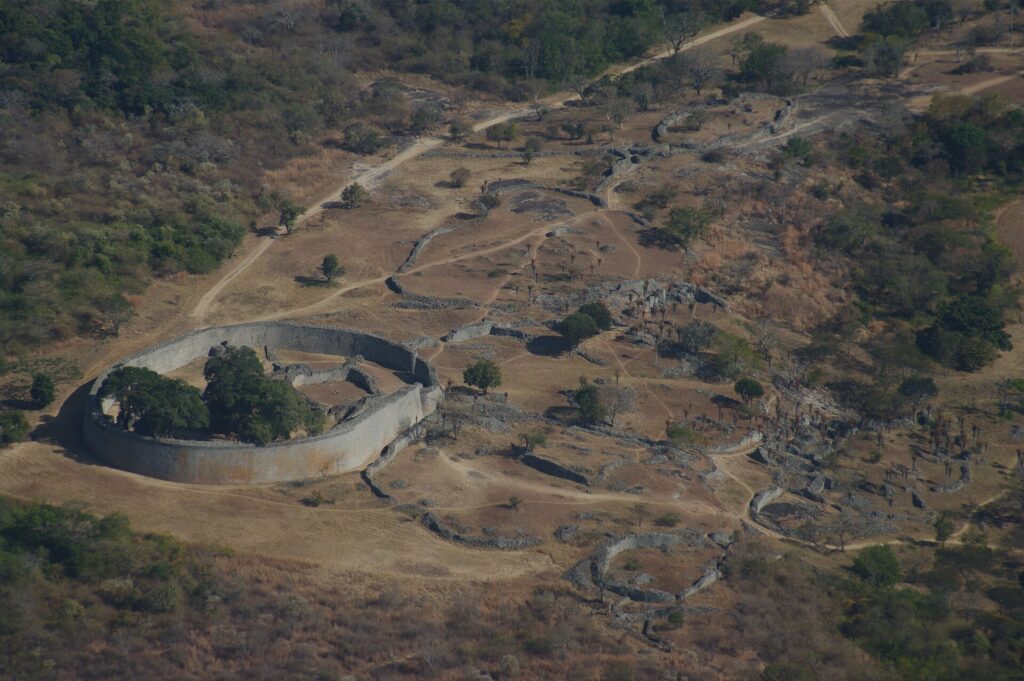
Great Zimbabwe, near Masvingo: the largest stone city of the plateau, with the Hill Complex, the Great Enclosure and its conical tower, and the Valley ruins. Archaeologists date its main period to roughly the 13th to 15th centuries. Today it is both a national symbol and a place where ceremonies are held, and its use is negotiated between National Museums and Monuments and local families.
The Matobo Hills (Matopos) and the Mwari shrines: the hills south of Bulawayo hold the oracle shrines of Mwari, known collectively as Matonjeni, including Njelele, Dula and Zhame. Delegations from across the region have come to these shrines for rain. The shrines and their custodians follow their own rules, and what happens inside belongs to them.
Mount Nyangani, the highest point in Zimbabwe, in the eastern highlands: regarded as sacred, with stories of people disappearing on its slopes, and local practices of asking permission before climbing.
Chinhoyi Caves (Chirorodziva, 'pool of the fallen'): a deep blue pool linked to stories of conflict and the past.
The Zambezi valley in Dande: the home of many of the great northern mhondoro, studied by David Lan.
In narratives, these places function as sources of power and as the destinations of delegations seeking rain.
Shona cosmology is mapped onto the land more than into separate spaces. Mwari is associated with the sky (denga) and with rain, and also with the rock and the pool: one of Mwari's praise names, Dzivaguru, means 'great pool'. Heaven and the deep water are both places of the divine.
The ancestors live in the earth and in the land, especially at graves, hills and groves. When the ancestors are said to be 'in the soil', this is literal and spiritual at once: the land itself holds the dead.
The homestead has its own sacred geography. The kitchen hut, where the hearth is, and specific places inside the home are linked to the family's ancestors; offerings are made there. The village and its fields belong to the chiefdom's spirit; beyond them, in the forest and the wild, live wandering spirits and dangerous powers.
Movement between realms happens through specific means. The dead cross at death and return home through kurova guva. Spirits cross into the living through possession, usually at a bira with music. The living send messages upward through prayer, snuff, beer and the voice of a medium, and in the south-west through messengers to the Mwari shrines.
By the 10th century CE, farming communities with cattle were living on the plateau and in the Limpopo valley, and trade goods from the Indian Ocean were reaching the interior.
In the 13th century, Mapungubwe, in the Limpopo valley, flourished as a centre of trade and rank, then declined around 1290.
By the 14th century, Great Zimbabwe was the largest centre on the plateau, with the Great Enclosure built in this period and gold trade flowing toward the Swahili town of Kilwa via Sofala.
By c. 1450, Great Zimbabwe was in decline, and power moved to the Mutapa state in the north, founded in tradition by Nyatsimba Mutota, and to the Torwa state at Khami in the south-west.
In 1561, the Portuguese Jesuit Gonçalo da Silveira was killed at the Mutapa court, and in the following decades Portuguese traders and soldiers pressed into the north.
In the 1680s and 1690s, Changamire Dombo and his Rozvi army defeated the Portuguese and took over the south-western state.
In the late 1830s, the Ndebele under Mzilikazi settled in the south-west, and the Rozvi state ended.
In 1890, the British South Africa Company's column occupied Mashonaland.
In 1896 to 1897, the Shona and Ndebele rose against colonial rule, guided by mediums including Nehanda and Kaguvi, who were executed in 1898.
In 1980, after the liberation war, Zimbabwe became independent, taking its name from the stone city.
The stories of the plateau are full of arrival. Clan and chiefdom histories commonly begin with an ancestor who came from elsewhere, met people already living there, and made agreements or fought for the land. The previous inhabitants are often remembered as the owners of the soil, who keep ritual duties even after a newcomer becomes chief.
The best-known movement is the northward migration associated with Nyatsimba Mutota, remembered as moving from the south (often linked to the Great Zimbabwe area) toward the Zambezi in search of salt, and founding the Mutapa state. The spirits of Mutota and his descendants became the great mhondoro of the north.
Another is the rise of the Rozvi under Changamire Dombo in the late 17th century. Rozvi groups later scattered northward and eastward under pressure from Nguni-speaking invaders in the 1830s, carrying their name and claims with them.
What was carried in migration was the line of ancestors and the totem, which did not depend on place. What was lost was the direct tie to the graves of the earlier dead, which is why distant groups have continued to send messengers to old shrines.
In modern times, labour migration to South Africa and Britain has created Shona communities abroad who still return for ceremonies.
The plateau was never isolated. Gold, ivory and other goods went east to the Swahili coast; glass beads, cloth and Chinese and Persian ceramics came inland. Archaeologists have found coins from Kilwa and Chinese ceramics at Great Zimbabwe. Arab and Swahili traders and, from the 16th century, Portuguese traders settled at fairs and on the Zambezi.
The Shona states borrowed goods and ideas but kept control of their own religion and politics. The Mutapa rulers dealt with the Portuguese on their own terms for long periods, and the Rozvi drove them from the plateau in the 1690s. Some Portuguese who settled became part of local society, and the prazo estates of the Zambezi valley mixed Portuguese and African practice.
In the 19th century, the Ndebele settled in the south-west, and the Mwari shrines came to serve Ndebele as well as Kalanga and Shona communities; the Ndebele kings sent their own messengers to the shrines. Venda and Sotho-speaking neighbours shared elements of the Mwari faith.
Christian missions arrived from the late 19th century. Many Shona today are Christian and also honour ancestors; African independent churches, such as those studied by M. L. Daneel, combine both. The tradition kept its integrity by absorbing new elements into its relationship with the ancestors rather than surrendering it.
Yes. The tradition is living. Across Zimbabwe, families hold bira and kurova guva ceremonies, consult n'anga and mediums, and keep the chisi day and totem rules. The Mwari shrines in the Matobo Hills are still visited, and mhondoro mediums are still active in the Zambezi valley and elsewhere.
What has changed is the setting. Most Shona today are Christian, and many combine church membership with ancestral obligations, sometimes openly, sometimes quietly. Urban life, migration and economic hardship have made some ceremonies harder to hold, and some are condensed or held less often. Ngano told by grandmothers at night are less common in cities, though they live on in schools, radio and books.
Mbira is flourishing. Players such as Stella Chiweshe, Ephat Mujuru and families of mbira players have carried the instrument to the world, and Thomas Mapfumo's chimurenga music adapted mbira patterns to the electric guitar. In 2020, UNESCO inscribed the art of crafting and playing mbira/sansi of Malawi and Zimbabwe on its list of intangible heritage.
Contemporary practitioners include healers organised through the Zimbabwe National Traditional Healers Association, mediums, mbira players and the elders of each family.
The Shona tradition did not pass through the Atlantic slave trade in any large or well-documented way, unlike traditions of West and West-Central Africa, so there is no recorded Shona-derived religion in the Americas comparable to those of Yorùbá or Kongo origin.
Its diaspora is more recent. Labour migration to the mines of South Africa began in the late 19th century, and since the late 1990s large numbers of Zimbabweans have moved to South Africa, Britain, Botswana, the United States, Australia and elsewhere. These communities adapt ceremonies to their new homes, sometimes holding a bira in a city flat with recorded mbira, or sending money and returning home for kurova guva. Many families report keeping totems and praise names abroad as the clearest link to identity.
Mbira is the most visible diaspora form. Since the 1970s, teachers such as Ephat Mujuru and Dumisani Maraire taught mbira and marimba in the United States, and a global community of players now exists, some studying in Zimbabwe with Shona teachers.
Within Zimbabwe, colonisation and urbanisation have also displaced the tradition: people born in towns may learn ancestral rites only when a crisis sends them back to the rural home.
Since independence in 1980, the stories and spirits of the plateau have been publicly reclaimed. Great Zimbabwe gave the nation its name and the Zimbabwe Bird its flag emblem, and the history of the stone builders was restored to the African people who built it, against the colonial-era claims that others had built it. Archaeologists from David Randall-MacIver (1905) and Gertrude Caton-Thompson (1929) to Zimbabwean scholars such as Innocent Pikirayi and Shadreck Chirikure have established its African origin.
The return of the Zimbabwe Birds is another recovery. Most of the birds removed in the 1890s were returned by South Africa in 1981, and in 2003 Germany returned a missing part of one.
Nehanda has been honoured in public memory, including a statue unveiled in Harare in 2021, and in Yvonne Vera's novel Nehanda (1993). Families and the government have sought the return of the skulls of resistance leaders thought to be held in British museums; this continues.
Mbira teachers, cultural centres and university music departments have expanded teaching. Healers' associations have sought legal recognition.
What remains incompletely known includes the meaning of Great Zimbabwe's walls and enclosures to their builders and much of the court poetry of the Mutapa and Rozvi states, which was not written down.
Mwari, the high God and creator, is known by praise names including Musikavanhu ('creator of people'), Nyadenga ('of the sky'), Wokumusoro ('the one above') and Dzivaguru ('great pool'). Mwari is not depicted in images, is associated with the sky, rain, fertility and the order of the world, and is described by some sources as having male, female and child aspects. In the south-west, Mwari speaks from the rocks of the Matobo shrines, where messengers bring gifts and requests in times of drought; the ritual protocol belongs to the shrine custodians.
Murenga is a name tied to the 1896 to 1897 rising, which Shona speakers call the Chimurenga, a word widely understood to come from Murenga. Some sources describe Murenga as an ancestral war spirit, others as a title of Mwari; scholars disagree.
Nehanda is a female mhondoro, in Korekore tradition the daughter or sister of the early Mutapa rulers, whose medium Charwe Nyakasikana led resistance in 1896 and was executed in 1898.
Chaminuka, a mhondoro associated with Chitungwiza, is remembered for a medium who foretold the coming of strangers and was killed in the 1880s.
Kaguvi, a mhondoro whose medium Gumboreshumba helped lead the 1896 rising, was executed alongside Nehanda.
Mutota and Dzivaguru are discussed in the deity list below.
Vadzimu (singular mudzimu): family ancestors who protect their descendants. They are addressed by the senior family member, honoured with beer and snuff, and asked for help. When neglected, they send warning signs such as illness.
Mhondoro: 'lions', the spirits of royal ancestors and founders of chiefdoms, guardians of the land and the rain. Each has a territory and a medium. They may appear in lion form, and real lions are sometimes understood as their presence.
Mashavi (singular shavi): spirits of people or animals who died away from home or without proper rites, who choose living hosts. They bring skills: healing, hunting, music, dancing, and in recent times even foreign ways. A shavi of a stranger can make a person good at a trade. Hosts honour their shavi with special dances and cloth.
Ngozi: the avenging spirit of a person who was murdered or badly wronged. It returns to afflict the family of the wrongdoer until compensation is paid. It is the most feared spirit.
Spirits used by varoyi (witches): familiars and harmful powers. These belong to the realm of uroyi and are opposed by healers.
The rules of interaction are seniority, offering, respect and restitution. No spirit is approached without the right person and the right gift.
The lion (shumba) is the most important sacred animal: the form of the mhondoro and a royal symbol. Lions seen near a village may be understood as the spirits watching over it. Shumba is also a major totem.
The bateleur eagle, called shiri ya Mwari, 'bird of God', is regarded as Mwari's messenger. Many scholars link the soapstone birds of Great Zimbabwe to an eagle such as this, though their exact meaning is debated.
The python (shato) is associated with rain and with pools in several traditions of the region, and is treated with respect; in some places it may not be killed.
The njuzu are water spirits recorded in Shona belief, often described as half human or as beings who live in pools and rivers. They may take a person under the water, who, if they return, may come back as a healer. Accounts of their appearance vary by region.
Tsuro, the hare, is the great trickster of ngano, small and clever, who outwits lion, elephant and baboon, but is sometimes caught out by his own greed.
The tortoise (kamba) and baboon (gudo) recur in ngano as rivals and foils to the hare.
The story of Nehanda is the most important Shona narrative today, because it joins ancestral myth, historical resistance and the birth of the nation.
In Korekore tradition, Nehanda is a royal spirit from the time of the Mutapa state, linked to the early kings of the north; some versions call her the daughter of Mutota, others his sister. After death she became a mhondoro, a guardian of land and rain, and her spirit took mediums from generation to generation.
In the 1890s, her medium was Charwe Nyakasikana, of the Mazowe area. When the British South Africa Company occupied the country in 1890, took land and cattle, and imposed taxes and forced labour, the people suffered. In 1896, first the Ndebele and then the Shona rose. Charwe, possessed by Nehanda, gave counsel and support to the rising, together with the medium of Kaguvi. The British defeated the rising in 1897 and captured both mediums. In 1898, they were tried and hanged in Salisbury (Harare).
Tradition holds that Nehanda's medium said her bones would rise again. Whether these words were spoken is debated by historians, but the phrase became the memory of the rising. In the 1970s, the liberation war was called the Second Chimurenga, and Nehanda's later medium was taken to guerrilla camps in Mozambique.
The story reveals that ancestors do not die, that the land is held in trust from them, and that justice may take generations.
The Medium (svikiro): a person, often of modest standing, who becomes the voice of an ancestor. Through them the dead speak to the living; their arc is from illness and calling to authority and sometimes martyrdom.
The Founding Ancestor: the arriving chief who takes the land, marries, sets the rules and becomes a mhondoro. Their story is the charter of the chiefdom.
The Trickster, Tsuro the hare: small, clever and often selfish, who outwits the large and powerful. His arc is not reform; he remains himself, and sometimes pays for his tricks.
The Orphan or Wronged Child: a child abused by a stepmother or family, often helped by ancestors or animals, whose suffering is revealed and rewarded. The arc moves from neglect to justice.
The Jealous Relative: a co-wife, sister or brother whose envy drives the plot and is exposed.
The Healer (n'anga): who finds hidden causes and restores balance. Often the turning point of a story.
The Muroyi (witch): who harms in secret and whose exposure is the story's resolution.
The Avenging Dead (ngozi): who returns until justice is done.
These figures stand in relation to the community; each either protects it, tests it, or threatens it.
Nyanhehwe and Dzivaguru. In Korekore tradition recorded by David Lan and others, Dzivaguru was the earlier ruler of the land in the Zambezi valley, a ruler linked to rain, darkness and the pool. Nyanhehwe Matope, son of Mutota, came and took the land. Dzivaguru withdrew, taking the rain and the light, and the newcomers could only get them back through ritual relations with Dzivaguru's people. Structure: arrival, contest, settlement. It shows how newcomers rule while the earlier people keep ritual power over rain.
Mwedzi (Mwuetsi), the Moon. Recorded by Leo Frobenius in the early 20th century from the Rozvi region: the first man, Mwuetsi, lived under the water, then on land, and was given wives by Maori (God), from whom the world's plants, animals and people came. When he broke a command, the land suffered drought and he was strangled and replaced. Frobenius's recording is debated by scholars, but the story is widely retold. Structure: creation, breach, drought, sacrifice. It links kingship, fertility and rain.
Tsuro and the Well. A common ngano: the animals dig a well in drought, but the hare refuses to work and steals water at night. The animals set a trap, and the hare is caught. Structure: drought, refusal, theft, exposure, punishment, with a song at each return to the well. It teaches the duty to share work for a common good.
Titles: Musikavanhu (creator of people), Nyadenga (of the sky), Wokumusoro (the one above), Dzivaguru (great pool); Mwali in Kalanga
Domain: High God and creator; sky, rain, fertility and the order of the land
In the stories: Appears in accounts of the Matonjeni oracle shrines of the Matobo Hills and in rain-seeking delegations from across the plateau.
Notes: Mwari is not depicted in images. In the south-west Mwari is approached through oracle shrines whose custodians hold the ritual knowledge; elsewhere Mwari is usually reached through ancestors. M. L. Daneel and Terence Ranger have written the main studies of the cult.
Titles: Murenga Sororenzou (as recorded in some accounts)
Domain: Resistance and war; the spirit behind the Chimurenga
In the stories: Named in the traditions of the 1896-1897 rising, the First Chimurenga, and in the naming of the liberation war of the 1970s.
Notes: The word Chimurenga is widely understood to derive from Murenga. Some sources describe Murenga as an ancestral war spirit, others as a title or aspect of Mwari; scholars disagree, and the name should be treated with that uncertainty.
Titles: Mbuya Nehanda (Grandmother Nehanda); Nyakasikana
Domain: Female mhondoro of the northern and central plateau; land, rain and resistance
In the stories: The rising of 1896-1897 and the hanging of her medium Charwe Nyakasikana in 1898; the remembered saying that her bones would rise again.
Notes: In Korekore tradition Nehanda is linked to the early Mutapa royal house. Her mediums have succeeded one another across generations. She is a central figure in Zimbabwean national memory and in Yvonne Vera's novel Nehanda (1993).
Titles: Associated with Chitungwiza; Pasipamire (name of a 19th-century medium)
Domain: Mhondoro of the Zezuru; prophecy and rain
In the stories: The story of the medium Pasipamire, who foretold the coming of strangers and was killed by men sent by the Ndebele king in the 1880s.
Notes: Chaminuka is among the most senior Zezuru spirits. Accounts of Pasipamire's death differ in detail. Stanlake Samkange and others have drawn on his story in fiction.
Titles: Sekuru Kaguvi; Gumboreshumba (his medium in the 1890s)
Domain: Mhondoro associated with war and the 1896 rising
In the stories: The organisation of the 1896-1897 rising in Mashonaland and the execution of his medium alongside Nehanda's in 1898.
Notes: Kaguvi's medium Gumboreshumba is recorded by Terence Ranger as a leading organiser of the Shona rising. He is commemorated with Nehanda in national memory; Kaguvi is also linked by some accounts with the Murenga tradition.
Titles: Nyatsimba Mutota; founder of the Mutapa dynasty
Domain: Royal mhondoro of the north; founding ancestor of the Korekore chiefdoms
In the stories: The northward migration from the south to the Zambezi in search of salt and the founding of the Mutapa state around the mid-15th century.
Notes: Mutota is remembered as both a historical founder and a great spirit, with mediums in the Zambezi valley. David Lan's Guns and Rain describes his spirit's role in the politics of Dande.
Titles: Great Pool (the name's meaning); linked to rain and darkness
Domain: Earlier ruler and spirit of the Zambezi valley land; rain
In the stories: The contest with Nyanhehwe Matope, son of Mutota, in which Dzivaguru withdraws, taking rain and light with him.
Notes: Dzivaguru is also a praise name of Mwari, and the relation between the two is discussed by scholars. In Korekore tradition the descendants of Dzivaguru's people keep ritual duties over rain.
Titles: Mwedzi (the Moon); the first man
Domain: First man, kingship and fertility in a recorded creation myth
In the stories: The creation story of the moon-man, his wives Massassi and Morongo, the drought and his death, recorded by Leo Frobenius.
Notes: The story was recorded by Frobenius in the early 20th century, and scholars question how far his version reflects Shona tellers' own wording. It is included here with that caution.
Also in Southern Africa