The Lore · North Africa · Lore Universe

River Kingdoms

Nile Valley / Nubian / Beja

Ma'at, cosmic balance, resurrection, the weighing of the heart, pharaonic divine kingship.

North Africa 5,000+ years A living tradition

Why its stories are told

Stories were told to keep the world working. Temple recitations of myth did something: they helped the sun rise, Osiris revive and the king's rule hold.

Kemet (Egyptian km.t, 'the Black Land', after the dark silt the Nile flood left on the fields). Egyptian writing did not record vowels, so the conventional pronunciation is KEM-et.

i

The Land · Geography

Where its peoples live.

The Nile runs north through desert from the confluence of the White and Blue Niles at Khartoum to the Mediterranean, broken in Nubia by six cataracts of rock and rapids. Life is a strip of green between two deserts.

The Egyptians named the fertile land Kemet, the Black Land, and the desert Deshret, the Red Land. The contrast between them structures the stories: the black land of order, cultivation and burial; the red land of Seth, foreign peoples and danger.

The flood came every summer from the Ethiopian highlands. Its height decided whether the year would be plenty or famine, and the Famine Stela at Sehel tells of a seven-year famine ended by the god Khnum of Elephantine.

East and west set the stories' directions: the sun rises in the east, life's side; the west is the land of the dead, where tombs lay.

In Nubia the river is narrower and the land poorer; villages cling to the banks, and the Nile is everything. For the Beja, the land is the Red Sea Hills, dry pasture and wells, whose names and owners are the substance of lineage memory.

Sacred SitesAbydos: the cult centre of Osiris, where his head was said to be buried. Pilgrims came for his festival; the tomb of the early king Djer was later revered as Osiris's tomb. Abydos is a destination in the funerary texts, where the dead go to join the god. Named only, never pictured.
Cosmological MapAt the beginning there was only Nun, dark water without limit. From it rose the first mound, on which the creator stood; every temple's sanctuary repeated that mound. The world as it is: earth (Geb) lies flat, with Egypt at its centre and foreign lands at its edges.
ii

The People · Cultural Foundation · Society

Its people and how they live together.

Three bodies of people make this universe.

The rmṯ n Kmt, the ancient Egyptians, lived along the lower Nile from the First Cataract at Aswan to the Delta. Their culture took shape out of the Predynastic communities of Naqada in Upper Egypt and of the Delta, which were joined into one kingdom around 3100 BCE.

The Nubians lived between the First and Sixth Cataracts. Archaeologists name their successive cultures A-Group, C-Group and Kerma, followed by the kingdoms of Kush centred at Napata and then Meroë, and later the Christian kingdoms of Nobadia, Makuria and Alwa. Today's Nubians, speakers of Nobiin and Kenzi-Dongolawi, live in southern Egypt and northern Sudan.

The Beja live in the Red Sea Hills and the desert between the Nile and the Red Sea, from southeastern Egypt through eastern Sudan into Eritrea. Many scholars connect their ancestors with the Medjay of Egyptian texts and with the Blemmyes of Roman sources, though the exact links are debated. Their story culture formed around herding, wells and lineage, and moved with seasonal pasture rather than long migration.

Cultural Values

1. Maat. Right order: speaking truth, doing justice, keeping balance between people, land and gods. Every other value sits inside it.

2. Continuity beyond death. A good life is one that lasts, through a remembered name, a cared-for tomb and offerings from the living.

3. Restoration over conquest. The best outcome is the return of what was right, not the triumph of something new.

4. Duty to the community and the king. The teaching texts praise the official who feeds the hungry, gives clothes to the naked and a boat to the one without one.

5. Hospitality and honour, strongly marked among the Beja, where receiving the guest well and guarding lineage honour are the measure of a person.

These values produce story logic that can seem unfamiliar to readers trained on Western plots. Ancestors and the dead are as present as the living. A hero's personal desire matters less than whether the world is set right. Change is suspect; the ideal is to be as things were at the First Time, when the gods set the world in order.

F1Gender RolesAncient Egyptian women could own and inherit property, make contracts, bring cases to court and run households and estates.Read it all

Ancient Egyptian women could own and inherit property, make contracts, bring cases to court and run households and estates. Most offices of state were held by men, but women held titles as priestesses, chantresses, mistresses of the house and, at the top, queens.

The cosmos is gendered in balanced pairs: Shu and Tefnut, Geb and Nut, Osiris and Isis. Isis is the most active figure in the Osiris myth: she searches, restores, conceives and protects. Hathor and Sekhmet show female power as joy and as destructive rage.

Hatshepsut ruled as king c. 1479–1458 BCE, taking the full royal titles. In the 25th Dynasty and after, Kushite princesses such as Amenirdis I and Shepenupet II held the office of God's Wife of Amun at Thebes, a position of great religious and economic power.

Meroë had ruling queens and queen mothers called kandake (kentake): Amanirenas led war against Rome in the 20s BCE; Amanitore is shown as a co-ruler at Naqa.

Among Nubians and Beja today, women hold the household and its rites; Dahl describes Atmaan Beja ideals of male responsibility and honour that shape public roles.

F2Age HierarchyAge brings authority. The teaching texts take the form of a father, usually an aged official, instructing his son.Read it all

Age brings authority. The teaching texts take the form of a father, usually an aged official, instructing his son. The Instruction of Ptahhotep opens with a description of old age's weakness and then claims the right to teach because of it. Elders hold accumulated knowledge of right conduct, and the son who listens is praised.

A son had a sacred duty to bury his parents and keep their offerings. Horus is the model: the son who avenges and cares for his father. This duty passed responsibility from one generation to the next.

In the tales, the young prince of the Tale of the Doomed Prince or the young Si-Osire in the Setne stories show that youth can carry exceptional knowledge, but it is framed as gift or reincarnation, not as overturning elders.

The ideal life was said to last 110 years, a figure used for Joseph in Genesis as well, which some scholars read as an Egyptian ideal.

Among Beja, elder men hold genealogical knowledge and negotiate disputes; their word has weight in matters of land, wells and marriage. Among Nubians, elders hold memory of the old villages before the dams.

F3Class & CasteAncient Egypt had no caste system, but it was strongly ranked: the king; high officials and priests; scribes; craftspeople; and the farmers who made up most of the population.Read it all

Ancient Egypt had no caste system, but it was strongly ranked: the king; high officials and priests; scribes; craftspeople; and the farmers who made up most of the population. Mobility existed, chiefly through scribal education, and the Satire of the Trades urges boys to become scribes rather than suffer the labour of other trades.

The justification was Maat: an ordered society reflected an ordered cosmos, with each person in place.

The storytellers who wrote were scribes and priests, an elite. Yet the stories reach down: the Eloquent Peasant has a farmer argue nine eloquent petitions, and the official must listen. Justice for the poor is a mark of good rule.

The Kushite state had its own elite, priests of Amun and royal lineages, with succession through brothers and sisters as well as sons.

Among present-day Beja, lineages are ranked by descent and history; among Nubians, the major distinction has been between those who stayed in the villages and those who migrated to work. Nubian writers like Oddoul and Idris Ali write about displacement and the treatment of Nubians as a marginalised people within Egypt.

F4Community StructureAncient Egypt was organised as a kingdom divided into provinces (nomes), each with a capital, a temple and local gods, governed by officials who answered to the king.Read it all

Ancient Egypt was organised as a kingdom divided into provinces (nomes), each with a capital, a temple and local gods, governed by officials who answered to the king. Within that, the household was the basic unit: a man, his wife, children, other kin and dependants. The household gave identity, labour, inheritance and burial.

Membership carried obligations: labour and taxes for the state, offerings and care for the dead, respect for the gods of one's town. Expulsion was exile. Sinuhe's flight shows what being cut off from Egypt meant: to die abroad, wrapped in a sheepskin, without proper burial.

Kush was a kingdom with centres at Napata and Meroë, temple towns, and a wide countryside of farmers and herders.

Nubian village life ran along the Nile in extended families, and village identity persisted after relocation to Kom Ombo and New Halfa.

Beja society is organised in lineages (often described in the scholarship as clans and sub-sections) with collective rights to pasture and wells. Belonging means sharing hospitality and defence; losing one's lineage connection means losing standing and access to land.

iii

Through Time · History

Through 5,000+ years.

  1. 3100 BCE

    3100 BCE Upper and Lower Egypt were joined under one king, remembered as the start of the dynasties.

  2. About 2350 BCE

    About 2350 BCE the Pyramid Texts were carved in the pyramid of Unas, the oldest large body of religious writing in the world.

  3. 2500

    2500 to 1500 BCE the Nubian kingdom of Kerma flourished south of the Third Cataract.

  4. Around 1500 BCE

    Around 1500 BCE the New Kingdom pharaohs, beginning with Ahmose and Thutmose I, destroyed Kerma and ruled Nubia to beyond the Fourth Cataract.

  5. 727 BCE

    In 727 BCE (the date varies by a few years in the scholarship) the Kushite king Piye marched north and took Egypt, and his successors ruled as the 25th Dynasty until the Assyrian sack of Thebes in 663 BCE.

  6. 270 BCE

    270 BCE royal burials had moved to Meroë.

  7. 4th century CE

    By the mid-4th century CE Meroë had declined.

  8. 530s CE

    In the 530s CE the temple of Philae was closed.

  9. 652 CE

    In 652 CE Makuria and Arab Egypt agreed the Baqt treaty.

Read the whole history

By c. 3100 BCE Upper and Lower Egypt were joined under one king, remembered as the start of the dynasties. About 2350 BCE the Pyramid Texts were carved in the pyramid of Unas, the oldest large body of religious writing in the world. From c. 2500 to 1500 BCE the Nubian kingdom of Kerma flourished south of the Third Cataract.

Around 1500 BCE the New Kingdom pharaohs, beginning with Ahmose and Thutmose I, destroyed Kerma and ruled Nubia to beyond the Fourth Cataract. In 727 BCE (the date varies by a few years in the scholarship) the Kushite king Piye marched north and took Egypt, and his successors ruled as the 25th Dynasty until the Assyrian sack of Thebes in 663 BCE.

By c. 270 BCE royal burials had moved to Meroë. In 30 BCE Egypt became a Roman province; in the 20s BCE Kandake Amanirenas fought Rome. By the mid-4th century CE Meroë had declined. In the 530s CE the temple of Philae was closed. In 652 CE Makuria and Arab Egypt agreed the Baqt treaty. Between 1963 and 1971 the Aswan High Dam flooded Lower Nubia, and Nubians were moved to Kom Ombo and New Halfa.

Migration Patterns

Movement along the Nile shaped the tradition. Nubians came north as soldiers (the Medjay and Nubian archers served Egyptian kings), traders and settlers; Egyptians went south as conquerors, priests and administrators. The worship of Amun went south and took root at Jebel Barkal; Kushite kings brought it back north as rulers of Egypt.

Cultural Exchanges

Egypt and Nubia exchanged for millennia: gold, ivory, ebony and incense came north; Egyptian temples, writing and gods went south. Kushite kings read and wrote Egyptian, built pyramids and restored Egyptian temples, while keeping their own burial customs, royal succession and gods.

Cultural Context

The Nile made these stories. Each year the river rose, covered the fields and drew back, leaving them renewed. A people whose life depended on that return told stories in which order is threatened, broken and restored, and in which death is followed by rising. Kingship shaped the tradition from the start. The king stood between gods and people and his task was to uphold Maat.

iv

The Sacred · Deities and Spirits

Named, and never pictured.

Ra The sun, creation, kingship, the order of the day and night

The Destruction of Mankind (Book of the Heavenly Cow); Isis and the Secret Name of Ra; the night journey through the Duat in the Amduat

Amun Hidden power, kingship, Thebes, and in Kush the god who chooses the king

The Opet festival and royal birth inscriptions; the Victory Stela of Piye, where Amun of Napata sends Piye north

Osiris Death, renewal, the dead, and the regenerating earth and grain

The Osiris myth; the judgement of the dead in Book of the Dead spell 125; the Contendings of Horus and Seth

Isis Heka, motherhood, protection, healing, mourning and kingship

The Osiris myth; Isis and the Secret Name of Ra; healing spells on the Metternich Stela

Horus Kingship, the sky, rightful succession, protection

The Contendings of Horus and Seth; the Osiris myth; the healing of the Eye of Horus

Seth Desert, storms, foreign lands, disorder, and strength used against chaos

The Osiris myth; the Contendings of Horus and Seth; the repelling of Apep from the sun boat

Maat Truth, justice, cosmic balance and right order

The weighing of the heart in Book of the Dead spell 125; temple scenes of the king offering Maat

Thoth Writing, wisdom, the moon, reckoning and judgement

The weighing of the heart; the Contendings of Horus and Seth; the search for the Book of Thoth in the Setne tales

Anubis Embalming, cemeteries and guiding the dead

The Osiris myth, in which he helps wrap Osiris; the weighing of the heart, where he tends the scales

Apedemak War, royal power and protection, in Meroitic Kush

Temple hymns and reliefs at Naqa and Musawwarat es-Sufra; no long narrative myth survives

Sacred ElementsSacredness in this tradition comes through presence, word and form.

Sacredness in this tradition comes through presence, word and form. A cult statue became a dwelling for a god's ba once the proper rites were performed. A written name or image carried the reality of what it named, which is why names were carved for eternity and why enemies' names were sometimes erased.

Sacred things include the cult statue in the temple's inner sanctuary; the ankh, sign of life; the djed pillar, linked to Osiris and stability; the wedjat eye of Horus, sign of wholeness restored; the scarab, sign of becoming; the benben stone of Heliopolis, the first mound in solid form; and the heart, the seat of thought and conscience, weighed at judgement.

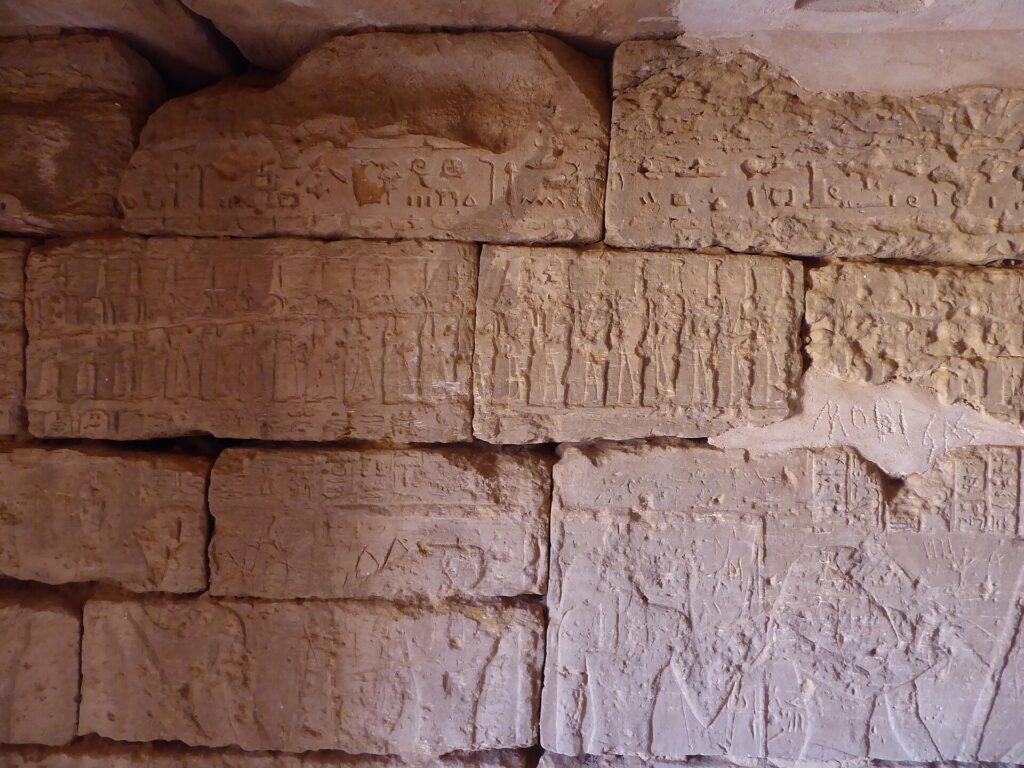
Words were sacred: hieroglyphs were medu netjer, 'the god's words', and heka, effective speech, made things happen.

Places became sacred where the gods were born, buried or appeared: Abydos for Osiris, Heliopolis for the sun, Jebel Barkal for Amun of Napata. The Nile itself, and the flood the god Hapi brought, carried life.

Among Nubians the Nile remains a sacred presence in household rites; among the Beja the sacredness of the Qur'an and of saints' tombs now frames older practices.

Divine HierarchyThere are many gods (netjeru), organised in families and groupings that differed by city.

There are many gods (netjeru), organised in families and groupings that differed by city. Heliopolis held the Ennead, nine gods: Atum the creator; Shu and Tefnut; Geb and Nut; and Osiris, Isis, Seth and Nephthys. Hermopolis held the Ogdoad, eight primordial beings of the waters. Memphis made Ptah the creator who made the world by thought and speech. Thebes raised Amun, joined with the sun as Amun-Ra, to the head of the gods in the New Kingdom.

The gods relate as kin, allies, rivals and aspects of one another. A god could take another's name and powers (Amun-Ra, Ra-Horakhty); scholars describe this as a flexible system rather than a fixed ladder.

Humans relate to gods through the king and the temple, and through personal prayer, which grows more visible in the New Kingdom. Below the great gods are local deities, household protectors such as Bes and Taweret, and the dead.

In Kush, Amun of Jebel Barkal held first place, and in the Meroitic period local gods such as the lion god Apedemak stood beside him. Among present-day Nubians and Beja, Islam is the frame, with God above all.

Ancestor RoleThe dead were present and active. A justified dead person became an akh, an effective spirit able to help or harm the living.

The dead were present and active. A justified dead person became an akh, an effective spirit able to help or harm the living. They needed food, drink, incense and the speaking of their name; in return they could intercede with the gods.

The living communicated through offerings at the tomb chapel and through letters to the dead, written on pottery bowls or linen and left at the tomb. These letters, known from the Old Kingdom to the New Kingdom, ask a dead parent or spouse to stop a family illness, to defend the writer in the tribunal of the dead, or to help a woman conceive. Some complain that the dead person is troubling the house without cause.

The protocol is reciprocity. The offering formula (ḥtp-dj-nsw, 'an offering the king gives') asks passers-by to speak it so the dead receive bread, beer, oxen and fowl. The name spoken keeps the person alive.

In the Theban Beautiful Festival of the Valley, families visited the tombs, ate and drank with their dead. Among present-day Nubians and Beja, Muslim practice frames remembrance of the dead, with Thursday and feast-day visits to graves.

Spirit WorldThe ordered world sits in the middle of Nun, the dark, limitless waters.

The ordered world sits in the middle of Nun, the dark, limitless waters. Above is the sky, the body of the goddess Nut arching over the earth, Geb, with Shu, the air, between them. Below and beyond is the Duat, the realm the sun crosses each night and where the dead travel and are judged.

The Duat is not simply below ground; it is the hidden side of the world, entered at the western horizon and left at the eastern. The funerary books map it in hours and gates, with rivers, lakes of fire, guardian beings and the Hall of the Two Truths where Osiris judges.

What crosses: the sun goes down and rises; the ba of the dead leaves the tomb by day and returns at night; gods come into their statues; dreams carry messages from gods and the dead. Crossing requires knowledge, the right names and words, and the right rites. Those without them are stopped by guardians.

The goal of the justified dead is the Field of Reeds (sḫt-jꜣrw), an ideal Egypt where crops grow tall, or to join the sun in its boat. Nubian belief today also recognises beings who live in the river, documented by Kennedy's team in the 1960s.

Ritual StructureDaily temple ritual kept the gods present: at dawn the priest opened the shrine, greeted, purified, clothed and fed the cult statue, then sealed the shrine again.

Daily temple ritual kept the gods present: at dawn the priest opened the shrine, greeted, purified, clothed and fed the cult statue, then sealed the shrine again. The king was in principle the priest of every temple; the priests acted for him.

Transition rites: coronation, which made the heir into Horus; the Heb Sed festival, which renewed a king's rule, usually after thirty years of reign; and the funeral, which turned the dead into an Osiris. The Opening of the Mouth rite restored the senses to the mummy or statue so it could eat, breathe and speak.

Restoration rites: festivals that re-enacted the Osiris myth at Abydos; spells to repel Apep; healing rites using heka against illness and dangerous beings.

In stories, ritual works as frame and resolution. The tribunal in the Contendings of Horus and Seth is a ritual hearing. Sinuhe's return ends with funerary rites provided for him. The Book of the Dead is itself a script spoken by the deceased.

Nubian rites marking birth, circumcision and marriage have long included visits to the Nile, with washing and offerings, as Kennedy recorded.

Primary DeitiesRa (Re), the sun, creator and ruler of the gods, crosses the sky by day and the Duat by night.

Ra (Re), the sun, creator and ruler of the gods, crosses the sky by day and the Duat by night. His symbols are the sun disc and the falcon head; he merges with other gods as Ra-Horakhty and Amun-Ra.

Amun, 'the Hidden One', god of Thebes, became king of the gods in the New Kingdom. In Kush, Amun of Jebel Barkal was shown as ram-headed and chose the kings.

Osiris, lord of the dead and of renewal, is shown as a mummified king with green or black skin, holding crook and flail. His myth is the heart of the tradition.

Isis (Aset), his sister-wife, mother of Horus, mistress of heka, is shown with a throne sign on her head; she restores, protects and heals.

Horus (Heru), the falcon, son of Isis and Osiris, embodied in every living king.

Seth, god of desert, storm and disorder, the murderer of Osiris and also the defender of the sun boat.

Maat, the goddess of order, wears an ostrich feather; her feather balances the heart at judgement.

Thoth (Djehuty), ibis- or baboon-headed god of writing and wisdom, records the verdict.

Anubis (Inpu), the jackal, god of embalming and guardian of tombs.

Apedemak, the lion-headed war god of Meroë.

Spirit TypesThe akh: a justified dead person transformed into an effective spirit, capable of helping or harming the living.

The akh: a justified dead person transformed into an effective spirit, capable of helping or harming the living. They are addressed in letters to the dead and fed through offerings.

The ba: the mobile aspect of a person, shown as a human-headed bird, which leaves the tomb by day and returns to the body at night. Gods also have bas, which can dwell in statues or sacred animals.

The ka: life force, inherited and sustained by food offerings; the ka statue in a tomb housed it.

The restless dead: those not properly buried or remembered, who could cause illness and fear. Healing texts include spells against dead men and dead women who trouble the living.

Demons and guardians of the Duat: gatekeepers with knives and fierce names who challenge the dead; the knowledge of their names lets one pass. Household protectors, Bes and Taweret, guarded birth and sleep.

In present-day Nubian belief, beings of the river are recognised, and jinn are recognised within the Islamic frame, as among the Beja; Kennedy's team documented the zar spirit-possession ceremony among Nubians and Egyptians, a practice whose details belong to its participants.

Mythological CreaturesApep (Apophis): a vast serpent of chaos who attacks the sun's boat each night in the Duat, trying to swallow it or run its river dry.

Apep (Apophis): a vast serpent of chaos who attacks the sun's boat each night in the Duat, trying to swallow it or run its river dry. He is repelled every night, by Seth at the prow and by spells recited in temples, but never destroyed.

Ammit, 'the Devourer of the Dead', is part crocodile, part lion and part hippopotamus. She waits beside the scales in the Hall of the Two Truths and eats the heart that fails the weighing, ending that person's existence.

The benu: a heron-like bird linked to the sun and the creation at Heliopolis, which rested on the benben stone; some scholars connect it to the Greek phoenix.

The sphinx: a lion with a king's head, a guardian of sacred places and an image of royal power, as at Giza.

Mehen: a coiled serpent who protects the sun god in the Duat, the good counterpart to Apep.

The divine cow, Hathor or Nut, raises the sun god into the sky in the Book of the Heavenly Cow.

The ram of Amun and the lion of Apedemak are the great animal forms of Kush; the Meroitic lion god was sometimes shown with a serpent body.

Taboos & ProhibitionsWhat breaks sacred order is listed in the Declaration of Innocence: killing, robbing, lying, cheating with weights, taking temple offerings, damming or polluting water others need, causing pain, acting arrogantly.

What breaks sacred order is listed in the Declaration of Innocence: killing, robbing, lying, cheating with weights, taking temple offerings, damming or polluting water others need, causing pain, acting arrogantly. Each is a breach of Maat.

Ritual prohibitions, called bwt, varied by place and god: certain foods, animals or acts were forbidden in a given nome or temple. Priests observed purity rules before entering a sanctuary: shaving, washing, abstaining from sex for a period.

Violating a tomb was among the gravest wrongs, and tomb inscriptions curse anyone who damages the tomb or its offerings. Erasing someone's name attacked their existence.

Consequences could be immediate, as in punishment by courts (the tomb robbery trials of the late New Kingdom are recorded), or delayed until the judgement after death, where a heart heavy with wrong was eaten by Ammit, the Devourer. That is the one thing that cannot be undone: the second death, total annihilation.

Among Nubians and Beja, Islamic prohibitions frame life today, with local rules around the river, saints' tombs and guest honour.

This part carries no pictures. Gods, spirits, the ancestors and ceremonies are named, with their roles, and drawn as marks only.

v

The Stories · Signature Stories

Its signature stories.

The story of Osiris is the central story of this tradition. No single Egyptian text tells it from start to finish; it is pieced together from the Pyramid Texts, hymns, temple inscriptions and the later account of Plutarch. Osiris, son of Geb and Nut, ruled Egypt as a good king with his sister-wife Isis. His brother Seth, jealous, killed him.

The Osiris Myth

The murder of Osiris by Seth, his restoration by Isis and Nephthys, and the birth and triumph of Horus. Pieced together from Egyptian sources and told in full by Plutarch.

Source: Geraldine Pinch, Egyptian Mythology: A Guide to the Gods, Goddesses, and Traditions of Ancient Egypt, 2002 (to check)

The Contendings of Horus and Seth

An 80-year dispute over the throne argued before the Ennead, full of tricks and contests, ending in Horus's victory. Known from Papyrus Chester Beatty I, c. 1160 BCE.

Source: Miriam Lichtheim, Ancient Egyptian Literature, Vol. II: The New Kingdom, 1976 (to check)

The Destruction of Mankind

Humanity plots against the aging sun god, who sends his Eye as Hathor-Sekhmet to slaughter them, then stops her with beer dyed red and withdraws to the sky.

Source: Miriam Lichtheim, Ancient Egyptian Literature, Vol. II: The New Kingdom, 1976 (to check)

Isis and the Secret Name of Ra

Isis makes a serpent that bites Ra and will cure him only if he tells her his hidden name, gaining power for Horus. A healing spell from a New Kingdom papyrus in Turin.

Source: Geraldine Pinch, Egyptian Mythology, 2002 (to check)

The Tale of Sinuhe

A courtier flees Egypt, prospers abroad and returns in old age to be forgiven and buried at home. Regarded by many scholars as the masterpiece of Middle Kingdom literature.

Source: Miriam Lichtheim, Ancient Egyptian Literature, Vol. I: The Old and Middle Kingdoms, 1973 (to check)

The Tale of the Shipwrecked Sailor

A sailor wrecked on an island meets a great serpent who tells him of his own loss and sends him home with gifts. A story within a story, told to encourage an official.

Source: Miriam Lichtheim, Ancient Egyptian Literature, Vol. I, 1973 (to check)

The Eloquent Peasant

A robbed farmer delivers nine petitions on justice and Maat before he is given redress. A Middle Kingdom text on speech and just rule.

Source: Miriam Lichtheim, Ancient Egyptian Literature, Vol. I, 1973 (to check)

The Tale of Two Brothers

Bata, falsely accused by his brother's wife, goes through a series of transformations, including bull and tree, and is reborn as king. From Papyrus D'Orbiney, 19th Dynasty.

Source: Miriam Lichtheim, Ancient Egyptian Literature, Vol. II, 1976 (to check)

Setne Khamwas and Si-Osire

A Demotic tale in which Setne's son shows him the judgement of the dead and defeats a Nubian sorcerer at Pharaoh's court. It joins the judgement theme with an Egypt-Nubia rivalry in magic.

Source: Miriam Lichtheim, Ancient Egyptian Literature, Vol. III: The Late Period, 1980 (to check)

And 3 more stories in the catalog below.

vi

The Telling · Oral Tradition · Narrative Structure

How its stories are told, and the shape they move in.

Oral TechniquesMuch of the surviving tradition is written, but it was made to be spoken. Egyptian literary texts use thought couplets: a line, then a second that repeats or extends it.
Performance ElementsAncient performance drew on harps, lutes, lyres, flutes, frame drums and the sistrum, a rattle sacred to Hathor shaken by priestesses and noblewomen. Clappers and hand-clapping kept rhythm.
Audience ParticipationIn temple festivals the people were the audience and the chorus. At Abydos, crowds joined the procession of Osiris, and the great Osiris festival included a staged fight in which participants defended the god's boat.
Memory DevicesEgypt's great memory device was writing in stone. Temple walls, tombs and obelisks fixed names, myths and rituals for eternity, and the tradition explicitly believed that carved words would outlast the people who made them.
Narrative StructureThe fundamental pattern is order, disruption and restoration. A right state exists; something breaks it (a murder, a usurpation, a rebellion, an exile); the broken state is endured, contested, judged; and the right state returns, often renewed and stronger.

Writers by Structure →

vii

The Figures · Survival and Diaspora

Who walks through its stories, and where they went.

The rightful heir (Horus): young, wronged, protected by his mother, who must win his place through ordeal and judgement. Every king plays him.

The resolute mother and sister (Isis, Nephthys): she searches, mourns, heals and outwits. She is the most active figure in many stories and the model for mothers protecting children.

The disorderly brother (Seth): strong, violent, necessary. He breaks the order but is given a place within it.

The wise scribe (Thoth, and human scribes like Setne): keeper of knowledge, arbiter, record-keeper. In the Setne tales, knowledge sought for its own sake brings trouble.

The exile who returns (Sinuhe): flees in fear, thrives abroad, longs for home and is welcomed back. His story affirms that Egypt is where a life is completed.

The just petitioner (the Eloquent Peasant): powerless but truthful, whose words win justice.

The magician (Djedi in the Westcar Papyrus; Si-Osire; the Nubian sorcerers of Setne II): power through words.

The restorer king (Piye, Taharqa in their inscriptions): Kushite rulers who present themselves as bringing back Amun's order.

Survival and diaspora

Modern Survival

Partially. The temple religion of Kemet and Kush ended as a public institution by the 6th century CE, and no continuous priesthood survives. Its texts survive, read by scholars and by many people of African descent who take Kemet as part of their own heritage. Egyptian itself continues as Coptic, still the liturgical language of the Coptic Orthodox Church.

Diaspora Adaptations

Two kinds of diaspora carry this universe. The first is Nubian displacement: from the 1960s, Nubians moved from drowned villages to Kom Ombo and New Halfa, and in large numbers to Cairo, Alexandria and Khartoum. There, Nubian clubs and associations organised by home village keep songs, weddings and dialects going.

Revival Movements

Nubian cultural movements work for the right to return to lands near Lake Nasser and for recognition of Nubian language and history. Writers such as Haggag Hassan Oddoul and Idris Ali, and singers and filmmakers, have made the drowned villages a living subject.

viii

The Catalog · its places, peoples, practices and sources

What the lore holds.

Places

Abydos The cult centre of Osiris in Upper Egypt and the site of early royal tombs, a pilgrimage place for millennia. Named only.
Thebes (Waset) and Karnak Capital of the New Kingdom and city of Amun-Ra, with the vast temple of Karnak and the royal tombs across the river. Named only.
Philae Island temple of Isis at the First Cataract, a shared sacred site for Egyptians, Meroites and Blemmyes; moved to Agilkia island during the UNESCO Nubia Campaign. Named only.
Jebel Barkal A sacred mountain near the Fourth Cataract held to be a home of Amun, where Kushite kings were crowned; a UNESCO World Heritage Site. Named only.
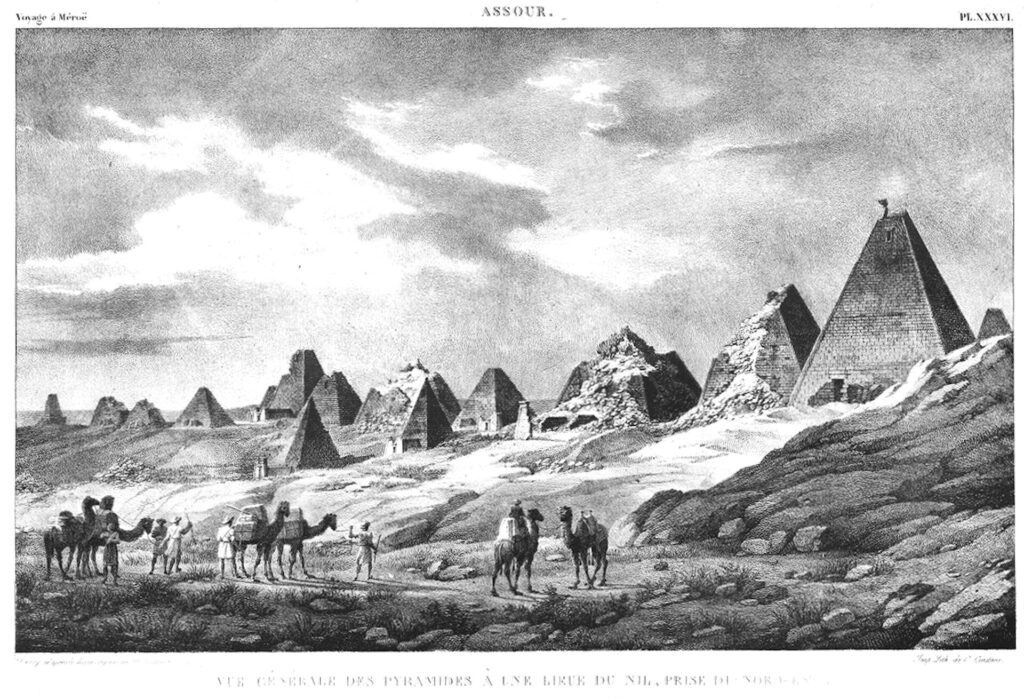
Meroë The later royal city of Kush, with iron-working remains and pyramid fields for its kings and queens.
Kerma Capital of the Kerma kingdom, the first great Nubian state, with its massive mud-brick temple known as the Western Deffufa. Named only.
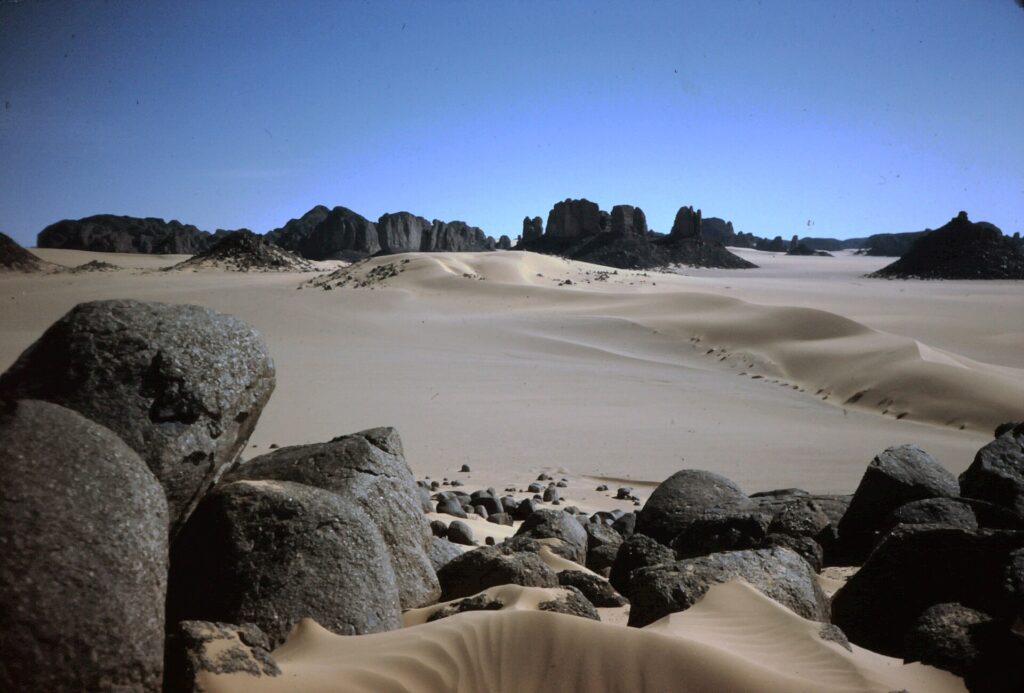
The Red Sea Hills The homeland of the Beja, a range of dry hills and wadis between the Nile and the Red Sea.

Peoples

  • Rmṯ n Kmt (Ancient Egyptians)The people of Kemet, along the lower Nile from Aswan to the Delta, who made the pharaonic civilisation.Jan Assmann, The Search for God in Ancient Egypt, 2001 (to check)
  • KushitesThe people of the kingdoms of Kerma, Napata and Meroë in Nubia, who ruled Egypt as the 25th Dynasty.László Török, The Kingdom of Kush, 1997 (to check)
  • Nobiin-speaking Nubians (Fadija and Mahas)Nubians of southern Egypt and northern Sudan who speak Nobiin; many were displaced by the Aswan High Dam.Robert A. Fernea and Elizabeth W. Fernea, Nubian Ethnographies, 1991 (to check)
  • Kenzi-Dongolawi NubiansNubians who speak Kenzi (Kenuzi) in Egypt and Dongolawi around Dongola in Sudan, related languages within Nile Nubian.John G. Kennedy (ed.), Nubian Ceremonial Life, 1978 (to check)
  • BejaA Cushitic-speaking people of the Red Sea Hills and Eastern Desert, including the Hadendowa, Bishariin, Amarar and Beni Amer.Gudrun Dahl, Responsible Men, 1991 (to check)

Practices

  • Opening of the MouthA funerary rite performed on mummies and statues to restore their ability to eat, breathe and speak in the afterlife.Jan Assmann, Death and Salvation in Ancient Egypt, 2005 (to check)
  • MummificationThe preparation of the body for eternity, modelled on the wrapping of Osiris and performed by priests under Anubis's patronage.Jan Assmann, Death and Salvation in Ancient Egypt, 2005 (to check)
  • Heb SedThe festival of royal renewal, usually held after thirty years of reign, in which the king's power was ritually restored.Jan Assmann, The Search for God in Ancient Egypt, 2001 (to check)
  • Opet FestivalThe yearly Theban festival in which Amun's statue travelled from Karnak to Luxor temple, renewing the king's divine power.Jan Assmann, The Search for God in Ancient Egypt, 2001 (to check)
  • Letters to the DeadWritten appeals to dead relatives, left at tombs on bowls or linen, asking for help or relief from trouble.Jan Assmann, Death and Salvation in Ancient Egypt, 2005 (to check)
  • Nubian Nile life-cycle ritesVisits to the Nile with washing and offerings at birth, circumcision and marriage, recorded among Nubians in the 1960s.John G. Kennedy (ed.), Nubian Ceremonial Life, 1978 (to check)
  • Beja jabana coffee gatheringThe preparation and serving of coffee among the Beja, central to hospitality, conversation and poetry.Gudrun Dahl, Responsible Men, 1991 (to check)

The sacred, named

  • AnkhGeraldine Pinch, Egyptian Mythology, 2002 (to check)
  • Djed pillarGeraldine Pinch, Egyptian Mythology, 2002 (to check)
  • Wedjat (Eye of Horus)Geraldine Pinch, Egyptian Mythology, 2002 (to check)
  • Benben stoneJan Assmann, The Search for God in Ancient Egypt, 2001 (to check)
  • The secret names of the godsGeraldine Pinch, Egyptian Mythology, 2002 (to check)

Sources

  • Miriam Lichtheim, Ancient Egyptian Literature (3 vols), 1973–1980The standard English collection of Egyptian literary and religious texts, from the Old Kingdom to the Late Period.
  • Jan Assmann, The Search for God in Ancient Egypt, 2001A study of how Egyptians understood the gods, the cosmos and the temple.
  • Cheikh Anta Diop, The African Origin of Civilization: Myth or Reality, 1974The Senegalese historian's argument for Egypt as an African civilisation; influential and debated.
  • Maulana Karenga, Maat, the Moral Ideal in Ancient Egypt, 2004A study of Maat as an ethical system, drawing on Egyptian texts.
  • Derek A. Welsby, The Kingdom of Kush: The Napatan and Meroitic Empires, 1996A history and archaeology of Kush from Napata to Meroë.
  • John G. Kennedy (ed.), Nubian Ceremonial Life, 1978Ethnographic studies of Nubian ceremonies, spirit beliefs and change, from the period of the High Dam.
  • Haggag Hassan Oddoul, Nights of Musk: Stories from Old Nubia, 2005Short stories by a Nubian writer about life in Nubia and the loss of the villages.
  • Idris Ali, Dongola: A Novel of Nubia, 1998A novel by a Nubian writer about exile, return and Nubian identity.

The World Bible

All 47 sections.

For the reader who wants all of it: every section of River Kingdoms, in its eleven parts.

ACultural Foundation7 sections

A1Tradition Name

Kemet (Egyptian km.t, 'the Black Land', after the dark silt the Nile flood left on the fields). Egyptian writing did not record vowels, so the conventional pronunciation is KEM-et. The people called themselves rmṯ n Kmt, 'the people of Kemet', and their country Tawy, 'the Two Lands', Upper and Lower Egypt joined under one king. In Coptic, the last stage of the Egyptian language, the name survives as Kēme.

The order at the centre of this universe is Maat (mꜣꜥt, conventionally MAH-aht, often written Ma'at): truth, justice and cosmic balance in one word. Its opposite is isfet, disorder.

To the south lay Ta-Seti, 'Land of the Bow', the Egyptian name for Lower Nubia, and the kingdom the Egyptians called Kush (kꜣš). The Kushites of Napata and Meroë wrote their own language, Meroitic, which can be read aloud but is still only partly understood. Present-day Nubians speak Nobiin and Kenzi-Dongolawi. The Beja of the Red Sea Hills call their language Bidhaawyeet, also written To Bedawie; Hadendowa, Bishariin, Amarar and Beni Amer are among their best-known divisions.

A2Cultural Origin

Three bodies of people make this universe.

The rmṯ n Kmt, the ancient Egyptians, lived along the lower Nile from the First Cataract at Aswan to the Delta. Their culture took shape out of the Predynastic communities of Naqada in Upper Egypt and of the Delta, which were joined into one kingdom around 3100 BCE.

The Nubians lived between the First and Sixth Cataracts. Archaeologists name their successive cultures A-Group, C-Group and Kerma, followed by the kingdoms of Kush centred at Napata and then Meroë, and later the Christian kingdoms of Nobadia, Makuria and Alwa. Today's Nubians, speakers of Nobiin and Kenzi-Dongolawi, live in southern Egypt and northern Sudan.

The Beja live in the Red Sea Hills and the desert between the Nile and the Red Sea, from southeastern Egypt through eastern Sudan into Eritrea. Many scholars connect their ancestors with the Medjay of Egyptian texts and with the Blemmyes of Roman sources, though the exact links are debated. Their story culture formed around herding, wells and lineage, and moved with seasonal pasture rather than long migration.

A3Cultural Context

The Nile made these stories. Each year the river rose, covered the fields and drew back, leaving them renewed. A people whose life depended on that return told stories in which order is threatened, broken and restored, and in which death is followed by rising.

Kingship shaped the tradition from the start. The king stood between gods and people and his task was to uphold Maat. The myth of Osiris, murdered and restored, and of his son Horus, who wins the throne, explained why each king was Horus in life and Osiris in death.

Stories served many functions: temple rites, funerary texts that guided the dead, teaching literature (sebayt) for scribes and officials, and entertainment tales copied on papyrus. Sacred texts carved in temples and tombs were for the gods and the dead; tales such as Sinuhe or the Shipwrecked Sailor were read and recited among the literate and their households.

Among Nubians and Beja the context is now largely Muslim, and story belongs to the household, the wedding, the coffee gathering and the Nile bank, with older beliefs about river beings and spirits running alongside Islam.

A4Source Validation

The ancient Egyptian and Kushite material rests on texts the Egyptians and Kushites wrote themselves: the Pyramid Texts, Coffin Texts and Book of the Dead; temple inscriptions; tale and teaching papyri; and royal stelae such as the Victory Stela of Piye. These are read here through standard translations and scholarship, chiefly Miriam Lichtheim's Ancient Egyptian Literature (1973–1980), Raymond Faulkner's translations, Jan Assmann's studies of Egyptian religion, and Derek Welsby and László Török on Kush.

African scholars who have engaged this tradition include Cheikh Anta Diop and Théophile Obenga, who argued for Egypt's place within African history and language; parts of their argument are debated by other Egyptologists, and that debate is noted where it matters. Maulana Karenga's study of Maat is also drawn on.

For living Nubian practice the record is John G. Kennedy's Nubian Ceremonial Life (1978) and the Nubian ethnographies of Robert and Elizabeth Fernea, alongside Nubian writers Haggag Hassan Oddoul and Idris Ali. For the Beja, Gudrun Dahl's Responsible Men (1991). Review by Nubian and Beja community readers and native speakers has not yet been done for this entry and is marked as needed.

A5Cultural Values

1. Maat. Right order: speaking truth, doing justice, keeping balance between people, land and gods. Every other value sits inside it.

2. Continuity beyond death. A good life is one that lasts, through a remembered name, a cared-for tomb and offerings from the living.

3. Restoration over conquest. The best outcome is the return of what was right, not the triumph of something new.

4. Duty to the community and the king. The teaching texts praise the official who feeds the hungry, gives clothes to the naked and a boat to the one without one.

5. Hospitality and honour, strongly marked among the Beja, where receiving the guest well and guarding lineage honour are the measure of a person.

These values produce story logic that can seem unfamiliar to readers trained on Western plots. Ancestors and the dead are as present as the living. A hero's personal desire matters less than whether the world is set right. Change is suspect; the ideal is to be as things were at the First Time, when the gods set the world in order.
A6Worldview

Causation runs through the gods, the dead and moral action. Floods, illness and victory have divine causes; a sick person might write to a dead relative asking them to stop troubling the house, or to intervene with the gods on their behalf. Wrong action loosens Maat and invites disorder; right action holds the world together.

The individual is a node in a web: of family, of the dead, of the king and the gods. The person themselves is several parts: body, heart (ib), name (ren), shadow, ka (life force), ba (the mobile soul often shown as a human-headed bird) and akh (the effective, transfigured dead).

Time is twofold. Neheh is cyclical time, the daily and yearly returns of sun and flood. Djet is enduring, unchanging time, the stillness in which Osiris rests. Both run at once. History moves forward through king lists and years of reign, but each reign renews the First Time.

Reality is layered: the visible land; the sky of the goddess Nut; the Duat, the realm the sun crosses at night; and Nun, the dark waters that surround the ordered world and from which it first rose.

A7Storytelling Purpose

Stories were told to keep the world working. Temple recitations of myth did something: they helped the sun rise, Osiris revive and the king's rule hold. Funerary texts gave the dead the words and knowledge to pass safely through the Duat.

The tellers in ancient Egypt were specialists. Lector priests (ẖry-ḥb) read the sacred books aloud in rites. Scribes copied and recited tales and teachings. Harpers sang at banquets and funerals, as in the Song of the Harper. Writing was held by a small literate class, so the power to fix a story in text sat with temple and court.

Everyday story still circulated orally, much of it unrecorded. Some tales reach us because a scribe set them down for entertainment or teaching.

Among Nubians, women and elders hold much of the household story, songs and Nile lore, especially while men have been away working in Egyptian and Sudanese cities. Among the Beja, poetry and genealogy are central, recited at gatherings, and knowledge of lineage gives standing. Stories come out at weddings, births, coffee gatherings and the evening hours.

BStory Structure8 sections

B1Narrative Structure

The fundamental pattern is order, disruption and restoration. A right state exists; something breaks it (a murder, a usurpation, a rebellion, an exile); the broken state is endured, contested, judged; and the right state returns, often renewed and stronger. The sun's daily journey is the model: it sets, travels through the dangers of the night and rises again.

This is closest to a cyclical restoration shape, with a strong judicial element. Many stories turn on a hearing before a tribunal of gods or judges: Horus and Seth argue before the Ennead; the Eloquent Peasant pleads nine times; the dead are judged in the Hall of the Two Truths. It is therefore a hybrid: cycle, trial and return.

Movement in these stories is often literal travel along the Nile or into foreign lands and back (Sinuhe, the Shipwrecked Sailor, Wenamun), or a descent into the Duat and a rising out of it. The direction of travel matters: going out from Egypt is danger and diminishment, coming home is restoration. Return to the homeland for burial is itself a resolution.

B2Conflict Type

The driving force is imbalance. There are fights, and Seth and Horus wound each other badly, but the deep problem is not that one side wants something the other has. It is that Maat has been disturbed and must be put back.

The constant opponent of order is isfet, embodied in the serpent Apep, who tries every night to stop the sun's boat. Apep cannot be destroyed for ever, only repelled again and again, so conflict in this tradition is ongoing maintenance rather than a final war.

Seth is more complicated. He murders Osiris and disputes the throne, yet he also stands at the prow of the sun boat and spears Apep. Disorder within the family of gods can be brought inside order and put to use. Many stories show conflict ending in assignment, each power receiving its proper place.

In the human tales the tension comes from injustice (the Eloquent Peasant robbed of his goods), fear and exile (Sinuhe fleeing after the king's death), and false accusation (the Tale of Two Brothers). Each is a breach in right relation that must be repaired.

B3Protagonist Type

The protagonist is often a role more than an individual. Horus is every rightful king; Osiris is every king who has died and every person who hopes to rise. The deceased in the Book of the Dead speaks as Osiris and identifies with gods in turn to pass each danger.

In the myths, a family is the protagonist: Osiris, Isis, Nephthys, Horus and Seth together, with the struggle inside the family deciding the world's order. Isis, with her skill in words and her persistence, drives most of the action.

The tales have more individual figures: Sinuhe the courtier, the sailor, the peasant Khunanup, Setne Khamwas the prince-scholar. Even these are measured by how well they keep their place in the order of things. Sinuhe's adventure abroad matters because it ends in the king's forgiveness and a tomb at home.

The king is a special protagonist, both human and divine. Royal inscriptions such as Piye's stela present the king as the one through whom the gods act. Kushite kings told their own stories in that frame, presenting themselves as restorers of Amun's order in Egypt.

B4Resolution Pattern

Stories end in restoration and placement. Horus is awarded the throne by the tribunal of gods; Osiris rules the dead; Seth is given a role in the sky and in the sun's boat. Everyone has a seat. The world is back as it should be.

A satisfying ending in this cosmology is one that lasts. Sinuhe returns, is forgiven, receives a tomb and a funerary endowment; the tale ends with him waiting peacefully for the day of death. The Eloquent Peasant is given justice and the robber's goods. The deceased passes the judgement and becomes a justified one, maa-kheru, 'true of voice'.

Punishment of wrongdoers forms part of the ending but is not its centre. The Destruction of Mankind ends not with humanity destroyed but with the sun god stopping the slaughter and withdrawing into the sky, a new arrangement of the world.

The resolution is never permanent in a linear sense. Apep returns each night; every king dies and a new Horus rises. The ending is a renewal that will need to be renewed again.

B5Time Structure

Time in these stories runs on two tracks together. Neheh is the time of cycles: the sun's daily round, the yearly flood, the reign that begins and ends. Djet is the time of permanence, in which things that have been completed endure. A king's rule repeats the First Time (sep tepi), when the creator first raised the mound from the waters of Nun.

The mythic stories therefore happen in the First Time and also now. When a ritual recites Isis finding Osiris, it is happening again. The funerary texts collapse the deceased's own night journey into the sun's, so two time streams run in one text.

The tales are more linear: Sinuhe's life runs from flight to old age, and Wenamun's report proceeds day by day. Yet even these are framed by regnal dates and the order of kings, so personal time is set inside royal time.

The Book of Amduat structures the night into twelve hours, each a region of the Duat, giving a story shaped like a clock: the same journey every night, told hour by hour, with the dawn as the reliable end.

B6Community Role

The community appears through the king, the household and the gods. In myth, humanity is a party in the story: people rebel against the aging sun god in the Destruction of Mankind and are almost wiped out. The well-being of the whole land depends on whether the throne is rightly held.

In the tales, the community is the court, the village and the household. Sinuhe's return is witnessed by the royal children, who sing for his pardon. The Eloquent Peasant's case is heard by an official who reports to the king; the peasant speaks for everyone wronged by the powerful.

Individuals are measured by what they give. Tomb autobiographies list the good done for the community: grain for the hungry, care for the widow, burial for the man without a son. The community expects the story to confirm that such conduct is rewarded and that the land is held together.

Among Nubians and Beja the community role is plainer and close: the village on the Nile bank, the lineage in the hills. A wedding or a newborn's rites are communal events and the stories told there belong to everyone present.

B7Moral Framework

Right action is acting according to Maat: telling the truth, judging fairly, sharing food, respecting the gods and the dead, keeping one's word, not taking what belongs to others. Morality is relational: the teaching texts speak of how to behave toward superiors, equals and the poor, and what one owes depends on the relationship. Yet Maat itself is not negotiable.

The clearest statement is the Declaration of Innocence in Book of the Dead spell 125, sometimes called the Negative Confession. The deceased declares before forty-two judges that they have not robbed, killed, lied, caused weeping, polluted the water or taken milk from a child's mouth.

What earns condemnation is greed, injustice, arrogance, violence against the weak and disturbance of the gods' offerings. What earns honour is generosity, self-control, good speech and quiet competence. The Instruction of Ptahhotep warns against pride in knowledge: 'good speech is more hidden than greenstone, yet it is found among maids at the grindstones.'

Stories teach this logic by showing consequence: the false wife in the Tale of Two Brothers is punished, the truthful peasant is rewarded, the justified dead are welcomed by Osiris.

B8Transformation Arc

The central transformation is from death to renewed life. Osiris is killed and dismembered, restored by Isis and Nephthys, and becomes lord of the dead. The deceased is transformed from a corpse into an akh, an effective spirit, and in some texts takes the forms of birds, serpents, a lotus or the sun.

The Coffin Texts and Book of the Dead contain many 'spells for taking the form of' a falcon, a heron, a swallow, the benu bird. Transformation is a skill the dead must have to move freely.

The king's transformation is another strand: the heir becomes Horus at accession, and the dead king becomes Osiris. The coronation and burial rites carry this change.

In the tales, Bata in the Tale of Two Brothers becomes a bull, then a persea tree, then is reborn as the son of the woman who betrayed him and becomes king. Transformation is consequence and means at once.

What the tradition mourns is the failure to transform: the dead who are forgotten, whose name is erased, whose tomb is plundered. The second death, the total ending, is what the stories fear most.

CSpiritual System5 sections

C1Sacred Elements

Sacredness in this tradition comes through presence, word and form. A cult statue became a dwelling for a god's ba once the proper rites were performed. A written name or image carried the reality of what it named, which is why names were carved for eternity and why enemies' names were sometimes erased.

Sacred things include the cult statue in the temple's inner sanctuary; the ankh, sign of life; the djed pillar, linked to Osiris and stability; the wedjat eye of Horus, sign of wholeness restored; the scarab, sign of becoming; the benben stone of Heliopolis, the first mound in solid form; and the heart, the seat of thought and conscience, weighed at judgement.

Words were sacred: hieroglyphs were medu netjer, 'the god's words', and heka, effective speech, made things happen.

Places became sacred where the gods were born, buried or appeared: Abydos for Osiris, Heliopolis for the sun, Jebel Barkal for Amun of Napata. The Nile itself, and the flood the god Hapi brought, carried life.

Among Nubians the Nile remains a sacred presence in household rites; among the Beja the sacredness of the Qur'an and of saints' tombs now frames older practices.

C2Ancestor Role

The dead were present and active. A justified dead person became an akh, an effective spirit able to help or harm the living. They needed food, drink, incense and the speaking of their name; in return they could intercede with the gods.

The living communicated through offerings at the tomb chapel and through letters to the dead, written on pottery bowls or linen and left at the tomb. These letters, known from the Old Kingdom to the New Kingdom, ask a dead parent or spouse to stop a family illness, to defend the writer in the tribunal of the dead, or to help a woman conceive. Some complain that the dead person is troubling the house without cause.

The protocol is reciprocity. The offering formula (ḥtp-dj-nsw, 'an offering the king gives') asks passers-by to speak it so the dead receive bread, beer, oxen and fowl. The name spoken keeps the person alive.

In the Theban Beautiful Festival of the Valley, families visited the tombs, ate and drank with their dead. Among present-day Nubians and Beja, Muslim practice frames remembrance of the dead, with Thursday and feast-day visits to graves.

C3Spirit World

The ordered world sits in the middle of Nun, the dark, limitless waters. Above is the sky, the body of the goddess Nut arching over the earth, Geb, with Shu, the air, between them. Below and beyond is the Duat, the realm the sun crosses each night and where the dead travel and are judged.

The Duat is not simply below ground; it is the hidden side of the world, entered at the western horizon and left at the eastern. The funerary books map it in hours and gates, with rivers, lakes of fire, guardian beings and the Hall of the Two Truths where Osiris judges.

What crosses: the sun goes down and rises; the ba of the dead leaves the tomb by day and returns at night; gods come into their statues; dreams carry messages from gods and the dead. Crossing requires knowledge, the right names and words, and the right rites. Those without them are stopped by guardians.

The goal of the justified dead is the Field of Reeds (sḫt-jꜣrw), an ideal Egypt where crops grow tall, or to join the sun in its boat. Nubian belief today also recognises beings who live in the river, documented by Kennedy's team in the 1960s.

C4Ritual Structure

Daily temple ritual kept the gods present: at dawn the priest opened the shrine, greeted, purified, clothed and fed the cult statue, then sealed the shrine again. The king was in principle the priest of every temple; the priests acted for him.

Transition rites: coronation, which made the heir into Horus; the Heb Sed festival, which renewed a king's rule, usually after thirty years of reign; and the funeral, which turned the dead into an Osiris. The Opening of the Mouth rite restored the senses to the mummy or statue so it could eat, breathe and speak.

Restoration rites: festivals that re-enacted the Osiris myth at Abydos; spells to repel Apep; healing rites using heka against illness and dangerous beings.

In stories, ritual works as frame and resolution. The tribunal in the Contendings of Horus and Seth is a ritual hearing. Sinuhe's return ends with funerary rites provided for him. The Book of the Dead is itself a script spoken by the deceased.

Nubian rites marking birth, circumcision and marriage have long included visits to the Nile, with washing and offerings, as Kennedy recorded.

C5Divine Hierarchy

There are many gods (netjeru), organised in families and groupings that differed by city. Heliopolis held the Ennead, nine gods: Atum the creator; Shu and Tefnut; Geb and Nut; and Osiris, Isis, Seth and Nephthys. Hermopolis held the Ogdoad, eight primordial beings of the waters. Memphis made Ptah the creator who made the world by thought and speech. Thebes raised Amun, joined with the sun as Amun-Ra, to the head of the gods in the New Kingdom.

The gods relate as kin, allies, rivals and aspects of one another. A god could take another's name and powers (Amun-Ra, Ra-Horakhty); scholars describe this as a flexible system rather than a fixed ladder.

Humans relate to gods through the king and the temple, and through personal prayer, which grows more visible in the New Kingdom. Below the great gods are local deities, household protectors such as Bes and Taweret, and the dead.

In Kush, Amun of Jebel Barkal held first place, and in the Meroitic period local gods such as the lion god Apedemak stood beside him. Among present-day Nubians and Beja, Islam is the frame, with God above all.

DPerformance4 sections

D1Oral Techniques

Much of the surviving tradition is written, but it was made to be spoken. Egyptian literary texts use thought couplets: a line, then a second that repeats or extends it. They use refrains, as in the Song of the Harper's 'Make holiday, do not weary of it', and in hymns that repeat a god's name at the head of each verse.

The Eloquent Peasant is built from nine petitions, each a rising display of rhetoric. Lists and litanies are central to the funerary texts: the deceased names each guardian, each gate, each judge. Naming is the technique.

Lector priests read rituals aloud and the texts include stage notes on who speaks. The Lamentations of Isis and Nephthys were to be sung by two women playing the goddesses.

Nubian song, as performed by Hamza El Din and village singers, uses call-and-response and the steady pulse of the tar frame drum, with long melodic lines in Nobiin. Beja poetry, recited at gatherings, uses formal verse and repeated praise formulas tied to lineage and honour.

Silence matters too: the ideal person in the teaching texts is the 'silent one', who speaks rarely and well.

D2Performance Elements

Ancient performance drew on harps, lutes, lyres, flutes, frame drums and the sistrum, a rattle sacred to Hathor shaken by priestesses and noblewomen. Clappers and hand-clapping kept rhythm. Tomb paintings show banquets with women musicians and dancers, and funeral processions with mourners raising their arms and throwing dust on their heads.

Temple festivals were processions: the god's statue carried in a portable boat-shrine on the shoulders of priests, along avenues and on the river, with singing, dancing and oracle consultations along the way, as at the Opet festival at Thebes. Masks, such as the jackal mask used by a priest playing Anubis, appear in funerary ritual.

The body tells the story in gesture. Standard poses of praise, mourning, offering and greeting are fixed in art and were performed in life.

Nubian weddings and celebrations bring frame drums, lyre (tanbūra) and clapping, with women's ululation, and dance in lines. Beja gatherings centre on coffee (jabana) prepared and served with ceremony, and on poetry, song and sword displays at weddings.

D3Audience Participation

In temple festivals the people were the audience and the chorus. At Abydos, crowds joined the procession of Osiris, and the great Osiris festival included a staged fight in which participants defended the god's boat. Stelae set up along the processional way let individuals take part for ever through their names.

The offering formula carved on tombs is an appeal to the audience: 'O you who live upon earth, who pass by this tomb', speak the offering for me. The reader completes the rite by speaking.

Oracle processions let people bring questions to the god, who answered by moving the boat-shrine forward or back.

In funerary rites mourners, both family and professional, answer the lament with cries and gestures. The Book of the Dead's dialogues with gatekeepers are scripted call-and-response between the deceased and the guardians.

Among Nubians, song is participatory: the chorus repeats the leader's lines, clapping and ululation answer the singer, and dancers join. At Beja coffee gatherings listeners respond to poetry and supply genealogy, correcting or extending the teller.

D4Memory Devices

Egypt's great memory device was writing in stone. Temple walls, tombs and obelisks fixed names, myths and rituals for eternity, and the tradition explicitly believed that carved words would outlast the people who made them. The Instruction known from the Chester Beatty papyri says the writers of the past are remembered through their books, not their tombs.

King lists, such as the one at Abydos, carried royal memory over centuries. Annals, such as the Palermo Stone, recorded each year's events. Copying was a scribal training method: students copied classic texts like the Satire of the Trades and the Instruction of Amenemhat, so the same works passed through generations.

Fixed formulas held texts together: offering formulas, epithets of gods, standard openings. Images and words worked together on tomb walls.

Among Nubians, memory passes through songs, place names and the memory of villages drowned under Lake Nasser, now kept in writing and music by Nubian authors and singers. Among Beja, genealogy held by elder men locates every person in the lineage and grounds rights to land and wells.

EMagic & Power4 sections

E1Magic System

The power system is heka: effective speech and action that brings about what is spoken. Heka was also a god, present at creation, the force by which the creator made the world. It was not forbidden or marginal; it was a normal part of religion, medicine and kingship.

What heka can do: heal illness, ward off snakes and scorpions, protect children and mothers in childbirth, guide the dead, defend the king, repel Apep. It acts through spoken words, written spells, amulets, figurines, images and the knowledge of true names.

The rules: the practitioner must know the right words and names; the spell often works by identifying the patient or speaker with a god in a myth (the child stung by a scorpion becomes Horus, healed by Isis). Purity matters. The power belongs to the gods and is shared, not owned.

What it cannot do is overturn Maat. The tale of Isis and the secret name of Ra shows that even a goddess must work through knowledge and bargaining. The Westcar Papyrus magicians can part waters and rejoin a severed head, but the final word belongs to the king and the gods.

E2Power Sources

Power comes from the gods and the First Time. The creator gave heka to humanity, according to the Instruction for Merikare, 'as weapons to ward off the blow of events'.

Kingship is inherited and divinely confirmed: the king is the son of Ra and the living Horus, and in New Kingdom and Kushite texts the god Amun chooses him. Kushite kings presented their rule as given by Amun of Jebel Barkal.

Knowledge is a second source. Priests and scribes held power through the sacred books, the House of Life where texts were kept and copied, and command of names. In the Setne tales, the prince seeks the book of Thoth, whose spells give command over heaven and earth, and suffers for taking what was not his.

The dead hold power once justified. Women in rites and as mothers draw on Isis's model of persistence and skill.

Accessing power has costs: purity rules, training, the risk of misuse, and for Setne a nightmare of loss before he returns the stolen book. Power taken outside right order turns against its holder.

E3Taboos & Prohibitions

What breaks sacred order is listed in the Declaration of Innocence: killing, robbing, lying, cheating with weights, taking temple offerings, damming or polluting water others need, causing pain, acting arrogantly. Each is a breach of Maat.

Ritual prohibitions, called bwt, varied by place and god: certain foods, animals or acts were forbidden in a given nome or temple. Priests observed purity rules before entering a sanctuary: shaving, washing, abstaining from sex for a period.

Violating a tomb was among the gravest wrongs, and tomb inscriptions curse anyone who damages the tomb or its offerings. Erasing someone's name attacked their existence.

Consequences could be immediate, as in punishment by courts (the tomb robbery trials of the late New Kingdom are recorded), or delayed until the judgement after death, where a heart heavy with wrong was eaten by Ammit, the Devourer. That is the one thing that cannot be undone: the second death, total annihilation.

Among Nubians and Beja, Islamic prohibitions frame life today, with local rules around the river, saints' tombs and guest honour.

E4Initiation Rites

Entry into priestly knowledge was graded. Priests were inducted into temple service, purified, and given access to inner spaces step by step; only certain priests could enter the sanctuary or read certain books. Some knowledge was described in the texts themselves as secret, not to be shown to others. That knowledge belongs to its keepers and its content is not set out here.

The king's coronation and the Heb Sed festival were initiations of a kind: the heir dies as a private person and is born as Horus; at the Sed, the king's power is renewed through rites that included a ritual run.

The great initiation in this tradition is death itself. The funeral and the passage through the Duat have stages: embalming, the Opening of the Mouth, the journey past gates and guardians, the weighing of the heart, and the welcome by Osiris. The person dies and the akh is born.

Among Nubians, boys' circumcision and weddings are the main passages, marked with feasts, song and Nile rites. Among the Beja, coming of age and marriage confer adult responsibility and honour within the lineage.

FSocial Structure4 sections

F1Gender Roles

Ancient Egyptian women could own and inherit property, make contracts, bring cases to court and run households and estates. Most offices of state were held by men, but women held titles as priestesses, chantresses, mistresses of the house and, at the top, queens.

The cosmos is gendered in balanced pairs: Shu and Tefnut, Geb and Nut, Osiris and Isis. Isis is the most active figure in the Osiris myth: she searches, restores, conceives and protects. Hathor and Sekhmet show female power as joy and as destructive rage.

Hatshepsut ruled as king c. 1479–1458 BCE, taking the full royal titles. In the 25th Dynasty and after, Kushite princesses such as Amenirdis I and Shepenupet II held the office of God's Wife of Amun at Thebes, a position of great religious and economic power.

Meroë had ruling queens and queen mothers called kandake (kentake): Amanirenas led war against Rome in the 20s BCE; Amanitore is shown as a co-ruler at Naqa.

Among Nubians and Beja today, women hold the household and its rites; Dahl describes Atmaan Beja ideals of male responsibility and honour that shape public roles.

F2Age Hierarchy

Age brings authority. The teaching texts take the form of a father, usually an aged official, instructing his son. The Instruction of Ptahhotep opens with a description of old age's weakness and then claims the right to teach because of it. Elders hold accumulated knowledge of right conduct, and the son who listens is praised.

A son had a sacred duty to bury his parents and keep their offerings. Horus is the model: the son who avenges and cares for his father. This duty passed responsibility from one generation to the next.

In the tales, the young prince of the Tale of the Doomed Prince or the young Si-Osire in the Setne stories show that youth can carry exceptional knowledge, but it is framed as gift or reincarnation, not as overturning elders.

The ideal life was said to last 110 years, a figure used for Joseph in Genesis as well, which some scholars read as an Egyptian ideal.

Among Beja, elder men hold genealogical knowledge and negotiate disputes; their word has weight in matters of land, wells and marriage. Among Nubians, elders hold memory of the old villages before the dams.

F3Class & Caste

Ancient Egypt had no caste system, but it was strongly ranked: the king; high officials and priests; scribes; craftspeople; and the farmers who made up most of the population. Mobility existed, chiefly through scribal education, and the Satire of the Trades urges boys to become scribes rather than suffer the labour of other trades.

The justification was Maat: an ordered society reflected an ordered cosmos, with each person in place.

The storytellers who wrote were scribes and priests, an elite. Yet the stories reach down: the Eloquent Peasant has a farmer argue nine eloquent petitions, and the official must listen. Justice for the poor is a mark of good rule.

The Kushite state had its own elite, priests of Amun and royal lineages, with succession through brothers and sisters as well as sons.

Among present-day Beja, lineages are ranked by descent and history; among Nubians, the major distinction has been between those who stayed in the villages and those who migrated to work. Nubian writers like Oddoul and Idris Ali write about displacement and the treatment of Nubians as a marginalised people within Egypt.

F4Community Structure

Ancient Egypt was organised as a kingdom divided into provinces (nomes), each with a capital, a temple and local gods, governed by officials who answered to the king. Within that, the household was the basic unit: a man, his wife, children, other kin and dependants. The household gave identity, labour, inheritance and burial.

Membership carried obligations: labour and taxes for the state, offerings and care for the dead, respect for the gods of one's town. Expulsion was exile. Sinuhe's flight shows what being cut off from Egypt meant: to die abroad, wrapped in a sheepskin, without proper burial.

Kush was a kingdom with centres at Napata and Meroë, temple towns, and a wide countryside of farmers and herders.

Nubian village life ran along the Nile in extended families, and village identity persisted after relocation to Kom Ombo and New Halfa.

Beja society is organised in lineages (often described in the scholarship as clans and sub-sections) with collective rights to pasture and wells. Belonging means sharing hospitality and defence; losing one's lineage connection means losing standing and access to land.

GGeography3 sections

G1Geographical Setting

The Nile runs north through desert from the confluence of the White and Blue Niles at Khartoum to the Mediterranean, broken in Nubia by six cataracts of rock and rapids. Life is a strip of green between two deserts.

The Egyptians named the fertile land Kemet, the Black Land, and the desert Deshret, the Red Land. The contrast between them structures the stories: the black land of order, cultivation and burial; the red land of Seth, foreign peoples and danger.

The flood came every summer from the Ethiopian highlands. Its height decided whether the year would be plenty or famine, and the Famine Stela at Sehel tells of a seven-year famine ended by the god Khnum of Elephantine.

East and west set the stories' directions: the sun rises in the east, life's side; the west is the land of the dead, where tombs lay.

In Nubia the river is narrower and the land poorer; villages cling to the banks, and the Nile is everything. For the Beja, the land is the Red Sea Hills, dry pasture and wells, whose names and owners are the substance of lineage memory.

G2Sacred Sites

Abydos: the cult centre of Osiris, where his head was said to be buried. Pilgrims came for his festival; the tomb of the early king Djer was later revered as Osiris's tomb. Abydos is a destination in the funerary texts, where the dead go to join the god.

Heliopolis (Iunu): the city of the sun and of Atum, site of the benben stone and the Ennead.

Thebes (Waset): Karnak, home of Amun-Ra, and Luxor temple, linked by the Opet procession; across the river, the royal tombs of the Valley of the Kings.

Philae: island temple of Isis at the First Cataract, a pilgrimage site for Egyptians, Meroites and Blemmyes. Its temple was closed in the 530s CE.

Jebel Barkal: a flat-topped mountain near the Fourth Cataract with a pinnacle that the Egyptians and Kushites read as a rearing cobra. They held it to be a dwelling of Amun, and Kushite kings were crowned there.

Meroë: the later royal city of Kush, with pyramids for kings and queens. Naqa: temples of Apedemak and Amun.

For Nubians today, the Nile itself and the saints' tombs along it are sites of rites.

G3Cosmological Map

At the beginning there was only Nun, dark water without limit. From it rose the first mound, on which the creator stood; every temple's sanctuary repeated that mound.

The world as it is: earth (Geb) lies flat, with Egypt at its centre and foreign lands at its edges. The sky (Nut) arches over it, her body spangled with stars; the sun travels across her by day, is swallowed in the west and born from her in the east at dawn. Air (Shu) holds them apart.

The Duat lies on the hidden side of this world, entered at the western horizon. It is mapped in the funerary books as twelve regions for the twelve hours of night, with a river the sun's boat sails along, gates, guardians, caverns and lakes. At its heart is the place where the sun unites with Osiris.

The dead move between realms by knowing the way: the Book of Two Ways in the Coffin Texts is literally a map of routes. They may travel with the sun, go to the Field of Reeds or join the circumpolar stars, the 'imperishable ones' that never set.

HHistory3 sections

H1Historical Events

By c. 3100 BCE Upper and Lower Egypt were joined under one king, remembered as the start of the dynasties. About 2350 BCE the Pyramid Texts were carved in the pyramid of Unas, the oldest large body of religious writing in the world. From c. 2500 to 1500 BCE the Nubian kingdom of Kerma flourished south of the Third Cataract.

Around 1500 BCE the New Kingdom pharaohs, beginning with Ahmose and Thutmose I, destroyed Kerma and ruled Nubia to beyond the Fourth Cataract. In 727 BCE (the date varies by a few years in the scholarship) the Kushite king Piye marched north and took Egypt, and his successors ruled as the 25th Dynasty until the Assyrian sack of Thebes in 663 BCE.

By c. 270 BCE royal burials had moved to Meroë. In 30 BCE Egypt became a Roman province; in the 20s BCE Kandake Amanirenas fought Rome. By the mid-4th century CE Meroë had declined. In the 530s CE the temple of Philae was closed. In 652 CE Makuria and Arab Egypt agreed the Baqt treaty. Between 1963 and 1971 the Aswan High Dam flooded Lower Nubia, and Nubians were moved to Kom Ombo and New Halfa.

H2Migration Patterns

Movement along the Nile shaped the tradition. Nubians came north as soldiers (the Medjay and Nubian archers served Egyptian kings), traders and settlers; Egyptians went south as conquerors, priests and administrators. The worship of Amun went south and took root at Jebel Barkal; Kushite kings brought it back north as rulers of Egypt.

The move of the Kushite capital from Napata to Meroë shifted the culture further south into savannah country, where local gods and the Meroitic language came forward.

The Beja and their predecessors moved seasonally across the Eastern Desert, and in Roman and Byzantine times groups called Blemmyes pressed on Upper Egypt and took part in the Philae cult.

In the 20th century, labour migration took Nubian men to Cairo, Alexandria and Khartoum, while women held the villages. Then came forced relocation: after the Aswan dams, especially the High Dam, tens of thousands of Nubians were moved from their villages to new settlements at Kom Ombo in Egypt and New Halfa in Sudan. Much was carried: language, songs, village names. Much was lost: the land, the river at the doorstep, the graves.

H3Cultural Exchanges

Egypt and Nubia exchanged for millennia: gold, ivory, ebony and incense came north; Egyptian temples, writing and gods went south. Kushite kings read and wrote Egyptian, built pyramids and restored Egyptian temples, while keeping their own burial customs, royal succession and gods. The Shabaka Stone, set up by the Kushite king Shabaka, preserves the Memphite Theology, which he said he copied from a worm-eaten older text.

Foreign rulers came: the Hyksos (c. 1650–1550 BCE), Libyan dynasties, Assyrians, Persians from 525 BCE, the Greek Ptolemies after 332 BCE and Rome after 30 BCE. Each absorbed Egyptian forms; the Ptolemies built temples in the old style. The cult of Isis spread across the Mediterranean.

Christianity came to Egypt in the first centuries CE and to the Nubian kingdoms in the 6th century; Coptic and Old Nubian Christian literature followed. Islam came to Egypt from 641 CE and became dominant in Nubia after the 14th century and among the Beja over several centuries, with Sufi orders such as the Khatmiyya strong in eastern Sudan.

Integrity was kept through language, the Nile rites, Nubian song and Beja lineage.

IModern Survival3 sections

I1Modern Survival

Partially. The temple religion of Kemet and Kush ended as a public institution by the 6th century CE, and no continuous priesthood survives. Its texts survive, read by scholars and by many people of African descent who take Kemet as part of their own heritage. Egyptian itself continues as Coptic, still the liturgical language of the Coptic Orthodox Church.

The Nubian and Beja traditions are living. Nubians in Egypt and Sudan speak Nobiin and Kenzi-Dongolawi, sing in them, and keep life-cycle rites, including Nile visits for newborns and weddings in some communities. Nubian writers, musicians and activists carry the memory of the old villages and the demand to return to the land by the lake.

The Beja are a large people in eastern Sudan, Egypt and Eritrea who speak Bidhaawyeet, herd, farm and trade, and keep poetry, genealogy and hospitality at the centre of life. Their political voice has included the Beja Congress, founded in 1958.

What has changed: Islam is the frame of belief for Nubians and Beja; urban life and displacement have thinned rural practice. What has been lost: the drowned Nubian villages and much of Meroitic understanding.

I2Diaspora Adaptations

Two kinds of diaspora carry this universe. The first is Nubian displacement: from the 1960s, Nubians moved from drowned villages to Kom Ombo and New Halfa, and in large numbers to Cairo, Alexandria and Khartoum. There, Nubian clubs and associations organised by home village keep songs, weddings and dialects going. Nubian music became known worldwide through Hamza El Din, whose album Escalay (1971) took Nubian song to international audiences, and through the singer Mohamed Mounir.

The second is the wider African diaspora's reclamation of Kemet. Enslaved Africans did not carry Kemetic religion through the Middle Passage, but from the 19th century onward African American and Caribbean writers looked to Egypt and Kush as African civilisations. In the 20th century Cheikh Anta Diop's work and Afrocentric scholarship strengthened this.

Maulana Karenga's Kawaida philosophy, and the Kwanzaa celebration he created in 1966, draw in part on Maat as an ethical model. Kemetic study groups, names and art across the Americas and Europe build a living relationship with the tradition from texts and monuments, which their practitioners describe as recovery and others as new creation.

I3Revival Movements

Nubian cultural movements work for the right to return to lands near Lake Nasser and for recognition of Nubian language and history. Writers such as Haggag Hassan Oddoul and Idris Ali, and singers and filmmakers, have made the drowned villages a living subject. Nubian activists have campaigned for a constitutional right of return in Egypt, included in Article 236 of the 2014 constitution, though how it will be carried out is disputed.

Nobiin is being written by community scholars in an adapted Old Nubian (Coptic-based) script and in Latin and Arabic scripts, with dictionaries and teaching materials made by Nubian speakers.

Kemetic revival religious groups have formed in the United States and elsewhere since the 1970s and 1980s, including Kemetic Orthodoxy, founded in 1988, which reconstruct temple practice from texts. Scholars note these are modern reconstructions.

The UNESCO Nubia Campaign of 1960–1980 moved temples such as Abu Simbel and Philae above the waters. What remains lost: the old Nubian villages under the lake, many sites, and the full meaning of Meroitic writing.

JDeities3 sections

J1Primary Deities

Ra (Re), the sun, creator and ruler of the gods, crosses the sky by day and the Duat by night. His symbols are the sun disc and the falcon head; he merges with other gods as Ra-Horakhty and Amun-Ra.

Amun, 'the Hidden One', god of Thebes, became king of the gods in the New Kingdom. In Kush, Amun of Jebel Barkal was shown as ram-headed and chose the kings.

Osiris, lord of the dead and of renewal, is shown as a mummified king with green or black skin, holding crook and flail. His myth is the heart of the tradition.

Isis (Aset), his sister-wife, mother of Horus, mistress of heka, is shown with a throne sign on her head; she restores, protects and heals.

Horus (Heru), the falcon, son of Isis and Osiris, embodied in every living king.

Seth, god of desert, storm and disorder, the murderer of Osiris and also the defender of the sun boat.

Maat, the goddess of order, wears an ostrich feather; her feather balances the heart at judgement.

Thoth (Djehuty), ibis- or baboon-headed god of writing and wisdom, records the verdict.

Anubis (Inpu), the jackal, god of embalming and guardian of tombs.

Apedemak, the lion-headed war god of Meroë.

J2Spirit Types

The akh: a justified dead person transformed into an effective spirit, capable of helping or harming the living. They are addressed in letters to the dead and fed through offerings.

The ba: the mobile aspect of a person, shown as a human-headed bird, which leaves the tomb by day and returns to the body at night. Gods also have bas, which can dwell in statues or sacred animals.

The ka: life force, inherited and sustained by food offerings; the ka statue in a tomb housed it.

The restless dead: those not properly buried or remembered, who could cause illness and fear. Healing texts include spells against dead men and dead women who trouble the living.

Demons and guardians of the Duat: gatekeepers with knives and fierce names who challenge the dead; the knowledge of their names lets one pass. Household protectors, Bes and Taweret, guarded birth and sleep.

In present-day Nubian belief, beings of the river are recognised, and jinn are recognised within the Islamic frame, as among the Beja; Kennedy's team documented the zar spirit-possession ceremony among Nubians and Egyptians, a practice whose details belong to its participants.

J3Mythological Creatures

Apep (Apophis): a vast serpent of chaos who attacks the sun's boat each night in the Duat, trying to swallow it or run its river dry. He is repelled every night, by Seth at the prow and by spells recited in temples, but never destroyed.

Ammit, 'the Devourer of the Dead', is part crocodile, part lion and part hippopotamus. She waits beside the scales in the Hall of the Two Truths and eats the heart that fails the weighing, ending that person's existence.

The benu: a heron-like bird linked to the sun and the creation at Heliopolis, which rested on the benben stone; some scholars connect it to the Greek phoenix.

The sphinx: a lion with a king's head, a guardian of sacred places and an image of royal power, as at Giza.

Mehen: a coiled serpent who protects the sun god in the Duat, the good counterpart to Apep.

The divine cow, Hathor or Nut, raises the sun god into the sky in the Book of the Heavenly Cow.

The ram of Amun and the lion of Apedemak are the great animal forms of Kush; the Meroitic lion god was sometimes shown with a serpent body.

KStories3 sections

K1Signature Story

The story of Osiris is the central story of this tradition. No single Egyptian text tells it from start to finish; it is pieced together from the Pyramid Texts, hymns, temple inscriptions and the later account of Plutarch.

Osiris, son of Geb and Nut, ruled Egypt as a good king with his sister-wife Isis. His brother Seth, jealous, killed him. In Plutarch's version Seth trapped him in a chest and threw it in the Nile; in many versions Seth cut his body into pieces and scattered them across Egypt.

Isis searched the land with her sister Nephthys, mourning and gathering the pieces. With Anubis they wrapped the body, the first mummy. Isis, in the form of a kite, hovered over him, breathed life into him and conceived a son. Osiris did not return to rule the living; he became king of the dead.

Isis hid in the Delta marshes and raised Horus, protecting him from snakes and scorpions. When grown, Horus fought Seth for the throne, lost an eye and had it restored. The gods judged, and Horus became king.

The story reveals the core: order broken, mourning, restoration, judgement, and life through death.

K2Archetype Characters

The rightful heir (Horus): young, wronged, protected by his mother, who must win his place through ordeal and judgement. Every king plays him.

The resolute mother and sister (Isis, Nephthys): she searches, mourns, heals and outwits. She is the most active figure in many stories and the model for mothers protecting children.

The disorderly brother (Seth): strong, violent, necessary. He breaks the order but is given a place within it.

The wise scribe (Thoth, and human scribes like Setne): keeper of knowledge, arbiter, record-keeper. In the Setne tales, knowledge sought for its own sake brings trouble.

The exile who returns (Sinuhe): flees in fear, thrives abroad, longs for home and is welcomed back. His story affirms that Egypt is where a life is completed.

The just petitioner (the Eloquent Peasant): powerless but truthful, whose words win justice.

The magician (Djedi in the Westcar Papyrus; Si-Osire; the Nubian sorcerers of Setne II): power through words.

The restorer king (Piye, Taharqa in their inscriptions): Kushite rulers who present themselves as bringing back Amun's order.

K3Story Examples

The Tale of Sinuhe (Middle Kingdom): when King Amenemhat I dies, the courtier Sinuhe overhears news and flees in panic to the Levant. He prospers among a local ruler, marries and defeats a champion in single combat. In old age he longs for Egypt. The new king, Senusret I, writes inviting him home; he returns, is forgiven and given a tomb. Structure: departure from order, life outside, return and completion. It affirms that a life is fulfilled by burial at home.

The Eloquent Peasant: Khunanup, travelling to market with goods, is robbed by an official's servant. He appeals to the high steward Rensi, who is so impressed by his speech that the king orders him kept speaking. After nine petitions on justice and Maat, he is given his goods and the robber's property. Structure: injustice, extended trial, restoration. It teaches that speech serves Maat.

Setne Khamwas and Si-Osire (Demotic, Roman period): Setne's son Si-Osire shows him the judgement of the dead and later defeats a Nubian sorcerer in a magical contest at Pharaoh's court. He is revealed as a reborn magician. Structure: contest framed by revelation, showing Egypt and Nubia as rivals in heka.

✦Deities & Spirits10

Ra

Titles: Re; Ra-Horakhty; Atum-Ra; the Lord of All

Domain: The sun, creation, kingship, the order of the day and night

In the stories: The Destruction of Mankind (Book of the Heavenly Cow); Isis and the Secret Name of Ra; the night journey through the Duat in the Amduat

Notes: Ra crosses the sky by day and the Duat by night in his boat, renewed each dawn. Every king was called son of Ra. He merges with other gods, most of all Amun, as the head of the gods.

Amun

Titles: Amun-Ra; the Hidden One; Lord of the Thrones of the Two Lands; Amun of Napata, dwelling in the Pure Mountain

Domain: Hidden power, kingship, Thebes, and in Kush the god who chooses the king

In the stories: The Opet festival and royal birth inscriptions; the Victory Stela of Piye, where Amun of Napata sends Piye north

Notes: From a local god of Thebes, Amun became king of the gods in the New Kingdom. In Kush he was worshipped as a ram-headed god at Jebel Barkal and confirmed each king by oracle. Kushite rulers presented their conquest of Egypt as his work.

Osiris

Titles: Wsir; Wennefer, the Perfect Being; Foremost of the Westerners; Lord of Abydos

Domain: Death, renewal, the dead, and the regenerating earth and grain

In the stories: The Osiris myth; the judgement of the dead in Book of the Dead spell 125; the Contendings of Horus and Seth

Notes: Osiris is the murdered king restored to life as ruler of the dead. Every dead person hoped to become an Osiris. His festivals at Abydos re-enacted his death and rising.

Isis

Titles: Aset; Great of Magic; Mother of the God; Lady of Philae

Domain: Heka, motherhood, protection, healing, mourning and kingship

In the stories: The Osiris myth; Isis and the Secret Name of Ra; healing spells on the Metternich Stela

Notes: Isis restores Osiris, raises Horus and wins his throne through cleverness and persistence. Her temple at Philae was a pilgrimage centre for Egyptians, Meroites and Blemmyes until the 6th century CE. Her cult spread across the Roman world.

Horus

Titles: Heru; Horus son of Isis; Horus of the Horizon; Harpocrates (Horus the Child)

Domain: Kingship, the sky, rightful succession, protection

In the stories: The Contendings of Horus and Seth; the Osiris myth; the healing of the Eye of Horus

Notes: Horus is the falcon god embodied in every living king. His long struggle with Seth ends with the gods' tribunal awarding him the throne. His wounded and restored eye, the wedjat, is the sign of wholeness.

Seth

Titles: Set; Sutekh; Great of Strength; Lord of the Red Land

Domain: Desert, storms, foreign lands, disorder, and strength used against chaos

In the stories: The Osiris myth; the Contendings of Horus and Seth; the repelling of Apep from the sun boat

Notes: Seth murders Osiris and contests the throne with Horus. Yet he also guards the sun boat against Apep, and some kings honoured him. He shows disorder given a place within order.

Maat

Titles: Daughter of Ra; Lady of Truth

Domain: Truth, justice, cosmic balance and right order

In the stories: The weighing of the heart in Book of the Dead spell 125; temple scenes of the king offering Maat

Notes: Maat is both a principle and a goddess, shown with an ostrich feather on her head. The king offered a figure of her to the gods as proof of his rule. Her feather is the weight against which the heart is measured.

Thoth

Titles: Djehuty; Lord of Divine Words; Lord of Hermopolis; the Ibis

Domain: Writing, wisdom, the moon, reckoning and judgement

In the stories: The weighing of the heart; the Contendings of Horus and Seth; the search for the Book of Thoth in the Setne tales

Notes: Thoth is shown as an ibis-headed man or a baboon. He records the verdict at the judgement and advises the gods' tribunal. Scribes regarded him as their patron.

Anubis

Titles: Inpu; He Who Is upon His Mountain; Lord of the Sacred Land; Foremost of the Divine Booth

Domain: Embalming, cemeteries and guiding the dead

In the stories: The Osiris myth, in which he helps wrap Osiris; the weighing of the heart, where he tends the scales

Notes: Anubis is shown as a jackal or a jackal-headed man. Priests wore his mask in funerary rites. He guards tombs and leads the dead to judgement.

Apedemak

Titles: Lion of the South; Lord of Naqa

Domain: War, royal power and protection, in Meroitic Kush

In the stories: Temple hymns and reliefs at Naqa and Musawwarat es-Sufra; no long narrative myth survives

Notes: Apedemak is a lion-headed god worshipped in the Meroitic kingdom, shown in his temple at Naqa with three heads and four arms in one relief. His cult shows Kush keeping its own gods beside Amun. Scholars know him mainly from images and short texts.

Also in North Africa

Every Lore Universe →