The Lore · North Africa · Lore Universe

Desert Veils

Amazigh / Tuareg

Tuareg indigo-veiled warriors, Tifinagh script (world's oldest still-used alphabet), matrilineal Tuareg structure, Saharan trans-continental trade, Berber resistance to Arab and Roman conquest.

North Africa Also in West Africa 3,000+ years A living tradition

Why its stories are told

Stories are told to teach, to court, to remember and to give the community its sense of itself. Among the Kel Tamasheq, tales (tinfusen, singular tanfust) are told in the evening in the tent, often by older women to children.

The peoples of this lore call themselves Imaziɣen (singular Amaziɣ, feminine Tamaziɣt), usually written Imazighen and Amazigh.

i

The Land · Geography

Where its peoples live.

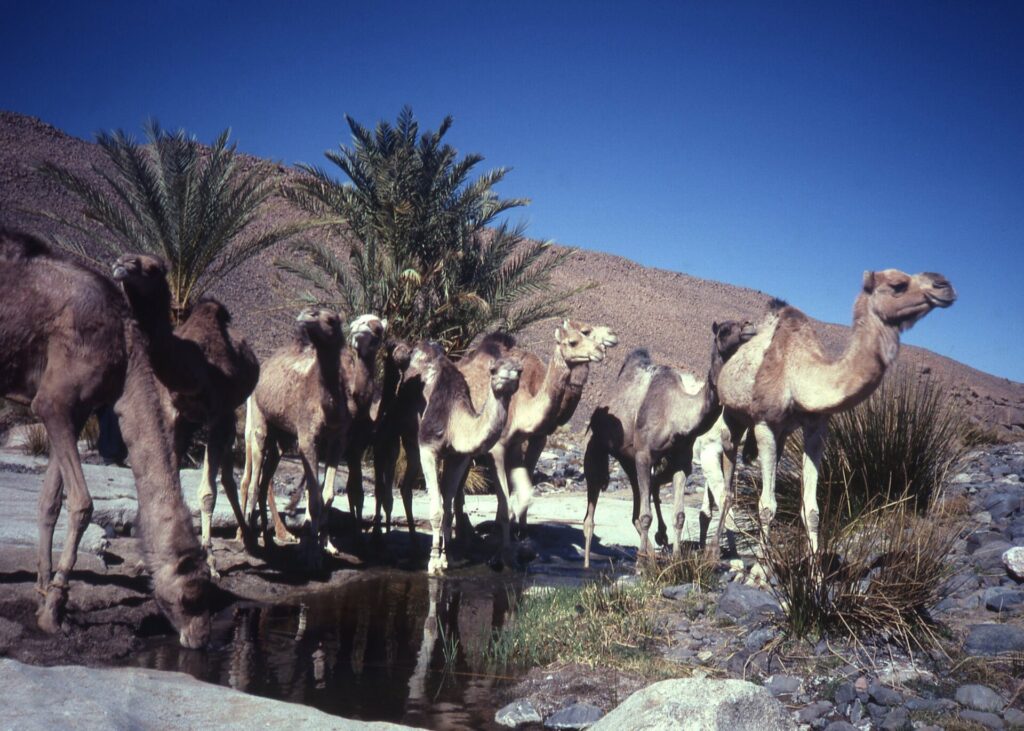
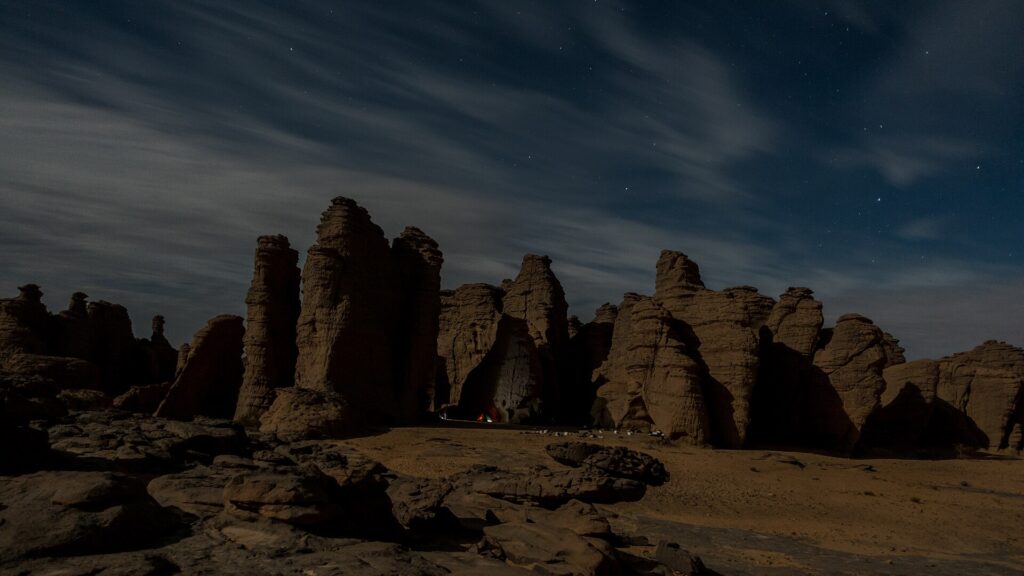
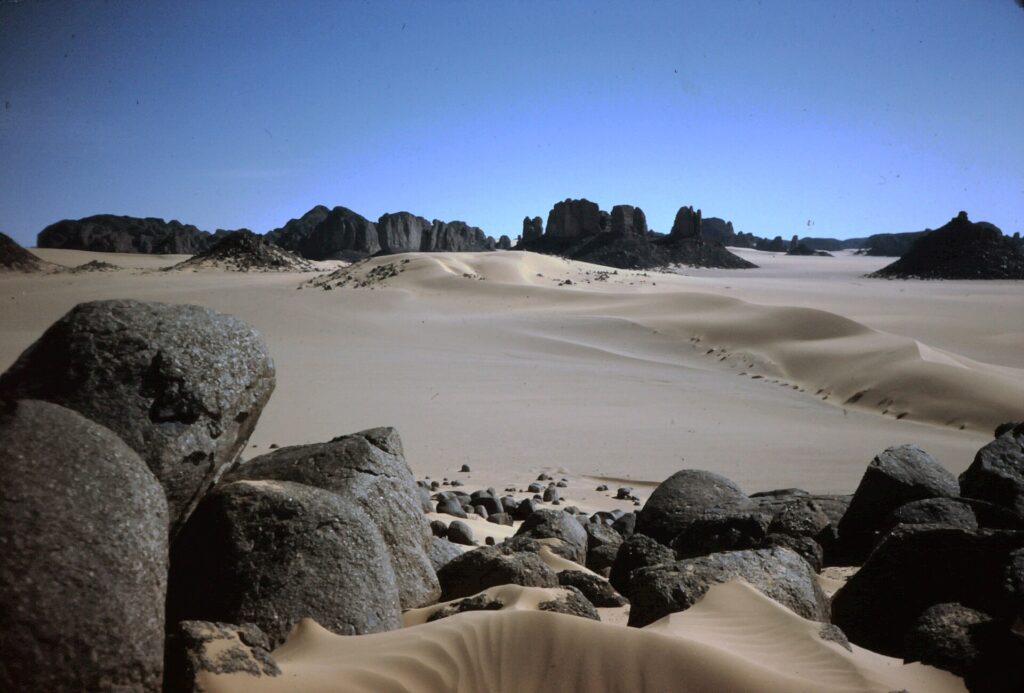
The lore spans two landscapes. The Sahara of the Kel Tamasheq is a world of high massifs, the Ahaggar, the Tassili n'Ajjer, the Aïr and the Adrar des Ifoghas, of gravel plains, sand seas, dry riverbeds (wadis), wells and oases. Rain is rare and irregular; drought shapes life. The Sahel to the south is a land of seasonal pasture.

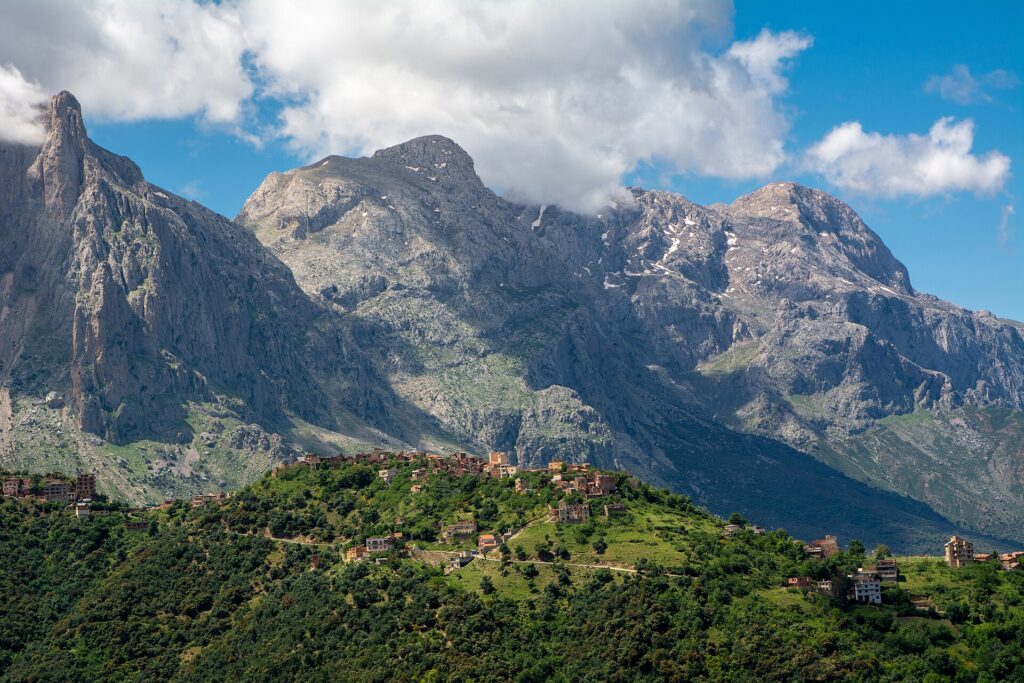
The northern Amazigh lands are mountain countries: the Rif, the Middle and High Atlas, the Anti-Atlas, the Djurdjura of Kabylia and the Aurès. There villages cling to slopes, fields are terraced, and snow, olives and figs mark the seasons.

The environment shapes stories directly. In the desert, the empty space beyond the camp is where spirits live; wells are meeting places, sites of courtship and conflict; a lost path means death. In the mountains, ogres live in the forest and gorges, and the village is the safe centre.

The land is a record. Rock engravings and paintings in the Tassili, some many thousands of years old, show cattle, people and animals of a greener Sahara, and Kel Tamasheq people today say these images belong to earlier peoples. The land carries lineage memory too: every well and pass has a name and a story.

Sacred SitesAbalessa, near Tamanrasset in the Ahaggar, holds the tomb attributed to Tin Hinan, the ancestress of the Kel Ahaggar nobles. It was opened by a Franco-American team in 1925, who found the skeleton of a woman with jewellery; later dating placed the burial around the 4th–5th century CE. Named only, never pictured.
Cosmological MapThe cosmology most Imazighen share today is Islamic: the heavens above, the earth, and the realm of the dead and of judgement. Within that frame lies a more local map of the visible and invisible worlds. Among the Kel Tamasheq, the key line is between the inhabited and the empty.
ii

The People · Cultural Foundation · Society

Its people and how they live together.

This lore belongs to the Amazigh peoples, the longest-settled population of North Africa west of the Nile valley, and to their Saharan branch, the Kel Tamasheq. Egyptian records name Libyan peoples on Egypt's western border, the Tjehenu, Tjemehu, Libu and Meshwesh, from the second millennium BCE; most historians see them as ancestors or relatives of later Amazigh nations, though the line cannot be traced person by person.

The main communities whose stories are gathered here are: the Kel Tamasheq confederations, including the Kel Ahaggar of the Algerian Ahaggar, the Kel Ajjer of the Tassili, the Kel Ayr of the Aïr in Niger, the Kel Adagh of the Adrar des Ifoghas in Mali, and the Iwellemmeden of the Niger bend; the Iqbayliyen of Kabylia and the Djurdjura in Algeria; the Ishawiyen of the Aurès; the Ishelhiyen and the Imazighen of the Middle and High Atlas in Morocco; the Irifiyen of the Rif; the Mozabites of the M'zab valley; and the Siwi of Siwa in Egypt.

The Kel Tamasheq traditions themselves tell of ancestors who came south from the northern oases into the central Sahara. Historians connect this with movements of Sanhaja and other Amazigh groups into the desert in the first millennium CE, after the camel became common there.

Cultural Values

1. Takarakit, reserve or modesty: the Kel Tamasheq ideal of self-restraint before others, especially in-laws and elders. It is the value behind the men's veil, and in stories the hero who speaks too much or eats greedily before others is shamed.

2. Honour and the defence of the weak: in Tamasheq poetry, courage in raids and battle is praised, but so is the protection of guests, women and dependants. Hospitality to a traveller in the desert is a duty, not a kindness.

3. Freedom and self-rule: many Amazigh tales and songs set a small community against a stronger power and admire the one who refuses submission. Village assemblies, such as the Kabyle tajmaɛt, embody self-government.

4. Lineage and the mother's line: among the Kel Tamasheq, descent through women matters for status and, in some confederations, for leadership. Stories often turn on a sister's son, a mother's counsel or a founding ancestress.

5. Wit over force: the clever nephew, the small boy and the patient woman beat ogres and kings.

The collective comes before the individual, and the living answer to the dead through genealogy. A Western reader may find it strange that a hero's victory can be less admired than his restraint, or that a story ends happily when a lineage is secured rather than when a lover is won.

F1Gender RolesGender among the Kel Tamasheq does not fit Western expectations. Men, not women, veil their faces.Read it all

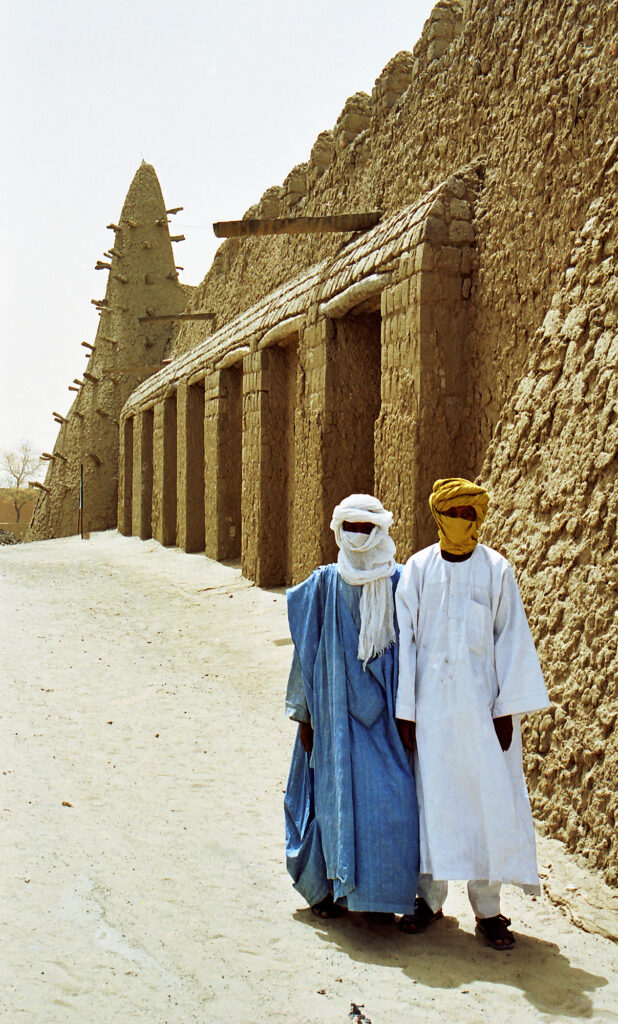
Gender among the Kel Tamasheq does not fit Western expectations. Men, not women, veil their faces. Women do not cover their faces, have wide freedom to meet men socially, and in many confederations own the tent, which is built by and passes through women. In divorce, which is common and not shameful, a woman keeps the tent and often her herd.

Women are the main keepers of music and poetry: they play the imzad and tende, compose poems, and judge men's poems at the ahal. A woman's verse can raise or lower a man's honour. Many of the poets in Foucauld's collection are women.

Descent through women matters for status and, in some confederations, for chiefship; historians and anthropologists debate how far Kel Tamasheq society should be called matrilineal, since Islamic inheritance law, which favours sons, also applies, and practice differs between groups.

Men herd camels, travel on caravans, raid in the past and hold political office. In the northern Amazigh communities gender roles are more segregated: Kabyle village assemblies were male, while women held the tale, song, pottery and weaving traditions, and older women had real authority in the household.

F2Age HierarchyAge brings authority and changes duties.Read it all

Age brings authority and changes duties. Among the Kel Tamasheq, children move freely; youth is the time of the ahal, poetry, courtship and courage; married adults carry the household and herds; elders give counsel and settle disputes.

Susan Rasmussen's study of the Kel Ewey shows that aging also changes reserve: younger men must veil most carefully and avoid their in-laws, while older men and women relax some rules. Older women gain authority and freedom of speech, and many become the main tellers of tales.

Elders hold genealogy, the memory of past alliances and conflicts, knowledge of pastures and wells, and the right to speak in assemblies. In Kabylia the tajmaɛt was led by senior men, and village elders kept customary law.

What elders hold that others cannot access is the long view: who married whom three generations ago, which well belongs to which lineage, what was promised at a past peace. This knowledge gives them power in negotiation, marriage and disputes. In stories, the old woman is often the one who knows the way out.

F3Class & CasteKel Tamasheq society was historically divided into ranked groups.Read it all

Kel Tamasheq society was historically divided into ranked groups. The imajeghen (nobles) were warriors and owners of the right to rule; the imghad were tributary herders; the ineslemen were religious clerics; the inaden were smiths and artisans; and the iklan were people of servile status, many descended from captives. These ranks were justified by descent and custom; they have weakened greatly since colonial and independence-era abolitions, but they remain in memory and sometimes in marriage choices.

The inaden hold a special place. They make jewellery, weapons and tools, are thought to have power over fire and the unseen, and act as go-betweens in marriages and disputes, as messengers and as reciters of praise and genealogy. Their status is ambiguous: needed and respected, but set apart.

In stories, nobles prize honour and reserve, smiths are clever and sharp-tongued, and religious men are sources of blessing and judgement. Northern Amazigh villages were more equal among landholding families, with marabout lineages set apart for their religious role. Poets came from all ranks.

F4Community StructureKel Tamasheq society is built from the tent (ehen), the household of a married woman and her family; the camp (aghiwen), a group of tents moving together; the lineage or descent gr…Read it all

Kel Tamasheq society is built from the tent (ehen), the household of a married woman and her family; the camp (aghiwen), a group of tents moving together; the lineage or descent group (tawshit); and the confederation, a political union of lineages under a chief (amenokal), such as the Kel Ahaggar or the Kel Ayr. Each confederation historically had its drum (ettebel) as a symbol of authority.

Membership carries duties: mutual aid in drought, defence, sharing of pasture, hospitality, and loyalty in disputes. In return a member has protection, a share in wells and grazing, and a place in the genealogy.

In northern Amazigh lands, communities are villages and village federations. In Kabylia the village assembly (tajmaɛt) governs land, water, repairs and feud by customary law; in the Atlas, collective granaries such as the igudar of the Anti-Atlas were managed by community rules.

Expulsion or loss of protection is severe: a person without kin in the desert has no one to give water, defend them or remember them. Exile is a theme of many poems, both by those driven out and by those who left to work in towns or abroad.

iii

Through Time · History

Through 3,000+ years.

  1. About 5000 BCE

    Rock art in the Tassili n'Ajjer and the Acacus records herding peoples of a wetter Sahara from about 5000 BCE, though the art's link to later Amazigh peoples is debated.

  2. 13th and 12th centuries BCE

    In the 13th and 12th centuries BCE, Egyptian records describe wars with Libyan peoples, the Libu and Meshwesh, on Egypt's western border.

  3. Around 945 BCE

    Around 945 BCE, Shoshenq I, of Meshwesh Libyan descent, founded Egypt's 22nd Dynasty.

  4. 5th century BCE

    By the 5th century BCE, the Garamantes of the Fezzan ruled a Saharan state with irrigated oases and trade routes.

  5. 202 BCE

    In 202 BCE, the Amazigh king Massinissa, allied with Rome, became master of Numidia.

  6. 5th century CE

    In the 4th–5th century CE, a woman of high rank was buried at Abalessa, in the tomb later honoured as Tin Hinan's.

  7. 683

    In 683, the Amazigh leader Kusaila defeated the Arab commander Uqba ibn Nafi.

  8. Around 698–703

    Around 698–703, Dihya, called the Kahina, led the last great resistance in the Aurès before her defeat.

  9. 11th century

    In the 11th century, the Sanhaja Almoravids built an empire from the Sahara to Spain.

Read the whole history

Rock art in the Tassili n'Ajjer and the Acacus records herding peoples of a wetter Sahara from about 5000 BCE, though the art's link to later Amazigh peoples is debated. In the 13th and 12th centuries BCE, Egyptian records describe wars with Libyan peoples, the Libu and Meshwesh, on Egypt's western border. Around 945 BCE, Shoshenq I, of Meshwesh Libyan descent, founded Egypt's 22nd Dynasty. By the 5th century BCE, the Garamantes of the Fezzan ruled a Saharan state with irrigated oases and trade routes. In 202 BCE, the Amazigh king Massinissa, allied with Rome, became master of Numidia. From 112 to 105 BCE, his grandson Jugurtha fought Rome. From 17 to 24 CE, Tacfarinas led a long revolt against Roman rule. In the 4th–5th century CE, a woman of high rank was buried at Abalessa, in the tomb later honoured as Tin Hinan's.

In 683, the Amazigh leader Kusaila defeated the Arab commander Uqba ibn Nafi. Around 698–703, Dihya, called the Kahina, led the last great resistance in the Aurès before her defeat. In the 11th century, the Sanhaja Almoravids built an empire from the Sahara to Spain. Around 1100, by tradition, Kel Tamasheq herders founded Timbuktu. In 1902, the Kel Ahaggar were defeated by French forces at Tit. In 1916–1917, Kaocen ag Kedda led a revolt and besieged Agadez. In 1980, the Berber Spring in Kabylia demanded recognition of Tamaziɣt. In 2011, Morocco made Tamaziɣt an official language, and in 2016 Algeria did the same.

Migration Patterns

Movement is at the heart of this tradition. The Kel Tamasheq are pastoralists who move with their herds each season between pastures and wells; many also took part in long-distance caravans carrying salt, dates, grain and goods across the Sahara between North Africa and the Sahel. The salt caravans from the Aïr to Bilma and from the north to Timbuktu were still running in the 20th century.

Cultural Exchanges

Amazigh peoples have lived among other powers for three thousand years. They traded and fought with Egypt, Carthage and Rome; Punic and Latin shaped the coast's culture, and some scholars argue that the Carthaginian goddess Tanit may have local African roots, though this is debated. Christianity spread among many Amazigh in late Roman times; Augustine of Hippo was born in Numidia.

Cultural Context

These stories exist because a dispersed people, spread over an area larger than Western Europe and living under many states, needed ways to carry genealogy, law, honour and memory without a single court or capital. For the Kel Tamasheq, poetry and tale keep alive who descends from whom, which camp owes what to which, and what happened at each well and pass.

iv

The Sacred · Deities and Spirits

Named, and never pictured.

Amanay The one God of Islam, source of all decree and blessing

Not the subject of myth; addressed in prayer and blessing in Kel Tamasheq speech and poetry

Amun of Siwa Oracle; kingship; the desert oasis

Alexander the Great's visit to the oracle at Siwa in 331 BCE; Herodotus on the Ammonians

Gurzil War and protection of the Laguatan people of Libya

Corippus, Iohannis (6th century), describes the image of Gurzil carried into battle against Byzantine forces

Mastiman Uncertain; Corippus associates him with sacrifice and war

Mentioned in Corippus, Iohannis

Anzar Rain, rivers, fertility of the land

Anzar and the young woman bathing in the river; the ghonja rain-bride procession

Tislit n Anzar Rain, the bond between people and rain

Anzar and the young woman bathing in the river

Tafukt and Ayyur Sun and moon, time, the seasons

Herodotus, Histories Book 4, on Libyan sacrifices to the sun and moon

Kel Essuf The empty places beyond the camp; illness and possession

Kel Tamasheq accounts of spirit encounters and tende n goumaten healing, recorded by Susan Rasmussen

Ifri Caves, protection, possibly trade

Known from a Latin inscription near Constantine (ancient Cirta) and a cave sanctuary

Sacred ElementsFor nearly all Imazighen today, sacredness flows first from God and the Qur'an.

For nearly all Imazighen today, sacredness flows first from God and the Qur'an. The written word of the Qur'an carries power, which is why Kel Tamasheq men and women wear leather amulets (tereout) holding Qur'anic verses written by religious specialists (ineslemen); their exact contents belong to the people who make and wear them.

Places carry sacredness through the dead and the holy: the tombs of saints (marabouts), visited for blessing (baraka); ancestral tombs such as that of Tin Hinan at Abalessa; and older pre-Islamic burial monuments across the Sahara. Ancient sources and later scholarship also record that sleeping at ancestors' tombs to receive dreams was practised; Herodotus describes this among the Nasamones.

Objects of authority are charged with meaning: the ettebel, the great drum that stands for a Kel Tamasheq confederation's chief and his people. Blacksmiths' fire and iron are regarded as powerful and ambiguous.

Words matter: blessings, curses and the names of God protect, and some words are avoided in the wild. The mechanism of sacredness is closeness to God's word, to blessed people, or to the dead, and respect for what is set apart.

Divine HierarchyToday the hierarchy for nearly all Imazighen is Islamic: one God, above all; angels and prophets; saints whose blessing can be sought; and the jinn, created beings who can be good or harmful.

Today the hierarchy for nearly all Imazighen is Islamic: one God, above all; angels and prophets; saints whose blessing can be sought; and the jinn, created beings who can be good or harmful. This has been true for most Imazighen for many centuries.

Before and alongside the coming of Islam there was an older religious world, known only in fragments from Greek, Latin and Arabic writers, inscriptions and later folk practice. Herodotus wrote that the Libyans sacrificed to the sun and the moon. Amun of Siwa, Ammon to the Greeks, had a famous oracle in the Siwa oasis. The Latin poet Corippus names gods of the Amazigh peoples of 6th-century Libya, including Gurzil, linked to a bull, and Mastiman. Latin inscriptions from Roman North Africa name many local gods, known only by their names. Scholars disagree about how widely any of them were worshipped.

In folk practice, Anzar, the rain, was addressed in processions into the 20th century in Kabylia and elsewhere. These beings did not form a single pantheon; they belonged to particular peoples and places.

Ancestor RoleAncestors here are not worshipped as gods, and Islam discourages any practice that looks like it.

Ancestors here are not worshipped as gods, and Islam discourages any practice that looks like it. They remain present, however, in three ways.

First, through genealogy: a person's standing depends on descent, and among the Kel Tamasheq the noble lineages of the Ahaggar trace themselves to Tin Hinan. Reciting lineages is a way of keeping ancestors in the present.

Second, through tombs: graves of ancestors and holy people are visited, and the dead may come in dreams, especially to someone who sleeps near the grave. Ancient writers record this practice among Libyan peoples; anthropologists such as Rasmussen describe Kel Tamasheq people visiting tombs and receiving dreams in more recent times. The dead are greeted with prayers for their souls.

Third, through obligations: the living honour the dead by keeping their names, their word and their alliances. Poems remember the fallen of famous battles by name.

What the dead want is to be remembered properly and prayed for, and to have their descendants live with honour. Neglect and shame dishonour the dead as well as the living.

Spirit WorldThe unseen world in this tradition is shaped by Islam and by older Saharan and Maghrebi belief.

The unseen world in this tradition is shaped by Islam and by older Saharan and Maghrebi belief. It has three broad parts: the realm of God, the angels and the Prophet; the realm of the dead, who await judgement; and the hidden world of the jinn, which overlaps the visible world.

Among the Kel Tamasheq the beings of this hidden world are called Kel Essuf, 'the people of the solitude' or 'of the wild', the emptiness beyond the camp. They live in deserted places, ruins, wells, trees and the dark, and they are drawn to people who are alone, grieving or careless. In the north they are usually called jnun (jinn).

Crossings happen in both directions. Spirits can enter a person and cause illness or possession, especially, Rasmussen records among the Kel Ewey, at times of social stress. People can reach the unseen through prayer, dreams at tombs, healing dances and the work of religious specialists. The rules are about place and time: the edge of the camp, dusk and night, and moments of grief or anger are when the boundary is thinnest.

Ritual StructureRituals mark the passages of life and restore balance when it is lost.

Rituals mark the passages of life and restore balance when it is lost.

Passages include the naming of a child on the seventh day, a young man's first tying of the veil (tagelmust), marriage with its days of music, camel display and poetry, and death with Islamic burial and condolence visits. Kel Tamasheq marriages are known for the long period in which the bride's family and the groom's family exchange gifts and the couple's tent is set up, often by the bride's kin.

Restoring balance: when spirits cause illness, the Kel Ewey and other Kel Tamasheq hold tende n goumaten, evenings of drumming and song in which the afflicted person dances until the spirit is calmed. Rain rites in Kabylia and Morocco, the Anzar processions, ask for rain in drought. Collective gatherings such as the Sebeiba at Djanet renew peace between groups. The full content of these rites belongs to their keepers.

In stories, rituals appear as frames (a tale told at a wedding), as events (a girl's marriage to the rain) and as resolutions (the dance that drives out a spirit, the procession that brings rain).

Primary DeitiesFor nearly all Imazighen today, there is one God, in Arabic Allah and in Tamasheq often Amanay or Mess-inegh, 'our Lord'.

For nearly all Imazighen today, there is one God, in Arabic Allah and in Tamasheq often Amanay or Mess-inegh, 'our Lord'. God is not pictured; worship is through prayer, fasting, the Qur'an and the call to prayer. God is the source of baraka and of all decree.

The older beings known from historical sources are remembered, studied and, in a few cases, still addressed in folk custom:

Amun of Siwa (Ammon), whose oracle in the Siwa oasis was famous across the ancient Mediterranean, shown in Greek and Roman art with ram's horns.

Gurzil, named by the 6th-century poet Corippus as a god of the Laguatan people of Libya, linked with a bull and carried into battle in the form of an image.

Mastiman, also named by Corippus, linked by him to the Roman Jupiter; little more is known.

Anzar, the rain, addressed in processions in Kabylia, the Aurès and Morocco into the 20th century; in story he loves a young woman and withholds water until she joins him.

The sun and moon, which Herodotus says the Libyans honoured with sacrifice. Ritual protocols for these older beings are mostly lost or belong to the communities that keep them.

Spirit TypesThe Kel Essuf, 'people of the solitude', are the main spirits of Kel Tamasheq belief.

The Kel Essuf, 'people of the solitude', are the main spirits of Kel Tamasheq belief. They live in the empty places beyond the camp and are drawn to people who are alone, afraid or grieving. They can cause illness or possession, but they are not simply evil; they are other. Protection comes from staying near others, from amulets, from prayer and from avoiding the wild at night.

The jinn (jnun in Maghrebi speech) of Islamic teaching are the same kind of being in northern understanding: created from smokeless fire, Muslim or not, helpful or harmful. Healers and religious specialists treat their effects through Qur'anic recitation and, in some communities, through music and dance.

The dead, who may appear in dreams, especially at their tombs, and who give advice or warning.

Saints, holy people whose baraka continues after death, visited at shrines for blessing and help.

Some named female spirits are known in Moroccan folk belief, such as Aisha Qandisha, though she is shared with Arabic-speaking communities. The rules of interaction are respect, avoidance and the protection that blessing brings.

Mythological CreaturesThe ogre and ogress are the great creatures of Amazigh tales.

The ogre and ogress are the great creatures of Amazigh tales. In Kabyle tales the ogress, teryel, lives in the forest or a cave, eats humans, can take human form, and has power over the wild; but she can be tricked, and in some tales she treats a child who suckles at her breast as her own. Taos Amrouche's collection Le Grain magique and Frobenius's Kabyle collections contain many such tales. The male ogre is equally dangerous and often slow-witted.

Animals speak in tales: the jackal (uccen) is a trickster, sly and often punished, in Kabyle and Moroccan Amazigh tales; the hedgehog (insi) is clever and often outwits the jackal; the lion is strong but foolish.

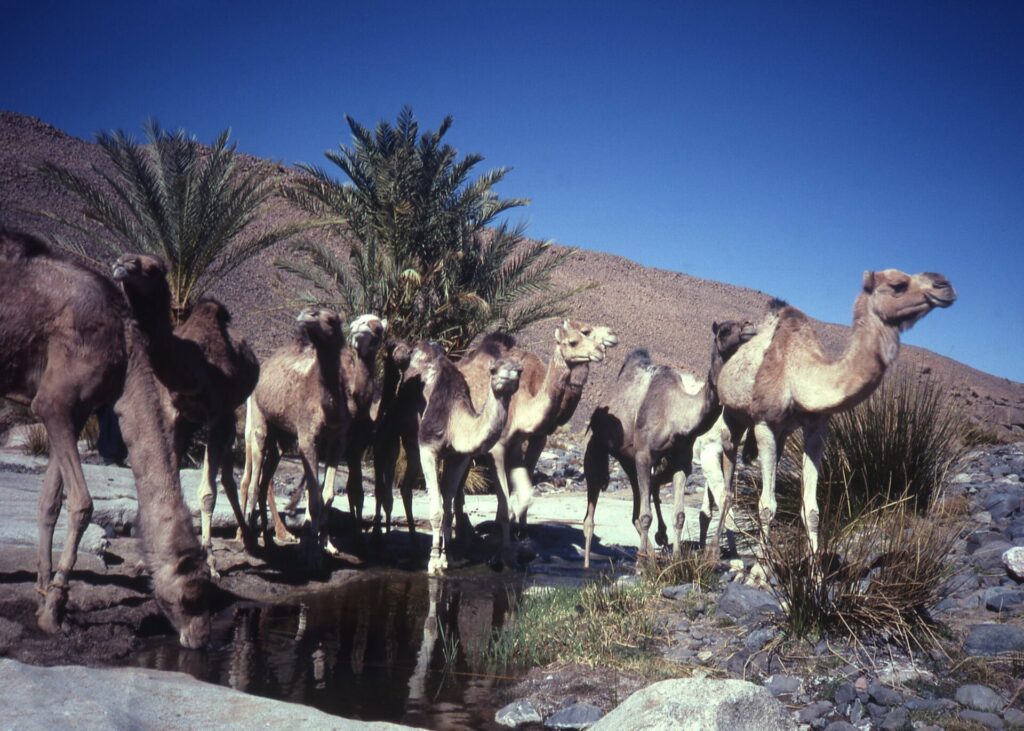
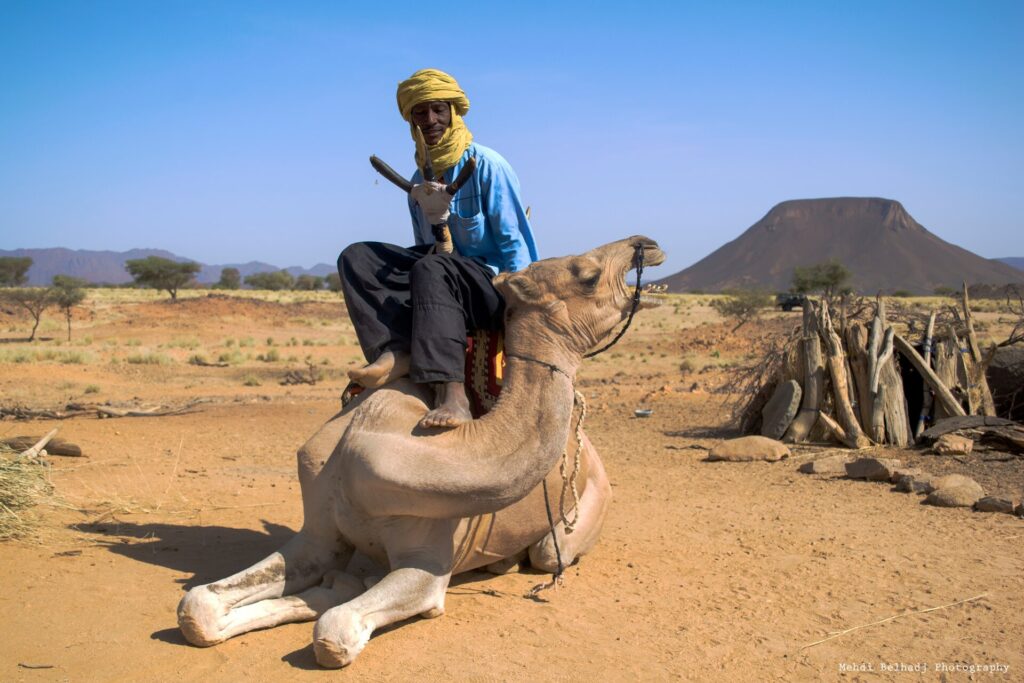
The camel, central to Kel Tamasheq life, appears in poetry as a companion and a source of pride, praised for its colour, speed and endurance; it is loved, not monstrous.

In Moroccan Amazigh tales, fairy-like beings from another world, such as the bride in the tale of Hemmu Unamir, marry humans and leave when a promise is broken. These beings stand between humans and the unseen.

Taboos & ProhibitionsFor nearly all Imazighen today, Islamic law defines the forbidden: idolatry, theft, adultery, murder, and breaking the fast or prayer without cause.

For nearly all Imazighen today, Islamic law defines the forbidden: idolatry, theft, adultery, murder, and breaking the fast or prayer without cause.

Among the Kel Tamasheq, customary rules of reserve are strong. A man should not show his mouth before his in-laws and elders; he should not eat in front of his wife's mother; a woman's family in-laws are treated with formal respect. Breaking these rules brings shame, not punishment, but shame in this society is serious.

Rules toward the unseen: avoid empty places at night, do not whistle or call out in the wild, do not insult spirits, and protect children and new mothers, who are vulnerable. Breaking these invites harm from the Kel Essuf, sometimes at once, sometimes later.

Rules of hospitality: a guest's safety is sacred; harming a guest or refusing water to a traveller brings lasting disgrace on a lineage. Breaking alliance or betraying kin is remembered in poetry for generations.

What cannot be undone: killing within kin, a poem of public shame that has spread, and lost honour. The consequences are often collective, falling on the whole lineage.

This part carries no pictures. Gods, spirits, the ancestors and ceremonies are named, with their roles, and drawn as marks only.

v

The Stories · Signature Stories

Its signature stories.

The story of Tin Hinan is told among the Kel Ahaggar as the founding of their noble line. Long ago, a woman of noble birth named Tin Hinan, whose name is often glossed as 'she of the tents' (the meaning is debated), left the Tafilalt in the north and travelled south across the desert with a companion, often named Takamat, a woman of lower status.

Tin Hinan and Takamat

The founding story of the Kel Ahaggar: a noble woman and her companion travel from the Tafilalt to the Ahaggar, and from them descend the noble and tributary lineages.

Source: Johannes and Ida Nicolaisen, The Pastoral Tuareg, 1997 (to check)

Anzar and the Bride of the Rain

The rain loves a young woman and withholds water until she agrees to join him; the story explains the ghonja rain processions.

Source: Mouloud Mammeri, Poèmes kabyles anciens, 1980 (to check)

Aligurran and Amamellen

Kel Tamasheq tales of a wise maternal uncle and his clever sister's son, who compete in wit.

Source: Johannes and Ida Nicolaisen, The Pastoral Tuareg, 1997 (to check)

Hemmu Unamir

A Tašelḥit tale of a young man who marries a woman from another world and loses her when a promise is broken.

Source: Gabriel Camps, Les Berbères: mémoire et identité, 1980 (to check)

Mqidech

Kabyle tales of a small, youngest boy who outwits ogres and saves his brothers.

Source: Taos Amrouche, Le Grain magique, 1966 (to check)

Tales of the Teryel

Kabyle tales of the ogress who lives in the forest, devours humans and can be tricked.

Source: Leo Frobenius, Volksmärchen der Kabylen, 1921–1922 (to check)

Dihya of the Aurès

The story of the queen and war leader called the Kahina, who led resistance to the Arab conquest around 698–703; much of it comes through later Arab historians and modern retellings.

Source: Ibn Khaldun, Kitab al-'Ibar, 14th century (to check)

Kusaila

The Amazigh leader who defeated Uqba ibn Nafi in 683 and held Kairouan for a time.

Source: Michael Brett and Elizabeth Fentress, The Berbers, 1996 (to check)

The First Mother of the World

Kabyle tales of the first woman and man and the origin of animals and customs, recorded early in the 20th century.

Source: Leo Frobenius, Volksmärchen der Kabylen, 1921–1922 (to check)

And 2 more stories in the catalog below.

vi

The Telling · Oral Tradition · Narrative Structure

How its stories are told, and the shape they move in.

Oral TechniquesKel Tamasheq poetry is metrical and sung or chanted; Foucauld recorded several metres, and poets choose them to suit the subject. A poem is composed in the mind and kept in memory, and a skilled reciter keeps the rhythm exact.
Performance ElementsAmong the Kel Tamasheq, two instruments shape performance. The imzad is a one-string bowed fiddle made from a gourd covered with skin, played only by women; it accompanies sung poetry and is associated with the ahal and with courage, since men were said to fight harder after hearing it.
Audience ParticipationListeners are always part of the act. At a Kel Tamasheq tende, women sing and clap in response to the lead singer, men ride camels around the singers, and the crowd's ululations reward a good verse or a good rider.
Memory DevicesThe tradition carries memory through several means. Metre and rhyme: Kel Tamasheq and Kabyle poetry use set metres, and once a poem is learned, its rhythm guides the reciter. Short stanzas like the Kabyle isefra are easy to repeat and spread fast.
Narrative StructureThe tales of this tradition most often follow a journey-and-return or trial pattern: a person leaves home, often a child, a nephew or a young woman, meets danger in the wild (an ogress, a spirit, a cruel ruler), escapes or outwits it through cleverness and help from kin, and comes back to restore the household.

Writers by Structure →

vii

The Figures · Survival and Diaspora

Who walks through its stories, and where they went.

The ancestress: a founding woman, like Tin Hinan, whose journey and courage create a lineage. She is honoured, remembered at her tomb, and her name gives identity to her descendants.

The clever nephew: Amamellen, the sister's son, outwits his maternal uncle Aligurran, a figure of age and authority. Their contest of wits shows the tension and bond between uncle and nephew in a society where the mother's brother matters.

The small trickster: Mqidech in Kabyle tales, a small boy, the youngest, who defeats ogres and saves his brothers through quick thinking.

The ogress: the danger of the wild, devouring but sometimes motherly, overcome by cunning.

The warrior queen: Dihya of the Aurès, who led resistance and is now a symbol of Amazigh courage, though much about her comes from later Arab historians and modern retelling.

The wise old woman: the teller herself and her characters, who know the way out.

The poet: the one whose verses make or break honour, man or woman.

The fool: Djeha, shared across North Africa, who says the wrong thing and so shows the truth.

Survival and diaspora

Modern Survival

Yes. The tradition is living. Tens of millions of people in Morocco, Algeria, Libya, Tunisia, Egypt, Mali, Niger, Burkina Faso and Mauritania speak Amazigh languages, and Kel Tamasheq communities still herd camels and goats, hold festivals, play the imzad and tende, and compose poetry.

Diaspora Adaptations

The Amazigh diaspora is not a Middle Passage diaspora, though captives from the Sahel were carried north across the Sahara for centuries, and some Saharan communities descend from them. The main modern diaspora formed through labour migration and exile. From Kabylia, migration to France began early in the 20th century and grew after independence.

Revival Movements

The Amazigh cultural movement is one of the largest language movements in Africa. In April 1980, Algerian authorities banned a lecture by Mouloud Mammeri on old Kabyle poetry at Tizi Ouzou; the protests that followed became the Berber Spring (Tafsut Imaziɣen). Further protests in Kabylia in 2001, the Black Spring, were met with deadly force.

viii

The Catalog · its places, peoples, practices and sources

What the lore holds.

Places

Abalessa Oasis in the Ahaggar with the tomb honoured as Tin Hinan's, excavated in 1925 and dated to around the 4th–5th century CE. Named only.
Ahaggar (Hoggar) The high massif of southern Algeria, home of the Kel Ahaggar, with Tamanrasset as its main town.
Tassili n'Ajjer Plateau of southeastern Algeria, home of the Kel Ajjer, with rock art listed by UNESCO in 1982.
Aïr Mountains and Agadez Massif in northern Niger and the old caravan town at its foot, centre of the Kel Ayr and seat of a sultanate.
Siwa Oasis in Egypt's Western Desert, home of the Siwi people and site of the ancient oracle of Amun. Named only.
Djurdjura and Kabylia The mountain range and region east of Algiers, home of the Iqbayliyen and centre of the modern Amazigh movement.
Timbuktu City on the Niger bend founded, by tradition recorded in the Tarikh al-Sudan, by Kel Tamasheq herders around 1100.

Peoples

  • Kel TamasheqThe Saharan Amazigh peoples called Tuareg by outsiders, who call themselves Imuhaɣ, Imajeɣen or Imušaɣ.Johannes and Ida Nicolaisen, The Pastoral Tuareg, 1997 (to check)
  • Kel AhaggarConfederation of the Ahaggar, whose noble Kel Rela lineage traces itself to Tin Hinan.Johannes and Ida Nicolaisen, The Pastoral Tuareg, 1997 (to check)
  • Kel EweyKel Tamasheq community of the Aïr in Niger, studied closely for spirit possession, aging and gender.Susan Rasmussen, Spirit Possession and Personhood among the Kel Ewey Tuareg, 1995 (to check)
  • IqbayliyenThe Kabyle people of northern Algeria, speakers of Taqbaylit.Mouloud Mammeri, Poèmes kabyles anciens, 1980 (to check)
  • IshelhiyenAmazigh people of the Souss, the High Atlas and the Anti-Atlas in Morocco, speakers of Tašelḥit.Michael Brett and Elizabeth Fentress, The Berbers, 1996 (to check)

Practices

  • ImzadOne-string bowed fiddle played by Kel Tamasheq women to accompany sung poetry; recognised by UNESCO in 2013.UNESCO, Practices and knowledge linked to the Imzad of the Tuareg communities, 2013 (to check)
  • TendeWomen's mortar drum and the gatherings of song, clapping and camel display around it; also used in spirit-healing dances.Susan Rasmussen, Spirit Possession and Personhood among the Kel Ewey Tuareg, 1995 (to check)
  • AhalEvening courtship gatherings of young Kel Tamasheq men and women, with music and poetry.Charles de Foucauld, Poésies touarègues, 1925–1930 (to check)
  • TagelmustThe veil and turban worn by Kel Tamasheq men, first tied at adulthood and linked to the value of reserve.Susan Rasmussen, The Poetics and Politics of Tuareg Aging, 1997 (to check)
  • SebeibaAnnual festival at Djanet of the Kel Ajjer, with drumming and dance, marking peace between communities; recognised by UNESCO in 2014.UNESCO, Ritual and ceremonies of Sebeïba in the oasis of Djanet, 2014 (to check)
  • YennayerThe Amazigh new year at the turn of the agricultural year in January, now a public holiday in Algeria and Morocco.Gabriel Camps, Les Berbères: mémoire et identité, 1980 (to check)
  • Tifinagh writingUse of the Amazigh script for inscriptions, names and messages, continuous among the Kel Tamasheq and revived as neo-Tifinagh.Gabriel Camps, Les Berbères: mémoire et identité, 1980 (to check)

The sacred, named

  • Tomb of Tin HinanGabriel Camps, Les Berbères: mémoire et identité, 1980 (to check)
  • Oracle of Amun at SiwaHerodotus, Histories, Book 4, 5th century BCE (to check)
  • TereoutSusan Rasmussen, Spirit Possession and Personhood among the Kel Ewey Tuareg, 1995 (to check)
  • EttebelJohannes and Ida Nicolaisen, The Pastoral Tuareg, 1997 (to check)

Sources

  • Poésies touarèguesLarge collection of Kel Ahaggar poetry with French translation, gathered from poets, many of them women.
  • The Pastoral TuaregTwo-volume study of Kel Tamasheq ecology, society and culture.
  • Spirit Possession and Personhood among the Kel Ewey TuaregEthnography of spirit illness and tende healing in the Aïr.
  • The BerbersStandard English history of the Amazigh peoples from antiquity to the present.
  • Les Berbères: mémoire et identitéSynthesis of Amazigh history, archaeology and culture by a leading scholar.
  • Poèmes kabyles anciensOld Kabyle poems collected from reciters by a Kabyle writer and scholar.
  • Le Grain magiqueKabyle tales, poems and proverbs learned from the author's mother, Fadhma Aït Mansour Amrouche.
  • The Bleeding of the StoneNovel by a Libyan Tuareg writer set in the desert of the Kel Tamasheq.

The World Bible

All 47 sections.

For the reader who wants all of it: every section of Desert Veils, in its eleven parts.

ACultural Foundation7 sections

A1Tradition Name

The peoples of this lore call themselves Imaziɣen (singular Amaziɣ, feminine Tamaziɣt), usually written Imazighen and Amazigh. The word is often glossed as 'free people', a reading many Amazigh writers use, though linguists treat the etymology as uncertain. Pronunciation: ee-mah-ZEE-ghen, ah-mah-ZEEGH, with the gh a soft sound from the back of the throat, like a French r. The English 'Berber' comes through Arabic and Latin from the Greek word for foreigners, and many Imazighen prefer not to use it.

The Saharan branch call themselves by forms of the same root: Imuhaɣ in the Ahaggar, Imajeɣen in the Aïr, Imušaɣ in the Ajjer, and also Kel Tamasheq, 'people of the Tamasheq language'. 'Tuareg' (Twareg) is an outside name of Arabic origin. Their language is Tamahaq, Tamajaq or Tamasheq depending on region.

Other Amazigh nations name their own languages: Taqbaylit (Kabyle, Iqbayliyen), Tašelḥit (Ishelhiyen of the Souss and Anti-Atlas), Tarifit (Irifiyen of the Rif), Tachawit (Ishawiyen of the Aurès), Tumẓabt (Mozabites) and Siwi (Siwa oasis). The shared language family is Tamaziɣt.

A2Cultural Origin

This lore belongs to the Amazigh peoples, the longest-settled population of North Africa west of the Nile valley, and to their Saharan branch, the Kel Tamasheq. Egyptian records name Libyan peoples on Egypt's western border, the Tjehenu, Tjemehu, Libu and Meshwesh, from the second millennium BCE; most historians see them as ancestors or relatives of later Amazigh nations, though the line cannot be traced person by person.

The main communities whose stories are gathered here are: the Kel Tamasheq confederations, including the Kel Ahaggar of the Algerian Ahaggar, the Kel Ajjer of the Tassili, the Kel Ayr of the Aïr in Niger, the Kel Adagh of the Adrar des Ifoghas in Mali, and the Iwellemmeden of the Niger bend; the Iqbayliyen of Kabylia and the Djurdjura in Algeria; the Ishawiyen of the Aurès; the Ishelhiyen and the Imazighen of the Middle and High Atlas in Morocco; the Irifiyen of the Rif; the Mozabites of the M'zab valley; and the Siwi of Siwa in Egypt.

The Kel Tamasheq traditions themselves tell of ancestors who came south from the northern oases into the central Sahara. Historians connect this with movements of Sanhaja and other Amazigh groups into the desert in the first millennium CE, after the camel became common there.

A3Cultural Context

These stories exist because a dispersed people, spread over an area larger than Western Europe and living under many states, needed ways to carry genealogy, law, honour and memory without a single court or capital. For the Kel Tamasheq, poetry and tale keep alive who descends from whom, which camp owes what to which, and what happened at each well and pass.

History pressed on the tradition from outside again and again: Carthage and Rome on the coast, the Arab conquests of the 7th century, the long Islamisation of the countryside, French colonial rule from 1830 in Algeria and from the 1890s in the Sahara, and the borders drawn after independence that cut the Kel Tamasheq across five states. Each pressure left its mark in songs of resistance and in tales of cunning against stronger powers.

Stories serve to teach young people manners and reserve, to court, to mock the proud, to praise the brave and to record grief. Most tales and poems are secular and can be told in any household. Sacred contexts are Islamic for nearly all Imazighen today: Qur'anic recitation, the praise of saints and prayers at shrines. Older rites, such as rain processions and spirit-healing dances, sit between the two, and their keepers decide where and when they are performed.

A4Source Validation

The written record begins with outsiders: Egyptian inscriptions, Herodotus' Histories (Book 4, 5th century BCE), Sallust's account of Jugurtha, the Latin poet Corippus on Amazigh gods in the 6th century CE, and the medieval Arab historians, above all Ibn Khaldun, whose Kitab al-'Ibar contains the fullest medieval history of the Amazigh nations. All of these must be read knowing who wrote them and why.

For the Kel Tamasheq, the largest early collection is Charles de Foucauld's Poésies touarègues, gathered from Kel Ahaggar poets and published in 1925–1930; the poets themselves, many of them women, are the real authorities behind it. Later fieldwork includes Johannes and Ida Nicolaisen on pastoral Tuareg society, Susan Rasmussen on the Kel Ewey of the Aïr, Dominique Casajus on the Kel Ferwan, and Hélène Claudot-Hawad on Tuareg political thought.

For the northern Imazighen, the key insider voices are Mouloud Mammeri, who collected old Kabyle poetry from its reciters, the Amrouche family (Fadhma Aït Mansour Amrouche, Jean Amrouche and Taos Amrouche) who wrote down songs and tales learned from their own mothers, and the historian-archaeologist Gabriel Camps. Today the Haut Commissariat à l'Amazighité in Algeria and the Institut Royal de la Culture Amazighe (IRCAM) in Morocco fund collection in Tamaziɣt by native speakers. No elders were consulted directly for this entry; it rests on published work.

A5Cultural Values

1. Takarakit, reserve or modesty: the Kel Tamasheq ideal of self-restraint before others, especially in-laws and elders. It is the value behind the men's veil, and in stories the hero who speaks too much or eats greedily before others is shamed.

2. Honour and the defence of the weak: in Tamasheq poetry, courage in raids and battle is praised, but so is the protection of guests, women and dependants. Hospitality to a traveller in the desert is a duty, not a kindness.

3. Freedom and self-rule: many Amazigh tales and songs set a small community against a stronger power and admire the one who refuses submission. Village assemblies, such as the Kabyle tajmaɛt, embody self-government.

4. Lineage and the mother's line: among the Kel Tamasheq, descent through women matters for status and, in some confederations, for leadership. Stories often turn on a sister's son, a mother's counsel or a founding ancestress.

5. Wit over force: the clever nephew, the small boy and the patient woman beat ogres and kings.

The collective comes before the individual, and the living answer to the dead through genealogy. A Western reader may find it strange that a hero's victory can be less admired than his restraint, or that a story ends happily when a lineage is secured rather than when a lover is won.
A6Worldview

For most Imazighen today, causation rests finally with God (in Tamasheq often Amanay or Mess-inegh, 'our Lord'), under Islamic teaching. Alongside this sits an older and still active understanding that unseen beings, the jinn or Kel Essuf, 'people of the solitude', can cause illness, madness or misfortune, especially in empty places and at liminal times such as dusk. Envy and the evil eye are also recognised causes of harm.

The individual is always a member: of a tent, a camp, a lineage, a confederation, or in the north of a village and its assembly. A person's misfortune is a matter for kin, and a person's shame falls on them too.

Time is layered. There is the linear Islamic history from creation to judgement; the cyclical time of seasons, migration routes, rains and the Yennayer new year; and genealogical time, which runs back through named ancestors to founders like Tin Hinan. Reality is layered too: the visible camp and the invisible world of the Kel Essuf overlap, and the boundary between them is felt most in the open desert, at wells, in graves and in the dark.

A7Storytelling Purpose

Stories are told to teach, to court, to remember and to give the community its sense of itself. Among the Kel Tamasheq, tales (tinfusen, singular tanfust) are told in the evening in the tent, often by older women to children. Sung and recited poetry (tisiway, singular tasiwit) is a public art, performed at the ahal courtship gatherings and at festivals, and can carry praise, love, satire and history.

Anyone may tell a tale, but some people are recognised specialists. Among the Kel Tamasheq the inaden (smiths) have a role as go-betweens, messengers and reciters of genealogy and praise. Poets, women and men, gain prestige from their verses; a sharp poem can wound a reputation. In Kabylia, the imeddaḥen, itinerant singers, recited long religious and heroic poems, and the old poets such as Si Mohand ou Mhand (19th century) are still quoted.

Telling happens daily in the evening, at weddings and births, at seasonal gatherings, and in times of crisis, when laments and war poems are made. The teller holds power over reputations: in a society that prizes honour, the person who can make a verse that will be repeated in every camp is someone to respect, court or fear.

BStory Structure8 sections

B1Narrative Structure

The tales of this tradition most often follow a journey-and-return or trial pattern: a person leaves home, often a child, a nephew or a young woman, meets danger in the wild (an ogress, a spirit, a cruel ruler), escapes or outwits it through cleverness and help from kin, and comes back to restore the household. Kabyle tales often move in chains of episodes, each one a new trial, joined by formulas.

Alongside this sits a second pattern, the genealogical and founding story: Tin Hinan coming to the Ahaggar, a lineage arising from an ancestress, a saint founding a village. These stories do not climax; they explain why things are as they are.

The poetry of the Kel Tamasheq is a third form, built not on plot but on scenes: a camp, a battle, a camel, a beloved's face, each set side by side. Many texts are hybrids: a tale with poems sung inside it, or a battle poem that also records a genealogy. Story movement is outward into danger and back to the tent, the well and the kin.

B2Conflict Type

Narrative tension comes from several sources, and Western-style conflict is only one of them.

The first is threat from the wild: ogres and ogresses (in Kabyle, the teryel), jinn and the Kel Essuf live beyond the camp or village, and the story begins when someone crosses into their space. The tension is between the human, ordered world and the dangerous outside.

The second is imbalance within kin: a jealous co-wife, a cruel stepmother, an uncle who tests or a brother who betrays. These stories are resolved by restoring proper relations rather than by destroying an enemy.

The third is honour under pressure: a raid, a debt, an insult, an occupying power. War poetry and resistance stories, about Dihya against the Arab armies or the Kel Ahaggar at Tit against the French, belong here.

The fourth is drought and the withholding of rain, as in the Anzar story, where the tension is between people and the forces that feed them, resolved through a bargain or a gift. Across all four, the driving force is usually a broken balance that must be set right, not a quest for personal gain.

B3Protagonist Type

The usual protagonist is an individual, but one defined by kinship: the sister's son, the youngest child, the orphan, the wife or the daughter. The Kel Tamasheq clever nephew Amamellen, who outwits his maternal uncle Aligurran, is the clearest example: he is himself, but his place as sister's son gives the story its meaning in a society that traces much through women.

Women are very often central. Ancestresses such as Tin Hinan, warrior queens such as Dihya of the Aurès, and the young women of Kabyle tales who outwit ogresses are protagonists in their own right, not prizes. Small boys, like the Kabyle trickster Mqidech, win by speed of mind.

In founding stories the protagonist can be a lineage or a whole confederation, with the ancestor standing for all who descend from her. In rain stories the protagonist is the community, represented by a bride or a procession. Spirits and gods are rarely the heroes; they are forces met along the way.

B4Resolution Pattern

The most common ending is restoration: the child returns to the mother's tent, the stolen bride is recovered, the rain falls again, the lineage continues. Victory over the ogress or the tyrant matters, but mainly because it lets ordinary life resume.

Founding stories end with continuation: from this woman came this people; from this saint, this village. The satisfying end is the present day, the listener's own existence.

Some tales end in a clever reversal, the trickster's last joke, with the proud humbled and laughter as the resolution. Others, especially the poetry of war and exile, end in grief: the dead are named, the camp is empty, and the poem itself becomes the memorial. That too is a proper ending, because the act of naming keeps the dead in the community's memory.

Kabyle tellers often close with a formula that releases the listeners and returns the tale to where it came from, marking the end as a crossing back into the ordinary world.

B5Time Structure

Tales are set in an undated 'once' that the opening formula announces, a time when animals spoke and ogres walked near villages. Within the tale, time moves forward in a chain of episodes, often counted in threes or sevens.

Founding stories and genealogies run on another clock: a line of named generations from an ancestress like Tin Hinan to the present chief or camp. This is linear but compressed; scholars note that generations are often merged or skipped, so the list keeps meaning rather than measuring years.

The seasonal clock shapes much telling: the rainy season, the cure salée gathering of herds at the salt pastures, the date harvest in the oases, Yennayer at the turn of the agrarian year. Some stories and songs belong to these moments, and the same story returns each year.

Poetry often layers times: a poet stands at an empty campsite and sees the past gathering there, so present and past overlap in one scene. Islamic time, from creation to judgement, frames all of these for most tellers today.

B6Community Role

The community is rarely the story's background. In Kel Tamasheq poetry, the camp, the confederation and its rivals are always present: poems praise or mock named families, and listeners know the people involved. In Kabyle tales, the village and its assembly judge the hero's actions.

Individuals act on behalf of kin, and their success or failure is the kin's. A young man's courage brings honour to his mother's line; a woman's poem can raise or lower a man's standing across the region. The ahal gatherings make this clear: young people meet, sing and court under the eyes of the community, and reputations are made in public.

The community expects a story to be told well, to respect reserve and decency, to name lineages correctly and to carry a lesson that fits its values. A teller who gets a genealogy wrong will be corrected. Satire is allowed and enjoyed, but it has consequences, and the community also expects the teller to bear them.

B7Moral Framework

Morality here is largely relational. Right action is defined by the duties a person owes to kin, guests, elders, allies and God. The same act, sharp speech, for example, can be praiseworthy against an enemy and shameful toward an in-law.

What earns honour: courage, generosity, hospitality to strangers, keeping one's word, protecting dependants, and above all reserve (takarakit), the control of appetite, speech and display in front of others. A man who keeps his veil properly and a woman who answers wit with wit both earn admiration.

What earns condemnation: cowardice, greed, breaking hospitality, betraying kin, boasting, and shamelessness. Islamic law and ethics frame these for most tellers, but older customary law (in Kabylia the qanun of each village) also governs land, water and feud.

Stories teach through consequence and laughter. The greedy are tricked, the proud are mocked in verse, the patient are rewarded. A listener learns not a rule but how a person of standing behaves.

B8Transformation Arc

Transformation is usually a consequence rather than the goal. The child who survives the ogress returns grown, ready for marriage; the young man who first ties the veil passes into adulthood; the bride of the rain enters a new state, and the land with her.

The tradition celebrates transformations that bring a person more fully into their role: the youth who earns a place in the men's company, the girl whose poems and music make her known at the ahal, the orphan who wins back a family. It also celebrates changes in the land: drought to rain, empty pasture to green.

What it mourns is the loss of the camp, the lineage or freedom: the desert depopulated by drought, the herds lost in the famines of the 1970s and 1980s, the warriors killed at Tit, the exile to towns. Modern Tamasheq song and poetry carry much of this mourning.

Physical transformation appears in tales, people turned into animals or spirits taking human form, but usually as a danger to be undone, not as a gift.

CSpiritual System5 sections

C1Sacred Elements

For nearly all Imazighen today, sacredness flows first from God and the Qur'an. The written word of the Qur'an carries power, which is why Kel Tamasheq men and women wear leather amulets (tereout) holding Qur'anic verses written by religious specialists (ineslemen); their exact contents belong to the people who make and wear them.

Places carry sacredness through the dead and the holy: the tombs of saints (marabouts), visited for blessing (baraka); ancestral tombs such as that of Tin Hinan at Abalessa; and older pre-Islamic burial monuments across the Sahara. Ancient sources and later scholarship also record that sleeping at ancestors' tombs to receive dreams was practised; Herodotus describes this among the Nasamones.

Objects of authority are charged with meaning: the ettebel, the great drum that stands for a Kel Tamasheq confederation's chief and his people. Blacksmiths' fire and iron are regarded as powerful and ambiguous.

Words matter: blessings, curses and the names of God protect, and some words are avoided in the wild. The mechanism of sacredness is closeness to God's word, to blessed people, or to the dead, and respect for what is set apart.

C2Ancestor Role

Ancestors here are not worshipped as gods, and Islam discourages any practice that looks like it. They remain present, however, in three ways.

First, through genealogy: a person's standing depends on descent, and among the Kel Tamasheq the noble lineages of the Ahaggar trace themselves to Tin Hinan. Reciting lineages is a way of keeping ancestors in the present.

Second, through tombs: graves of ancestors and holy people are visited, and the dead may come in dreams, especially to someone who sleeps near the grave. Ancient writers record this practice among Libyan peoples; anthropologists such as Rasmussen describe Kel Tamasheq people visiting tombs and receiving dreams in more recent times. The dead are greeted with prayers for their souls.

Third, through obligations: the living honour the dead by keeping their names, their word and their alliances. Poems remember the fallen of famous battles by name.

What the dead want is to be remembered properly and prayed for, and to have their descendants live with honour. Neglect and shame dishonour the dead as well as the living.

C3Spirit World

The unseen world in this tradition is shaped by Islam and by older Saharan and Maghrebi belief. It has three broad parts: the realm of God, the angels and the Prophet; the realm of the dead, who await judgement; and the hidden world of the jinn, which overlaps the visible world.

Among the Kel Tamasheq the beings of this hidden world are called Kel Essuf, 'the people of the solitude' or 'of the wild', the emptiness beyond the camp. They live in deserted places, ruins, wells, trees and the dark, and they are drawn to people who are alone, grieving or careless. In the north they are usually called jnun (jinn).

Crossings happen in both directions. Spirits can enter a person and cause illness or possession, especially, Rasmussen records among the Kel Ewey, at times of social stress. People can reach the unseen through prayer, dreams at tombs, healing dances and the work of religious specialists. The rules are about place and time: the edge of the camp, dusk and night, and moments of grief or anger are when the boundary is thinnest.

C4Ritual Structure

Rituals mark the passages of life and restore balance when it is lost.

Passages include the naming of a child on the seventh day, a young man's first tying of the veil (tagelmust), marriage with its days of music, camel display and poetry, and death with Islamic burial and condolence visits. Kel Tamasheq marriages are known for the long period in which the bride's family and the groom's family exchange gifts and the couple's tent is set up, often by the bride's kin.

Restoring balance: when spirits cause illness, the Kel Ewey and other Kel Tamasheq hold tende n goumaten, evenings of drumming and song in which the afflicted person dances until the spirit is calmed. Rain rites in Kabylia and Morocco, the Anzar processions, ask for rain in drought. Collective gatherings such as the Sebeiba at Djanet renew peace between groups. The full content of these rites belongs to their keepers.

In stories, rituals appear as frames (a tale told at a wedding), as events (a girl's marriage to the rain) and as resolutions (the dance that drives out a spirit, the procession that brings rain).

C5Divine Hierarchy

Today the hierarchy for nearly all Imazighen is Islamic: one God, above all; angels and prophets; saints whose blessing can be sought; and the jinn, created beings who can be good or harmful. This has been true for most Imazighen for many centuries.

Before and alongside the coming of Islam there was an older religious world, known only in fragments from Greek, Latin and Arabic writers, inscriptions and later folk practice. Herodotus wrote that the Libyans sacrificed to the sun and the moon. Amun of Siwa, Ammon to the Greeks, had a famous oracle in the Siwa oasis. The Latin poet Corippus names gods of the Amazigh peoples of 6th-century Libya, including Gurzil, linked to a bull, and Mastiman. Latin inscriptions from Roman North Africa name many local gods, known only by their names. Scholars disagree about how widely any of them were worshipped.

In folk practice, Anzar, the rain, was addressed in processions into the 20th century in Kabylia and elsewhere. These beings did not form a single pantheon; they belonged to particular peoples and places.

DPerformance4 sections

D1Oral Techniques

Kel Tamasheq poetry is metrical and sung or chanted; Foucauld recorded several metres, and poets choose them to suit the subject. A poem is composed in the mind and kept in memory, and a skilled reciter keeps the rhythm exact. Women sing poems at the ahal accompanied by the imzad; the voice is clear and controlled, and silence between verses lets a line land.

Tales are told in a quieter, conversational voice, with changes of voice for ogres and animals, songs embedded in the tale, and repetitions of key phrases at each new episode.

Kabyle tellers, usually older women, open with formulas that set the tale apart from ordinary speech and close with another formula that returns the listeners to ordinary life. Mouloud Mammeri and Taos Amrouche record these formulas. Within the tale, repetition in threes, dialogue and sung refrains carry the action.

Kabyle poetry is built in short rhymed stanzas, such as the nine-line isefra of Si Mohand ou Mhand, made to be remembered and repeated. A good line is quoted as a proverb.

D2Performance Elements

Among the Kel Tamasheq, two instruments shape performance. The imzad is a one-string bowed fiddle made from a gourd covered with skin, played only by women; it accompanies sung poetry and is associated with the ahal and with courage, since men were said to fight harder after hearing it. In 2013 UNESCO recognised imzad practices of Algeria, Mali and Niger.

The tende is a drum made by stretching a goat-skin over a wooden mortar, played by women; it accompanies singing, clapping and men's camel parades at festivals, and it is the instrument of the tende n goumaten spirit-healing dances.

Dress is part of performance: men's indigo or white veils (tagelmust), women's head-cloths and silver jewellery made by the inaden, camels decorated with leather and saddles. In the north, Amazigh performance includes the ahidus of the Middle Atlas and the ahwash of the High Atlas and Souss, line and circle dances of men and women with frame drums, and the bendir drum.

The body is restrained in storytelling and expressive in dance: in tende the camel riders circle the women's drum; in ahidus shoulders and feet move together.

D3Audience Participation

Listeners are always part of the act. At a Kel Tamasheq tende, women sing and clap in response to the lead singer, men ride camels around the singers, and the crowd's ululations reward a good verse or a good rider.

At the ahal, young men and women answer one another in song and poetry; courtship itself is a form of audience participation. A poem made at an ahal can be answered by another poem at the next.

In Kabyle tale-telling the children answer the opening formula, ask questions, and sing the refrains with the teller. They know many tales already and will correct a teller who skips a step.

In ahidus and ahwash dances there is little separation between performers and audience: the line of dancers is the community, and a poet may step forward to improvise verses answered by the chorus. In the Ahellil of the Gourara, sung by Zenata communities in the Algerian Sahara and recognised by UNESCO in 2008, a lead singer and a chorus alternate through the night. Participation means the story is never owned by one voice.

D4Memory Devices

The tradition carries memory through several means.

Metre and rhyme: Kel Tamasheq and Kabyle poetry use set metres, and once a poem is learned, its rhythm guides the reciter. Short stanzas like the Kabyle isefra are easy to repeat and spread fast.

Formulas: tale openings, closings and refrains are fixed, and episodes repeat in set patterns, so the teller rebuilds the tale each time from known parts.

Genealogies: lineages are recited in order and attached to stories, so the history of a confederation is held in the names of its ancestors.

Writing: Tifinagh, the Amazigh script descended from the ancient Libyco-Berber alphabet, has been used by the Kel Tamasheq continuously for short inscriptions, names, love messages and games. It was not used for long texts, but it shows that the tradition carried its own script, attested from at least the last centuries BCE (scholars disagree on how much earlier). Claims that it is the world's oldest alphabet still in use are popular but not established.

The land itself: wells, rock engravings, tombs and passes recall stories. Specialists, poets, smiths and older women, carry the most.

EMagic & Power4 sections

E1Magic System

The power system of this lore is not 'magic' in the Western sense, but a set of known forces that can protect or harm.

Baraka, blessing, comes from God and is held by saints, holy lineages, the Qur'an and some places. It heals, protects and brings plenty. It can be passed on through contact, prayer and descent.

The jinn and Kel Essuf can cause illness, madness and accidents. They can be calmed or driven out through Qur'anic healing by religious specialists or through tende n goumaten music and dance.

The evil eye (tehot among the Kel Tamasheq) and envious speech can cause harm unknowingly; praise without a blessing can be dangerous.

Smiths (inaden) are regarded as having a special relation to fire and to the unseen, which makes them powerful and set apart.

What cannot be done: undo God's decree, raise the dead, or force a person's love without consequence. The stated rules come from Islam; the unstated rules are about place, time, reserve and respect: do not boast, do not walk alone at night, do not insult the unseen.

E2Power Sources

Divine power, through baraka, comes from God and flows through the Qur'an, saints and holy lineages. The ineslemen (religious clerics) among the Kel Tamasheq and the marabout lineages in the north hold it by descent and learning. Accessing it costs piety, study and obligation: those with baraka are expected to mediate, heal and make peace.

Ancestral power comes through descent. Noble lineages among the Kel Tamasheq trace their authority to founding ancestors; chiefly office in some confederations, like the Kel Ahaggar, passed through the female line, so a chief's sister's son could succeed him.

Earned power comes through courage, poetry and wisdom. A warrior, a poet or a skilled judge earns a standing that birth alone cannot give.

Power from the unseen, through relations with jinn, is ambiguous and risky. Smiths' power over fire and metal is respected and kept at a distance.

Stolen power appears in tales: the ogress's treasure, the king's secret, won by a trickster at great risk. The cost of any power is responsibility, envy from others and, for unseen power, danger to oneself.

E3Taboos & Prohibitions

For nearly all Imazighen today, Islamic law defines the forbidden: idolatry, theft, adultery, murder, and breaking the fast or prayer without cause.

Among the Kel Tamasheq, customary rules of reserve are strong. A man should not show his mouth before his in-laws and elders; he should not eat in front of his wife's mother; a woman's family in-laws are treated with formal respect. Breaking these rules brings shame, not punishment, but shame in this society is serious.

Rules toward the unseen: avoid empty places at night, do not whistle or call out in the wild, do not insult spirits, and protect children and new mothers, who are vulnerable. Breaking these invites harm from the Kel Essuf, sometimes at once, sometimes later.

Rules of hospitality: a guest's safety is sacred; harming a guest or refusing water to a traveller brings lasting disgrace on a lineage. Breaking alliance or betraying kin is remembered in poetry for generations.

What cannot be undone: killing within kin, a poem of public shame that has spread, and lost honour. The consequences are often collective, falling on the whole lineage.

E4Initiation Rites

Among the Kel Tamasheq, the clearest passage to adult manhood is the first tying of the tagelmust, the veil and turban, at around the age when a young man becomes able to marry and to take part in the life of men. Ethnographers such as the Nicolaisens and Rasmussen describe it as a family event, sometimes with a religious specialist present, after which the young man is expected to show reserve before elders and in-laws. What is set aside is childhood freedom of manner; what is born is a man of standing.

For girls, adulthood is marked more gradually: through wearing the head-cloth, learning music and poetry, taking part in the ahal and marriage, when a woman receives her own tent.

Religious learning is a different path: students study the Qur'an with a teacher and may become ineslemen or marabouts, holders of written knowledge.

Spirit healing has its own passage: a person who has gone through tende n goumaten may become part of the community of those who know the spirits. Smiths pass their craft within families. The inner content of craft and healing knowledge belongs to their keepers.

FSocial Structure4 sections

F1Gender Roles

Gender among the Kel Tamasheq does not fit Western expectations. Men, not women, veil their faces. Women do not cover their faces, have wide freedom to meet men socially, and in many confederations own the tent, which is built by and passes through women. In divorce, which is common and not shameful, a woman keeps the tent and often her herd.

Women are the main keepers of music and poetry: they play the imzad and tende, compose poems, and judge men's poems at the ahal. A woman's verse can raise or lower a man's honour. Many of the poets in Foucauld's collection are women.

Descent through women matters for status and, in some confederations, for chiefship; historians and anthropologists debate how far Kel Tamasheq society should be called matrilineal, since Islamic inheritance law, which favours sons, also applies, and practice differs between groups.

Men herd camels, travel on caravans, raid in the past and hold political office. In the northern Amazigh communities gender roles are more segregated: Kabyle village assemblies were male, while women held the tale, song, pottery and weaving traditions, and older women had real authority in the household.

F2Age Hierarchy

Age brings authority and changes duties. Among the Kel Tamasheq, children move freely; youth is the time of the ahal, poetry, courtship and courage; married adults carry the household and herds; elders give counsel and settle disputes.

Susan Rasmussen's study of the Kel Ewey shows that aging also changes reserve: younger men must veil most carefully and avoid their in-laws, while older men and women relax some rules. Older women gain authority and freedom of speech, and many become the main tellers of tales.

Elders hold genealogy, the memory of past alliances and conflicts, knowledge of pastures and wells, and the right to speak in assemblies. In Kabylia the tajmaɛt was led by senior men, and village elders kept customary law.

What elders hold that others cannot access is the long view: who married whom three generations ago, which well belongs to which lineage, what was promised at a past peace. This knowledge gives them power in negotiation, marriage and disputes. In stories, the old woman is often the one who knows the way out.

F3Class & Caste

Kel Tamasheq society was historically divided into ranked groups. The imajeghen (nobles) were warriors and owners of the right to rule; the imghad were tributary herders; the ineslemen were religious clerics; the inaden were smiths and artisans; and the iklan were people of servile status, many descended from captives. These ranks were justified by descent and custom; they have weakened greatly since colonial and independence-era abolitions, but they remain in memory and sometimes in marriage choices.

The inaden hold a special place. They make jewellery, weapons and tools, are thought to have power over fire and the unseen, and act as go-betweens in marriages and disputes, as messengers and as reciters of praise and genealogy. Their status is ambiguous: needed and respected, but set apart.

In stories, nobles prize honour and reserve, smiths are clever and sharp-tongued, and religious men are sources of blessing and judgement. Northern Amazigh villages were more equal among landholding families, with marabout lineages set apart for their religious role. Poets came from all ranks.

F4Community Structure

Kel Tamasheq society is built from the tent (ehen), the household of a married woman and her family; the camp (aghiwen), a group of tents moving together; the lineage or descent group (tawshit); and the confederation, a political union of lineages under a chief (amenokal), such as the Kel Ahaggar or the Kel Ayr. Each confederation historically had its drum (ettebel) as a symbol of authority.

Membership carries duties: mutual aid in drought, defence, sharing of pasture, hospitality, and loyalty in disputes. In return a member has protection, a share in wells and grazing, and a place in the genealogy.

In northern Amazigh lands, communities are villages and village federations. In Kabylia the village assembly (tajmaɛt) governs land, water, repairs and feud by customary law; in the Atlas, collective granaries such as the igudar of the Anti-Atlas were managed by community rules.

Expulsion or loss of protection is severe: a person without kin in the desert has no one to give water, defend them or remember them. Exile is a theme of many poems, both by those driven out and by those who left to work in towns or abroad.

GGeography3 sections

G1Geographical Setting

The lore spans two landscapes. The Sahara of the Kel Tamasheq is a world of high massifs, the Ahaggar, the Tassili n'Ajjer, the Aïr and the Adrar des Ifoghas, of gravel plains, sand seas, dry riverbeds (wadis), wells and oases. Rain is rare and irregular; drought shapes life. The Sahel to the south is a land of seasonal pasture.

The northern Amazigh lands are mountain countries: the Rif, the Middle and High Atlas, the Anti-Atlas, the Djurdjura of Kabylia and the Aurès. There villages cling to slopes, fields are terraced, and snow, olives and figs mark the seasons.

The environment shapes stories directly. In the desert, the empty space beyond the camp is where spirits live; wells are meeting places, sites of courtship and conflict; a lost path means death. In the mountains, ogres live in the forest and gorges, and the village is the safe centre.

The land is a record. Rock engravings and paintings in the Tassili, some many thousands of years old, show cattle, people and animals of a greener Sahara, and Kel Tamasheq people today say these images belong to earlier peoples. The land carries lineage memory too: every well and pass has a name and a story.

G2Sacred Sites

Abalessa, near Tamanrasset in the Ahaggar, holds the tomb attributed to Tin Hinan, the ancestress of the Kel Ahaggar nobles. It was opened by a Franco-American team in 1925, who found the skeleton of a woman with jewellery; later dating placed the burial around the 4th–5th century CE. Whether the woman buried there was the Tin Hinan of tradition is uncertain, but the site is honoured as hers.

The Siwa oasis in Egypt's Western Desert held the oracle of Amun, visited by Alexander the Great in 331 BCE; the Siwi people still live there and speak an Amazigh language.

The Tassili n'Ajjer, home of the Kel Ajjer, holds one of the world's great collections of rock art, listed by UNESCO in 1982. Djanet there is the site of the Sebeiba festival.

Across the north, tombs of saints, such as the many shrines of the Souss and Kabylia, are visited for blessing and at annual festivals (moussems). Pre-Islamic monuments such as the Medracen in Algeria and the royal tombs of Numidia are seen as works of ancient ancestors.

In narrative, these sites are sources of identity and of dreams, places where the ancestors may still be met.

G3Cosmological Map

The cosmology most Imazighen share today is Islamic: the heavens above, the earth, and the realm of the dead and of judgement. Within that frame lies a more local map of the visible and invisible worlds.

Among the Kel Tamasheq, the key line is between the inhabited and the empty. The tent and camp are the human centre, protected by people, fire, prayer and amulets. Outside lies essuf, the solitude, the wild where the Kel Essuf live. Ethnographers such as Casajus describe the tent itself, owned by women, as the centre of the social world and the open desert as its opposite.

Directions matter for prayer, which faces Mecca, and for movement: herds follow the seasons north and south, caravans east and west.

The living move toward the unseen world through dreams at tombs, through prayer, through possession during illness and through the music of healing dances. The dead pass on to the next world but may be met in dreams. The boundary is crossed at thresholds: the edge of camp, wells, ruins, graves, and the hours of dusk and night.

HHistory3 sections

H1Historical Events

Rock art in the Tassili n'Ajjer and the Acacus records herding peoples of a wetter Sahara from about 5000 BCE, though the art's link to later Amazigh peoples is debated. In the 13th and 12th centuries BCE, Egyptian records describe wars with Libyan peoples, the Libu and Meshwesh, on Egypt's western border. Around 945 BCE, Shoshenq I, of Meshwesh Libyan descent, founded Egypt's 22nd Dynasty. By the 5th century BCE, the Garamantes of the Fezzan ruled a Saharan state with irrigated oases and trade routes. In 202 BCE, the Amazigh king Massinissa, allied with Rome, became master of Numidia. From 112 to 105 BCE, his grandson Jugurtha fought Rome. From 17 to 24 CE, Tacfarinas led a long revolt against Roman rule. In the 4th–5th century CE, a woman of high rank was buried at Abalessa, in the tomb later honoured as Tin Hinan's.

In 683, the Amazigh leader Kusaila defeated the Arab commander Uqba ibn Nafi. Around 698–703, Dihya, called the Kahina, led the last great resistance in the Aurès before her defeat. In the 11th century, the Sanhaja Almoravids built an empire from the Sahara to Spain. Around 1100, by tradition, Kel Tamasheq herders founded Timbuktu. In 1902, the Kel Ahaggar were defeated by French forces at Tit. In 1916–1917, Kaocen ag Kedda led a revolt and besieged Agadez. In 1980, the Berber Spring in Kabylia demanded recognition of Tamaziɣt. In 2011, Morocco made Tamaziɣt an official language, and in 2016 Algeria did the same.

H2Migration Patterns

Movement is at the heart of this tradition. The Kel Tamasheq are pastoralists who move with their herds each season between pastures and wells; many also took part in long-distance caravans carrying salt, dates, grain and goods across the Sahara between North Africa and the Sahel. The salt caravans from the Aïr to Bilma and from the north to Timbuktu were still running in the 20th century.

The Kel Tamasheq's own traditions tell of ancestors arriving from the north, such as Tin Hinan coming from the Tafilalt in Morocco. Historians link the spread of Amazigh-speaking groups into the central Sahara with the camel and the growth of trans-Saharan trade from the early first millennium CE.

Migration carried language, genealogy, poetry, the tent and the herd. It lost settled monuments and sometimes ties to the north.

In the 20th century, the great droughts of 1968–1974 and 1984–1985 killed many herds and drove many Kel Tamasheq into towns and into exile in Algeria and Libya. Young men who went to Libya for work became known as ishumar, and from that exile came a new music of guitars and longing. From Kabylia and the Rif, large numbers went to France, Belgium and the Netherlands.

H3Cultural Exchanges

Amazigh peoples have lived among other powers for three thousand years. They traded and fought with Egypt, Carthage and Rome; Punic and Latin shaped the coast's culture, and some scholars argue that the Carthaginian goddess Tanit may have local African roots, though this is debated. Christianity spread among many Amazigh in late Roman times; Augustine of Hippo was born in Numidia.

Islam came with the Arab conquests of the 7th century and over many centuries became the faith of almost all Imazighen. Amazigh dynasties, the Almoravids, Almohads and others, then became great champions of Islam across North Africa and Spain. Arabic spread, and many Amazigh communities became Arabic-speaking.

In the Sahara, the Kel Tamasheq traded and intermarried with Songhai, Hausa, Arab and Fulɓe peoples; the ineslemen brought Islamic learning, and towns like Agadez and Timbuktu mixed languages and peoples.

What was resisted was the loss of language and self-rule. The tradition held its integrity by keeping its language at home, its poetry, its kinship rules and the unusual Kel Tamasheq customs of veiling and women's freedom, while absorbing Islam as its own.

IModern Survival3 sections

I1Modern Survival

Yes. The tradition is living. Tens of millions of people in Morocco, Algeria, Libya, Tunisia, Egypt, Mali, Niger, Burkina Faso and Mauritania speak Amazigh languages, and Kel Tamasheq communities still herd camels and goats, hold festivals, play the imzad and tende, and compose poetry.

What is kept: language, poetry, music, the veil, women's ownership of the tent in many places, Tifinagh writing, the ahal in some regions, festivals like the Sebeiba at Djanet and the cure salée at In-Gall, and Yennayer celebrations across North Africa.

What has changed: many Kel Tamasheq now live in towns; drought, conflict and borders have broken old routes; the old ranks have weakened; and the imzad's players became fewer in the late 20th century, prompting efforts to teach it again. Rebellions in Niger and Mali, especially after 1990 and in 2012, have displaced many people.

Contemporary practitioners include the women who still play the imzad and tende, the poets of the camps, the singers of the Ahellil, and musicians such as Tinariwen and Bombino, who carry Tamasheq poetry to world audiences. In the north, Kabyle singers and poets, from the late Lounès Matoub to today's artists, keep the songs alive.

I2Diaspora Adaptations

The Amazigh diaspora is not a Middle Passage diaspora, though captives from the Sahel were carried north across the Sahara for centuries, and some Saharan communities descend from them. The main modern diaspora formed through labour migration and exile.

From Kabylia, migration to France began early in the 20th century and grew after independence. In Paris, Kabyle cafés, associations and radio became centres of song, poetry and political thought; the Académie berbère in Paris in the late 1960s promoted the neo-Tifinagh alphabet and the Amazigh flag. From the Rif and the Souss, large communities settled in the Netherlands, Belgium, Spain and Germany, keeping weddings, music and the language.

For the Kel Tamasheq, the ishumar exiles in Libya and Algeria in the 1970s–1990s created the guitar music called tishoumaren or assouf, in which old poetic forms meet electric guitars. This music has spread worldwide.

What diaspora communities made from fragments is a shared Amazigh identity across countries, symbolised by the flag, the Tifinagh letter yaz (ⵣ) and Yennayer, which unites people whose grandparents had different local names.

I3Revival Movements

The Amazigh cultural movement is one of the largest language movements in Africa. In April 1980, Algerian authorities banned a lecture by Mouloud Mammeri on old Kabyle poetry at Tizi Ouzou; the protests that followed became the Berber Spring (Tafsut Imaziɣen). Further protests in Kabylia in 2001, the Black Spring, were met with deadly force.

Gains followed: Algeria created the Haut Commissariat à l'Amazighité in 1995, made Tamaziɣt a national language in 2002 and an official language in 2016, and made Yennayer a national holiday in 2018. Morocco founded IRCAM in 2001, adopted neo-Tifinagh for teaching in 2003, made Tamaziɣt official in 2011 and declared Yennayer a public holiday in 2023.

In the Sahara, associations in Algeria, Niger and Mali have worked to teach the imzad to young women, and UNESCO's 2013 listing supported this. Festivals, Tamasheq radio and schools teaching in Tamajaq add to the work.

Writers lead much of it: the Tuareg poet Hawad, the Libyan Tuareg novelist Ibrahim al-Koni, and Kabyle authors writing in Taqbaylit. What remains lost is much of the old religious world before Islam, known only by names, and many poems from regions where no one wrote them down.

JDeities3 sections

J1Primary Deities

For nearly all Imazighen today, there is one God, in Arabic Allah and in Tamasheq often Amanay or Mess-inegh, 'our Lord'. God is not pictured; worship is through prayer, fasting, the Qur'an and the call to prayer. God is the source of baraka and of all decree.

The older beings known from historical sources are remembered, studied and, in a few cases, still addressed in folk custom:

Amun of Siwa (Ammon), whose oracle in the Siwa oasis was famous across the ancient Mediterranean, shown in Greek and Roman art with ram's horns.

Gurzil, named by the 6th-century poet Corippus as a god of the Laguatan people of Libya, linked with a bull and carried into battle in the form of an image.

Mastiman, also named by Corippus, linked by him to the Roman Jupiter; little more is known.

Anzar, the rain, addressed in processions in Kabylia, the Aurès and Morocco into the 20th century; in story he loves a young woman and withholds water until she joins him.

The sun and moon, which Herodotus says the Libyans honoured with sacrifice. Ritual protocols for these older beings are mostly lost or belong to the communities that keep them.

J2Spirit Types

The Kel Essuf, 'people of the solitude', are the main spirits of Kel Tamasheq belief. They live in the empty places beyond the camp and are drawn to people who are alone, afraid or grieving. They can cause illness or possession, but they are not simply evil; they are other. Protection comes from staying near others, from amulets, from prayer and from avoiding the wild at night.

The jinn (jnun in Maghrebi speech) of Islamic teaching are the same kind of being in northern understanding: created from smokeless fire, Muslim or not, helpful or harmful. Healers and religious specialists treat their effects through Qur'anic recitation and, in some communities, through music and dance.

The dead, who may appear in dreams, especially at their tombs, and who give advice or warning.

Saints, holy people whose baraka continues after death, visited at shrines for blessing and help.

Some named female spirits are known in Moroccan folk belief, such as Aisha Qandisha, though she is shared with Arabic-speaking communities. The rules of interaction are respect, avoidance and the protection that blessing brings.

J3Mythological Creatures

The ogre and ogress are the great creatures of Amazigh tales. In Kabyle tales the ogress, teryel, lives in the forest or a cave, eats humans, can take human form, and has power over the wild; but she can be tricked, and in some tales she treats a child who suckles at her breast as her own. Taos Amrouche's collection Le Grain magique and Frobenius's Kabyle collections contain many such tales. The male ogre is equally dangerous and often slow-witted.

Animals speak in tales: the jackal (uccen) is a trickster, sly and often punished, in Kabyle and Moroccan Amazigh tales; the hedgehog (insi) is clever and often outwits the jackal; the lion is strong but foolish.

The camel, central to Kel Tamasheq life, appears in poetry as a companion and a source of pride, praised for its colour, speed and endurance; it is loved, not monstrous.

In Moroccan Amazigh tales, fairy-like beings from another world, such as the bride in the tale of Hemmu Unamir, marry humans and leave when a promise is broken. These beings stand between humans and the unseen.

KStories3 sections

K1Signature Story

The story of Tin Hinan is told among the Kel Ahaggar as the founding of their noble line. Long ago, a woman of noble birth named Tin Hinan, whose name is often glossed as 'she of the tents' (the meaning is debated), left the Tafilalt in the north and travelled south across the desert with a companion, often named Takamat, a woman of lower status. They travelled on camels with their animals and few possessions.

In the desert, food and water ran short. In one well-known telling, Takamat, sent ahead, found grain stored by ants and gathered it, and so the two women survived. They reached the Ahaggar, where the land was empty, or in some versions where other people already lived, and settled at Abalessa.

From Tin Hinan came the Kel Rela, the noble lineage from which the amenokal of the Kel Ahaggar was chosen. From Takamat came other lineages of the confederation, of tributary status. The two women thus founded the order of Kel Ahaggar society.

The story reveals the tradition's values: descent through a woman as the source of rule; the journey as founding act; cooperation between ranks; survival through cleverness and the gifts of the land. It also explains present social order as the outcome of an ancestress's journey. Versions differ in details, and tellers know them.

K2Archetype Characters

The ancestress: a founding woman, like Tin Hinan, whose journey and courage create a lineage. She is honoured, remembered at her tomb, and her name gives identity to her descendants.

The clever nephew: Amamellen, the sister's son, outwits his maternal uncle Aligurran, a figure of age and authority. Their contest of wits shows the tension and bond between uncle and nephew in a society where the mother's brother matters.

The small trickster: Mqidech in Kabyle tales, a small boy, the youngest, who defeats ogres and saves his brothers through quick thinking.

The ogress: the danger of the wild, devouring but sometimes motherly, overcome by cunning.

The warrior queen: Dihya of the Aurès, who led resistance and is now a symbol of Amazigh courage, though much about her comes from later Arab historians and modern retelling.

The wise old woman: the teller herself and her characters, who know the way out.

The poet: the one whose verses make or break honour, man or woman.

The fool: Djeha, shared across North Africa, who says the wrong thing and so shows the truth.

K3Story Examples

Anzar and the Bride of the Rain (Kabyle and wider Amazigh). Anzar, the rain, sees a beautiful young woman bathing in a river and asks for her. She refuses. He withdraws, and the river and springs dry up. In grief for the land, she agrees and calls to him; he returns, and the waters flow. Communities long carried a ladle dressed as a bride, the ghonja, in processions in time of drought, singing to Anzar. Structure: imbalance, refusal, sacrifice, restoration. It shows that the people's welfare comes through a gift and a bond with the forces that feed them.

Hemmu Unamir (Tašelḥit, Morocco). A young man marries a woman from another world, who forbids him to tell anyone or to break a certain promise. When the promise is broken, she leaves, and he must follow her through great trials. Structure: union, prohibition, breach, quest. It shows the cost of broken trust and the weight of a promise.

Mqidech and the Ogress (Kabyle). The youngest of brothers, small and despised, leads them through the ogress's house by tricks and saves them. Structure: chain of trials with a reversal of expectation. It shows wit over force and the youngest's worth.

✦Deities & Spirits9

Amanay

Titles: Allah; Mess-inegh ('our Lord'); God

Domain: The one God of Islam, source of all decree and blessing

In the stories: Not the subject of myth; addressed in prayer and blessing in Kel Tamasheq speech and poetry

Notes: Amanay is a Tamasheq word for God used by Kel Tamasheq speakers. For nearly all Imazighen, God is one and is not pictured. Blessings and curses in poetry invoke God's name.

Amun of Siwa

Titles: Ammon; Zeus Ammon; Jupiter Ammon

Domain: Oracle; kingship; the desert oasis

In the stories: Alexander the Great's visit to the oracle at Siwa in 331 BCE; Herodotus on the Ammonians

Notes: Amun's oracle at Siwa was famous across the ancient Mediterranean; Greeks and Romans pictured him with ram's horns. How far he was an Egyptian god adopted by Libyan peoples, or a local god merged with Amun, is debated.

Gurzil

Titles: Bull-linked god of the Laguatan

Domain: War and protection of the Laguatan people of Libya

In the stories: Corippus, Iohannis (6th century), describes the image of Gurzil carried into battle against Byzantine forces

Notes: Known almost entirely from Corippus, who was hostile to those he described. He is said to be the son of Amun and a cow, according to Corippus. A site at Ghirza in Libya has been linked to his worship by some scholars, but this is uncertain.

Mastiman

Titles: Linked by Corippus with Jupiter

Domain: Uncertain; Corippus associates him with sacrifice and war

In the stories: Mentioned in Corippus, Iohannis

Notes: Only a name and a few lines survive. He shows that the Amazigh peoples of late antique Libya had their own gods beyond the Egyptian and Roman ones. Further claims should be treated with caution.

Anzar

Titles: The Rain; lord of rain and water

Domain: Rain, rivers, fertility of the land

In the stories: Anzar and the young woman bathing in the river; the ghonja rain-bride procession

Notes: Anzar was addressed in rain processions in Kabylia, the Aurès and Morocco into the 20th century, with children and women carrying a ladle dressed as a bride. The story of his love for a young woman explains the rite. It survives as folk practice alongside Islam.

Tislit n Anzar

Titles: The Bride of Anzar; Ghonja

Domain: Rain, the bond between people and rain

In the stories: Anzar and the young woman bathing in the river

Notes: The bride of the rain appears in story as the young woman Anzar loves and in ritual as the dressed ladle carried in procession. She stands for the community's gift to the rain. Details of songs vary by village.

Tafukt and Ayyur

Titles: Sun and Moon (Amazigh names)

Domain: Sun and moon, time, the seasons

In the stories: Herodotus, Histories Book 4, on Libyan sacrifices to the sun and moon

Notes: Herodotus reports that the Libyans sacrificed only to the sun and moon. The Tamaziɣt words tafukt (sun) and ayyur (moon) are still used. Folk sayings and some tales personify them, but no full myth cycle is recorded.

Kel Essuf

Titles: People of the solitude; people of the wild; jinn

Domain: The empty places beyond the camp; illness and possession

In the stories: Kel Tamasheq accounts of spirit encounters and tende n goumaten healing, recorded by Susan Rasmussen

Notes: The Kel Essuf are the beings of the wild in Kel Tamasheq belief, close to the jinn of Islam. They are dangerous to the lonely and grieving. Music, prayer and the company of others protect against them.

Ifri

Titles: Ifru; spirit of the cave

Domain: Caves, protection, possibly trade

In the stories: Known from a Latin inscription near Constantine (ancient Cirta) and a cave sanctuary

Notes: Some scholars connect Ifri with caves and with the name Africa itself, but this is a debated hypothesis. Little is known about her worship. She is listed here as an attested but uncertain figure.

Also in North Africa

Every Lore Universe →