The Bird with the Beautiful Song
A boy brings home a bird with the most beautiful song. His father kills it, and with it the song, and drops dead.
Source: Colin Turnbull, The Forest People, 1961 (to check)
The Lore · Central Africa · Lore Universe
Aka, Baka, Mbuti
Forest as deity, polyphonic communal singing, hunter-gatherer cosmology, reciprocal consciousness with the forest.
Why its stories are told
Stories, songs and spirit performances are told and made for several reasons. They bring the camp into harmony and draw the forest's attention and goodwill. They teach the rules of sharing and taboo.
No single self-name covers all of these peoples. Each uses its own: Mbuti (m-BOO-tee), also BaMbuti, of the Ituri forest in northeastern Democratic Republic of Congo.
The Land · Geography
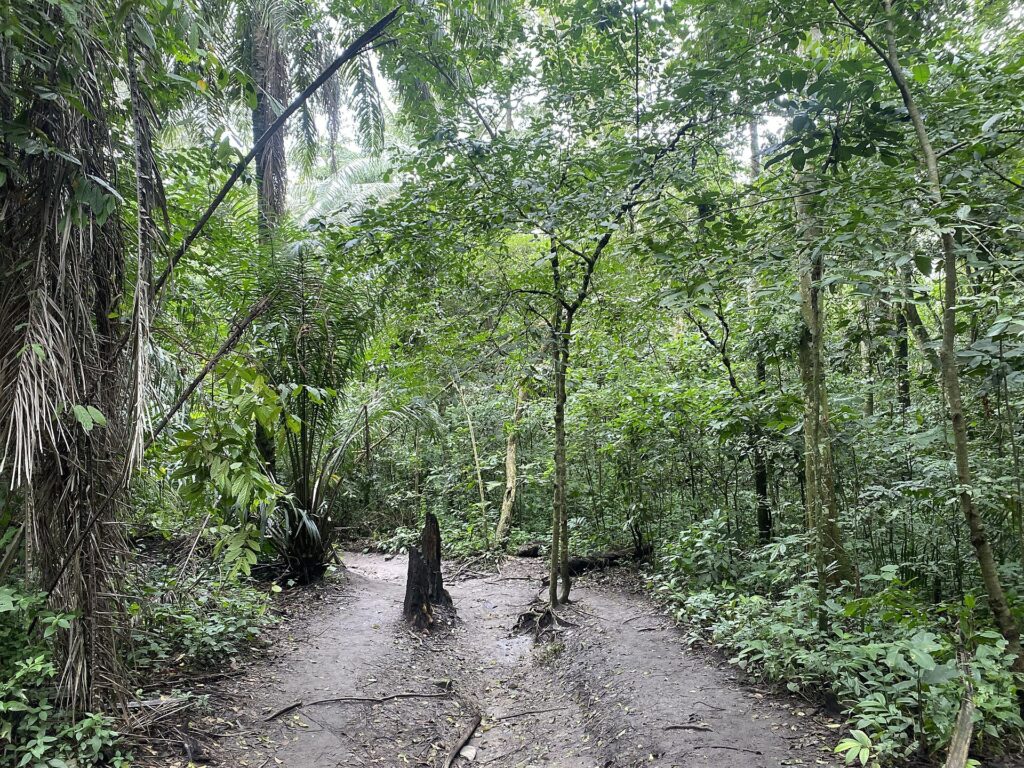
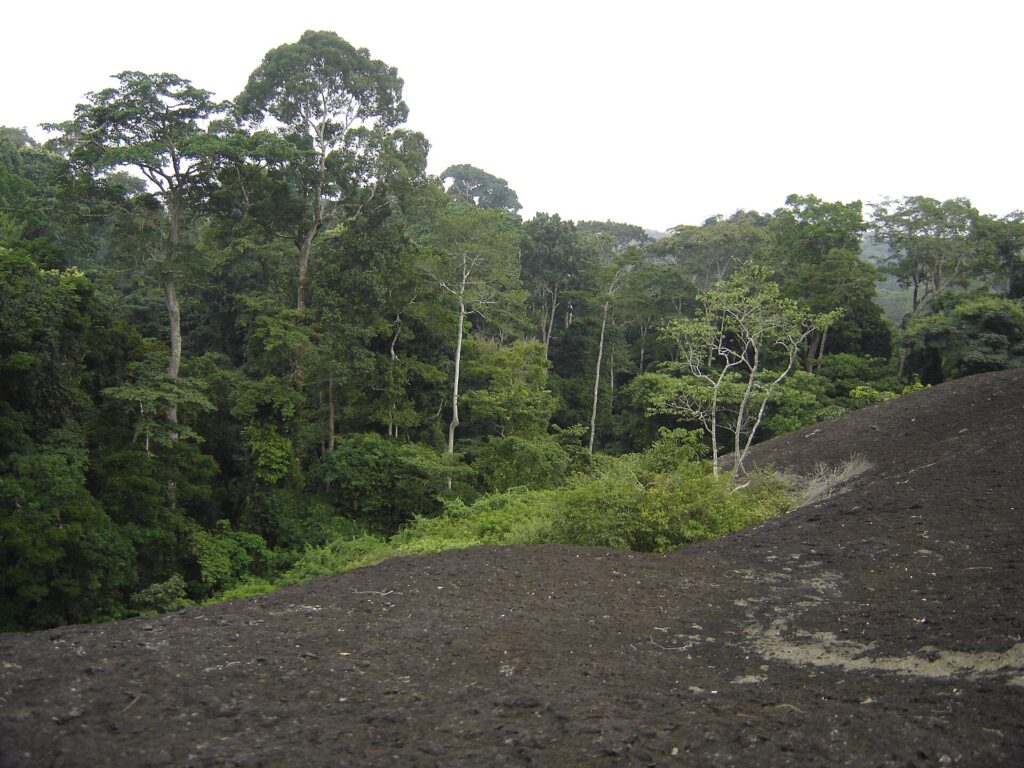
The setting is the equatorial rainforest of the Congo Basin and its edges, from the Ituri in the east to Cameroon and Gabon in the west. The forest is dense, tall and humid, with high rainfall and a relatively steady temperature through the year. There are dry and wet seasons, and the honey season and the fruiting of certain trees mark the year.
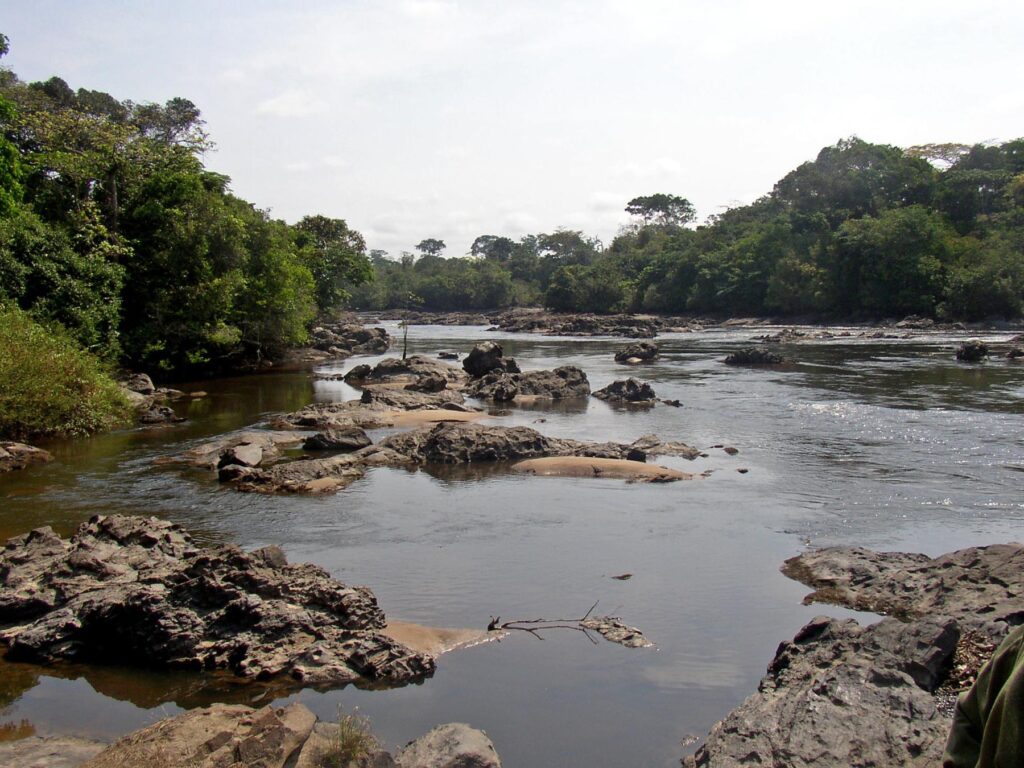
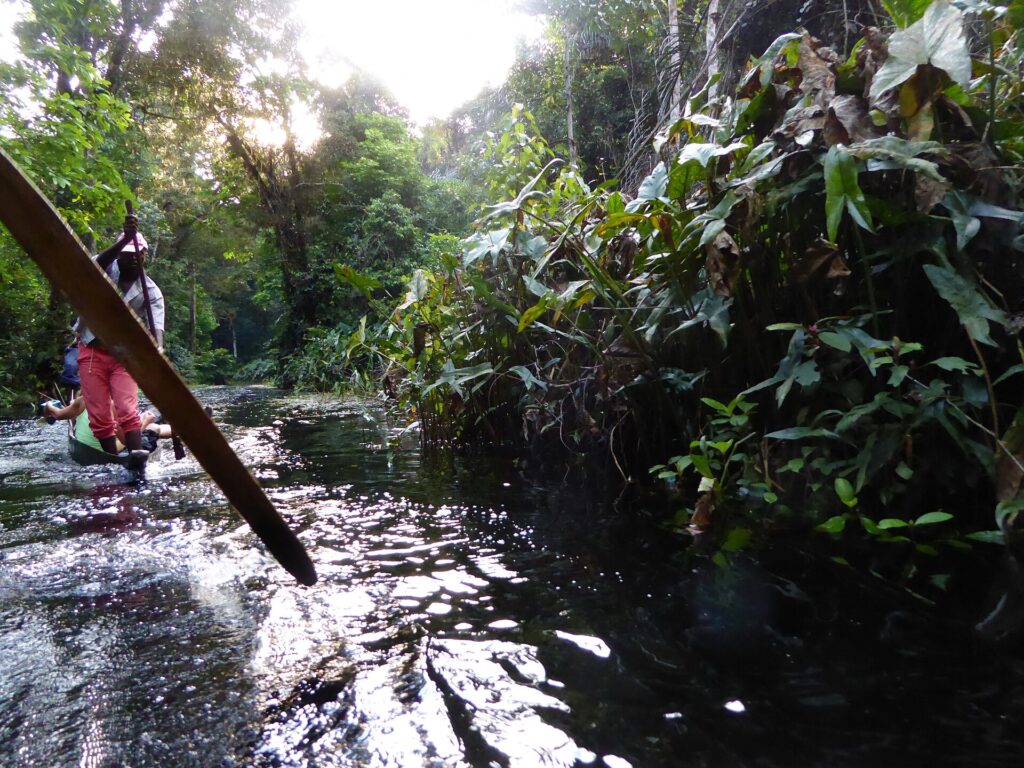
Rivers run through the forest: the Ituri, Epulu, Sangha, Ubangi, Dja and many smaller streams. They are paths, fishing grounds and boundaries. Light is filtered and dim, and sound carries far through the canopy, which helps explain why sound and song matter so much.
The forest shapes the stories at every level. They are full of its animals, plants, trees and honey, and of its dangers. Many tales are set on hunting paths or at honey trees. The forest's sounds enter the songs.
To the people, the forest is home, parent and giver. Turnbull's account records Mbuti saying that the forest is good. Leaving it for good, or losing it to logging and conservation zones, means losing both a way of life and the setting of the stories.
The People · Cultural Foundation · Society
Mbuti: the Ituri forest of northeastern DRC, along the Ituri and Epulu rivers. The Efe speak Lese, a Central Sudanic language shared with their Lese farming neighbours. The net-hunting Mbuti speak the Bantu languages of their Bila and Budu neighbours.
Aka (BaAka): the Lobaye and Sangha-Mbaéré forests of the Central African Republic and the Likouala and Sangha regions of the Republic of Congo. They speak a Bantu language.
Baka: southeastern Cameroon (Boumba-et-Ngoko, Haut-Nyong), the Minvoul area of northern Gabon and neighbouring forest. They speak a Ubangian language related to Ngbaka.
Genetic studies by Etienne Patin, Paul Verdu and others suggest that the ancestors of these forest peoples separated from the ancestors of their farming neighbours some 60,000 years ago, and that the western and eastern forest groups divided some 20,000 years ago. These figures are estimates and debated. Little archaeology survives in the acid forest soils.
Serge Bahuchet has argued that Aka and Baka share an old forest vocabulary, for honey, plants and the hunt, from before they took up their present, unrelated languages. If so, that forest knowledge is older than the languages that carry it.
1. Sharing on demand. Food, especially meat and honey, is shared across the camp. Among the Mbendjele, anyone may ask for a share and expect to receive it. Hoarding is the clearest wrong.
2. Equality. No one may command others. People who try are mocked, and people who boast are cut down by laughter and public complaint.
3. Reciprocity with the forest. The forest is a giving parent. People owe it respect, song and correct conduct, and in return it gives game, honey and health.
4. Harmony in sound. Communal singing in which every voice has its own line expresses and makes the right state of the camp. Turnbull recorded the Mbuti contrast between ekimi, quiet and harmony, and akami, noise and disorder.
5. Freedom of movement. People may leave a camp when tensions rise, so conflict is solved by distance.
The collective comes first, but individuals keep great freedom. Western readers expecting a hero's conquest will find that here the hero is usually the one who brings the camp back into harmony, and that success at others' expense is failure.
Ethnographers have described relations between women and men among these peoples as relatively equal. Barry Hewlett's work found that Aka fathers spend more time holding and caring for infants than fathers in any other society then recorded.
Men and women both take part in net hunting. Among the net-hunting Mbuti and Aka, women and children drive game toward nets that men hold. Men hunt with spears and bows, especially for large game, and climb trees for honey. Women gather plants, fish and carry much of the camp's daily food.
Each gender has its own sacred domains. Among the Mbuti, the molimo trumpet belongs to the men. The elima belongs to the women and girls. Among the Mbendjele, Lewis describes men's and women's spirit performances, including the women's Yele, and argues that each gender's secret knowledge balances the other's. That balance underpins equality between them.
Women's voices are essential in all major song. They also speak out in camp disputes, and Lewis records that women may mock men who misbehave in public performance.
Age confers respect and knowledge, but not the right to command. Older men and women know the forest, its plants and spirits, the songs and the history of the camp. Their opinions carry weight in discussions, and they lead or teach in performance and initiation.
Turnbull described the Mbuti in loose age grades: children, youths, adults and elders. Each had typical roles. Youths, for example, are especially active in the molimo and in mocking adults who misbehave, and in his account they acted as a source of correction.
Children take part in nearly everything. They learn by joining hunts, gathering, songs and dances, and by watching. Aka infants are held by many people and grow up in close contact with adults.
Elders hold knowledge that others cannot fully access: the deeper knowledge of spirits, healing and initiation, and the long memory of camps and places. They do not command, but their knowledge is sought, and in some performances only they may lead certain parts.
Old age is a time of respect. As in many egalitarian societies, an elder who tries to dominate is mocked.
Within forest camps there are no hereditary classes, castes or chiefs. Leveling practices actively prevent differences of rank: demand sharing, mockery, public complaint and the freedom to leave.
The wider society is another matter. Forest peoples have long been treated by their farming neighbours as lower in status. In many areas individual forest families are tied to particular farming families in inherited relationships, exchanging labour, meat and honey for crops and goods. Farmers often describe these ties as ownership, while forest people describe them as partnership or ignore them when it suits. Scholars from Turnbull to Lewis have recorded the gap between the two views. Discrimination, land loss and denial of rights remain serious problems.
Storytellers and song leaders have no special social status within the camp. They are respected for skill alone.
The inequality appears in stories and songs, often as mockery of villagers' pride, or as tales of forest people outwitting those who claim to own them. The forest is the place of freedom, and the village the place of being ruled.
The basic unit is the camp, usually of some fifteen to sixty people related by blood, marriage and friendship. Camps move several times a year as hunting and gathering demand. Membership changes often. People leave to join kin elsewhere, and camps split and re-form.
Kinship links camps across a wide area. Among the Aka and Mbuti, groups tied to a particular area of forest are connected by marriage and by clan ties, often patrilineal. Clan identity matters less than the camp in daily life.
Membership means sharing food on demand, joining hunts and performances, respecting taboos and keeping the peace. A person who is persistently stingy or disruptive faces mockery, public complaint and in the end avoidance.
Expulsion is rarely formal. The usual way to settle serious conflict is for one party to leave and join another camp. Turnbull recorded that a person who has done wrong may be sent out into the forest alone for a time, which is a serious threat in a society where no one lives alone.
Beyond camps, forest people also belong to wider networks of relationship with farming villages.
Through Time · History
60,000 years ago, according to genetic estimates, the ancestors of today's forest peoples separated from those of other African populations.
20,000 years ago, according to the same studies, the western and eastern forest groups divided.
In the 23rd century BCE, the Egyptian official Harkhuf wrote of bringing back a dancing 'dwarf' from the far south for the boy-king Pepi II.
1000 BCE, Bantu-speaking farmers had begun moving into the rainforest, and over the following centuries forest peoples took up their neighbours' languages while keeping their own way of life.
In 1870, the German botanist Georg Schweinfurth met Akka people at the Mangbetu court.
In 1887-1889, Henry Morton Stanley's expedition crossed the Ituri, and from 1885 to 1908 the Congo Free State's rubber regime brought violence to the region.
In 1904, Ota Benga was exhibited at the St Louis World's Fair, and in 1906 he was displayed at the Bronx Zoo.
In 1929, Paul Schebesta began fieldwork in the Ituri.
In 1961, Colin Turnbull published The Forest People.
c. 60,000 years ago, according to genetic estimates, the ancestors of today's forest peoples separated from those of other African populations. The estimate is debated.
c. 20,000 years ago, according to the same studies, the western and eastern forest groups divided.
In the 23rd century BCE, the Egyptian official Harkhuf wrote of bringing back a dancing 'dwarf' from the far south for the boy-king Pepi II. Many writers link this to forest peoples, but the identification is uncertain.
By c. 1000 BCE, Bantu-speaking farmers had begun moving into the rainforest, and over the following centuries forest peoples took up their neighbours' languages while keeping their own way of life.
In 1870, the German botanist Georg Schweinfurth met Akka people at the Mangbetu court.
In 1887-1889, Henry Morton Stanley's expedition crossed the Ituri, and from 1885 to 1908 the Congo Free State's rubber regime brought violence to the region.
In 1904, Ota Benga was exhibited at the St Louis World's Fair, and in 1906 he was displayed at the Bronx Zoo.
In 1929, Paul Schebesta began fieldwork in the Ituri. In 1961, Colin Turnbull published The Forest People.
In 1990, the Dzanga-Sangha reserve was created, and in 1992, the Okapi Wildlife Reserve.
In 2002-2003, during the Second Congo War, armed groups killed and abused Mbuti people in the Ituri.
In 2003, UNESCO proclaimed the oral traditions of the Aka a masterpiece of intangible heritage.
In 2011, the Republic of Congo passed a law on the rights of indigenous peoples, and in 2022, the DRC followed.
Movement is basic to this way of life, but it is mostly movement within the forest rather than migration across regions. Camps move several times a year, following game, honey and fruit seasons. People move between camps through kin and marriage.
The most important exchange is with farming neighbours, and it has gone on for thousands of years. Forest peoples took up their neighbours' languages and some of their tools, drums and crops. Some took part in neighbours' rituals, such as the Mbuti in the nkumbi initiation. Neighbours took forest knowledge of plants, healing, hunting and spirits.
The stories and songs come out of a life lived in the rainforest by small, mobile camps that hunt, gather and collect honey. They also come out of long relations with farming neighbours. These include the Bila and Lese in the Ituri, the Ngando and Mbati in the Lobaye, and the Konabembe, Nzime and others in Cameroon. Forest people trade meat, honey and labour with them for crops, iron and goods.
The Sacred · Deities and Spirits
The molimo accounts; The Bird with the Beautiful Song
Baka and Aka creation accounts
Accounts of how Ejengi came to the people (public outline only)
The Theft of Fire from Tore
Arebati and the making of the first man from clay
Accounts of Khonvoum renewing the sun, from early missionary-era writing
Mbendjele massana spirit performances
The forest itself carries the deepest significance. In Turnbull's account the Mbuti speak of it as mother and father, a giver of food, shelter and life, and as a being that hears and responds.
Sound is sacred. Song, especially polyphonic singing, is the main way of addressing the forest, waking it and making it glad. The Mbuti molimo trumpet speaks with the forest's voice. Its use and appearance belong to the men and are kept from women and children.
Forest spirits are sacred beings that come into camp in performances. They include Ejengi and the mokondi of the BaYaka and Baka, and the me of the Baka.
Blood and the taboos around it are sacred among the Mbendjele. Ekila covers menstrual blood, the blood of game and the rules linking them.
Honey is special: a gift of the forest and the focus of a season of feasting and song. Certain trees, rivers and places in the forest are also important to particular camps.
What makes something sacred is relationship. A thing is sacred because it connects people to the forest or to its spirits, and it must be handled with the right respect, at the right time and by the right people.
The answer depends on which people and which scholar.
In Turnbull's account of the net-hunting Mbuti, there is little elaborate hierarchy. The forest is the central divine reality, and the people speak of it in personal terms as mother, father and friend.
Schebesta recorded among the Efe and Mbuti a set of named beings. Arebati is a sky being associated with the moon and with creation. Tore is master of the forest and its animals, sometimes linked with thunder and the molimo. Popular compendia give the name Khonvoum to a Mbuti creator and great hunter. That attribution comes from early missionary-era writing, and its reliability is disputed.
Among the Baka and Aka, Komba is the creator, distant from daily life. Ejengi and other forest spirits are closer and are active in performance.
The relations between these beings are not fixed. Scholars have long debated how much the named beings reflect contact with farming neighbours' religion, or the questions of the ethnographers themselves.
Humans relate to all of them mostly through the forest: through song, sharing, respect for taboo and joining in performances.
The dead are not usually venerated at shrines as guardians of a lineage, in the way farmers' ancestors often are. In Turnbull's account, the Mbuti say that the dead return to the forest, and that death, like other trouble, can mean the forest is asleep. The molimo is held after a death to wake the forest and restore the camp's harmony. It addresses the forest more than the dead person.
Among the Baka and BaYaka, the dead join the spirits of the forest. Some spirits that come into camp during performances are linked with the dead or with forest beings who knew the first people. Accounts differ between groups and scholars on how far the dead remain active.
The living deal with the dead mainly through the forest and through song. They mourn openly, avoid quarrels in the time after a death, and join the molimo or other performances. Some groups also avoid speaking a dead person's name, as in many parts of the region.
What the dead seem to want, in these accounts, is the camp's harmony and the forest's continued goodwill. They do not ask for offerings so much as for the right conduct of those still living.
The spirit world is not a separate realm far away. It lies within the forest, in its depths, its streams and its darkness, and in the sky above the forest where some accounts place the creator.
Among the Baka and BaYaka, the forest spirits, called me among the Baka and mokondi among the BaYaka, live deep in the forest and come into camp when they are called by song and by people who know how to bring them. Ejengi is the greatest of these among the Mbendjele and Baka. In camp they appear as figures covered in raffia, and their nature is known to initiates.
In Schebesta's accounts of the Efe and Mbuti, Tore lives in the forest and rules its animals, and Arebati is a sky being linked with the moon. Turnbull found the Mbuti more often spoke simply of the forest.
Spirits, the dead and the forest's power can come into the camp, especially during performances. People go into the deep forest to hunt and gather and to meet the spirits there. Those who know the rules can do so safely.
The boundary is crossed through sound, darkness, initiation and death.
Rituals in this tradition are mostly communal performances.
The molimo of the Mbuti, as Turnbull described it, is held after a death or a run of misfortune. Over many nights the men sing to the forest while the molimo trumpet answers from the dark, and women and children stay in their huts. The molimo ends when the camp is in harmony again.
The elima marks a Mbuti girl's first menstruation. It is a celebration in which the girls in seclusion sing, young men come to court, and the camp rejoices.
Spirit performances, called massana among the Mbendjele, bring forest spirits such as Ejengi into camp, often before a hunt, after a death or to celebrate. Lewis recorded that women have their own spirit performances, including Yele, which is sung to help men's elephant hunts and belongs to women.
Boys' initiation into Ejengi knowledge among the Baka and BaYaka is restricted to its keepers. Many Mbuti boys also go through the nkumbi initiation of their farming neighbours.
In stories, rituals often stand behind events. A story explains why the molimo is sung, or a tale ends where a song begins.
The Forest (Ndura, among the Mbuti in Turnbull's account) is the central divine reality, parent and giver. It hears, sleeps and wakes, and it is addressed through song, above all in the molimo. It has no image. Its voice is the molimo trumpet and the sound of the forest itself.
Komba (Baka and Aka) is the creator who made the world, the forest and the first people, and then withdrew. He is distant from daily life and is rarely addressed directly.
Ejengi (Jengi; Baka and BaYaka) is the greatest of the forest spirits. He comes into camp as a figure covered in raffia, dances and moves among the singers, and brings protection and luck. Knowledge of Ejengi belongs to initiates.
Tore (Efe and Mbuti, as recorded by Schebesta) is the master of the forest and its animals. He is linked in some accounts with thunder and with the molimo. In one tale fire is stolen from him.
Arebati (Efe and Mbuti, as recorded by Schebesta) is a sky being associated with the moon and with the making of the first man from clay.
Scholars disagree about how far these named beings belong to the forest peoples' own tradition, and how far they reflect neighbours' religion or the ethnographers' questions.
Forest spirits are called me among the Baka and mokondi among the BaYaka. Many spirits live deep in the forest and come into camp in performance, called by song and by those who know them. Each has its own songs, dances and character. Ejengi is the greatest. Lewis records that the Mbendjele say the spirits come because they like the singing.
The dead return to the forest. Their spirits may join the forest spirits, or in Mbuti accounts they simply become part of the forest's life.
Spirits that guard game and honey are linked to particular animals and trees. Hunters respect them through taboos and hunting medicines.
Tricksters appear mostly as animals in tales, such as the tortoise or chameleon, rather than as spirits who are addressed in ritual.
People interact with these beings mainly through song and performance. Spirits come when the singing is good and leave when it falters. Women and children may not see some spirits up close, and initiates know their nature. Performances are open to the camp, but the knowledge inside them belongs to its keepers.
The bird with the beautiful song is the central figure of the Mbuti story recorded by Turnbull. It stands for the gift of song that the forest gives, and for the price of refusing it.
The chameleon appears in Efe and Mbuti accounts recorded by Schebesta as the creature that heard a sound inside a tree, cut it open, and released water and the first people. The chameleon is treated as an animal connected with the creator in many Central African traditions.
The elephant is the greatest game animal. Hunting it is a major event surrounded by performances such as the Mbendjele women's Yele, and in Baka and BaYaka accounts its hunt draws on spirits' help.
The okapi, a forest giraffe of the Ituri, belongs to Mbuti country and is named in its hunting lore.
The tortoise and other small animals are tricksters in tales, clever and slow, outwitting stronger animals.
The chimpanzee and other primates appear in tales as near-people, sometimes rivals and sometimes kin.
These creatures relate to humans as forest persons. They give, test or teach people, and the right relationship with them depends on respect and sharing.
Among the Mbendjele, Jerome Lewis describes ekila as the main system of taboos. It concerns menstrual blood, hunters' conduct, sharing meat and the relationships between hunting and sexuality. Breaking ekila brings bad luck in hunting, illness, or bad weather for the hunter and sometimes for the whole camp.
Other prohibitions are shared more widely. Hoarding and refusing to share are forbidden in practice. So is noise and quarrelling when the camp needs harmony, especially after a death. In the Mbuti molimo, women and children must not see the trumpet. Initiation knowledge must not be revealed to those outside it.
In myth, the founding prohibition is a limit set by the creator or the forest. In the tahu fruit story, eating the one forbidden fruit brings death into the world. That consequence is collective and permanent.
Some consequences are immediate, such as a failed hunt or an accident. Others are delayed, such as illness or a run of bad luck. Many can be repaired through confession, sharing and performance, but death and the first breach of the world cannot be undone.
This part carries no pictures. Gods, spirits, the ancestors and ceremonies are named, with their roles, and drawn as marks only.
The Stories · Signature Stories
The Bird with the Beautiful Song, as told to Colin Turnbull by Mbuti in the Ituri in the 1950s and set down in The Forest People (1961). A boy heard a beautiful song in the forest. He followed it and found a bird, the most beautiful he had ever seen, singing the most beautiful song he had ever heard.
The Telling · Oral Tradition · Narrative Structure
The Figures · Survival and Diaspora
The forest is the parent and giver. It has no arc of its own but responds to people's conduct, sleeping and waking.
The distant creator, such as Komba or Arebati, makes the world, sets limits, then withdraws. When people break the limit, the creator brings death or another lasting change.
The first people, a first man and woman, receive everything and are given one limit. They break it, and the world becomes as it is now.
The trickster animal, such as the tortoise or chameleon, is small, clever and often slow, and outwits stronger animals. The trickster usually wins, but sometimes it is caught by its own greed.
The stingy or proud one, a father, hunter or villager, refuses to share or tries to command. He is mocked, punished or killed. His arc is the clearest moral lesson.
The young one who brings the gift, a boy or girl who finds a song, a fruit or honey, is open to the forest. The community's response to them decides the outcome.
The singer or song leader begins the song that others carry. The song leader's role is the closest thing to a hero, because they bring the camp into harmony.
Survival and diaspora
Yes. In many forest communities people still hunt, gather and collect honey, sing polyphonic songs, hold spirit performances and tell stories. Mbuti, Efe, Aka, Baka and Mbendjele languages and songs are in daily use. Ejengi still comes into Baka and BaYaka camps, and molimo and elima performances are still recorded in parts of the Ituri. Much has changed.
Forest peoples were not taken across the Atlantic in large numbers, and no distinct forest-people community in the Americas is recorded. Their great displacement has happened within Central Africa, through the colonial rubber regime, resettlement along roads, logging and conservation, and war. Ota Benga's life stands for the violence of the colonial era.
Most of the work is about rights to land and forest, because the tradition depends on the forest. Forest peoples' organisations lead this work. LINAPYCO and other groups in the DRC, and Okani and others in Cameroon, campaign for land rights, recognition, health and schooling. They work with the Forest Peoples Programme and other partners.
The Catalog · its places, peoples, practices and sources

The World Bible
For the reader who wants all of it: every section of Forest Communion, in its eleven parts.
No single self-name covers all of these peoples. Each uses its own:
Mbuti (m-BOO-tee), also BaMbuti, of the Ituri forest in northeastern Democratic Republic of Congo. Under this name scholars often include the Efe (EH-feh), who hunt with bows, and the Sua and Asua, who hunt with nets.
Aka (AH-kah), also BaAka, Biaka or BaYaka, of the southwestern Central African Republic and northern Republic of Congo. The Mbendjele (m-ben-JEH-leh), studied by Jerome Lewis, are one BaYaka group in northern Congo.
Baka (BAH-kah) of southeastern Cameroon, northern Gabon, northern Congo and the southwestern Central African Republic.
The word Pygmy comes from the Greek pygmaios, 'a forearm's length'. It is an outsiders' word. Many people find it insulting, but it also appears in law and in the names of some advocacy groups, as in the DRC's 2022 law on 'indigenous Pygmy peoples'. Scholars increasingly write 'Central African forest hunter-gatherers' or use each people's own name, and this holding does the same.
Turnbull recorded that the Mbuti call the forest 'ndura' and speak of themselves as children of the forest.
Mbuti: the Ituri forest of northeastern DRC, along the Ituri and Epulu rivers. The Efe speak Lese, a Central Sudanic language shared with their Lese farming neighbours. The net-hunting Mbuti speak the Bantu languages of their Bila and Budu neighbours.
Aka (BaAka): the Lobaye and Sangha-Mbaéré forests of the Central African Republic and the Likouala and Sangha regions of the Republic of Congo. They speak a Bantu language.
Baka: southeastern Cameroon (Boumba-et-Ngoko, Haut-Nyong), the Minvoul area of northern Gabon and neighbouring forest. They speak a Ubangian language related to Ngbaka.
Genetic studies by Etienne Patin, Paul Verdu and others suggest that the ancestors of these forest peoples separated from the ancestors of their farming neighbours some 60,000 years ago, and that the western and eastern forest groups divided some 20,000 years ago. These figures are estimates and debated. Little archaeology survives in the acid forest soils.
Serge Bahuchet has argued that Aka and Baka share an old forest vocabulary, for honey, plants and the hunt, from before they took up their present, unrelated languages. If so, that forest knowledge is older than the languages that carry it.
The stories and songs come out of a life lived in the rainforest by small, mobile camps that hunt, gather and collect honey. They also come out of long relations with farming neighbours. These include the Bila and Lese in the Ituri, the Ngando and Mbati in the Lobaye, and the Konabembe, Nzime and others in Cameroon. Forest people trade meat, honey and labour with them for crops, iron and goods. The relationship is close, unequal and often tense.
Songs and stories do work in camp life. They hold an egalitarian community together and mark the bond with the forest. They answer death and failed hunting, and they mock anyone who grows proud or stingy.
Turnbull described how the Mbuti take part in their neighbours' rites, such as the nkumbi initiation, while keeping their own forest rites, above all the molimo, among themselves. Sacred contexts include the molimo, the spirit performances of the Baka and BaYaka, and women's hunting rites. Secular contexts include night tales, dances held for pleasure and the public shouting of grievances. Even so, the forest is present in both.
For the Mbuti, the main sources are Paul Schebesta, who worked in the Ituri from 1929, and Colin Turnbull, who worked there in the 1950s. Turnbull wrote The Forest People in 1961 and Wayward Servants in 1965. Later work came from Mitsuo Ichikawa and other Japanese researchers, and from Robert and Lee Ann Bailey and the Harvard Ituri Project on the Efe.
For the Aka, the main sources are Serge Bahuchet on ecology and language, Simha Arom on polyphony, Barry Hewlett on childhood and fathers, and Michelle Kisliuk on BaAka music and dance. For the Mbendjele, the main source is Jerome Lewis on ekila, spirit performance and speech.
For the Baka, there are Mitsuo Ichikawa and Daisaku Tsuru on music and ritual, Robert Brisson on language and myth, and the Cameroonian anthropologist Séverin Cécile Abéga.
Scholars disagree. Turnbull's portrait has been criticised as idealised. Schebesta's fuller pantheon may partly reflect neighbours' religion or his own questions.
Forest peoples' own organisations include LINAPYCO in the DRC and Okani in Cameroon. They work with the Forest Peoples Programme, and the Mbendjele have worked on mapping projects with University College London.
This holding draws on the published record. It has not yet been reviewed by community representatives.
1. Sharing on demand. Food, especially meat and honey, is shared across the camp. Among the Mbendjele, anyone may ask for a share and expect to receive it. Hoarding is the clearest wrong.
2. Equality. No one may command others. People who try are mocked, and people who boast are cut down by laughter and public complaint.
3. Reciprocity with the forest. The forest is a giving parent. People owe it respect, song and correct conduct, and in return it gives game, honey and health.
4. Harmony in sound. Communal singing in which every voice has its own line expresses and makes the right state of the camp. Turnbull recorded the Mbuti contrast between ekimi, quiet and harmony, and akami, noise and disorder.
5. Freedom of movement. People may leave a camp when tensions rise, so conflict is solved by distance.
The collective comes first, but individuals keep great freedom. Western readers expecting a hero's conquest will find that here the hero is usually the one who brings the camp back into harmony, and that success at others' expense is failure.
In Turnbull's account, Mbuti say that bad things, such as death, sickness or failed hunts, happen when the forest is 'asleep' and not watching over its children. The response is to sing, to wake the forest and make it happy again. The cause lies in the relationship, not in a hostile agent.
Among the Mbendjele, Jerome Lewis describes ekila. It is a web of rules and taboos connecting hunting, sharing, sexuality and blood. Breaking ekila brings bad luck in hunting, illness or bad weather. Causation is moral and ecological at once: conduct in camp affects the game in the forest.
The individual is part of a camp and a forest. A good hunt is a gift from the forest to the whole camp through the hunter.
Time is cyclical and seasonal, following the honey seasons, the rains, the movement of camps and the return of the dead to the forest. The founding stories are set in a first time, but it is not cut off from the present.
Reality is single but layered. Spirits, the dead and the forest's own life move within the same forest the living walk through.
Stories, songs and spirit performances are told and made for several reasons. They bring the camp into harmony and draw the forest's attention and goodwill. They teach the rules of sharing and taboo. They answer crises such as death, conflict and failed hunts. And they entertain.
Everyone takes part, and no one owns the role of teller. Older women and men are often the most admired storytellers. Among the BaYaka and Baka, particular men and women lead songs or spirit performances, and initiated people hold the knowledge of the spirits. Anyone may stand up in camp at night and speak their complaints aloud. Lewis calls this public speech mosambo among the Mbendjele.
Tales are mostly told in the evening and at night, at the hearth. Dances and songs happen whenever people choose, but large spirit performances and the molimo come in times of need or celebration.
No one gains authority by telling stories or leading songs. A song leader starts a song and the group carries it. Speaking out is open to all, and so is mockery.
The tradition's main form is the communal performance, in which a song, a dance or a spirit play is made by everyone present. Tales are short and episodic and are often interwoven with song, which listeners take up as a chorus. Kisliuk's and Arom's work shows that in BaAka performance each voice and each drum keeps its own pattern, and the whole emerges from their interlocking.
The tradition does not fit one imported template. It combines short explanatory myths about death and fire, trickster and animal tales, and long cyclical performances that answer a crisis and return the camp to harmony.
Stories move by cycles and by relationship. A breach of sharing or taboo, or the forest's sleep, leads to trouble. Song and right conduct bring the forest back, and life goes on. The molimo, as Turnbull describes it, is a performance lasting weeks or months that follows this pattern on a large scale.
In a tale, a short sequence of events leads to a change that explains the present, such as the coming of death. The listener's world is always the destination.
Narrative tension usually comes from imbalance in relationships rather than from open battle. Someone refuses to share, steals, disobeys a command from the forest or the creator, or breaks a taboo. The relationship between the camp and the forest goes wrong, and trouble follows.
In the tahu fruit story recorded by Schebesta among the Efe and Mbuti, people are given everything except one fruit. Eating it brings death into the world. The conflict is between a gift and a limit.
In the story of the bird with the beautiful song, recorded by Turnbull, the tension lies between the boy who brings the song home and the father who does not value it. The father's refusal to receive what the forest gives is the fault.
A second source of tension is the line between forest and village. In many tellings and in daily life, villagers are pictured as owners who seek control, while the forest people slip away and keep their own counsel.
In performance, the 'conflict' is the camp's own discord, which the singing resolves.
The deepest protagonist is the forest itself. It is a parent and giver who sleeps, wakes and responds. In Turnbull's account of the molimo, the song is sung to the forest, and its trumpet is the forest's voice.
In the myths, the protagonists are the first people, often a first man and woman, and the creator or forest being who gives them life and sets limits on them. Among the Efe and Mbuti, Schebesta recorded such beings as Arebati and Tore. Among the Baka and Aka, Komba is the creator.
In tales the protagonists are often animals: the chameleon, the tortoise, the antelope, the chimpanzee. Each is clever or foolish, generous or greedy. Hunters and honey-gatherers appear too, especially in stories that teach sharing.
The community acts as a protagonist in performance. The camp sings together, and its harmony or discord drives the action.
The spirits of the forest, such as Ejengi among the BaYaka and Baka, come into camp during performances. They are not individual heroes but presences who respond to the camp.
There are several typical endings.
Some stories end by setting the present world in place. Death comes to people, fire comes into human hands, rivers and forest take their form. The ending is the world as it is now.
Some end in restored harmony. The forest is woken by song, the spirits are satisfied and the hunt succeeds again. The camp's sound is good once more. This is the pattern of the molimo and of the spirit performances.
Some end in a consequence that cannot be reversed. The father who killed the bird dies. People who ate the forbidden fruit become mortal. These stories warn listeners.
Victory over an enemy is rare. Trickster tales end with someone outwitted, but rarely with a final defeat.
A satisfying ending is one where the relationship between people and forest is right again, or where the listener understands why it went wrong. It often closes on a song that the listeners take up and carry.
Narrative time is mostly cyclical. Camps move through the year, the honey season comes and goes, and the rains return. The molimo, as Turnbull recorded it, is a cycle of nightly singing over weeks or months, ending when the forest has been made happy again.
The myths are set in a first time, when people were made, when death and fire came and when the creator or forest being lived closer to people. That time is not entirely past. Its pattern repeats in the present when someone breaks a limit or refuses a gift.
Performance time is layered. In BaAka polyphony, Arom showed that each voice and drum keeps its own cycle and the cycles interlock, so many time streams run at once. Some scholars and BaAka performers suggest that this layered sound mirrors the forest itself, where many voices sound at once. That reading is interpretive.
The dead are in the forest with the living. Time does not separate them so much as a shift in state does.
The community often acts as the main actor. In performance, the camp sings and dances together, and the harmony of its many voices is the event. A performance fails if people refuse to join or quarrel. Each person has a part, and no voice dominates.
In tales, the community usually appears as the camp that receives or refuses gifts, shares or hoards, and must live with the consequences together.
Individual characters relate to the community through sharing. A hunter's skill is a gift to all, and a successful honey-gatherer brings the honey back. An individual who keeps something for himself, or who brings disorder, harms everyone.
The community expects a story or a song to bring people together, make them laugh and teach them, without lecturing. In Mbendjele camps, Lewis records that people use song, laughter and public speech to deal with problems openly, so performance also does the work of resolving disputes.
The forest is part of the community as well. It is the parent, and it listens.
Morality is relational. It rests on keeping the bond with the forest and the bonds within the camp in good order.
Condemned conduct includes hoarding food, refusing to share on demand, trying to command others, boasting, quarrelling without resolution, disrespecting the forest, and breaking taboos tied to hunting, blood and sex. Among the Mbendjele these taboos are grouped under ekila. Theft from the forest beings is a fault too, though stories sometimes treat it as a gift taken.
Honoured conduct includes generosity, humour, singing well and joining in, skill in hunting and honey-gathering used for others, and the ability to calm a quarrel.
Stories teach this moral logic mainly through consequence. The father who kills the bird dies. The people who ate the tahu fruit must die. In camp, mockery and public complaint do the rest.
There is no fixed law code. Turnbull and Lewis both stress that people argue about what is right in each case, and that the answer is reached together.
Transformation in this tradition is about state more than about the self. The camp moves from discord to harmony, from noise to quiet, from a sleeping forest to a waking one. A good performance changes the camp's state, and with it the forest's.
In myth, the transformations are of the world. People go from deathless to mortal, fire passes from a forest being to humans, and in some accounts water and the first people come out of a tree. These changes are irreversible, and some are mourned, especially the coming of death.
Personal transformation is marked by rites. Among the Mbuti, a girl becomes a woman through the elima. Among the Baka and BaYaka, initiation brings boys into the knowledge of Ejengi. Becoming a successful hunter or an elder is gradual.
The spirits themselves change form. A forest spirit such as Ejengi comes into camp as a figure covered in raffia, and the camp's experience changes while it is present.
The tradition celebrates transformations that bring people back into harmony, and it mourns those that came from breaking limits.
The forest itself carries the deepest significance. In Turnbull's account the Mbuti speak of it as mother and father, a giver of food, shelter and life, and as a being that hears and responds.
Sound is sacred. Song, especially polyphonic singing, is the main way of addressing the forest, waking it and making it glad. The Mbuti molimo trumpet speaks with the forest's voice. Its use and appearance belong to the men and are kept from women and children.
Forest spirits are sacred beings that come into camp in performances. They include Ejengi and the mokondi of the BaYaka and Baka, and the me of the Baka.
Blood and the taboos around it are sacred among the Mbendjele. Ekila covers menstrual blood, the blood of game and the rules linking them.
Honey is special: a gift of the forest and the focus of a season of feasting and song. Certain trees, rivers and places in the forest are also important to particular camps.
What makes something sacred is relationship. A thing is sacred because it connects people to the forest or to its spirits, and it must be handled with the right respect, at the right time and by the right people.
The dead are not usually venerated at shrines as guardians of a lineage, in the way farmers' ancestors often are. In Turnbull's account, the Mbuti say that the dead return to the forest, and that death, like other trouble, can mean the forest is asleep. The molimo is held after a death to wake the forest and restore the camp's harmony. It addresses the forest more than the dead person.
Among the Baka and BaYaka, the dead join the spirits of the forest. Some spirits that come into camp during performances are linked with the dead or with forest beings who knew the first people. Accounts differ between groups and scholars on how far the dead remain active.
The living deal with the dead mainly through the forest and through song. They mourn openly, avoid quarrels in the time after a death, and join the molimo or other performances. Some groups also avoid speaking a dead person's name, as in many parts of the region.
What the dead seem to want, in these accounts, is the camp's harmony and the forest's continued goodwill. They do not ask for offerings so much as for the right conduct of those still living.
The spirit world is not a separate realm far away. It lies within the forest, in its depths, its streams and its darkness, and in the sky above the forest where some accounts place the creator.
Among the Baka and BaYaka, the forest spirits, called me among the Baka and mokondi among the BaYaka, live deep in the forest and come into camp when they are called by song and by people who know how to bring them. Ejengi is the greatest of these among the Mbendjele and Baka. In camp they appear as figures covered in raffia, and their nature is known to initiates.
In Schebesta's accounts of the Efe and Mbuti, Tore lives in the forest and rules its animals, and Arebati is a sky being linked with the moon. Turnbull found the Mbuti more often spoke simply of the forest.
Spirits, the dead and the forest's power can come into the camp, especially during performances. People go into the deep forest to hunt and gather and to meet the spirits there. Those who know the rules can do so safely.
The boundary is crossed through sound, darkness, initiation and death.
Rituals in this tradition are mostly communal performances.
The molimo of the Mbuti, as Turnbull described it, is held after a death or a run of misfortune. Over many nights the men sing to the forest while the molimo trumpet answers from the dark, and women and children stay in their huts. The molimo ends when the camp is in harmony again.
The elima marks a Mbuti girl's first menstruation. It is a celebration in which the girls in seclusion sing, young men come to court, and the camp rejoices.
Spirit performances, called massana among the Mbendjele, bring forest spirits such as Ejengi into camp, often before a hunt, after a death or to celebrate. Lewis recorded that women have their own spirit performances, including Yele, which is sung to help men's elephant hunts and belongs to women.
Boys' initiation into Ejengi knowledge among the Baka and BaYaka is restricted to its keepers. Many Mbuti boys also go through the nkumbi initiation of their farming neighbours.
In stories, rituals often stand behind events. A story explains why the molimo is sung, or a tale ends where a song begins.
The answer depends on which people and which scholar.
In Turnbull's account of the net-hunting Mbuti, there is little elaborate hierarchy. The forest is the central divine reality, and the people speak of it in personal terms as mother, father and friend.
Schebesta recorded among the Efe and Mbuti a set of named beings. Arebati is a sky being associated with the moon and with creation. Tore is master of the forest and its animals, sometimes linked with thunder and the molimo. Popular compendia give the name Khonvoum to a Mbuti creator and great hunter. That attribution comes from early missionary-era writing, and its reliability is disputed.
Among the Baka and Aka, Komba is the creator, distant from daily life. Ejengi and other forest spirits are closer and are active in performance.
The relations between these beings are not fixed. Scholars have long debated how much the named beings reflect contact with farming neighbours' religion, or the questions of the ethnographers themselves.
Humans relate to all of them mostly through the forest: through song, sharing, respect for taboo and joining in performances.
Song is the backbone of the tradition, and BaAka and Baka polyphony is among the most intricate in the world. Simha Arom showed that each voice follows its own melodic and rhythmic pattern and that the patterns interlock. Voices move freely within a set framework, so each performance is new.
Yodelling, a rapid alternation between chest and head voice, is a signature of the style. Hocketing, where singers each provide single notes that combine into a melody, is common. Among the Ba-Benzélé, a BaYaka group, the hindewhu alternates a single-pitch whistle with the voice. Herbie Hancock based the opening of his 1973 version of Watermelon Man on a recording of it.
Tales are often cantefables. A spoken narrative is broken by songs that listeners join. Tellers act out animal voices and movements, and ideophones imitate the sounds of the forest.
Silence matters too. In Turnbull's account, the quiet of the forest at night is the setting into which the molimo song and trumpet sound, and the Mbuti prize ekimi, quiet, as the right state of the camp.
Performance uses voice, body and the forest's own materials.
Instruments include drums, often borrowed or made in the manner of neighbours. Others are the harp-zither, the musical bow, rattles and clapping sticks. The molimo trumpet of the Mbuti is a long tube, of wood or bamboo or in some camps a metal pipe, and its use belongs to the men.
Among the Baka, women perform liquindi, water drumming, standing waist-deep in a stream and striking the water's surface with their hands to make interlocking rhythms.
Dance runs through all performance. People dance in circles and lines and imitate animals, and dancing goes on for hours.
In spirit performances, the forest spirits appear as figures covered in raffia or leaves. Ejengi is a great raffia figure who dances and moves among the singers. What lies inside these figures belongs to initiates.
The body sings, claps, dances and moves together with others. In BaAka dance, Kisliuk observed that individuals step into and out of the centre while the group sustains the song, so the line between performer and audience shifts constantly.
Listening and performing are hard to separate. In a song, anyone present may join, take a voice part, add a yodel or a clap, or drop out to rest. The performance depends on many people taking part. A song with too few singers fails, and singers urge each other on.
In tales, listeners sing the chorus parts of cantefables, comment, laugh and answer the teller. They may finish a phrase or correct a detail.
In spirit performances, the camp's singing calls the spirit into camp. Kisliuk and Lewis record that the forest spirit will not come or stay unless the singing is strong and good. Women's voices are essential even in performances that men lead.
In the molimo, as Turnbull described it, the men sing nightly and the women and children listen from their huts. At certain points women take part too, through song and through a ritual role, and they are not wholly outside.
Participation follows the rules of sharing. No one is excluded from ordinary song. Restricted performances keep their own rules about who may see and join.
Memory is carried in daily practice. Songs are sung over and over, in the same frameworks with new variations, so children learn them by singing alongside adults from early childhood. Barry Hewlett's work with the Aka records how much infants and small children are held and carried by many adults, and that they take part in dances and singing from the start.
Polyphonic songs are a memory device in themselves. Each part is short and repeated, and the full song is held by the group rather than by any one person.
Knowledge of the forest is held through use. People know plants, animal behaviour, honey trees and paths through hunting and gathering, and they tie stories to places.
Specialised knowledge, of spirits, healing plants and hunting medicine, is kept by those who have been initiated or taught. It passes through apprenticeship.
Recordings and books now also hold some of the tradition. Arom's recordings, Louis Sarno's archive of BaYaka music from Yandoumbé and community mapping projects let some of it reach new listeners. Communities themselves remain the main keepers.
Power is a matter of relationship with the forest and its spirits more than individual sorcery.
Song can wake the forest, bring the spirits into camp, make the hunt succeed and heal discord. Among the Baka, women's dawn singing before an elephant hunt is said to help the hunt. Lewis records the same purpose for the Mbendjele women's Yele.
Hunting medicine and plant knowledge are part of the power system. Hunters use plant preparations to bring luck and protect themselves. Forest peoples are widely respected by their farming neighbours for knowledge of healing plants and spirits, and neighbours consult them.
There are limits. Power cannot be taken from the forest without respect. Breaking ekila or other taboos turns power against the person, bringing bad luck or illness. No one may use power to command others, and anyone who tries is mocked.
An unstated rule runs through the record: power belongs to the group and to the forest. When an individual uses it for private gain, it fails or rebounds.
The forest is the first source. It gives food, shelter, health and the success of the hunt to people who live rightly in it. In Turnbull's account the Mbuti say that the forest is good and that it gives freely.
The forest spirits are a second source. Ejengi and other spirits bring luck, protection and joy when they come into camp. Access to their deeper power is through initiation and knowledge held by groups of men or women.
Plants and forest substances are a third source. Hunting medicines, healing plants and protective preparations are learned from elders and sometimes said to be revealed by spirits.
Song is a fourth source and the means of access. Good singing opens the way between the camp and the forest, so power is accessed by the whole camp together.
Access has a cost. People must keep taboos, share what they receive, join in performances and accept limits. Among the Mbendjele, hunters must respect ekila, which shapes their conduct with women, game and blood. When people break these rules, their power falls away.
Among the Mbendjele, Jerome Lewis describes ekila as the main system of taboos. It concerns menstrual blood, hunters' conduct, sharing meat and the relationships between hunting and sexuality. Breaking ekila brings bad luck in hunting, illness, or bad weather for the hunter and sometimes for the whole camp.
Other prohibitions are shared more widely. Hoarding and refusing to share are forbidden in practice. So is noise and quarrelling when the camp needs harmony, especially after a death. In the Mbuti molimo, women and children must not see the trumpet. Initiation knowledge must not be revealed to those outside it.
In myth, the founding prohibition is a limit set by the creator or the forest. In the tahu fruit story, eating the one forbidden fruit brings death into the world. That consequence is collective and permanent.
Some consequences are immediate, such as a failed hunt or an accident. Others are delayed, such as illness or a run of bad luck. Many can be repaired through confession, sharing and performance, but death and the first breach of the world cannot be undone.
For Mbuti girls, the elima marks first menstruation. The girl and her companions stay in a special hut, where older women teach them songs and the ways of womanhood. Young men come to court, sometimes in playful combat with the girls. When the girls come out, they are women who may marry. Turnbull describes the elima as a time of joy for the whole camp.
For Mbuti boys, many go through the nkumbi circumcision rite of their farming neighbours. Turnbull reports that the Mbuti treat it as a matter of their relations with the village rather than of their forest religion. The molimo, which boys join as they grow, is closer to the forest.
Among the Baka and BaYaka, boys are initiated into knowledge of Ejengi. Women have their own initiations and spirit performances, such as Yele among the Mbendjele. The content of these initiations belongs to those who hold them and is not described here.
Initiation in this tradition does not mainly confer power to command. It brings people into shared knowledge and responsibility, and into the performances that keep the camp and forest in good relation.
Ethnographers have described relations between women and men among these peoples as relatively equal. Barry Hewlett's work found that Aka fathers spend more time holding and caring for infants than fathers in any other society then recorded.
Men and women both take part in net hunting. Among the net-hunting Mbuti and Aka, women and children drive game toward nets that men hold. Men hunt with spears and bows, especially for large game, and climb trees for honey. Women gather plants, fish and carry much of the camp's daily food.
Each gender has its own sacred domains. Among the Mbuti, the molimo trumpet belongs to the men. The elima belongs to the women and girls. Among the Mbendjele, Lewis describes men's and women's spirit performances, including the women's Yele, and argues that each gender's secret knowledge balances the other's. That balance underpins equality between them.
Women's voices are essential in all major song. They also speak out in camp disputes, and Lewis records that women may mock men who misbehave in public performance.
Age confers respect and knowledge, but not the right to command. Older men and women know the forest, its plants and spirits, the songs and the history of the camp. Their opinions carry weight in discussions, and they lead or teach in performance and initiation.
Turnbull described the Mbuti in loose age grades: children, youths, adults and elders. Each had typical roles. Youths, for example, are especially active in the molimo and in mocking adults who misbehave, and in his account they acted as a source of correction.
Children take part in nearly everything. They learn by joining hunts, gathering, songs and dances, and by watching. Aka infants are held by many people and grow up in close contact with adults.
Elders hold knowledge that others cannot fully access: the deeper knowledge of spirits, healing and initiation, and the long memory of camps and places. They do not command, but their knowledge is sought, and in some performances only they may lead certain parts.
Old age is a time of respect. As in many egalitarian societies, an elder who tries to dominate is mocked.
Within forest camps there are no hereditary classes, castes or chiefs. Leveling practices actively prevent differences of rank: demand sharing, mockery, public complaint and the freedom to leave.
The wider society is another matter. Forest peoples have long been treated by their farming neighbours as lower in status. In many areas individual forest families are tied to particular farming families in inherited relationships, exchanging labour, meat and honey for crops and goods. Farmers often describe these ties as ownership, while forest people describe them as partnership or ignore them when it suits. Scholars from Turnbull to Lewis have recorded the gap between the two views. Discrimination, land loss and denial of rights remain serious problems.
Storytellers and song leaders have no special social status within the camp. They are respected for skill alone.
The inequality appears in stories and songs, often as mockery of villagers' pride, or as tales of forest people outwitting those who claim to own them. The forest is the place of freedom, and the village the place of being ruled.
The basic unit is the camp, usually of some fifteen to sixty people related by blood, marriage and friendship. Camps move several times a year as hunting and gathering demand. Membership changes often. People leave to join kin elsewhere, and camps split and re-form.
Kinship links camps across a wide area. Among the Aka and Mbuti, groups tied to a particular area of forest are connected by marriage and by clan ties, often patrilineal. Clan identity matters less than the camp in daily life.
Membership means sharing food on demand, joining hunts and performances, respecting taboos and keeping the peace. A person who is persistently stingy or disruptive faces mockery, public complaint and in the end avoidance.
Expulsion is rarely formal. The usual way to settle serious conflict is for one party to leave and join another camp. Turnbull recorded that a person who has done wrong may be sent out into the forest alone for a time, which is a serious threat in a society where no one lives alone.
Beyond camps, forest people also belong to wider networks of relationship with farming villages.
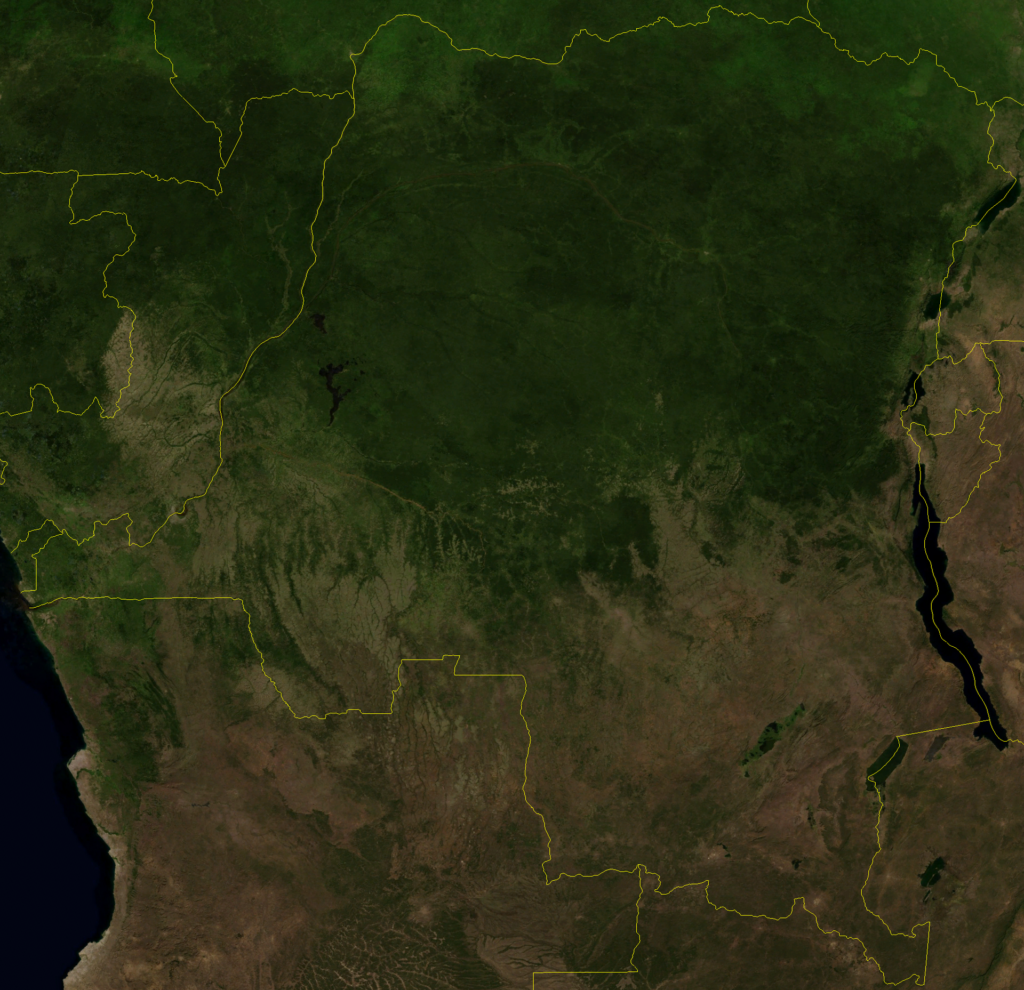
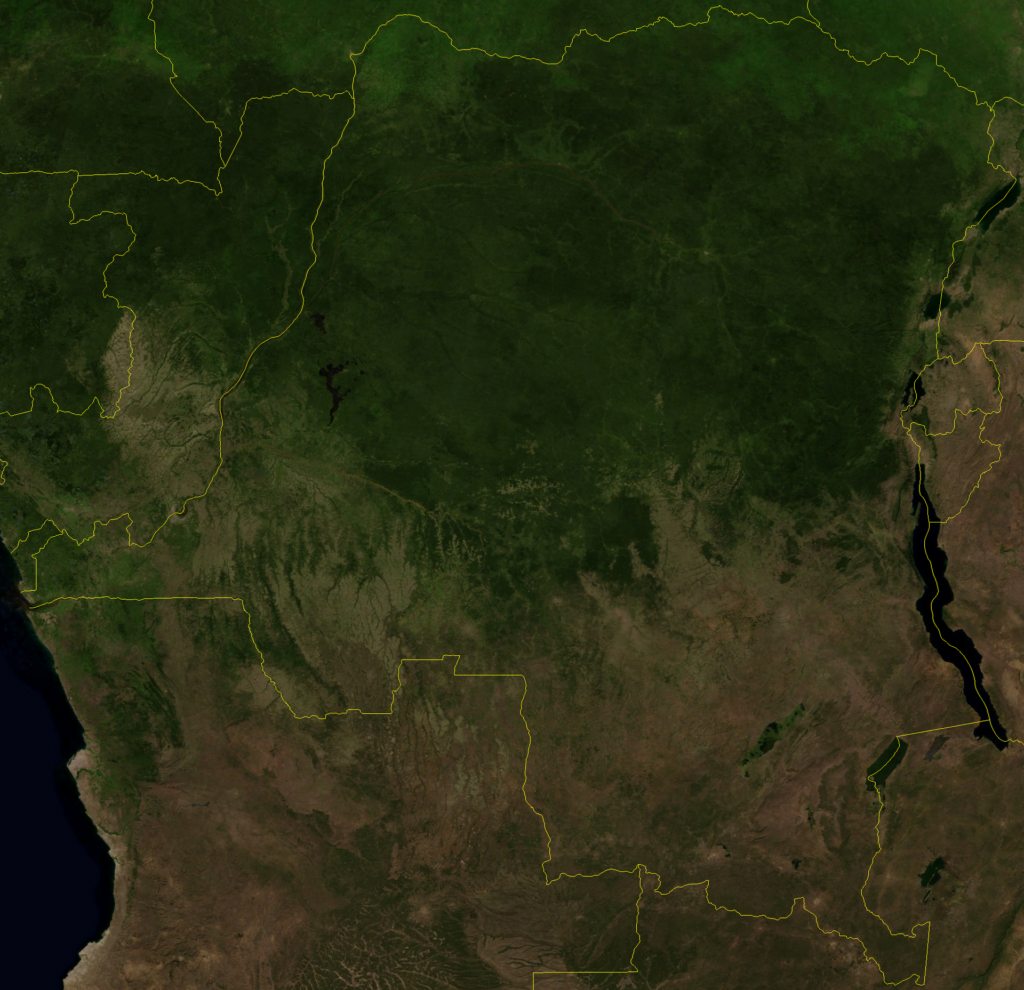
The setting is the equatorial rainforest of the Congo Basin and its edges, from the Ituri in the east to Cameroon and Gabon in the west. The forest is dense, tall and humid, with high rainfall and a relatively steady temperature through the year. There are dry and wet seasons, and the honey season and the fruiting of certain trees mark the year.
Rivers run through the forest: the Ituri, Epulu, Sangha, Ubangi, Dja and many smaller streams. They are paths, fishing grounds and boundaries. Light is filtered and dim, and sound carries far through the canopy, which helps explain why sound and song matter so much.
The forest shapes the stories at every level. They are full of its animals, plants, trees and honey, and of its dangers. Many tales are set on hunting paths or at honey trees. The forest's sounds enter the songs.
To the people, the forest is home, parent and giver. Turnbull's account records Mbuti saying that the forest is good. Leaving it for good, or losing it to logging and conservation zones, means losing both a way of life and the setting of the stories.
Sacredness here lies more in the whole forest, and in particular places that camps know, than in fixed shrines or temples. The deep forest, away from villages and roads, is where the spirits live and where the forest's power is strongest. Camps also hold certain trees, streams and clearings as important. Spirit performances are held in clearings at the edge of camp, which become sacred while the performance lasts.
The Ituri forest is the homeland of the Mbuti and Efe and the setting of Turnbull's molimo accounts, especially around Epulu and the Okapi Wildlife Reserve.
The Dzanga-Sangha forests around Bayanga in the Central African Republic are home to BaAka camps where Louis Sarno lived and recorded from the 1980s.
The Dja and Lobéké forests of southeastern Cameroon are home to Baka communities. The Nouabalé-Ndoki forests of northern Congo are part of Mbendjele country.
In stories and in practice, the deep forest works as a threshold and a source. Hunters go into it for food, the spirits come out of it, and the dead go back to it.
The recorded cosmos is simple in outline and centred on the forest.
The forest is the world. It holds the living, the animals, the spirits and the dead. Its depths are where spirits and the forest's deepest power lie. The camp is a clearing within it, and the village and fields lie at its edge, a different human world.
Above is the sky. In Schebesta's accounts of the Efe and Mbuti, the sky is home to beings such as Arebati, linked with the moon and creation. Among the Baka, Komba the creator is often placed above or beyond, distant from daily life.
Below are the rivers and the earth. Rivers are paths and boundaries, and some stories place the origin of water and the first people inside a great tree.
The main directions are inward and outward, into the deep forest and back to the camp, rather than the four compass points. Movement between realms happens through song, which calls spirits into camp and wakes the forest, through initiation, and through death, which returns a person to the forest.
Accounts vary between groups and between scholars.
c. 60,000 years ago, according to genetic estimates, the ancestors of today's forest peoples separated from those of other African populations. The estimate is debated.
c. 20,000 years ago, according to the same studies, the western and eastern forest groups divided.
In the 23rd century BCE, the Egyptian official Harkhuf wrote of bringing back a dancing 'dwarf' from the far south for the boy-king Pepi II. Many writers link this to forest peoples, but the identification is uncertain.
By c. 1000 BCE, Bantu-speaking farmers had begun moving into the rainforest, and over the following centuries forest peoples took up their neighbours' languages while keeping their own way of life.
In 1870, the German botanist Georg Schweinfurth met Akka people at the Mangbetu court.
In 1887-1889, Henry Morton Stanley's expedition crossed the Ituri, and from 1885 to 1908 the Congo Free State's rubber regime brought violence to the region.
In 1904, Ota Benga was exhibited at the St Louis World's Fair, and in 1906 he was displayed at the Bronx Zoo.
In 1929, Paul Schebesta began fieldwork in the Ituri. In 1961, Colin Turnbull published The Forest People.
In 1990, the Dzanga-Sangha reserve was created, and in 1992, the Okapi Wildlife Reserve.
In 2002-2003, during the Second Congo War, armed groups killed and abused Mbuti people in the Ituri.
In 2003, UNESCO proclaimed the oral traditions of the Aka a masterpiece of intangible heritage.
In 2011, the Republic of Congo passed a law on the rights of indigenous peoples, and in 2022, the DRC followed.
Movement is basic to this way of life, but it is mostly movement within the forest rather than migration across regions. Camps move several times a year, following game, honey and fruit seasons. People move between camps through kin and marriage.
Over the long term, genetic and linguistic studies suggest that forest peoples were living in the forest before farmers arrived, and that the arrival of Bantu-speaking and other farmers over the last three thousand years reshaped their world. They took up their neighbours' languages, which is why Aka, Baka and Mbuti groups speak unrelated languages today. Serge Bahuchet has argued that an older forest vocabulary survives beneath these languages. If so, what was carried through the language shift was knowledge of the forest itself: names of plants, animals and honey.
In the twentieth and twenty-first centuries, logging, conservation zones, roads and war have pushed many forest people out of the deep forest. Many have been resettled along roads and in villages. Some have moved to towns.
What is often lost in these moves is access to the forest, and with it the hunting, gathering and spirit performances that depend on it.
The most important exchange is with farming neighbours, and it has gone on for thousands of years. Forest peoples took up their neighbours' languages and some of their tools, drums and crops. Some took part in neighbours' rituals, such as the Mbuti in the nkumbi initiation. Neighbours took forest knowledge of plants, healing, hunting and spirits. Many farmers regard forest peoples as the first owners of the land and as people close to the spirits, and consult them.
Scholars disagree about how much of the named pantheon recorded by Schebesta and others came from neighbours' religion. Turnbull argued that the Mbuti kept their forest religion largely separate, while taking part in village rituals for social reasons.
Christian missions reached many forest communities in the twentieth century. Some people adopted Christian practice, and some combine it with forest performances.
In recent decades the music has travelled. Arom's recordings, Louis Sarno's work, Herbie Hancock's use of hindewhu and groups such as Baka Beyond have brought the songs to world audiences, sometimes with fair return to the musicians and sometimes without.
The tradition has kept its centre by keeping its bond with the forest and its practice of communal song.
Yes. In many forest communities people still hunt, gather and collect honey, sing polyphonic songs, hold spirit performances and tell stories. Mbuti, Efe, Aka, Baka and Mbendjele languages and songs are in daily use. Ejengi still comes into Baka and BaYaka camps, and molimo and elima performances are still recorded in parts of the Ituri.
Much has changed. Logging, mining, conservation zones and war have cut many communities off from parts of the forest. Many now live in roadside settlements and work for farmers, loggers or conservation projects. They face discrimination, poor health care and limited schooling. Children who grow up in settlements may learn less of the forest.
Some things are lost or under pressure. Spirit performances need people to know the forest deeply. Knowledge of plants and places fades where people cannot visit them.
Contemporary practitioners include singers, hunters and spirit performers in camps across the region. They also include forest people's organisations such as LINAPYCO in the DRC and Okani in Cameroon, and Mbendjele communities who have mapped their own forest with the help of the Sapelli app.
Forest peoples were not taken across the Atlantic in large numbers, and no distinct forest-people community in the Americas is recorded. Their great displacement has happened within Central Africa, through the colonial rubber regime, resettlement along roads, logging and conservation, and war.
Ota Benga's life stands for the violence of the colonial era. He was taken from the Kasai region of the Congo Free State. He was displayed at the St Louis World's Fair in 1904 and at the Bronx Zoo in 1906, and he died in Lynchburg, Virginia, in 1916. His story is now told and retold as a reckoning with that history.
In towns and roadside settlements, forest people adapt songs and dances to new settings, perform for visitors and festivals and mix forest songs with church music and popular styles.
The music has travelled far beyond the forest through recordings and borrowings, from Arom's archive to Herbie Hancock and Baka Beyond. This musical presence is not a community, but it carries fragments of the tradition across the world. Who controls that presence and who benefits from it is an open question.
Most of the work is about rights to land and forest, because the tradition depends on the forest.
Forest peoples' organisations lead this work. LINAPYCO and other groups in the DRC, and Okani and others in Cameroon, campaign for land rights, recognition, health and schooling. They work with the Forest Peoples Programme and other partners. In 2011 the Republic of Congo passed the first national law on indigenous peoples' rights in Africa, and in 2022 the DRC adopted a law protecting 'indigenous Pygmy peoples'.
Mapping projects let communities record their own forest uses and sacred places. The Mbendjele have worked with University College London's ExCiteS group, using the Sapelli app to map where they hunt, gather and hold performances, to defend those places in logging and conservation planning.
Music is a strong area of renewal. UNESCO's 2003 proclamation of the Aka oral traditions gave the songs recognition, and some communities now teach children songs and dances deliberately.
Much remains under threat. Access to the forest, knowledge of plants and spirits and the deep spirit performances all depend on the forest staying open to its people.
The Forest (Ndura, among the Mbuti in Turnbull's account) is the central divine reality, parent and giver. It hears, sleeps and wakes, and it is addressed through song, above all in the molimo. It has no image. Its voice is the molimo trumpet and the sound of the forest itself.
Komba (Baka and Aka) is the creator who made the world, the forest and the first people, and then withdrew. He is distant from daily life and is rarely addressed directly.
Ejengi (Jengi; Baka and BaYaka) is the greatest of the forest spirits. He comes into camp as a figure covered in raffia, dances and moves among the singers, and brings protection and luck. Knowledge of Ejengi belongs to initiates.
Tore (Efe and Mbuti, as recorded by Schebesta) is the master of the forest and its animals. He is linked in some accounts with thunder and with the molimo. In one tale fire is stolen from him.
Arebati (Efe and Mbuti, as recorded by Schebesta) is a sky being associated with the moon and with the making of the first man from clay.
Scholars disagree about how far these named beings belong to the forest peoples' own tradition, and how far they reflect neighbours' religion or the ethnographers' questions.
Forest spirits are called me among the Baka and mokondi among the BaYaka. Many spirits live deep in the forest and come into camp in performance, called by song and by those who know them. Each has its own songs, dances and character. Ejengi is the greatest. Lewis records that the Mbendjele say the spirits come because they like the singing.
The dead return to the forest. Their spirits may join the forest spirits, or in Mbuti accounts they simply become part of the forest's life.
Spirits that guard game and honey are linked to particular animals and trees. Hunters respect them through taboos and hunting medicines.
Tricksters appear mostly as animals in tales, such as the tortoise or chameleon, rather than as spirits who are addressed in ritual.
People interact with these beings mainly through song and performance. Spirits come when the singing is good and leave when it falters. Women and children may not see some spirits up close, and initiates know their nature. Performances are open to the camp, but the knowledge inside them belongs to its keepers.
The bird with the beautiful song is the central figure of the Mbuti story recorded by Turnbull. It stands for the gift of song that the forest gives, and for the price of refusing it.
The chameleon appears in Efe and Mbuti accounts recorded by Schebesta as the creature that heard a sound inside a tree, cut it open, and released water and the first people. The chameleon is treated as an animal connected with the creator in many Central African traditions.
The elephant is the greatest game animal. Hunting it is a major event surrounded by performances such as the Mbendjele women's Yele, and in Baka and BaYaka accounts its hunt draws on spirits' help.
The okapi, a forest giraffe of the Ituri, belongs to Mbuti country and is named in its hunting lore.
The tortoise and other small animals are tricksters in tales, clever and slow, outwitting stronger animals.
The chimpanzee and other primates appear in tales as near-people, sometimes rivals and sometimes kin.
These creatures relate to humans as forest persons. They give, test or teach people, and the right relationship with them depends on respect and sharing.
The Bird with the Beautiful Song, as told to Colin Turnbull by Mbuti in the Ituri in the 1950s and set down in The Forest People (1961).
A boy heard a beautiful song in the forest. He followed it and found a bird, the most beautiful he had ever seen, singing the most beautiful song he had ever heard. He brought the bird back to camp to share its song, but his father was annoyed at having to feed it. The boy pleaded and fed the bird himself.
The next day the bird sang again, and the boy fed it again. The father grew angrier. On the third day, when the boy was away, the father took the bird into the forest and killed it.
With the bird he killed the song, and with the song he killed himself. He dropped dead, and was dead forever.
The story is short and its meaning is plain to Mbuti listeners. Song is the forest's gift and the bond between the forest and its children. Whoever refuses to receive and care for that gift, and treats it as a cost, breaks the bond, and breaking the bond is death. The story also turns on sharing: the boy wants to share the song, and the father will not share food. Its structure, a gift, its refusal and an irreversible consequence, holds the tradition's values in very few lines.
The forest is the parent and giver. It has no arc of its own but responds to people's conduct, sleeping and waking.
The distant creator, such as Komba or Arebati, makes the world, sets limits, then withdraws. When people break the limit, the creator brings death or another lasting change.
The first people, a first man and woman, receive everything and are given one limit. They break it, and the world becomes as it is now.
The trickster animal, such as the tortoise or chameleon, is small, clever and often slow, and outwits stronger animals. The trickster usually wins, but sometimes it is caught by its own greed.
The stingy or proud one, a father, hunter or villager, refuses to share or tries to command. He is mocked, punished or killed. His arc is the clearest moral lesson.
The young one who brings the gift, a boy or girl who finds a song, a fruit or honey, is open to the forest. The community's response to them decides the outcome.
The singer or song leader begins the song that others carry. The song leader's role is the closest thing to a hero, because they bring the camp into harmony.
The Tahu Fruit and the Coming of Death (Efe and Mbuti, recorded by Paul Schebesta). The creator gave the first people everything in the forest, but forbade them to eat the fruit of the tahu tree. A pregnant woman craved it and persuaded her husband to pick it. The moon saw and reported it, and the creator, angered, sent death to people. The structure is a gift, a single limit, a breach and a permanent consequence. It shows that the forest's gifts come with limits, and that breaking them changes the world.
The Theft of Fire from Tore (Efe and Mbuti accounts, as recorded by Schebesta and in later summaries). Tore, master of the forest, kept fire. A man came to him and, while Tore was distracted, took the fire and fled through the forest. Tore chased him but could not catch him, and fire stayed with people. In some versions death follows this theft as well. The structure is a theft that brings a gift at a cost, and it explains how people came to have fire.
The Chameleon and the Tree (Efe and Mbuti, recorded by Schebesta). The chameleon heard a sound inside a great tree. He cut it open, and water poured out, forming the rivers, and with the water came the first people. The structure is a discovery that opens the world. It places the origin of water and people inside the forest itself.
Titles: Ndura (Mbuti, in Turnbull's account); mother and father of the forest people
Domain: Life, food, shelter, health, the success of the hunt
In the stories: The molimo accounts; The Bird with the Beautiful Song
Notes: In Turnbull's account the Mbuti speak of the forest as a parent who hears, sleeps and wakes. Song wakes it and makes it glad. It has no image, and its voice is the molimo trumpet.
Titles: The creator (Baka and Aka)
Domain: Creation of the world, the forest and the first people
In the stories: Baka and Aka creation accounts
Notes: Komba made the world and then withdrew from daily life. He is distant and rarely addressed directly. Accounts vary between communities.
Titles: Jengi; the great forest spirit
Domain: Protection, luck, joy, initiation
In the stories: Accounts of how Ejengi came to the people (public outline only)
Notes: Ejengi is the greatest of the forest spirits among the Baka and BaYaka. He comes into camp as a raffia-covered figure during performances. Knowledge of Ejengi belongs to initiates.
Titles: Master of the forest and its animals
Domain: Forest, game, thunder, fire
In the stories: The Theft of Fire from Tore
Notes: Schebesta recorded Tore among the Efe and Mbuti, and some accounts link him with thunder and the molimo. How far he belongs to forest tradition rather than neighbours' religion is debated.
Titles: Sky being; associated with the moon
Domain: Creation, the sky, the moon
In the stories: Arebati and the making of the first man from clay
Notes: Schebesta recorded Arebati among the Efe and Mbuti as a creator linked with the moon. Accounts of him come mainly from early ethnography. Turnbull found the forest itself more central.
Titles: Creator and great hunter (as given in popular compendia)
Domain: Creation, the hunt, the renewal of the sun
In the stories: Accounts of Khonvoum renewing the sun, from early missionary-era writing
Notes: Popular compendia name Khonvoum as a Mbuti creator and great hunter. The attribution comes from early missionary-era writing, and its reliability is disputed. He is included here as recorded, with that caution.
Titles: Forest spirits (BaYaka); me (Baka)
Domain: The deep forest, performance, luck, protection
In the stories: Mbendjele massana spirit performances
Notes: Many forest spirits come into camp when called by good singing. Each has its own songs and dances. Their deeper nature belongs to initiates.
Also in Central Africa