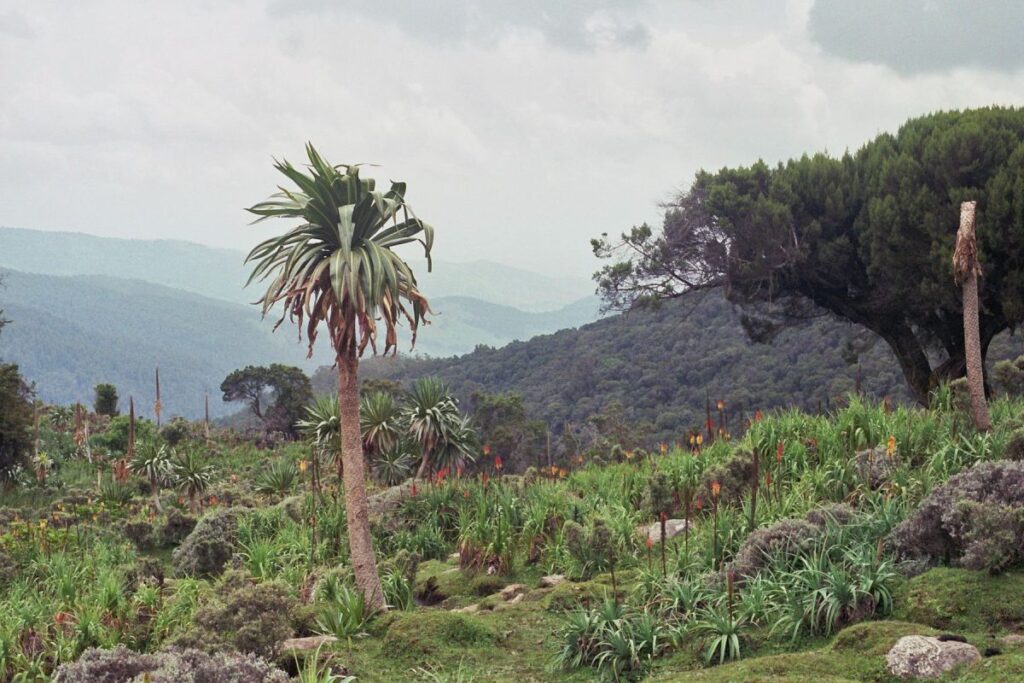
Arraweelo
The legendary queen who ruled over men and was overthrown by a young man's wit; her grave is honoured by women and scorned by men in tradition.
Source: Ahmed Artan Hanghe, Folktales from Somalia, 1988 (to check)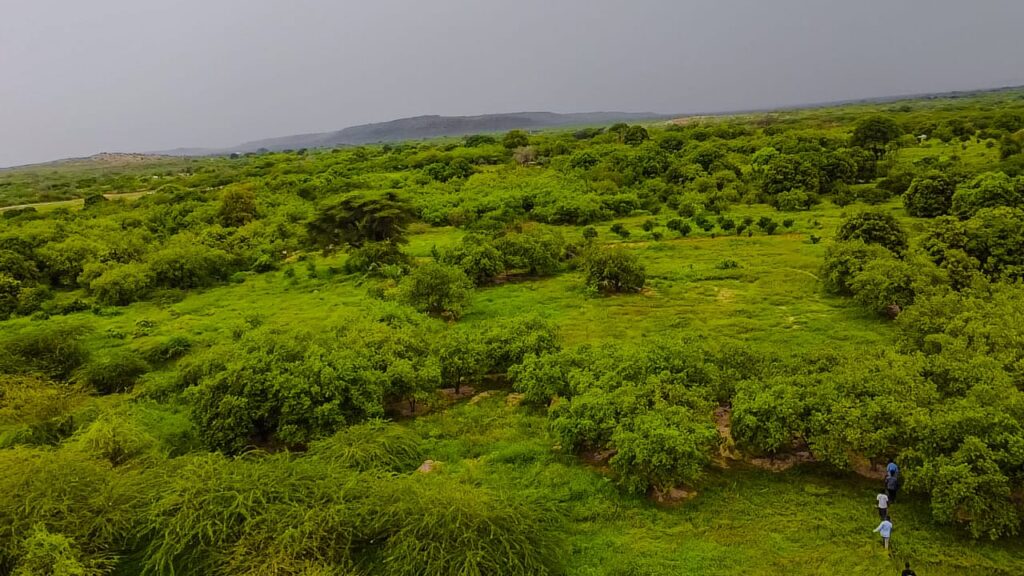
The Lore · Horn of Africa · Lore Universe
Horn pastoralists (Somali, Afar)
Camel-centred pastoralism, oral poetry (gabay) as high art, xeer customary law, clan as total social structure, Somali heroic tradition.
Why its stories are told
Stories and poems are told to argue, to remember, to teach and to entertain. A gabay may be composed to answer an insult, to press a claim over a well, to urge peace between lineages or to lament a death.
The Somali call themselves Soomaali (soh-MAH-lee) and their language Af-Soomaali, 'the Somali tongue'.
The Land · Geography
The Horn is a land of semi-desert plains, low thorn bush and sparse grass, rising in the north to the Golis and Ogo mountains and dropping to the hot coast of the Gulf of Aden. The Haud plateau, shared by Somaliland and Ethiopia, is rich seasonal grazing after the rains. In the south two permanent rivers, the Jubba and the Shabeelle, support farming. The Indian Ocean coast holds old trading towns: Mogadishu, Merca, Barawa.
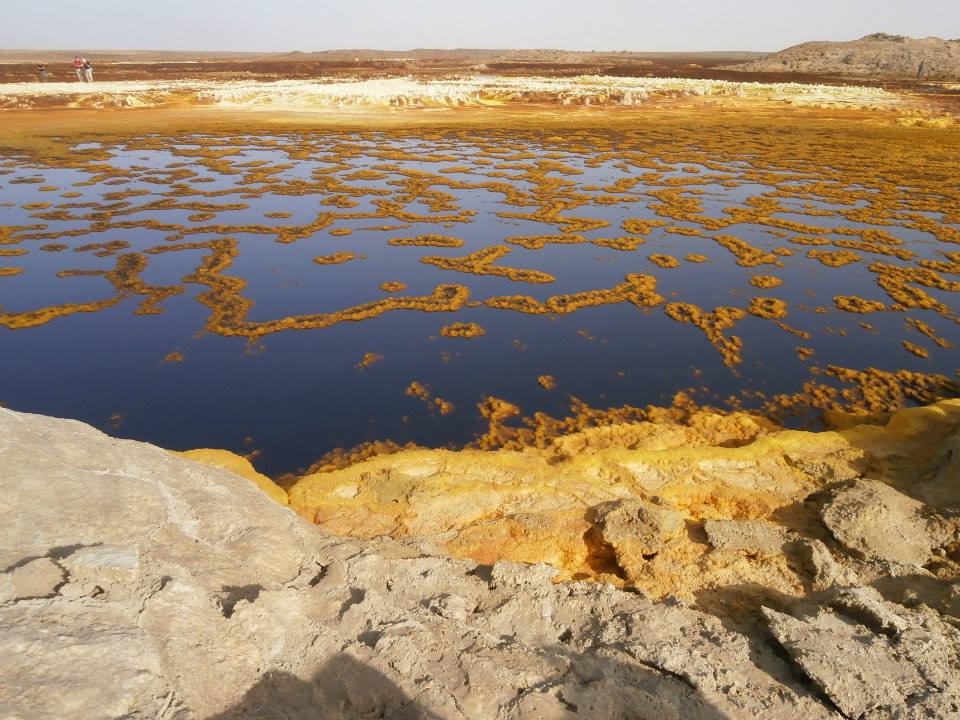
The Afar live in some of the hottest lowlands on earth: the Danakil Depression, with its salt flats and the active volcano Erta Ale, the lower Awash River and its oasis of Aussa, and the coast of Djibouti and Eritrea. Salt caravans cut from the Danakil flats have long carried salt to the highlands.
The land shapes every story. Rain decides life, and poems watch the sky. Wells are named and fought over. Camels make long movement possible and are the measure of wealth, bridewealth and blood-money. The landscape is known in fine detail by its grasses, wells and passes.
To the herders, the land is not owned in plots but used by right of lineage and agreement. Its poetry is the poetry of distance, of thirst and of the joy of the rains.
The People · Cultural Foundation · Society
The Somali and the Afar speak Lowland East Cushitic languages and are close kin in language to the Saho and, more distantly, the Oromo. Somali live across Somalia (including Somaliland and Puntland), Djibouti, the Somali Region of Ethiopia (Ogaden and Hawd), and northeastern Kenya. The Afar live in the Afar Region of Ethiopia, in Djibouti, and along the Red Sea coast of southern Eritrea.
Somali society is organised in clan families: Darood, Hawiye, Dir and Isaaq among the mainly pastoral northerners and central herders, and the agro-pastoral Digil and Mirifle (Rahanweyn) between the Jubba and Shabeelle rivers. The Afar are divided into two moieties, the Asahyammara ('red men') and Adohyammara ('white men'), and into many lineages under sultanates such as Aussa, Tadjoura, Rahayto, Gobaad and Biru.
Cushitic-speaking herders have lived in the Horn for several thousand years. Where the Somali began is debated: I. M. Lewis held that they spread south from the northern coast, while later scholars, including Lee Cassanelli, argue for an older homeland in the south and southwest. Both views agree that movement with herds shaped the clan genealogies that stories still recite.
1. Lineage solidarity. A person's first loyalty is to the agnatic line and, within it, to the group that pays and receives blood-money together. A story that seems to be about one man is nearly always about what his clan owes and is owed.
2. Honour and its defence in words. Reputation (sharaf) is won by generosity, courage and eloquence. A well-made poem can wound, shame or reconcile as surely as a raid, and the poet who answers a challenge well is honoured.
3. Hospitality and the obligations of the guest. A traveller arriving at a camp must be fed and protected; refusing this is shameful, and many stories turn on hospitality kept or broken.
4. Endurance and judgement in a hard land. Patience in drought, careful reading of rain and grazing, and wise husbanding of camels are praised as virtues, not merely skills.
5. Faith. Islam frames every other value; God's will is invoked at the opening and close of speeches and poems.
The priority runs from the group to the individual. Listeners raised on Western stories of the self-made hero may find it strange that a hero's victory can be judged wrong because it broke a treaty between lineages, or that a long poem can end with a settlement in camels rather than a triumph.
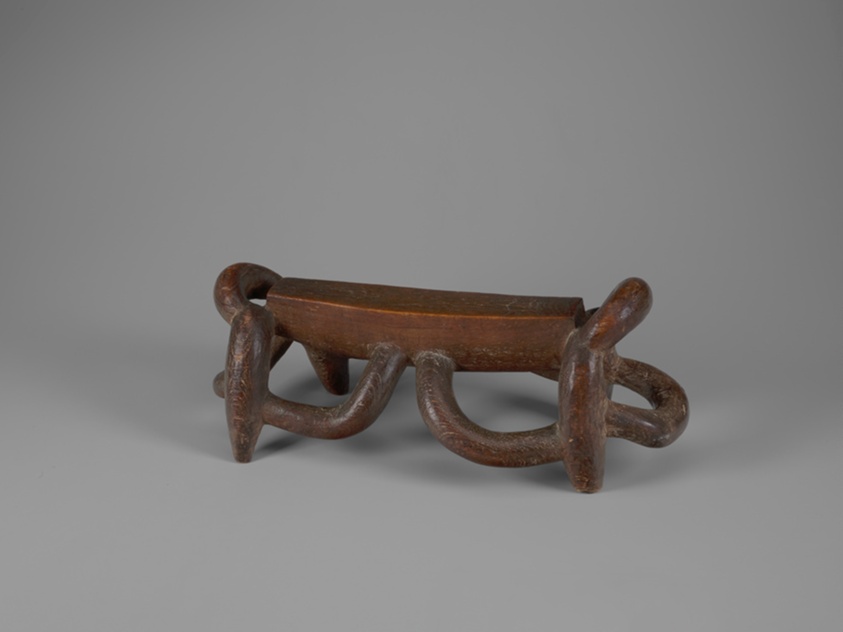
Somali and Afar gender roles are clearly divided, but not in the ways outsiders often assume. Men herd camels, defend the herds, sit in the assembly (shir), negotiate blood-money and, in the classical view, compose gabay. Women own and build the portable house (aqal among Somali), herd sheep and goats, manage milk and its vessels, and move the camp. When the camp moves, the house is women's work and women's property.
Women's power runs through several channels. As mothers and sisters they link lineages. They hold the right to their own bridewealth items in some areas. They have their own poetry, the buraambur, and their own work songs, in which they comment on men, on marriage and on public events. Lidwien Kapteijns has shown that women's verbal art carried strong political and social comment through the twentieth century.
Women also stand at the centre of saar ceremonies, and of many folktales: the clever girl who escapes Dhegdheer, the queen Arraweelo.
In the anti-colonial and independence movements, women such as Xaawo Taako became heroines, and from the 1950s women singers and poets took a leading public role. Today Somali women writers, such as Nadifa Mohamed, are among the tradition's best-known voices.
Age confers respect. Elders (odayaal) are the voice of the lineage at the assembly. They know genealogy, past agreements, the history of feuds and their settlement, and the precedents of xeer. This knowledge is what gives them authority: a dispute is settled by recalling how a similar case was settled before.
In Somaliland, the national council of elders, the Guurti, has formal standing as the upper house of parliament, a direct use of this tradition in modern government.
Adult men are herders, fighters and providers. Their status grows with their herds, their families and their reputation for courage and speech.
Youth are the camel herders, who live hard lives far from the main camp. Many poems praise their endurance; elders also warn them against rashness. Young poets may make their name by answering an older poet well.
Old women hold respect too, especially as mothers of sons, and their blessings and curses are feared.
What elders hold that others cannot is memory: of genealogy, of agreements, of past rulings and of old poems. Stories regularly show a young man saved by an elder's advice or a ruler shamed by an old man's wisdom.
Somali society describes itself as egalitarian among the 'noble' pastoral lineages: in principle any man may speak at the assembly, and Lewis called it a 'pastoral democracy'. But there are long-standing distinctions.
The main one is between pastoral lineages and occupational groups who have been held to lower status, often called collectively sab or by names such as Madhibaan (Midgaan), Yibir and Tumaal, who worked traditionally as leatherworkers, smiths, hunters and ritual specialists. They were attached to pastoral lineages as clients and barred from intermarriage. This exclusion is increasingly challenged by members of these communities and by Somali human rights organisations. In the south, communities of Bantu-speaking farmers, some descended from people enslaved in the nineteenth century, faced similar exclusion.
A second distinction is between the wadaad (man of religion) and the waranle (spearman, warrior), two roles in society rather than classes.
Among the Afar, sultans, lineage heads and religious lineages hold higher status.
The storytellers come from all ranks: poets from pastoral lineages dominate the classical record, but Yibir and other groups had their own ritual and verbal roles. In stories, status appears in hospitality, in marriage disputes, and in the honour of lineages.
The clan is the total structure. Every Somali belongs to a nested set of agnatic groups: the clan family (such as Darood or Hawiye), the clan, the sub-clan, and the diya-paying group (mag-paying group), a set of close lineages, often a few hundred to a few thousand men, who are bound by a written or spoken contract (heshiis) to pay and receive blood-money together. The diya-paying group is the core unit of obligation.
Membership carries duties: to contribute to blood-money, to defend kin, to share in hospitality and in support of the poor, and to stand together at the assembly. In return a person is protected; to harm him is to face his whole group.
The Afar are organised into lineages under sultans and lineage heads, with madaa law governing relations between them. The custom of dagu, the formal exchange of news whenever Afar meet, binds a dispersed people with shared information.
Expulsion or loss of lineage support is a disaster in a land without a state: a person cut off from kin has no protection and no one to pay or claim blood-money for him. A man may seek protection with another lineage as a client, but at a cost in status. Many poems are spoken by men who have lost their place.
Through Time · History
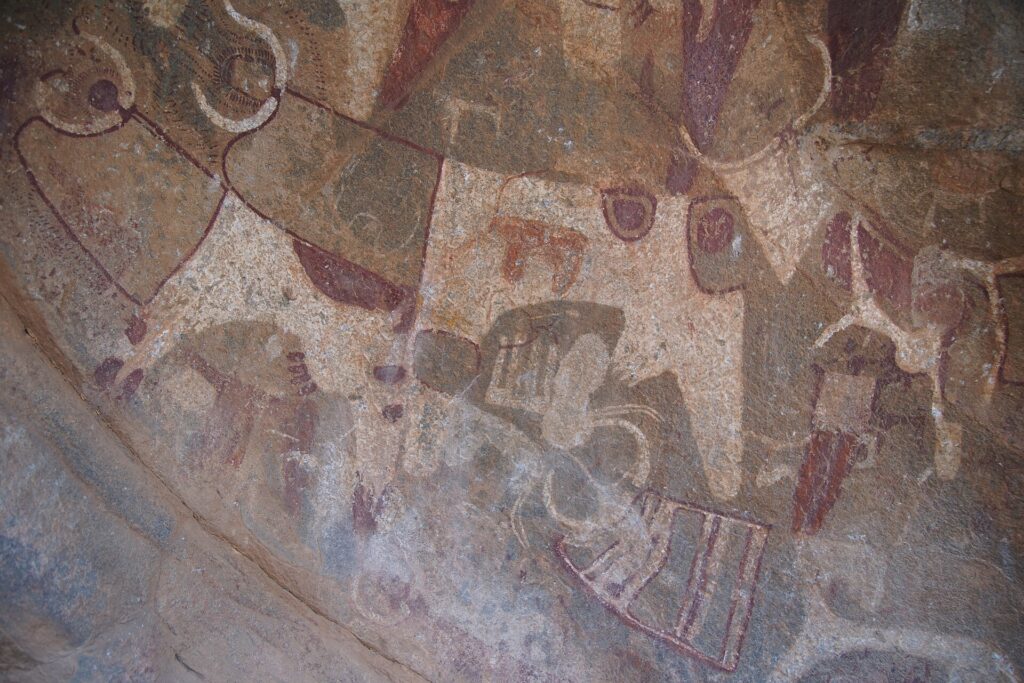
Rock paintings at Laas Geel show herders and long-horned cattle; researchers date them to between about 3000 and 1000 BCE, though estimates vary.
In about 1470 BCE an Egyptian expedition under Queen Hatshepsut sailed to the Land of Punt, which some scholars place on the Horn coast; its location is debated.
In the first century CE the Greek Periplus of the Erythraean Sea described trading ports on the northern Somali coast.
By the 10th century Islam was established in the coastal towns, including Zeila and Mogadishu.
In 1331 Ibn Battuta visited Mogadishu and described its sultan and markets.
In the 15th century an Ethiopian victory hymn for Emperor Yeshaq gives the earliest known written use of the name Somali.
Between 1529 and 1543 Imaam Axmed ibn Ibraahim, called Gurey, led the forces of the Adal Sultanate, including Somali and Afar fighters, deep into the Ethiopian highlands until his death in battle.
In about 1734 the Mudaito dynasty took power in the Afar Sultanate of Aussa.
From 1884 Britain, France and Italy divided the Somali coast, and Ethiopia took the Ogaden.
Rock paintings at Laas Geel show herders and long-horned cattle; researchers date them to between about 3000 and 1000 BCE, though estimates vary. In about 1470 BCE an Egyptian expedition under Queen Hatshepsut sailed to the Land of Punt, which some scholars place on the Horn coast; its location is debated. In the first century CE the Greek Periplus of the Erythraean Sea described trading ports on the northern Somali coast.
By the 10th century Islam was established in the coastal towns, including Zeila and Mogadishu. In 1331 Ibn Battuta visited Mogadishu and described its sultan and markets. In the 15th century an Ethiopian victory hymn for Emperor Yeshaq gives the earliest known written use of the name Somali. Between 1529 and 1543 Imaam Axmed ibn Ibraahim, called Gurey, led the forces of the Adal Sultanate, including Somali and Afar fighters, deep into the Ethiopian highlands until his death in battle.
In about 1734 the Mudaito dynasty took power in the Afar Sultanate of Aussa. From 1884 Britain, France and Italy divided the Somali coast, and Ethiopia took the Ogaden. From 1899 to 1920 Sayid Maxamed Cabdille Xasan led the Dervish resistance. In 1960 British Somaliland and the Italian trust territory united as Somalia. In 1972 Somali gained an official Latin script. In 1977 Djibouti became independent. In 1991 the Somali state collapsed and Somaliland declared its own independence.
Each event lives in poetry: the Dervish wars in the Sayid's own gabay, independence in the songs of the 1950s, and dictatorship and war in the chains of the 1970s and 1980s.
Pastoral life is movement. Each year herds move between wet-season and dry-season grazing, and in drought they travel far. These seasonal movements shaped the poetry of distance, of wells and of the return of the rains. Over centuries, larger movements spread Somali lineages across the Horn.
The deepest exchange is with Arabia and the Islamic world. Islam came early across the Red Sea and the Gulf of Aden, and Somali and Afar adopted it fully. Arabic became the language of religion, law and early writing; Arabic words entered Somali; Sufi orders brought poetry in Arabic and Somali praising the Prophet and the saints. Clan genealogies took Arabian ancestors.
These stories exist because the herding life demands them. Camels, sheep and goats must be moved across semi-desert to scattered wells and seasonal grazing; men and boys travel long distances with the camel herds while women and girls keep the smaller stock and the portable house. Speech is what holds such a dispersed society together.
The Sacred · Deities and Spirits
Invoked at the opening and close of gabay and speeches; the source of all barako in saint narratives.
No full myths are reliably recorded among Somali; the name survives in traces of language and old blessings.
Remembered as the teacher who brought learning to the region and devised a Somali way of teaching the Arabic letters; his tomb near Hargeysa hosts a yearly siyaaro.
His arrival from Arabia, marriage into local families and the birth of the sons who head the Isaaq lineages.
His arrival across the sea and marriage to Dombira, daughter of a local Dir chief, from whom the Darood lines descend.
His teaching in the southern towns, his religious poems in Somali and Arabic, and his killing in 1909 during the conflict with the Dervish movement.
Folktales of travellers meeting jinn at wells, ruins and in the night bush; healing stories of their expulsion by Qur'anic recitation.
Accounts of possession and healing ceremonies recorded by I. M. Lewis and others among Somali women.
For Somali and Afar today, the sacred is defined by Islam. The Qur'an, the name of God, the Prophet Muhammad and his family, prayer, the mosque and the pilgrimage carry divine significance. Within Somali popular religion, as I. M. Lewis described it, sacredness also gathers around the saints (awliyo), especially founding ancestors and holy men, whose tombs are visited at the yearly siyaaro.
The mechanism of sacredness is barako, blessing, which flows from God through the Prophet, the saints and their descendants and can be received by those who come near them in the right way. Men of religion (wadaad) carry some of this power and may write amulets (xirsi) containing Qur'anic verses.
Words are sacred too. A curse spoken by a holy man, an elder or a wronged mother is feared; a blessing is sought. Oaths sworn on the Qur'an bind.
Older layers are visible beneath. Scholars point to the sky-god Waaq, to seasonal rites such as the fire-lighting of Dab-shid in parts of southern Somalia, and to respect for certain trees and wells as traces of beliefs older than Islam. These are recorded with care: the communities themselves describe their faith as Islamic.
For Somali and Afar Muslims, there is one God, called Eebbe, Ilaah or Alla in Somali and Alla in Afar. There is no hierarchy of gods. Below God, in Islamic belief, are angels (malaa'ig), prophets, and the jinn, who are created beings and not divine.
Somali popular religion adds a human hierarchy of holiness. The Prophet and his family stand first; then the great saints, including founders of Sufi orders such as the Qadiriyya, Ahmadiyya and Salihiyya; then local saints, many of them founding ancestors of clans or famous teachers; then living men of religion (wadaad, sheekh) who carry barako by learning and descent. Lewis described this as a 'clan-based' popular Islam, in which the genealogy of saints mirrors the genealogy of lineages.
Scholars also record a sky-god, Waaq, worshipped by Somali and Oromo before Islam and still central to traditional Oromo religion as Waaqa. Among Somali he survives only in traces of language. Whether he headed a wider pantheon among the Somali is not known from reliable sources.
Humans relate to God directly in prayer and through the intercession of saints, a practice affirmed by Sufi tradition and questioned by reformist movements.
Ancestors are present in Somali and Afar life above all as names. A Somali traditionally knows his line of fathers back many generations, and that list places him in society: it says who will pay blood-money with him, who he may marry, and whose protection he can claim. In this sense the ancestors are always active, because the living arrange their obligations by them.
The founding ancestors of the great clan families, such as Sheikh Daarood and Sheikh Isxaaq, are remembered as holy men of Arabian origin who came across the sea, married into local families and founded lines. Scholars treat these genealogies as statements of Islamic belonging rather than literal history; the communities hold them as their own account. Their tombs are places of pilgrimage, and their barako passes to their descendants.
The protocol is Islamic: visitors to a tomb recite the opening chapter of the Qur'an, pray for the dead, and ask the saint's intercession with God, not the saint's own power apart from God. Reformist Muslims question even this.
What ancestors want from the living, as the tradition puts it, is remembrance, prayer and the keeping of the bonds between their descendants.
The unseen world has two main inhabitants in Somali and Afar understanding.
The jinn, beings made by God from smokeless fire as the Qur'an describes, live alongside humans in a world normally hidden. They frequent ruins, wells, empty places and the bush at night. Some are Muslim and harmless, others troublesome. They can afflict a person with illness or madness, and a wadaad may read Qur'anic verses to drive them out.
The saar (also zar) spirits are a distinct category, known across the Horn and beyond. They are understood to possess particular people, very often women, causing illness that is treated not by expulsion but by ceremonies in which the spirit is placated with music, incense, gifts and dance under a practitioner's guidance. I. M. Lewis read Somali saar as a space where women voice claims they cannot voice elsewhere; other scholars, and practitioners themselves, stress its healing and religious meaning.
Beyond these is the realm of the dead and the hereafter, which Islam describes. Crossings between the seen and unseen happen through possession, dreams, the barako of saints and the power of sacred words. The dead do not return as spirits in normal Islamic belief, though dreams of the dead are taken seriously.
Rituals mark the passage of life: naming a child, circumcision, marriage, and death and burial according to Islamic rule. Marriage is the most elaborate in narrative terms, because it binds two lineages; negotiations over bridewealth (yarad) and the wedding celebrations, with their songs and dances, are frequent settings in poems and stories.
Rituals that restore balance are of several kinds. Blood-money settlements at an assembly (shir) of elders close feuds and are themselves ritualised, with formal speeches, prayers and the counting of camels. Saar ceremonies placate possessing spirits. Recitation of the Qur'an drives out harmful jinn. The yearly siyaaro at a saint's tomb renews the bond between the saint's descendants, and between them and God.
Seasonal rites follow the herd's year. Prayers for rain are held in drought. In parts of southern Somalia the new year festival of Dab-shid, 'lighting the fire', is kept, a custom scholars connect with older solar calendars.
In stories, rituals often frame the action. A poem opens at a peace meeting; a folktale climaxes at a wedding; a lament is set at a grave. Settlement rituals serve as resolutions: once the camels are counted, the story is over.
For Somali and Afar, the primary divine being is God, called Eebbe, Ilaah or Alla in Somali and Alla in Afar. God is one, without image, the creator and judge. Prayer five times a day, fasting in Ramadan and the other pillars of Islam are the protocol. The Qur'an is God's word, and God's names are spoken constantly in blessing, oath and poetry. God sends rain and drought, life and death.
Before Islam, scholars record a sky-god, Waaq, among Somali and their Cushitic neighbours. Among the Oromo, Waaqa remains the creator in traditional religion. Among Somali the name survives only in traces of language; its old rites are not reliably documented, and no physical image is known. Whether Afar ancient religion centred on the same being is suggested by some writers but uncertain.
In Somali popular religion the saints stand closest to God. Aw Barkhadle, Sheikh Isxaaq, Sheikh Daarood and Sheikh Uways are revered, their tombs visited at siyaaro, their barako sought. They are not deities, and Somali Muslims are clear on this; but in stories they act with sacred power, and their symbols are their tombs, their descendants and their teachings.
Jinn are created beings of smokeless fire, described in the Qur'an, living in a world parallel to ours. Some are believers, some not. They frequent ruins, wells, graves and empty land, especially at night. A person who disturbs them may fall ill or lose their mind. Protection comes from God's name, Qur'anic recitation and amulets (xirsi) written by a wadaad. Folktales tell of people meeting jinn in the bush.
Saar spirits possess particular people, very often women, causing illness, sadness or strange behaviour. They are not driven out but placated, through ceremonies with music, incense, food and gifts, led by a practitioner. Each saar spirit may have its own character and demands. The rites belong to their practitioners.
Saints (awliyo) are the dead whose holiness gives them continuing barako; they intercede with God.
The evil eye (il) is not a spirit but a power of envious looking that can harm children, camels and good fortune; it is guarded against with blessings and amulets.
Ancestors are present through genealogy and memory, and the founding saints among them, rather than as wandering spirits.
Dhegdheer, 'Long-Ear', is the best known. She is a cannibal woman with one huge ear that can hear a traveller from far away. She lives in a valley, preys on people, and is finally defeated. In common versions her daughter flees to warn others, and Dhegdheer dies when a flood carries her away; the valley is then named for her. Children hear her story as a warning.
The qori-ismaris, recorded in Somali folktale collections, is a man who becomes a hyena by rubbing himself with a stick, and preys on livestock or people by night.
The hyena, the lion and the fox are common animal characters. The hyena is greedy and foolish, the fox clever, the lion strong but often outwitted.
The camel itself is not a monster but stands above all animals in meaning. Poets praise camels by colour and name; the she-camel is a symbol of wealth, life and beauty; the war camel and the warhorse carry heroes. In some poems the camel speaks or is addressed as a companion.
Jinn may take animal form in stories, especially as snakes or as strange animals at wells.
Many prohibitions are Islamic: forbidden foods such as pork and alcohol, sorcery, and breaches of the laws of marriage. Others belong to xeer and madaa, the customary law of Somali and Afar.
The gravest breaches in customary terms include killing a person who is protected by custom: a guest, a man of religion, a woman, a child, an elder, or an envoy sent to make peace. Such killings bring shame on the killer's whole lineage, and stories and poems condemn them harshly. Violating a sworn peace is also grave.
Marriage rules forbid unions within certain degrees of kinship, and in some regions marriage within one's own close lineage is discouraged.
The consequences are mostly collective. A killing obliges the killer's diya-paying group to pay blood-money; until it is paid, revenge is permitted and feared. A curse from a wronged elder, parent or holy man is expected to fall, sometimes years later.
Some things cannot be undone. A death can be compensated, never reversed. A poem once recited cannot be withdrawn: it lives in memory. And shame (ceeb) that attaches to a lineage through cowardice or betrayal can last for generations in the poems that recall it.
This part carries no pictures. Gods, spirits, the ancestors and ceremonies are named, with their roles, and drawn as marks only.
The Stories · Signature Stories
Arraweelo is the best known of Somali legendary figures, and her story is told across the Somali territories in many versions. Long ago, before Islam in most tellings, a woman named Arraweelo became ruler. She was a strong and able queen. She held that women should rule, because men had ruled badly and made war.
And 2 more stories in the catalog below.
The Telling · Oral Tradition · Narrative Structure
The Figures · Survival and Diaspora
The poet-hero speaks for his people in verse, defends their honour, answers rivals and judges rulers. He is a real, named person, such as Raage Ugaas, Salaan Carrabey or Sayid Maxamed Cabdille Xasan, and his arc is a life of argument.
The clever ruler or clever advisor wins by wit. Wiil Waal tests his people with riddles; a humble man finds the answer. The arc is the riddle set, struggled with and solved.
The man of religion (wadaad, sheekh) brings blessing, settles disputes, and stands outside the violence of the feud. Saints in stories perform wonders and their curses fall on wrongdoers.
The warrior (waranle) defends the herds and the lineage. His courage is praised, but stories warn against rash violence.
The elder (oday) holds memory and judgement. He advises the young and speaks at the assembly.
The lover is the poet whose love cannot reach marriage; Cilmi Boodhari is the model, and his arc ends in grief.
The powerful woman, like Arraweelo, or the clever girl, like Dhegdheer's daughter, tests the order of things.
The ogress or predator, Dhegdheer or the hyena-man, threatens from outside the camp, and is defeated by wit.
Survival and diaspora
Yes. The tradition is living. Somali poetry remains a central public art. New gabay are composed and answered on radio, television and social media; poets speak at peace conferences and political events; and the work of twentieth-century masters such as Hadraawi (Maxamed Ibraahim Warsame, 1943–2022) and Gaarriye (Maxamed Xaashi Dhamac, 1949–2012) is widely recited.
The Somali and Afar were not carried across the Atlantic in the Middle Passage in large numbers, so their diaspora is mostly recent. Before 1991 there were Somali seamen's communities in Cardiff, London and other British ports from the late nineteenth century, and labour migrants in the Gulf states.
Because the tradition is living, the work today is less revival than recording, publishing and teaching. In Somaliland, the Hargeysa Cultural Centre and the Hargeysa International Book Fair (held yearly since 2008, founded by Jama Musse Jama and others) gather poets, writers and readers and publish Somali literature. Redsea Online Cultural Foundation supports this work.
The Catalog · its places, peoples, practices and sources
The World Bible
For the reader who wants all of it: every section of Camel Clans, in its eleven parts.
The Somali call themselves Soomaali (soh-MAH-lee) and their language Af-Soomaali, 'the Somali tongue'. Their verbal art as a whole is suugaan (soo-GAAN), literature in the widest sense, and within it they distinguish maanso, the metred, alliterative poetry of named poets, from hees, songs sung at work, in dance and later on radio. The highest form of maanso is the gabay (GAH-bai). Customary law is xeer: Somali x is a breathy sound made deep in the throat, so the word sounds close to 'heer'.
The Afar call themselves Qafar and their language Qafar af. In Afar spelling q stands for a sound made by tightening the throat (the Arabic ʿayn), so the name is said roughly 'ʿAH-far'. Amharic and older European writing call them Adal or Danakil (singular Dankali); those are outsiders' names. Afar customary law is madaa.
Regional variants matter: southern Somali speakers of Af-Maay (the Digil and Mirifle, or Rahanweyn) have their own song and poetry forms alongside the northern standard forms that dominate print.
The Somali and the Afar speak Lowland East Cushitic languages and are close kin in language to the Saho and, more distantly, the Oromo. Somali live across Somalia (including Somaliland and Puntland), Djibouti, the Somali Region of Ethiopia (Ogaden and Hawd), and northeastern Kenya. The Afar live in the Afar Region of Ethiopia, in Djibouti, and along the Red Sea coast of southern Eritrea.
Somali society is organised in clan families: Darood, Hawiye, Dir and Isaaq among the mainly pastoral northerners and central herders, and the agro-pastoral Digil and Mirifle (Rahanweyn) between the Jubba and Shabeelle rivers. The Afar are divided into two moieties, the Asahyammara ('red men') and Adohyammara ('white men'), and into many lineages under sultanates such as Aussa, Tadjoura, Rahayto, Gobaad and Biru.
Cushitic-speaking herders have lived in the Horn for several thousand years. Where the Somali began is debated: I. M. Lewis held that they spread south from the northern coast, while later scholars, including Lee Cassanelli, argue for an older homeland in the south and southwest. Both views agree that movement with herds shaped the clan genealogies that stories still recite.
These stories exist because the herding life demands them. Camels, sheep and goats must be moved across semi-desert to scattered wells and seasonal grazing; men and boys travel long distances with the camel herds while women and girls keep the smaller stock and the portable house. Speech is what holds such a dispersed society together. Genealogy says who owes whom blood-money and protection, poetry argues claims to wells and pasture, and xeer and madaa settle disputes without a state.
The tradition was shaped by drought, by long competition over water, by the arrival of Islam on the Red Sea and Indian Ocean coasts, by the wars of the sixteenth century, and by colonial partition and the Dervish resistance. Each of these entered poetry.
The sacred and the secular sit side by side. Religious recitation, praise of the Prophet and of saints, and the siyaaro gatherings at saints' tombs belong to the domain of the wadaad, the man of religion. Gabay, war poetry, love poetry, folktales and riddles belong to the everyday world of the herder and the assembly, though poems freely invoke God and good poets are said to be given their gift.
This holding is drawn from published scholarship and from published collections of Somali and Afar oral literature, not from new fieldwork. The main works used are I. M. Lewis's ethnography of northern Somali clans and religion, B. W. Andrzejewski's studies and translations of Somali poetry (made with Somali poets and scholars, notably Muuse Xaaji Ismaaciil Galaal), Said S. Samatar's study of the poetry of Sayid Maxamed Cabdille Xasan, Lidwien Kapteijns's work on women's oral art, John William Johnson's study of the heello song form, and Didier Morin's collections of Afar poetry.
Somali scholars and writers who have shaped how the tradition is read include Muuse Galaal, Said Samatar, Ali Jimale Ahmed, Maxamed Daahir Afrax and the poets Hadraawi and Gaarriye, whose own commentary on poetics is widely cited. Cultural bodies active today include the Hargeysa Cultural Centre, which runs the Hargeysa International Book Fair, and Kayd Somali Arts and Culture in London.
No review by Somali or Afar elders or native-speaker readers has yet been recorded for this holding. That review is open, and corrections from the communities themselves take precedence over anything written here.
1. Lineage solidarity. A person's first loyalty is to the agnatic line and, within it, to the group that pays and receives blood-money together. A story that seems to be about one man is nearly always about what his clan owes and is owed.
2. Honour and its defence in words. Reputation (sharaf) is won by generosity, courage and eloquence. A well-made poem can wound, shame or reconcile as surely as a raid, and the poet who answers a challenge well is honoured.
3. Hospitality and the obligations of the guest. A traveller arriving at a camp must be fed and protected; refusing this is shameful, and many stories turn on hospitality kept or broken.
4. Endurance and judgement in a hard land. Patience in drought, careful reading of rain and grazing, and wise husbanding of camels are praised as virtues, not merely skills.
5. Faith. Islam frames every other value; God's will is invoked at the opening and close of speeches and poems.
The priority runs from the group to the individual. Listeners raised on Western stories of the self-made hero may find it strange that a hero's victory can be judged wrong because it broke a treaty between lineages, or that a long poem can end with a settlement in camels rather than a triumph.
Causation runs on two levels. Ultimately everything happens by the will of God (Eebbe, Ilaah), and Somali and Afar speech constantly marks this. In daily life, outcomes are also explained through human agency, through the blessing (barako) of saints and holy men, through curses, through the evil eye, and through jinn and saar spirits that can afflict a person. Drought is God's to send; a lost camel may also be the work of a rival's ill-will.
The individual is not a free-standing unit. A man's acts are his lineage's acts: if he kills, his diya-paying group pays; if he is killed, they claim compensation. A woman stands between her father's lineage and her husband's, and stories often sit on that seam.
Time is layered. There is the ordered round of the four seasons (Gu', Xagaa, Dayr, Jiilaal) and the herd's year; the long genealogical time reckoned in generations back to founding ancestors; and the Islamic time of revelation and the life to come. Reality is single in that God made all of it, but it contains an unseen world of jinn and spirits alongside the seen.
Stories and poems are told to argue, to remember, to teach and to entertain. A gabay may be composed to answer an insult, to press a claim over a well, to urge peace between lineages or to lament a death. Folktales (sheeko, sheeko-xariir) teach children cleverness and caution. Genealogies recited at assemblies fix who belongs where.
Everyone tells folktales; grandmothers are the usual tellers to children in the evening. Poetry is open to anyone in principle, but the great gabay are composed by recognised poets, called abwaan or gabayaa, whose names travel with their poems. Reciters (hafide) memorise and carry the poems of others, and must name the composer.
Poetry comes into its own at moments of tension: a dispute, a raid, a drought, a peace meeting, a marriage negotiation. In the twentieth century it also became the voice of political struggle, from the Dervish wars to the independence movement to the opposition poems of the 1970s and 1980s.
The power is real. A poet can shame a sultan or a government, and poets were jailed under the military regime for what they composed. A respected poet speaks with an authority that neither elders nor officials can simply silence.
The deepest structural pattern is the exchange: challenge and answer, claim and counter-claim. A gabay is usually a turn in a conversation. One poet speaks, another replies in the same metre and the same alliterating sound, and a third joins; in a poetic chain (silsilad) dozens of poets may answer each other over months or years. The 'story' is the whole exchange, and no single poem is complete without the others.
Narrative prose works differently. Folktales move through a short run of tests or encounters, often in threes, in which wit decides the outcome: the clever ruler sets a riddle, the girl escapes the ogress, the advisor finds the answer the king could not.
Genealogical narrative forms a third pattern: a founding ancestor arrives, marries in, and his sons become the lines that exist today. Each episode accounts for a present relationship between groups.
Across all three, movement is less from beginning to end than from imbalance to settlement. A wrong is done, words are exchanged, and the matter is closed by compensation, by marriage, by a just ruling or by God's decision. A story is finished when the relationship it disturbed is set right, or when the poets agree the argument has been won.
Conflict in the Western sense is present: raids, feuds, wars and duels of insult. But the driving force is usually a disturbance in obligations between groups rather than a clash of individual desires. Who has the right to a well, whose camels were taken, whose kinsman must be avenged or paid for, whose honour was slighted by a poem: these are the questions that start the action.
Scarcity sits beneath them. Drought tightens every relationship, and many poems begin with the land itself, the failed rains of Jiilaal, the herds thinning, before turning to the human quarrel that scarcity has sharpened.
In folktales the tension is often between cleverness and brute power: a ruler who demands the impossible, an ogress who devours, a strong man who is outwitted. In love poetry the conflict is between longing and the rules that govern marriage between lineages, as in the poems of Cilmi Boodhari. In religious narratives it is between faith and its opposite.
The nature of the force shapes the form. Because tension lies between groups, a story's natural end is a settlement or a decisive word, not the inner change of a lone hero.
There are three main protagonists.
The lineage. Genealogical narratives and many war poems are about the clan as a body: the descendants of a founding ancestor act, suffer and claim together. The named man at the centre stands for his line.
The poet. In the gabay tradition the speaking 'I' of the poem is the poet himself, a real and named person, defending his own honour and his people's. The poet-hero, above all Sayid Maxamed Cabdille Xasan, Raage Ugaas or Salaan Carrabey, is as much a protagonist as any warrior.
The clever one. Folktales favour the person who wins by wit: Wiil Waal the shrewd ruler, the advisor who solves a riddle, the girl who escapes the ogress Dhegdheer. Strength alone rarely wins in these stories.
Heroes of history also stand at the centre of epic memory: Imaam Axmed Gurey of the sixteenth-century wars, the Dervish leader, and women such as Xaawo Taako of the independence movement. Even then, they are remembered for what they did for and with their people.
The satisfying ending is restoration of right relations. A feud closes when the mag (blood-money, traditionally counted in camels, a hundred for a man by common northern xeer) is paid and accepted, or when a marriage binds the two groups. A poetic duel closes when one side cannot answer, or when the poets themselves call for peace. A folktale closes when the clever answer is given and the ruler, or the danger, is set right.
Victory alone does not satisfy. A raid that leaves a feud open is a beginning, not an end, and poets often remind listeners that today's victor will be tomorrow's target.
Some endings are God's decision. Laments end in acceptance; love poems that cannot reach marriage end in grief or death, as Cilmi Boodhari's poems and life are remembered.
Genealogical narratives end in the present: the founding ancestor's sons become the lineages that exist today, so the story's resolution is the world as it now is. In this sense many Somali and Afar stories never fully close. They hand the listener a relationship to keep up.
Time in these stories moves on three tracks at once.
The herd's year: the four seasons, Gu' (the main rains, roughly April to June), Xagaa (the dry summer), Dayr (the short rains, roughly October and November) and Jiilaal (the hard dry season). Poems mark their moment by season and grazing, and the turn from Jiilaal to Gu' is the turn from hardship to plenty.
Genealogical time: generations counted back, often twenty or more, to the founding ancestors. A Somali child traditionally learns this list of fathers, and stories hang on its names. This is a linear time, but it is lived as a tree, branching into lines that exist side by side now.
Sacred time: the Islamic calendar, the Prophet's life, the saints' anniversaries kept at their tombs, and the expectation of judgement.
In a single poem these can overlap. A poet speaks in one season, invokes ancestors of twenty generations past, and addresses God; the poem's time is the present argument, held up against the long line and the eternal.
The community is the protagonist more often than the background. In war poetry and genealogy, the lineage acts as one body. In the gabay tradition, even a personal poem is addressed to an audience of kin and rivals who will judge it, repeat it and reply to it.
Individuals relate to the community through the obligations of their line. A man is praised when he serves it with courage, generosity and good speech, and censured when he endangers it. A woman's position between her natal and marital lineages gives her a particular voice, and women's poetry (buraambur and work songs) often speaks of that double belonging and its costs.
What the community expects of a poem is that it be true to its occasion, well made, and answerable. Listeners judge it on the strictness of its alliteration and metre, on the force of its imagery, and on whether its argument holds. A poem that wins the assembly's agreement can change a decision; a poem judged weak shames its maker.
The community also keeps the poem. Once recited, it belongs to all who memorise it, though the composer's name must travel with it.
Morality is largely relational. Right action is what keeps faith with one's lineage, honours agreements between lineages, and respects the guest, the weak and the holy. Xeer defines many duties in detail, and Islamic law (sharia) frames others; the two work together, with xeer often governing matters between clans.
What earns condemnation: cowardice, meanness to guests, breaking a sworn agreement, killing a person under protection (such as a man of religion, a guest, a woman or a child), and betraying one's own people. What earns honour: generosity with livestock, courage in defence, wise judgement at the assembly, piety, and mastery of speech.
Stories teach this logic by showing consequences between groups. The ruler who demands the impossible is answered and shamed; the clever advisor is rewarded; the man who keeps hospitality to an enemy is praised. Arraweelo's tale is told, in many versions, as a warning about the abuse of power, though Somali women writers have reread her as a figure of resistance.
The moral voice of poetry can also turn on the community itself. Poets of the twentieth century, from the Dervish era to Hadraawi and Gaarriye, used gabay to accuse their own leaders of injustice.
Personal transformation is rarely the point. A hero is shown, tested and proved, not remade. The clever ruler was clever before the story began; the brave warrior was brave. What changes is the state of relations around them: a feud becomes peace, an insult is answered, a ruler learns where wisdom lies.
Where transformation is told, it is often a change of status. A boy becomes a man who can herd camels on the long treks and speak at the assembly; a young woman becomes a wife and mother in another lineage; a man becomes an elder whose word settles disputes; a herdsman becomes a wadaad through study.
The tradition mourns some changes. Laments grieve the loss of a wife, a brother or a herd; twentieth-century poems grieve the division of Somali lands among colonial powers, and later the collapse of the state and the scattering of the people across the world.
It celebrates others: the return of the rains, the reconciliation of enemies, the birth of sons, and, in the independence poems and songs of the 1950s, the hope of a united Somali nation. Transformation is welcomed when it restores, and mourned when it scatters.
For Somali and Afar today, the sacred is defined by Islam. The Qur'an, the name of God, the Prophet Muhammad and his family, prayer, the mosque and the pilgrimage carry divine significance. Within Somali popular religion, as I. M. Lewis described it, sacredness also gathers around the saints (awliyo), especially founding ancestors and holy men, whose tombs are visited at the yearly siyaaro.
The mechanism of sacredness is barako, blessing, which flows from God through the Prophet, the saints and their descendants and can be received by those who come near them in the right way. Men of religion (wadaad) carry some of this power and may write amulets (xirsi) containing Qur'anic verses.
Words are sacred too. A curse spoken by a holy man, an elder or a wronged mother is feared; a blessing is sought. Oaths sworn on the Qur'an bind.
Older layers are visible beneath. Scholars point to the sky-god Waaq, to seasonal rites such as the fire-lighting of Dab-shid in parts of southern Somalia, and to respect for certain trees and wells as traces of beliefs older than Islam. These are recorded with care: the communities themselves describe their faith as Islamic.
Ancestors are present in Somali and Afar life above all as names. A Somali traditionally knows his line of fathers back many generations, and that list places him in society: it says who will pay blood-money with him, who he may marry, and whose protection he can claim. In this sense the ancestors are always active, because the living arrange their obligations by them.
The founding ancestors of the great clan families, such as Sheikh Daarood and Sheikh Isxaaq, are remembered as holy men of Arabian origin who came across the sea, married into local families and founded lines. Scholars treat these genealogies as statements of Islamic belonging rather than literal history; the communities hold them as their own account. Their tombs are places of pilgrimage, and their barako passes to their descendants.
The protocol is Islamic: visitors to a tomb recite the opening chapter of the Qur'an, pray for the dead, and ask the saint's intercession with God, not the saint's own power apart from God. Reformist Muslims question even this.
What ancestors want from the living, as the tradition puts it, is remembrance, prayer and the keeping of the bonds between their descendants.
The unseen world has two main inhabitants in Somali and Afar understanding.
The jinn, beings made by God from smokeless fire as the Qur'an describes, live alongside humans in a world normally hidden. They frequent ruins, wells, empty places and the bush at night. Some are Muslim and harmless, others troublesome. They can afflict a person with illness or madness, and a wadaad may read Qur'anic verses to drive them out.
The saar (also zar) spirits are a distinct category, known across the Horn and beyond. They are understood to possess particular people, very often women, causing illness that is treated not by expulsion but by ceremonies in which the spirit is placated with music, incense, gifts and dance under a practitioner's guidance. I. M. Lewis read Somali saar as a space where women voice claims they cannot voice elsewhere; other scholars, and practitioners themselves, stress its healing and religious meaning.
Beyond these is the realm of the dead and the hereafter, which Islam describes. Crossings between the seen and unseen happen through possession, dreams, the barako of saints and the power of sacred words. The dead do not return as spirits in normal Islamic belief, though dreams of the dead are taken seriously.
Rituals mark the passage of life: naming a child, circumcision, marriage, and death and burial according to Islamic rule. Marriage is the most elaborate in narrative terms, because it binds two lineages; negotiations over bridewealth (yarad) and the wedding celebrations, with their songs and dances, are frequent settings in poems and stories.
Rituals that restore balance are of several kinds. Blood-money settlements at an assembly (shir) of elders close feuds and are themselves ritualised, with formal speeches, prayers and the counting of camels. Saar ceremonies placate possessing spirits. Recitation of the Qur'an drives out harmful jinn. The yearly siyaaro at a saint's tomb renews the bond between the saint's descendants, and between them and God.
Seasonal rites follow the herd's year. Prayers for rain are held in drought. In parts of southern Somalia the new year festival of Dab-shid, 'lighting the fire', is kept, a custom scholars connect with older solar calendars.
In stories, rituals often frame the action. A poem opens at a peace meeting; a folktale climaxes at a wedding; a lament is set at a grave. Settlement rituals serve as resolutions: once the camels are counted, the story is over.
For Somali and Afar Muslims, there is one God, called Eebbe, Ilaah or Alla in Somali and Alla in Afar. There is no hierarchy of gods. Below God, in Islamic belief, are angels (malaa'ig), prophets, and the jinn, who are created beings and not divine.
Somali popular religion adds a human hierarchy of holiness. The Prophet and his family stand first; then the great saints, including founders of Sufi orders such as the Qadiriyya, Ahmadiyya and Salihiyya; then local saints, many of them founding ancestors of clans or famous teachers; then living men of religion (wadaad, sheekh) who carry barako by learning and descent. Lewis described this as a 'clan-based' popular Islam, in which the genealogy of saints mirrors the genealogy of lineages.
Scholars also record a sky-god, Waaq, worshipped by Somali and Oromo before Islam and still central to traditional Oromo religion as Waaqa. Among Somali he survives only in traces of language. Whether he headed a wider pantheon among the Somali is not known from reliable sources.
Humans relate to God directly in prayer and through the intercession of saints, a practice affirmed by Sufi tradition and questioned by reformist movements.
The defining technique of Somali poetry is alliteration (higaad). In a classical poem every line, or every half-line, must contain a word beginning with the same consonant, or with a vowel, and this sound is held through the entire poem, which may run to a hundred lines or more. A poem 'in D' alliterates in D from beginning to end. Answering poems in a chain keep the same sound.
Metre is the second rule. Each genre has its own pattern of long and short syllables: the gabay is long and stately, the geeraar short and fast, suited to war and horsemanship, the jiifto measured and reflective. Somali scholars, including the poet Gaarriye, worked out these metres in detail in the 1970s, though poets had always heard them.
Gabay are chanted rather than sung, in a strong, carrying voice, with a melody fitted to the genre. Poems often open with a formula addressing the listeners or invoking God, and close with a statement of the poet's purpose.
Folktales are told in plain speech, with opening and closing formulas, repetition of key phrases, and changes of voice for characters. Silence and pause matter in all these forms: the audience waits for the next line's alliterating word.
Classical gabay needs no instrument. The poet or reciter stands or sits before the assembly and chants; the body is mostly still, with gestures to drive home a point. Authority comes from voice and words.
Song and dance surround poetry. Work songs (hees hawleed) accompany watering camels at the well, weaving mats, churning milk and pounding grain; they are sung in rhythm with the work. Dance songs at weddings and festivals involve clapping, stamping and lines of men and women facing each other. Among the Afar, group dances with chanted songs mark weddings and festivals, and men dance with sticks or with the curved Afar dagger (jile) at the waist.
The modern Somali song, the heello and later the hees, brought instruments: the oud (cuud), drums and, from the 1950s, full bands and radio orchestras in Hargeysa and Mogadishu.
In saar ceremonies, music, drums, incense and dance are central, and the possessed person's movements are part of the rite.
Objects appear in performance too: the herder's staff, the woven milk vessel (haan) in women's songs, and the camels themselves, which are sung to at watering and which poets praise by colour and name.
The audience of a gabay is a jury. Listeners know the metres and the rules of alliteration and judge each line as it comes, murmuring approval at a strong image or a hard alliteration well met. They will repeat good lines immediately and carry them to other camps.
Above all, the audience can answer. Any listener who is a poet may compose a reply, and in this way a poem draws others into a chain. A famous challenge may receive answers from across the Somali territories over years. The audience co-creates the tradition by deciding which poems live.
In song and dance the participation is physical. Work songs pass between a leader and a group; dance songs have choruses, handclaps and call-and-response between lines of men and women. Children's games and lullabies involve completing phrases.
In folktales, children respond to the teller, ask questions, and know the shape of the story well enough to anticipate it. Riddles and tongue-twisters invite the listener to compete.
At saar ceremonies those present sing, clap and support the possessed, so the healing is a shared act.
Alliteration and metre are the strongest memory devices. A listener who knows that a poem runs in G and in gabay metre can recover a forgotten line, because only words that fit both rules will do. This allows long poems to pass across generations with remarkable stability; scholars comparing recordings have found that famous nineteenth-century gabay are recited in very close versions across regions.
Naming is a second device. The composer's name and the occasion of the poem are always given with it, so poems are remembered as part of a known event. To recite another's poem without naming him is a serious breach.
Specialist reciters carry much of the tradition. In the past a great poet often had reciters who learnt his poems and spread them.
Genealogy is memorised from childhood and serves as a framework on which stories and poems hang.
Writing has added new devices. The Osmanya script was devised in the 1920s by Cismaan Yuusuf Keenadiid, and in 1972 a Latin orthography became the official script, after which collections of classical poetry were published in Somali. Recordings on cassette and now online keep poems in circulation. The Afar language was standardised in Latin script from the 1970s onward.
The supernatural power that matters most in this tradition is barako, the blessing that flows from God through the Prophet, saints and holy men. It cannot be bought or forced. It can heal, protect, bring rain or prosperity, and make a holy man's curse fall on those who harm him. Stories of saints describe wells springing up, enemies stopped, and wrongdoers struck down.
The word is the second power. A curse (habaar) by a parent, an elder or a man of religion is believed to take effect; a blessing (duco) is sought. A great poem is also a kind of power: a satire can destroy a reputation and a praise poem can raise one, and this is spoken of seriously.
Amulets (xirsi) with Qur'anic verses protect against illness, the evil eye and jinn. Qur'anic recitation drives out harmful spirits.
The rules are strict. Power belongs to God, and saints and men of religion are only channels. Seeking power from jinn or by sorcery (sixir) is forbidden in Islam and condemned. Power cannot overturn God's will. Unstated, but clear in the stories, is that power used for injustice turns back on the user.
Power comes from several sources, in a clear order.
Divine power comes from God alone. It reaches people through prayer, through the barako of saints, and through the Qur'an.
Inherited power runs in descent. The descendants of saints and of religious lineages are believed to carry some of the founder's barako, which is why certain lineages are respected as religious lines and why their curse is feared.
Earned power comes from learning and from speech. A wadaad gains standing by study of the Qur'an and Islamic law; a poet gains standing by mastery of the forms; an elder gains standing by wise judgement at the assembly. These powers are open to anyone in principle, but they take years.
Worldly power comes from numbers and wealth: a lineage with many fighting men and many camels is strong. Titled leaders (suldaan, ugaas, garaad, and the Afar sultans) hold authority that is partly inherited, partly granted by the agreement of elders.
The cost is responsibility. A man of barako who misuses it loses respect; a poet whose words cause a war bears blame; a leader who fails his people is answered in verse.
Many prohibitions are Islamic: forbidden foods such as pork and alcohol, sorcery, and breaches of the laws of marriage. Others belong to xeer and madaa, the customary law of Somali and Afar.
The gravest breaches in customary terms include killing a person who is protected by custom: a guest, a man of religion, a woman, a child, an elder, or an envoy sent to make peace. Such killings bring shame on the killer's whole lineage, and stories and poems condemn them harshly. Violating a sworn peace is also grave.
Marriage rules forbid unions within certain degrees of kinship, and in some regions marriage within one's own close lineage is discouraged.
The consequences are mostly collective. A killing obliges the killer's diya-paying group to pay blood-money; until it is paid, revenge is permitted and feared. A curse from a wronged elder, parent or holy man is expected to fall, sometimes years later.
Some things cannot be undone. A death can be compensated, never reversed. A poem once recited cannot be withdrawn: it lives in memory. And shame (ceeb) that attaches to a lineage through cowardice or betrayal can last for generations in the poems that recall it.
Somali and Afar societies do not have the formal age-set initiations of some neighbouring peoples. Status is conferred step by step through the life course.
Boys are circumcised in childhood, following Islamic practice. As they grow, they move from herding goats and sheep near the camp to herding camels with the young men, a step that is the real passage to manhood in pastoral terms: the camel herders (geeljire) travel far, live on milk, defend the herds and learn the land.
Girls also undergo circumcision in childhood in many communities. This practice is now opposed by many Somali and Afar women and men, and is restricted or banned by law in Somalia, Somaliland, Djibouti, Ethiopia and Kenya, though it continues in places. Girls learn the skills of the house and the smaller stock, and marriage makes them full adult women.
Religious knowledge is conferred by study. A child begins at the Qur'anic school (dugsi), and some continue to become men of religion through years with a sheekh.
Among the Afar, older records describe the young man proving himself in defence of the herds before marriage. Accounts vary, and where customs belong to the community's own keeping they are not described here.
Somali and Afar gender roles are clearly divided, but not in the ways outsiders often assume. Men herd camels, defend the herds, sit in the assembly (shir), negotiate blood-money and, in the classical view, compose gabay. Women own and build the portable house (aqal among Somali), herd sheep and goats, manage milk and its vessels, and move the camp. When the camp moves, the house is women's work and women's property.
Women's power runs through several channels. As mothers and sisters they link lineages. They hold the right to their own bridewealth items in some areas. They have their own poetry, the buraambur, and their own work songs, in which they comment on men, on marriage and on public events. Lidwien Kapteijns has shown that women's verbal art carried strong political and social comment through the twentieth century.
Women also stand at the centre of saar ceremonies, and of many folktales: the clever girl who escapes Dhegdheer, the queen Arraweelo.
In the anti-colonial and independence movements, women such as Xaawo Taako became heroines, and from the 1950s women singers and poets took a leading public role. Today Somali women writers, such as Nadifa Mohamed, are among the tradition's best-known voices.
Age confers respect. Elders (odayaal) are the voice of the lineage at the assembly. They know genealogy, past agreements, the history of feuds and their settlement, and the precedents of xeer. This knowledge is what gives them authority: a dispute is settled by recalling how a similar case was settled before.
In Somaliland, the national council of elders, the Guurti, has formal standing as the upper house of parliament, a direct use of this tradition in modern government.
Adult men are herders, fighters and providers. Their status grows with their herds, their families and their reputation for courage and speech.
Youth are the camel herders, who live hard lives far from the main camp. Many poems praise their endurance; elders also warn them against rashness. Young poets may make their name by answering an older poet well.
Old women hold respect too, especially as mothers of sons, and their blessings and curses are feared.
What elders hold that others cannot is memory: of genealogy, of agreements, of past rulings and of old poems. Stories regularly show a young man saved by an elder's advice or a ruler shamed by an old man's wisdom.
Somali society describes itself as egalitarian among the 'noble' pastoral lineages: in principle any man may speak at the assembly, and Lewis called it a 'pastoral democracy'. But there are long-standing distinctions.
The main one is between pastoral lineages and occupational groups who have been held to lower status, often called collectively sab or by names such as Madhibaan (Midgaan), Yibir and Tumaal, who worked traditionally as leatherworkers, smiths, hunters and ritual specialists. They were attached to pastoral lineages as clients and barred from intermarriage. This exclusion is increasingly challenged by members of these communities and by Somali human rights organisations. In the south, communities of Bantu-speaking farmers, some descended from people enslaved in the nineteenth century, faced similar exclusion.
A second distinction is between the wadaad (man of religion) and the waranle (spearman, warrior), two roles in society rather than classes.
Among the Afar, sultans, lineage heads and religious lineages hold higher status.
The storytellers come from all ranks: poets from pastoral lineages dominate the classical record, but Yibir and other groups had their own ritual and verbal roles. In stories, status appears in hospitality, in marriage disputes, and in the honour of lineages.
The clan is the total structure. Every Somali belongs to a nested set of agnatic groups: the clan family (such as Darood or Hawiye), the clan, the sub-clan, and the diya-paying group (mag-paying group), a set of close lineages, often a few hundred to a few thousand men, who are bound by a written or spoken contract (heshiis) to pay and receive blood-money together. The diya-paying group is the core unit of obligation.
Membership carries duties: to contribute to blood-money, to defend kin, to share in hospitality and in support of the poor, and to stand together at the assembly. In return a person is protected; to harm him is to face his whole group.
The Afar are organised into lineages under sultans and lineage heads, with madaa law governing relations between them. The custom of dagu, the formal exchange of news whenever Afar meet, binds a dispersed people with shared information.
Expulsion or loss of lineage support is a disaster in a land without a state: a person cut off from kin has no protection and no one to pay or claim blood-money for him. A man may seek protection with another lineage as a client, but at a cost in status. Many poems are spoken by men who have lost their place.
The Horn is a land of semi-desert plains, low thorn bush and sparse grass, rising in the north to the Golis and Ogo mountains and dropping to the hot coast of the Gulf of Aden. The Haud plateau, shared by Somaliland and Ethiopia, is rich seasonal grazing after the rains. In the south two permanent rivers, the Jubba and the Shabeelle, support farming. The Indian Ocean coast holds old trading towns: Mogadishu, Merca, Barawa.
The Afar live in some of the hottest lowlands on earth: the Danakil Depression, with its salt flats and the active volcano Erta Ale, the lower Awash River and its oasis of Aussa, and the coast of Djibouti and Eritrea. Salt caravans cut from the Danakil flats have long carried salt to the highlands.
The land shapes every story. Rain decides life, and poems watch the sky. Wells are named and fought over. Camels make long movement possible and are the measure of wealth, bridewealth and blood-money. The landscape is known in fine detail by its grasses, wells and passes.
To the herders, the land is not owned in plots but used by right of lineage and agreement. Its poetry is the poetry of distance, of thirst and of the joy of the rains.
The holiest places are the tombs of saints.
Aw Barkhadle, near Hargeysa, holds the tomb of Sheikh Yuusuf al-Kawneyn, remembered as a medieval teacher who brought Islamic learning to the region and devised a Somali way of teaching the Arabic letters. A yearly siyaaro is held there, and the ruins around the tomb are of an old town.
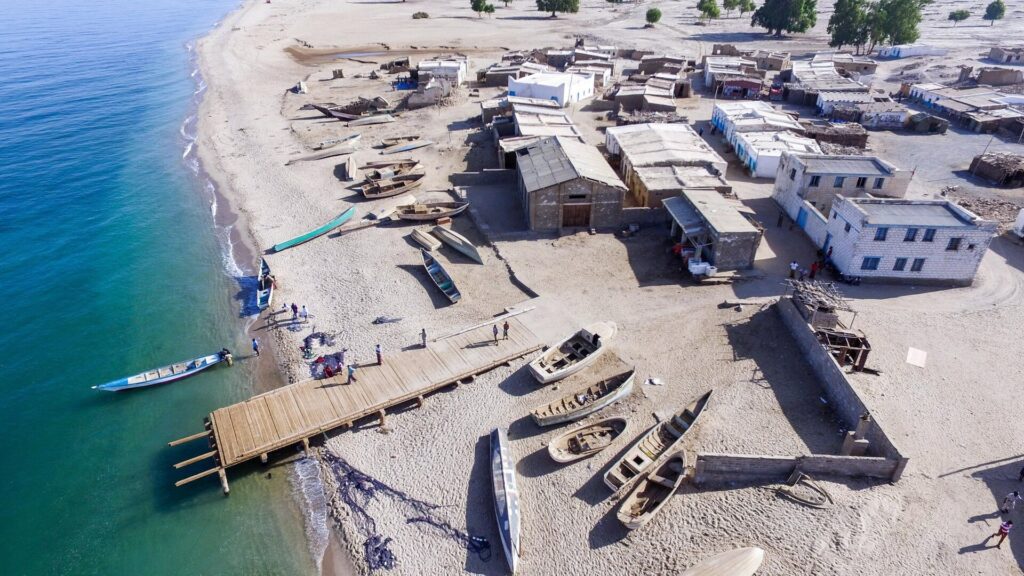
Maydh, on the Sanaag coast, holds the tomb of Sheikh Isxaaq, the founding ancestor of the Isaaq clan family. His descendants gather there.
Biyooley, in the south, holds the tomb of Sheikh Uways al-Barawi, the Qadiriyya teacher killed in 1909.
Tombs of other founding ancestors, including Sheikh Daarood, are also visited; their locations are given in clan tradition.
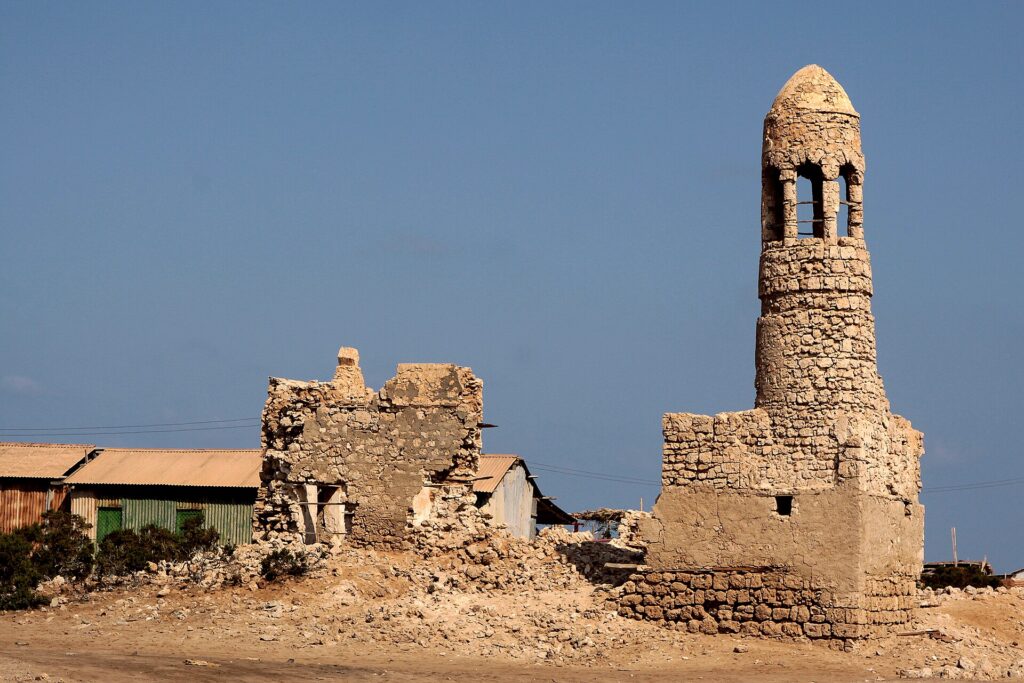
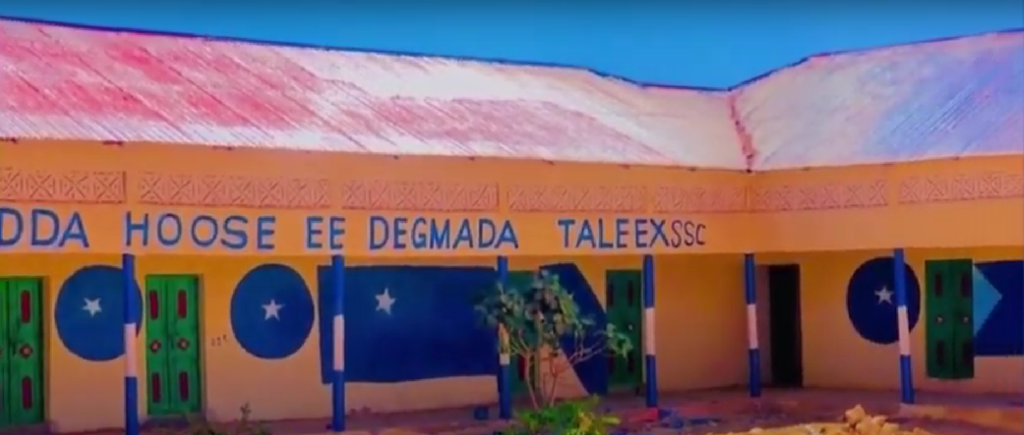
The ancient sites carry other meanings. Laas Geel, near Hargeysa, holds rock paintings of cattle and people thousands of years old, rediscovered by archaeologists in 2002 and long known to local people. Zeila, the old port on the Gulf of Aden, holds early mosques. Taleex, the stone fortress of the Dervish movement, is a site of national memory.
In stories, saints' tombs are destinations for healing and blessing; wells and old ruins are thresholds where jinn may be met.
The cosmology is Islamic: God above all, seven heavens, the earth, and the hereafter with its paradise and fire. Mecca and the Kaaba are the centre toward which prayer is directed, so every Somali and Afar camp is oriented to the northeast, toward Arabia. Arabia is also, in clan tradition, the land from which the founding ancestors came across the sea, so the direction of prayer and the direction of origin coincide.
The seen and unseen worlds overlap in space. Jinn live in the same places as humans, especially empty places, ruins and wells, and become dangerous at night. Saints' tombs are points where barako is especially near.
A second, practical map is drawn by the stars. Somali herders and specialists in star lore traditionally read the stars and the moon to reckon the seasons and the coming of rain, and this knowledge appears in poems.
Older layers, recorded by scholars, place Waaq in the sky as the giver of rain, and some customs connect height and the sky with blessing.
Movement between realms happens through death, through dreams, through possession, and through the prayers and barako that pass between the living, the saints and God.
Rock paintings at Laas Geel show herders and long-horned cattle; researchers date them to between about 3000 and 1000 BCE, though estimates vary. In about 1470 BCE an Egyptian expedition under Queen Hatshepsut sailed to the Land of Punt, which some scholars place on the Horn coast; its location is debated. In the first century CE the Greek Periplus of the Erythraean Sea described trading ports on the northern Somali coast.
By the 10th century Islam was established in the coastal towns, including Zeila and Mogadishu. In 1331 Ibn Battuta visited Mogadishu and described its sultan and markets. In the 15th century an Ethiopian victory hymn for Emperor Yeshaq gives the earliest known written use of the name Somali. Between 1529 and 1543 Imaam Axmed ibn Ibraahim, called Gurey, led the forces of the Adal Sultanate, including Somali and Afar fighters, deep into the Ethiopian highlands until his death in battle.
In about 1734 the Mudaito dynasty took power in the Afar Sultanate of Aussa. From 1884 Britain, France and Italy divided the Somali coast, and Ethiopia took the Ogaden. From 1899 to 1920 Sayid Maxamed Cabdille Xasan led the Dervish resistance. In 1960 British Somaliland and the Italian trust territory united as Somalia. In 1972 Somali gained an official Latin script. In 1977 Djibouti became independent. In 1991 the Somali state collapsed and Somaliland declared its own independence.
Each event lives in poetry: the Dervish wars in the Sayid's own gabay, independence in the songs of the 1950s, and dictatorship and war in the chains of the 1970s and 1980s.
Pastoral life is movement. Each year herds move between wet-season and dry-season grazing, and in drought they travel far. These seasonal movements shaped the poetry of distance, of wells and of the return of the rains.
Over centuries, larger movements spread Somali lineages across the Horn. In Lewis's reconstruction, Somali clans pushed southward and westward from the northern coast over the second millennium CE, reaching the Jubba region and beyond into what is now northeastern Kenya by the nineteenth century. Other historians argue the Somali originated in the south and spread north, and that the story of northern origins reflects the prestige of Arabian ancestry. The truth may combine both. What is clear is that movement brought Somali into contact, conflict and intermarriage with Oromo, with farming communities on the southern rivers, and with Afar to the north.
The Afar have moved within a narrower range, between the Awash and the Red Sea coast.
In the twentieth century came new movement: to cities, to work as seamen and soldiers in British service, and, after 1991, into refugee camps and diaspora communities across the world. Migration carried poetry and genealogy with it; what was lost was the daily herding context that gave the old images their life.
The deepest exchange is with Arabia and the Islamic world. Islam came early across the Red Sea and the Gulf of Aden, and Somali and Afar adopted it fully. Arabic became the language of religion, law and early writing; Arabic words entered Somali; Sufi orders brought poetry in Arabic and Somali praising the Prophet and the saints. Clan genealogies took Arabian ancestors. Yet Somali poetry kept its own metres and alliteration, quite unlike Arabic verse.
Trade connected the coast with India, Persia and the Swahili world. Coastal towns such as Mogadishu and Barawa shared much with Swahili culture, and the Barawa dialect is close to Swahili.
On land, exchange with the Oromo, Saho and Ethiopian highland peoples was close, sometimes hostile. The sky-god Waaq is shared with the Oromo. The saar spirit cult is shared across the Horn.
Colonial rule brought English, Italian and French, new schools, new borders, and radio. Somali artists absorbed Arabic and Indian music into the modern song from the 1950s.
The tradition held its integrity through its forms: alliteration, metre, genealogy and xeer were never given up, and new content was poured into them.
Yes. The tradition is living. Somali poetry remains a central public art. New gabay are composed and answered on radio, television and social media; poets speak at peace conferences and political events; and the work of twentieth-century masters such as Hadraawi (Maxamed Ibraahim Warsame, 1943–2022) and Gaarriye (Maxamed Xaashi Dhamac, 1949–2012) is widely recited. Classical poems are learnt and quoted.
Xeer continues to govern much of daily life, especially in rural areas and wherever the state is weak. Blood-money is still paid between diya-paying groups. In Somaliland, elders hold a formal place in government through the Guurti. Afar madaa remains in force in Afar communities.
Camel herding continues on a large scale; Somali regions hold one of the largest camel populations in the world.
What has changed: many Somali now live in cities or abroad, far from herding. The poetic chains that once passed by foot and word now pass by phone. Saar ceremonies are less common and opposed by reformist Muslims. Some occupational and status distinctions are being challenged.
What has been lost is harder to measure: some regional song forms, some older poets' work never written down, and the full herding context of the old images.
The Somali and Afar were not carried across the Atlantic in the Middle Passage in large numbers, so their diaspora is mostly recent. Before 1991 there were Somali seamen's communities in Cardiff, London and other British ports from the late nineteenth century, and labour migrants in the Gulf states. After the civil war of 1991, hundreds of thousands fled to Kenya, Ethiopia and Yemen, and onward to Britain, Scandinavia, the Netherlands, Canada, the United States and Australia. Large communities now live in London, Minneapolis, Toronto, Columbus and elsewhere.
In the diaspora the tradition has adapted. Poetry readings, festivals and online poetry exchanges link poets across continents. Genealogy keeps its role in organising support, remittances and marriage, though young people raised abroad may know it less fully. Clan-based associations exist alongside newer associations of Somali citizens of other nations.
New forms have grown from the old. Somali writers in English, such as Nuruddin Farah (in Africa and abroad) and Nadifa Mohamed in Britain, write from inside Somali life; younger poets in English draw on the alliterative ear and the concerns of the gabay.
Afar diaspora communities are smaller, mainly in the Gulf, Europe and North America.
Because the tradition is living, the work today is less revival than recording, publishing and teaching.
In Somaliland, the Hargeysa Cultural Centre and the Hargeysa International Book Fair (held yearly since 2008, founded by Jama Musse Jama and others) gather poets, writers and readers and publish Somali literature. Redsea Online Cultural Foundation supports this work. In London, Kayd Somali Arts and Culture runs the Somali Week Festival. Universities and publishers have produced editions of classical poetry with Somali texts and translations.
After the 1972 adoption of the Latin script, a national campaign recorded and published poetry, folktales and history. Much of this archive was damaged or scattered in the civil war after 1991, and scholars and community groups have worked to recover recordings and manuscripts.
Afar language work has grown since the 1990s, with Afar used in schools and broadcasting in Ethiopia and Djibouti, and collections of Afar poetry published by Didier Morin and Afar scholars.
What remains uncertain: many poems by lesser-known poets, women's songs from earlier generations, and regional forms of the south and of the Afar have not been fully recorded.
For Somali and Afar, the primary divine being is God, called Eebbe, Ilaah or Alla in Somali and Alla in Afar. God is one, without image, the creator and judge. Prayer five times a day, fasting in Ramadan and the other pillars of Islam are the protocol. The Qur'an is God's word, and God's names are spoken constantly in blessing, oath and poetry. God sends rain and drought, life and death.
Before Islam, scholars record a sky-god, Waaq, among Somali and their Cushitic neighbours. Among the Oromo, Waaqa remains the creator in traditional religion. Among Somali the name survives only in traces of language; its old rites are not reliably documented, and no physical image is known. Whether Afar ancient religion centred on the same being is suggested by some writers but uncertain.
In Somali popular religion the saints stand closest to God. Aw Barkhadle, Sheikh Isxaaq, Sheikh Daarood and Sheikh Uways are revered, their tombs visited at siyaaro, their barako sought. They are not deities, and Somali Muslims are clear on this; but in stories they act with sacred power, and their symbols are their tombs, their descendants and their teachings.
Jinn are created beings of smokeless fire, described in the Qur'an, living in a world parallel to ours. Some are believers, some not. They frequent ruins, wells, graves and empty land, especially at night. A person who disturbs them may fall ill or lose their mind. Protection comes from God's name, Qur'anic recitation and amulets (xirsi) written by a wadaad. Folktales tell of people meeting jinn in the bush.
Saar spirits possess particular people, very often women, causing illness, sadness or strange behaviour. They are not driven out but placated, through ceremonies with music, incense, food and gifts, led by a practitioner. Each saar spirit may have its own character and demands. The rites belong to their practitioners.
Saints (awliyo) are the dead whose holiness gives them continuing barako; they intercede with God.
The evil eye (il) is not a spirit but a power of envious looking that can harm children, camels and good fortune; it is guarded against with blessings and amulets.
Ancestors are present through genealogy and memory, and the founding saints among them, rather than as wandering spirits.
Dhegdheer, 'Long-Ear', is the best known. She is a cannibal woman with one huge ear that can hear a traveller from far away. She lives in a valley, preys on people, and is finally defeated. In common versions her daughter flees to warn others, and Dhegdheer dies when a flood carries her away; the valley is then named for her. Children hear her story as a warning.
The qori-ismaris, recorded in Somali folktale collections, is a man who becomes a hyena by rubbing himself with a stick, and preys on livestock or people by night.
The hyena, the lion and the fox are common animal characters. The hyena is greedy and foolish, the fox clever, the lion strong but often outwitted.
The camel itself is not a monster but stands above all animals in meaning. Poets praise camels by colour and name; the she-camel is a symbol of wealth, life and beauty; the war camel and the warhorse carry heroes. In some poems the camel speaks or is addressed as a companion.
Jinn may take animal form in stories, especially as snakes or as strange animals at wells.
Arraweelo is the best known of Somali legendary figures, and her story is told across the Somali territories in many versions.
Long ago, before Islam in most tellings, a woman named Arraweelo became ruler. She was a strong and able queen. She held that women should rule, because men had ruled badly and made war. She put women in positions of power and set men to the household work of women. In many versions she took a harsh revenge on men, maiming those who opposed her, so that men lived in fear.
She tested men with impossible tasks, ordering them to do what could not be done. In several versions an old man, whose son or grandson had been hidden from her, used the young man's advice to answer her tests. At last the young man, whom some call her grandson, led men against her and killed her.
Her grave, Taallo Arraweelo, is pointed to at more than one site. In tradition, passing men threw stones on it in contempt, while women laid fresh green leaves and flowers in honour.
The story's meaning is contested, which is itself telling. It has long been told by men as a warning against women's rule and the abuse of power. Somali women writers and scholars have reread Arraweelo as a figure of women's strength and resistance. The tale shows a tradition where power, gender and lineage are argued out in story, and where the hidden young man's wit, not force alone, decides the end.
The poet-hero speaks for his people in verse, defends their honour, answers rivals and judges rulers. He is a real, named person, such as Raage Ugaas, Salaan Carrabey or Sayid Maxamed Cabdille Xasan, and his arc is a life of argument.
The clever ruler or clever advisor wins by wit. Wiil Waal tests his people with riddles; a humble man finds the answer. The arc is the riddle set, struggled with and solved.
The man of religion (wadaad, sheekh) brings blessing, settles disputes, and stands outside the violence of the feud. Saints in stories perform wonders and their curses fall on wrongdoers.
The warrior (waranle) defends the herds and the lineage. His courage is praised, but stories warn against rash violence.
The elder (oday) holds memory and judgement. He advises the young and speaks at the assembly.
The lover is the poet whose love cannot reach marriage; Cilmi Boodhari is the model, and his arc ends in grief.
The powerful woman, like Arraweelo, or the clever girl, like Dhegdheer's daughter, tests the order of things.
The ogress or predator, Dhegdheer or the hyena-man, threatens from outside the camp, and is defeated by wit.
Wiil Waal and the best and worst. The ruler Wiil Waal, remembered as a garaad of the Jigjiga region, asks his men to bring him the best and the worst part of a sheep. All bring different cuts. One poor man brings the tongue both times: it is the best part when it speaks well, and the worst when it speaks ill. Wiil Waal rewards him. Structure: a test, failed answers, then the clever answer. Values: the power of speech, wisdom over wealth.
Dhegdheer. The cannibal Long-Ear lives in a valley and hunts travellers. Her daughter, horrified by her mother, flees to warn a town. Dhegdheer pursues her, but in common versions is drowned when a flood fills the riverbed. Structure: threat, escape, pursuit, and nature's judgement. Values: courage and loyalty beyond the household, the danger of the wild, and the land's own justice.
Raage Ugaas's lament. The nineteenth-century poet Raage Ugaas composed a famous lament on the death of his wife, describing his grief as a camel bellowing for its calf and as a man whose house has fallen. Structure: the poet's speaking voice, images of herd and land, and acceptance before God. Values: love within marriage, the dignity of grief, and the poet's power to make private loss a shared possession of the people.
Titles: Ilaah, Alla, God
Domain: The one God of Islam: creator, sustainer, judge; giver of rain, life and death
In the stories: Invoked at the opening and close of gabay and speeches; the source of all barako in saint narratives.
Notes: For Somali and Afar Muslims there is no other deity. God is without image and is approached directly through prayer. Every power in this tradition is understood as God's, passing through others only by God's will.
Titles: Waaqa (Oromo cognate)
Domain: Sky, rain and blessing in pre-Islamic belief
In the stories: No full myths are reliably recorded among Somali; the name survives in traces of language and old blessings.
Notes: Scholars record Waaq as a Cushitic sky-god shared with the Oromo, among whom Waaqa remains central in traditional religion. Among Somali he belongs to a past before Islam. Whether the Afar held the same belief is suggested by some writers but uncertain.
Titles: Sheikh Yuusuf al-Kawneyn, Yuusuf Bin Axmed al-Kawneyn
Domain: Saint of Islamic learning and blessing
In the stories: Remembered as the teacher who brought learning to the region and devised a Somali way of teaching the Arabic letters; his tomb near Hargeysa hosts a yearly siyaaro.
Notes: A revered medieval saint, not a deity. His dates are uncertain, and accounts of his life come from tradition and later writing. Visitors seek his barako through prayer to God.
Titles: Sheikh Isxaaq bin Axmed, founding ancestor of the Isaaq
Domain: Founding ancestor and saint of the Isaaq clan family
In the stories: His arrival from Arabia, marriage into local families and the birth of the sons who head the Isaaq lineages.
Notes: His tomb at Maydh on the Sanaag coast is a pilgrimage site. Scholars treat the Arabian origin as a claim of Islamic belonging; the Isaaq hold it as their own history. His barako is believed to pass to his descendants.
Titles: Cabdiraxmaan bin Ismaaciil al-Jabarti, founding ancestor of the Darood
Domain: Founding ancestor and saint of the Darood clan family
In the stories: His arrival across the sea and marriage to Dombira, daughter of a local Dir chief, from whom the Darood lines descend.
Notes: The genealogy places the Darood within Somali society through marriage into an older lineage. His tomb is visited by descendants; its location is given in clan tradition. As with other founding saints, scholars and community accounts differ on historical detail.
Titles: Sheekh Uways bin Maxamed al-Barawi
Domain: Sufi saint of the Qadiriyya order; religious poetry and teaching
In the stories: His teaching in the southern towns, his religious poems in Somali and Arabic, and his killing in 1909 during the conflict with the Dervish movement.
Notes: Born in Barawa in 1847, he spread the Qadiriyya across southern Somalia and East Africa. His tomb at Biyooley is a pilgrimage site. His opposition to the Dervish leader is remembered in poems on both sides.
Titles: Jinni (singular), the hidden ones
Domain: Unseen beings living alongside humans; illness and affliction when disturbed
In the stories: Folktales of travellers meeting jinn at wells, ruins and in the night bush; healing stories of their expulsion by Qur'anic recitation.
Notes: Jinn are created beings described in the Qur'an, made of smokeless fire. Some are believers and harmless; others trouble people. They are guarded against with God's name and with amulets.
Titles: Zar, Sar
Domain: Possessing spirits who cause illness and are placated through ceremony
In the stories: Accounts of possession and healing ceremonies recorded by I. M. Lewis and others among Somali women.
Notes: Saar is known across the Horn and beyond. The spirits are placated with music, incense and gifts rather than driven out. The ceremonies belong to their practitioners, and reformist Muslims oppose them.
Also in Horn of Africa